Posts

Did I miss it; did I miss the bottom for rates?

Question of the week:  Did I miss it; did I miss the rates bottom?

Answer:  Maybe.

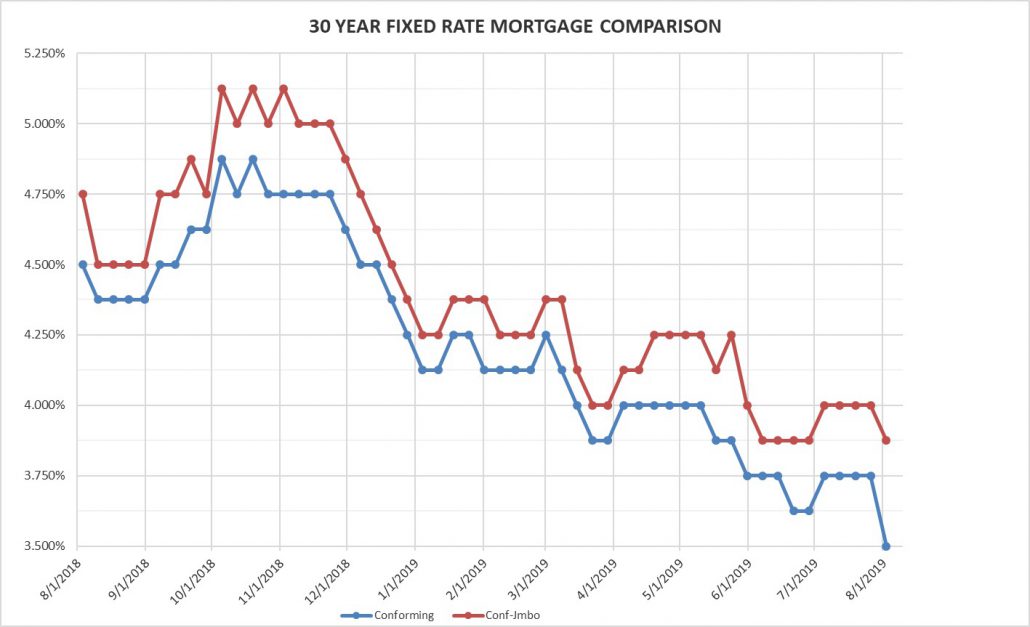
As you will see below rates this week went up the most in one week since the week ending October 5, 2018. When rates climbed at the end of last September they ended up peaking for about a month before we had a long slide down (down every Friday for five of six weeks).

Rate increases this sudden and this high are rare but they do happen. Why? Usually rates jump up on very positive economic news, political news, or a geopolitical event. This week the trigger for the rate jump appears to be the nice-nice talk between China and the United States on tariffs and trade agreements. This made investors positive about American businesses and removal of a drag on the economy and they left the safety of bonds and mortgages and bought equities, i.e. stocks in corporations.

Further pushing rates higher was today’s news that August was a very strong month for consumer spending as retail sales climbed 0.4% with a very large 1.8% increase in vehicle purchases. Consumer spending is 65-70% of our economy and if the cash registers continue to ring at a growing pace the economy will grow as well.

Also in the reports today was that hourly earnings are up 3.2% year over year, well above inflation which provides support for continued consumer spending.

All this good news in negative for lower rates for several reasons, primarily they show an economy that would be further away from the recession many pundits and media outlets have been used to fill the airwaves, interwebs and newsprint. Secondly, the potential of the trade war with China cooling down adds more support to pushing out any possible recession even further.

Currently the mortgage markets have priced in a rate cut of 0.25% by the Federal Reserve when it Open Market Committee meets, what is uncertain is whether there will be more rate cuts later this year. The economic and political news is making further cuts somewhat more unlikely—which investors have also been reacting to as some have been making decisions based on at least one further cut after next week.

If, for some reason the Fed does not cut its benchmark rate next week be prepared for another spike in rates.

So, did you miss the bottom? For the short term it appears that it is likely you did. For the medium term the answer is unknown as the current spike could be a sell-off to protect profits, in which case they will slowly move back to bonds when they feel equity markets are peaking, or near peaking.

All that said, even if you missed the bottom rates are really, really good. The current rates are where they were in July, which were near multi-year lows. If you have been considering making a purchase or refinance for the bottom of the market, you may want to consider doing so from the perspective of rates bouncing off what may have been the bottom.

Have a question? Ask me!

Typically this section of the WR&MU covers what is happening in the economy that impacts rates, today that was the first section!

Rates for Friday September 1, 2019: We will see over the next week or two if the spike in rates is a blip or a trend. I suggest not floating your rate and locking when you are able to avoid further rate loss should rates bump up more.

FIXED RATE MORTGAGES AT COST OF 1.25 POINTS LOCKED FOR 45 DAYS:

30 year conforming                                            3.625%     Up 0.25%

30 year high-balance conforming                     4.00%       Up 0.375%

Please note that these are base rates and adjustments may be added for condominiums, refinances, credit scores, loan to value, no impound account and period rate is locked. Rates are based on 20% down with 740 FICO score for purchase mortgages.

Thank you to everyone who sent happy anniversary issues to us last week. We had a great time scheduling nothing to do every day and knocking that important item off our to-do lists!

Have a great week,

Dennis

Past Weekly Rate & Market Updates can be found on my blog page at my website www.DennisCSmith.com/my-blog

Where are you?

Question of the week:  Where are you?

Answer:  On I-94 West leaving Milwaukee and heading to Steamboat Lake, Minnesota (near Walker, near Bimidji).

Leslie has command of the rental Hyundai Tuscon at 7:45 local time while I spend a few minutes getting out the big economic news this week and rate shift.  

Have a question? Ask me!

As expected, the Federal Reserve cut its benchmark rate by 0.25% on Wednesday—that move was already priced into the markets. After the announcement Fed Chair Jerome Powell held a press conference and his answers to some of the questions set the markets into a tizzy. The general expectation has been that the Fed would lower rates up to three-quarters of one percent this year (0.75%). At his news conference Powell indicated that Wednesday’s rate move could be a one-and-done, made to put some confidence into the economy. Sensing no more cheap money to borrow to buy, investors dumped their stock holdings and purchased bonds (see last week’s WR&MU for brief overview of relationship between stocks and bonds). This sent stocks prices and bond and mortgage rates tumbling. It should be noted this is the first time since the financial crisis of 2008 that the Fed has increased rates, the second longest period in history—the longest being from 1942 to 1954.

But wait, there’s more! In reaction to the markets collapse in 2008 the Fed began a policy known as “quantitative easing” during which it purchased U.S. Treasury bonds and Mortgage Backed Securities (MBS) to soak up supply and keep rates low. Last year the Fed announced a policy of “quantitative tightening.” Under this policy the Fed would start to sell its holdings of U.S. Treasury debt and mortgages. The impact of this policy is to tighten interest rates by lowering the prices on fixed rate assets, which as we learned last week pushes rates up. Originally the policy was to stay in effect for two more months, but the Fed cut the cycle by two months.

In other news…Economic data this week was counter to the Fed’s position of an economy that needs outside stimulus with lower rates. Positive economic news should lead to higher interest rates, ahead of the Fed rate cut we learned that consumer spending (65-70% of our economy) increased 0.3% in June and for the fifth month in a row personal income showed growth, increasing 0.4% for the month and up 3.2% from last year. With the gap between personal income growth and spending growth it is not a surprise that personal savings also increased, to 8.1%. Inflation concerns, a key factor for interest rates, are non-existent as prices increased a scant 0.1% in June and are up only 1.4% from last June; well, well below the Fed’s 2.0% inflation target. The inflation number is the only number that would hint at a rate increase, the other data all suggests an economy that is on track to continue record expansion that began in June 2009.

Lost in all the chatter about the Fed announcement will be today’s report from the Labor Department that the economy added another 164,000 jobs in July. More news that would suggest rates stay steady or face some upward pressure.

Rates for Friday August 2, 2019: The conforming rate is the lowest it has been since October 2016, hitting 3.5% this week following the Fed move and more importantly Powell’s comments. Will they last? Economic principles say no, and that they should not be this low.

FIXED RATE MORTGAGES AT COST OF 1.25 POINTS LOCKED FOR 45 DAYS:

30 year conforming                                            3.50%     Down 0.25%

30 year high-balance conforming                  3.75%     Down 0.125%  

Please note that these are base rates and adjustments may be added for condominiums, refinances, credit scores, loan to value, no impound account and period rate is locked. Rates are based on 20% down with 740 FICO score for purchase mortgages.

Why Milwaukee? Why not? Leslie and I are having a Planes, Trains and Automobiles summer trip. We flew to Oakland last Saturday evening and the next morning board the California Zephyr train headed for Chicago. The trip was beautiful, though a bit challenging at night as we opted for the small “sleepette” compartment rather than a sleeper. We crossed the Sierras and Rockies during the day and we really enjoyed the ride. Two nights in Chicago which included a fantastic meal with friends one night and “obstructed view” seats the next night to see Hamilton—a huge discount in price for seats near the back of the mezzanine that blocked the upper part of the stage—rarely used and no negative impact on our enjoyment.

In plotting our trip with the ultimate destination being Camp Birchwood, where one daughter has been since May as a counselor and the other there since early July as a camper, we saw Milwaukee was not out of the way for our automobile leg of the trip. Since neither of us had ever been we decided to make a stop. We are glad we did! A nice lunch river side, a great walk through the lake side part of the city to a fun and tasty Irish pub, then a walk back to our hotel had us wishing we scheduled a bit more time in the city.

The next two nights a Camp Birchwood, which is owned and run by a man who was my counselor at the camp when I was young, and was started by his father who was my dad’s counselor when he was a kid. We fly home from Minneapolis on Monday with our girls to complete the trip.

Signing off from I-94 a bit southeast of Madison.

Have a great week,

Dennis

Past Weekly Rate & Market Updates can be found on my blog page at my website www.DennisCSmith.com/my-blog

Why are there different rates or costs for the same mortgage product?

Question of the week:  Why are there different rates or costs for the same mortgage product?

Answer:  This is a question that is asked often, and one I typically answer every year to eighteen months in the Weekly Rate & Market Update.

Essentially why does a 30 year fixed rate mortgage of $400,000 have different costs for the family buying a condo versus a family purchasing a single family home versus a family refinancing and paying off an equity line versus….whatever other mortgage scenario is occurring?

Using the conforming mortgage as an example, defined as a loan that is eventually sold to Fannie Mae or Freddie Mac and that has been underwritten to their guidelines, the simple answer is “tiered pricing.”

If the most basic economic principle is supply and demand to determine prices, the second most basic investment principle is the greater the risk, the greater the return (the first most is fairly obvious, buy low and sell high); if there is little risk then you should not expect a very great return, conversely if there is greater risk then you should expect a greater return. If  you have a $10,000 deposit in a savings account at a federally insured bank that guarantees you will will get your money back if the bank collapses you should expect a very small return; if you invest your $10,000 in a start-up typewriter company you should expect a very high return should the venture become profitable.

Mortgages are investments. Your conventional mortgage is funded by a lender. The lender bundles your mortgage with others totaling tens of millions of dollars in mortgages. This bundle is then sold to Fannie Mae or Freddie Mac. Fannie or Freddie then puts the bundle with other bundles and issues investment vehicles called Mortgage Backed Securities (MBS). Investors across the country and around the world purchase MBS as part of their portfolios and investment strategies receiving regular payments, that are your interest payments, when you loan payoffs off investors receive a portion of the payoff in proportion to the investment.

The greater the risk the greater the return. Some mortgages are riskier than others, so investors in MBS will want a higher return on those mortgages.

What makes one mortgage more of a risk than other if they are being underwritten to the same guidelines? This is where tiered based pricing comes into play for mortgage consumers.

For different aspects of risk Fannie and Freddie charge more for the same rate. For example, a loan applicant for a loan with 5% with a very low credit score may pay up to two points (two percent of the loan amount) more for his mortgage than an applicant for a loan with 5% down who has an extremely high credit score. The lower credit score indicates a history of making credit payments on time, hence a higher risk, hence a higher cost for the loan than someone with outstanding credit.

Credit scores are just one of several risk factors that go into pricing a loan. Risk and risk pricing is determined by the historical defaults for mortgages with similar factors. Over the years, mortgagors with lower credit scores have defaulted on their mortgages more frequently than mortgagors with high credit scores, there for they are a greater risk, therefore their costs for the mortgage will be higher.

Here are the most common factors that result in tiered pricing:

  • Owner Occupancy: If you are living in the property being collateralized you will have lower pricing than someone purchasing for investment, an owner occupant is less likely to let a property go to foreclosure than an investor.
  • Number of Units: Most multi-unit properties purchased as primary residences eventually become investments, and multi-unit properties have a higher incidences of foreclosure as the mortgage payments are usually dependent ontenants making payments. Multi-unit properties have higher costs than single family units.
  • Condominium: Condominium owners are business partners with everyone else in their homeowners’ association, the quality of the complex is dependent on the HOA maintaining the property and a high degree of owner occupants living in the complex. Historically, condos have higher incidence of foreclosure. Because of these factors condos with greater than 75% loan-to-value (LTV) have higher costs than single family detached residences (i.e. a traditional house) or loans on condos with less than 75% LTV.
  • Loan-to-Value (LTV): The tiered pricing on LTV gets interesting. The common wisdom would be that the less equity a homeowner has in their property the greater the risk he will walk away and let a property go to foreclosure. And this is true, therefore with one exception the higher the LTV the higher the cost of the loan. The exception is LTVs between 75.01-80.00%, which have a higher cost than loans less than 20% equity. The reason is because loans with LTVs greater than 80% have mortgage insurance which covers the investors should the property go through foreclosure, properties with LTVs of 80% or less do not. If a borrower with 10% equity and a borrower with 22% equity both go through foreclosure, the loss for the investor is greater for the latter due to the lost interest and costs of foreclosure not being insured, as opposed to the 10% equity borrower who would have had mortgage insurance covering the losses.
  • Credit Score: We covered this above but to add to the cost, there is a matrix that has loan-to-value down one axis and FICO credit scores across the other. The higher the LTV the more the cost as credit scores drop, conversely the lower the LTV the lower the impact of the lower FICO score. In the example above the difference in cost for very low FICO borrower was two points higher than a very high FICO borrower if both were putting 5% down. The same very low FICO borrower putting 40% or more down payment would have loan costs that are two and a quarter points (2.25% of the loan amount) lower than the very low FICO borrower putting just 5% down. Your credit score impacts your mortgage costs depending on the LTV of the mortgage.
  • Cash-Out Refinance: Like credit scores the impact of the cost of pulling cash out of your property is dependent on the LTV of the mortgage. The higher the LTV the higher the cost of the mortgage. It should be noted that purchase and rate and term refinances are treated the same and both have lower costs than cash-out refinances.
  • Term of the Rate Lock: After all the factors have been sifted through the final cost differential is how long will the loan rate be guaranteed, how long is the rate locked. The longer the lock period the more expensive the loan, which makes sense as the lender is guaranteeing the rate if all factors input for the rate lock are shown to be valid for a longer period of time, protecting against higher rates. Most rate lock periods are in 15 day increments and the vast majority of our locks are either 30 or 45 days depending on the transaction type, complexity of the transaction and volume of business in the mortgage industry pipelines.

The costs are not paid in cash by the borrower, for instance if someone with a lower FICO score is purchasing a three unit building to rent with 25% down for a mortgage of $500,000 and the costs added by Fannie Mae are 4.125 points the borrower will not, probably not, come in with $20,625 more to close, but rather the interest rate would increase to off-set those additional costs, today that would be close to 5.5%.

The lowest cost mortgage is going to be a low LTV, high FICO purchase or rate and term refinance of a primary single-family residence; among the highest would be a low FICO, maximum LTV, cash-out non-owner occupied refinance. The first is relatively low risk, the second is relatively high risk.

There are more factors that go deeper into the weeds than I have gone with my examples, but you can see that with so many factors in play rate quotes can be risky proposition unless all the details and factors of the borrower and property are known. This is why when someone asks, “what are interest rates?” my response is, “well that depends….”

My weekly rate chart is based on the purchase of a detached single-family home for a borrower with a 740 FICO score putting 20% down payment into the transaction and locked for 45 days; a fairly normal transaction. If you have any of the factors above that are different then your rate may be different.

Let me know what your mortgage need is and allow me to provide you an accurate rate and cost for your transaction.

Have a question? Ask me!

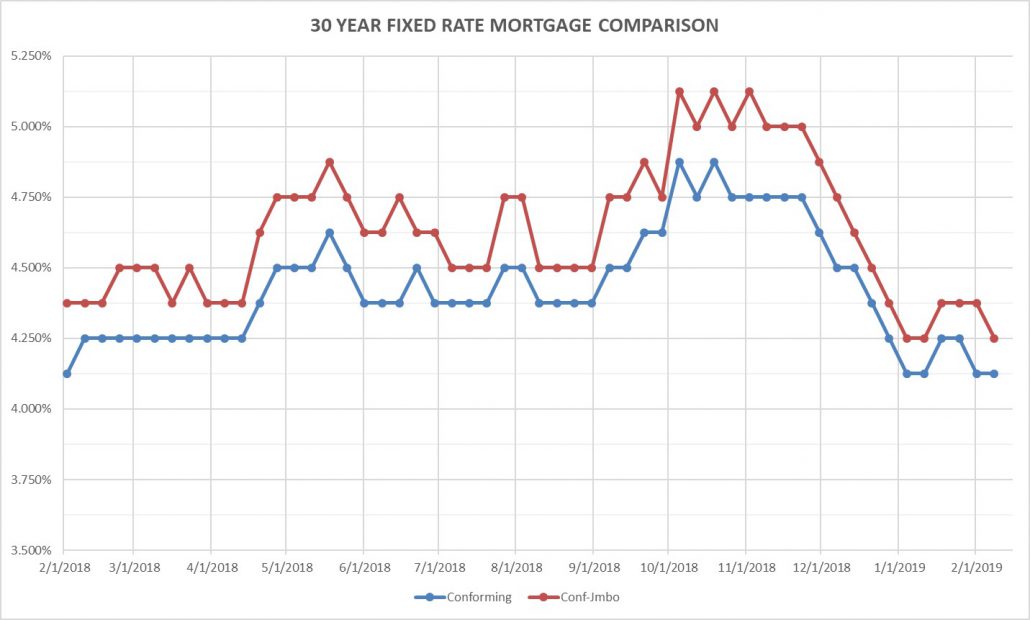
Rates for Friday February 8, 2019: Very little economic data of interest to rate markets released this week, as a result mortgage rates were fairly flat for the week. Had the Treasury not had three large sales of bonds rates likely would have dropped. Note that high-balance rates have drifted back closer to the conforming rate, which was flat from last Friday. Next week we get data on inflation, expectations are for very low increases in prices, should that not be the case and prices increased more than expected we may see a bounce in rates. Of greater impact on rates could be the negotiations with China on trade policies, if talks turn sour rates may react by climbing. For now the market is quiet and stable.

FIXED RATE MORTGAGES AT COST OF 1.25 POINTS LOCKED FOR 45 DAYS:

30 year conforming                                            4.125%     Flat

30 year high-balance conforming                   4.375%     Up 0.125%      

Please note that these are base rates and adjustments may be added for condominiums, refinances, credit scores, loan to value, no impound account and period rate is locked. Rates are based on 20% down with 740 FICO score for purchase mortgages.

Did whomever had 3-3 in your office pool buy lunch for everyone? For those with those numbers in the Super Bowl pool, especially a forward and backward score pool, the final minutes of the fourth quarter resulted in a nice payday. In recent years, we have been fortunate to have very exciting Super Bowls with fantastic finishes; for much of the history of the big game this was not the case and unfortunately Sunday’s NFL finale reverted to history with a dull game. What really aggravated many more than the punting contest on the field was the lack of excitement in the commercials. The only one I liked was the NFL’s ad with the Hall of Famers and All-Pros playing a game through the fancy dining room. What I really liked was the follow up on the commercial, a piece on Sam Gordon, the young lady seen towards the end of the advertisement. Click on the links and check them both out.

Now that football is over we can turn to baseball. Pitchers and catchers report to their teams’ training camps this week, to be followed four to five days later by position players. I am looking forward to my prediction of a few years ago of the Phillies having completed their rebuilding process and competing for their division title and hopefully making the playoffs—it all starts this coming week!

Have a great week,

Dennis

Past Weekly Rate & Market Updates can be found on my blog page at my website www.DennisCSmith.com/my-blog

1-18-19: Will the federal government shutdown impact the timing of my loan approval?

Question of the week:  Will the federal government shutdown impact the timing of my loan approval?

Answer:  No, well very, extremely likely no.

Unless you are in a rural area and obtaining a USDA or perhaps waiting for FHA to approve a condominium complex in which you are purchasing or refinancing one of the units.

At the start of the shutdown there was some delay for borrowers with properties in areas that required flood insurance, which is available only through the National Flood Insurance Program, however Congress passed legislation and the President signed into law a bill authorizing the program to May 2019 so the policies could be written.

For the vast majority of mortgages for residential mortgages there is minimal interaction with the federal government during the loan process.

One requirement for many mortgages is verification of your income by a review of your tax transcripts as filed with the IRS (to see why we need this form here is the WR&MU from April 2018 on the subject. For this process, we use IRS Form 4506-T, during a government shutdown the requests for a copy of your returns are not processed. Having experienced such delays in the past, in recent years lenders have eased the burden by allowing some work arounds to the Form 4506-T requirement, typically a copy of the cancelled check or other proof you paid taxes owed on the tax returns provided, or a copy of a bank statement showing the deposit of your refund that matches the refund on your tax returns provided.

Government insured loans, such as VA or FHA, are not impacted by the shutdown as the processing and underwriting is performed by private companies and not government agencies. While Fannie Mae and Freddie Mac are quasi-government agencies they are operated as private companies and are unaffected by the shutdown.

The primary area of impact during government shutdowns, once flood insurance is authorized, are inquiries for loan issues in which a response is required from either VA or FHA. It is very rare that a situation arises in which a lender will require a response from either of the agencies in order to approve a loan, but they do arise from time to time and any such cases arising during the shutdown will likely face delays until someone is available to reply.

In a broader view, the impact of the shutdown on mortgages is the impact it may have on the economy and subsequent impact on interest rates. Fundamentally, if there is an impact on rates it would be for rates to decline. A very prolonged shutdown could result in negative economic impact and regular readers of the WR&MU know that poor economic performance usually leads to lower interest rates.

If you are concerned that the government shutdown will impact your current loan in process, or a home mortgage you are contemplate, do not be concerned.

Have a question? Ask me!

With the government shutdown some key economic data that could impact mortgage rates is not being release. This week we would have had retail sales data for December, a key piece of information for gauging economic activity since consumer spending comprises 65-70% of the nation’s economy. With no data on how the Christmas shopping season went for retailers investors are left to speculate whether the 4th quarter GDP data will show 2018 ended strong and total growth over 3% or slowed down with growth being under 3%. The lack of information had no impact on rates as investors looked to other bits of news to guide their decisions.

Rates for Friday January 18, 2019: Stocks and bonds are in their traditional relationship, if stocks go up so do rates, if stocks go down so do rates. Stocks climbed this week, much of the increase on speculation that the trade dispute with China is cooling down and on rumors the United States may lower some tariffs. Investors fled their prior “flight to safety” of bonds and invested their sales proceeds in stocks. After thirteen weeks of rates being flat or down from the previous Friday we see mortgage rates tick up this week—the first Friday to Friday increase in rates since October 19th.

FIXED RATE MORTGAGES AT COST OF 1.25 POINTS LOCKED FOR 45 DAYS:

30 year conforming                                            4.25%      Up 0.125%

30 year high-balance conforming                    4.375%     Up 0.125%      

Please note that these are base rates and adjustments may be added for condominiums, refinances, credit scores, loan to value, no impound account and period rate is locked. Rates are based on 20% down with 740 FICO score for purchase mortgages.

After four weeks it is time for our daughter to return to Boston to finish her freshman year. Always a bit of a weather nut, looking at the national weather maps in the paper every day, something I got from my dad, I am much more so concerning weather in the Northeast these past five months. My weather-nerdness has us on somewhat of a concerned profile as a very big winter storm is on track to hit the Boston area late Saturday and into Sunday—include her 2:30 landing time at Logan Airport. Part of going to school back east, or anywhere that winter weather is not 50 degrees and some rain, is dealing with weather delays at the airport.

Not all lessons are learned in the classroom. Our plan tomorrow is to spend a bit of time at the bookstore to get some “old fashioned” books in case her Kindle runs out of juice.

Have a great week,

Dennis

Past Weekly Rate & Market Updates can be found on my blog page at my website www.DennisCSmith.com/my-blog

1-4-19: What is 2019 looking like for Stratis Financial?

Question of the week:  What is 2019 looking like for Stratis Financial?


Answer:  Exciting! We spent the last quarter of 2018 adding some new lender partners to expand our portfolio of mortgage products well beyond our foundational products of conventional and jumbo 30-year fixed rate mortgages. Our new lenders bring alternative products that can benefit self-employed borrowers, borrowers with extremely high-net worth and borrowers looking to secure housing through retirement. With our growth in lending options we can cover pretty much any mortgage need for residential homeowners or home buyers in the state of California.


Personally, I am excited to add a new relationship referral source that will enable me to be assist more families with their mortgage needs as well as strengthen my connections with past clients and referral sources.


From you I am looking for inquiries for your mortgage needs and plenty of questions to answer for you in 2019, please ask and I will answer and help you with solutions and options!


Have a question? Ask me!


Job growth and economic growth seem to be going in different directions. In the last revision for 3rd quarter 2018 Gross Domestic Product output the rate of growth was 3.4%, down from the prior quarter’s growth of 4.2%, current forecasts for the 1st quarter of 2019 are economic growth in the U.S. economy growing less than 3%. The data shows economic growth is slowing. In a seeming anomaly, during this slowing growth period employers have not been slowing their hiring practices, as evidence by today’s report on December employment from the Department of Labor. Blowing away forecasts, employers added 312,000 new jobs in December, the consensus forecast of economists surveyed by MarketWatch was an addition of 182,000 jobs. Also included in the report were upward revisions to the job growth data for October and November. The most reported employment number is always the unemployment rate, in December it rose from 3.7% to 3.9%, not due to layoffs but due to more people entering the job market seeking work.


This is very positive data, but the most important data in the report was that average hourly earnings for workers increased 0.4% for the month and year over year the increase was 3.2% in wages, matching the post-recession high of earlier this year. With wages growing over 3% and inflation growing right around 2% workers have more residual income to either spend on goods and services or put into savings, or both.


Today’s data has created confusion amongst the “experts” as to the short and long-term future for rates and the economy. Will the increase in hiring and wages spur economic growth? Will it push back, or push off, an expected recession in late 2019 to early 2020 or not at all? Will the job markets create inflation that will cause the Fed to react with more rate increases? Or is the labor market surge, a final movement before international markets seep into domestic markets causing economic slowing to accelerate to the point that the economy shrinks into recession? The economic data the past several months has been inconsistent with the employment showing growing strength while growth has been losing strength.


What does it all mean for interest rates? The hundred-billion-dollar question, literally. Quick recap: good economic news means higher interest rates; bad economic news means lower interest rates. What we see from our economic data is a combination. Good news: more workers working earning more income allowing them to spend more and sustain economic growth. Bad, or less than good, news: Economic growth has been slowing, international markets are slowing and in turmoil due to the ongoing tensions due to tariffs and negotiations between major trade partners, home sales slowing down nationwide. Rates have been dropping consistently for six weeks and are well down from their seven-year high in October. Last month the Fed indicated instead of three rate hikes in 2019 it would probably initiate two rates hikes, and the common wisdom has become that the Fed may not raise rates at all in 2019. What it means for rates in the short-term is likely continued volatility in equity markets, i.e. stock markets, which typically results in investors putting their money in the “safe havens” of fixed rate assets, such as bonds and mortgages. More money invested in fixed rate assets leads to lower returns on those assets, in other words lower rates, or lack of rising rates.


Rates for Friday January 4, 2019: Interest rates and stock markets continue their intra- and inter-day surges and falls, with the trend being lower rates through the volatility. Should there be resolution to the tariff/trade disputes, an agreement to open the closed portions of the federal government and positive news for the 4th quarter GDP the turmoil will subside and rates will rebound higher. If the confusion continues and the GDP news shows continued decline in growth rates will stabilize at current or lower levels. Take advantage of the current rate market while you are able to do so. Rates are down again this Friday from last.


FIXED RATE MORTGAGES AT COST OF 1.25 POINTS LOCKED FOR 45 DAYS:

30 year conforming                                            4.125%      Down 0.125%

30 year high-balance conforming                     4.25%        Down 0.125%


Please note that these are base rates and adjustments may be added for condominiums, refinances, credit scores, loan to value, no impound account and period rate is locked. Rates are based on 20% down with 740 FICO score for purchase mortgages.


The Smith family is on its annual post-Christmas/pre-back-to-school trip to a desert, this year returning to our favorite p-C/p-b-t-s location of Scottsdale, Arizona where the temperatures have been very cool, the skies clear and the relaxing fantastic.


We return to our familial abode tomorrow and back to mostly normal schedules on Monday (exception being our college freshman who is wondering what to do for the two more weeks before she returns).


Looking forward to a wonderful 2019 and helping you, your family, friends, neighbors and co-workers with your mortgage needs!


Have a great week,


Dennis


Past Weekly Rate & Market Updates can be found on my blog page at my website www.DennisCSmith.com/my-blog

11-30-18: What will be the cost of waiting, or is there one, to purchase your new home in mid to late 2019, or 2020, instead of now or the near future?

Question of the week:  What will be the cost of waiting, or is there one, to purchase your new home in mid to late 2019, or 2020, instead of now or the near future?


 Answer:  This installment of the Weekly Rate & Market update is a follow up to the WR&MU of November 16th when the question of the week was “What was the cost of waiting?”


I got very carried away writing the update this week and to follow is a lot of detailed economic information. My conclusion shown at the end is that there is little cost to waiting, but likely not a lot of benefit, if you can afford to purchase where you want to purchase today. If you are waiting for prices to drop significantly so you can afford to purchase in area you could afford a few years ago but cannot today, then your cost of waiting is the cost of homes in areas you can afford likely going up as will the home you currently cannot afford—essentially to see a decline in values of 15-20% is not very likely so you should change your expectations and neighborhoods to where you can buy. For those interested in my more detailed observations, bless you and read on!


The answer to this week’s question is speculation on my part based on several economic factors, trends and some educated guessing. Regarding the educated guessing part, I have degree in economics and political studies and have been a student of both for over 35 years. (Two famous jokes about economics at the end of the update for those interested. They were funny when I was in college, not sure they still are…)


To answer the question of the week, I am going to flip the standard format of the WR&MU by presenting economic news this week and how it relates to interest rates, then extrapolate out to what I see for 2019.


As you read the following keep in mind that there is upward pressure on rates when economies are doing well and there is inflation, there is downward pressure when economies are sluggish, slow growth or recession, and if there are extremely negative events such as threats of war, war, or economic collapse in other nations.


While economic data is usually the primary driver for interest rates, politics also has an influence. This weekend a political event will occur that could/should impact not only rates but our economy for the near and possibly long-term future. President Trump will be in Buenos Aires for the G20 summit and has a meeting scheduled with Chinese President Xi Jinping for the purpose of discussing the tariff war between the two largest economies in the world—by three to four-fold over the next nearest.


If the meeting goes poorly and there no movement to lower tariffs, or either or both sides are so upset they raise more tariffs, we will see higher rates due to higher inflation. With tariffs increasing prices of Chinese goods imported into the United States those goods will need to either be manufactured in the United States or imported from other nations. Either scenario will increase the prices of the goods, for those manufactured in the U.S. companies will need to hire workers in an economy that is at or near full employment, which will require higher wages, as well as purchase materials required to manufacture the increased supply of goods they will need to sell. Higher prices lead to higher rates.


The meeting will be considered “good” if there are mutual statements of starting talks to find common ground on the issues that led to the tariffs, mainly market dumping, counterfeiting of American brands and piracy of intellectual property. Any indication that both sides are looking to de-escalate will likely lead to lower rates as the expectation will be a relief on inflationary pressures and avoidance of further conflict.


This critical meeting between Trump and Xi can have a significant impact on our housing markets due to their potential impact on mortgage rates.


Another non-data event this week has had an impact on mortgage rates. Federal Reserve Chair Jerome Powell gave a speech to the Economic Club of New York. In the speech, he said that he believes rates are “near neutral,” and that prior business cycles have ended not due to inflation but rather because of asset prices. Regarding “near neutral,” this comment had investors buying bonds, and mortgages, putting downward pressure on rates as they read the comment to mean that the Fed may not increase rates four times between now and the end of 2019. Instead of the Fed rate increasing one percent over the next thirteen months, perhaps only three-quarters of a percent, or one-half of a percent. The comment about asset prices ending cycles instead of inflation brings forth another interpretation is that the Fed may shift from using inflation as their primary basis for rate increases and somehow may be looking at over all prices in different markets such as stocks and housing. If these interpretations are correct, and the Fed does strongly signal fewer rate increases in the near future the impact can be a sparking sales in the housing markets as rates remain near current levels or perhaps dip in the coming months/year.


Real and potential statements are not the only news impacting rates, and therefore housing markets, this week. We also had some real data, starting with consumer confidence for November. Consumer confidence impacts rates as consumer spending is 65-70% of our economy, happy and confident consumers are expected to spend more, leading to economic growth, leading to inflationary pressures, which lead to higher rates. The consumer confidence index dropped in November for the first time in five months, however the decline is not overly surprising since the October index was the highest in 18 years. The primary factor in the November decline was primarily due to feelings by respondents that they would see little to no income growth in 2019.


Speaking of consumers, this week we receive data on their spending and income in October. Consumer spending in October saw a big increase, 0.6%, from September, a good sign for retailers heading into the Christmas shopping season and a good sign for the Gross Domestic Product growth number for the 4th quarter, and for the year. Strong GDP growth is a strong indicator of inflation, which, as we have said repeatedly, leads to higher rates. Consumers increased spending in October, and earned more as incomes rose 0.5% from September, the highest monthly increase since January. Stronger earnings are also inflationary as they a) provide more money in households for spending and b) increase costs for employers who must raise their prices to accommodate the higher costs.


Released the same day as the reports on income and spending was the rate of inflation as calculated using the “PCE gauge,” which is the Federal Reserve’s preferred inflation index (it excludes food and energy and thus is labelled the “core inflation rate”). Despite higher spending and incomes, the annualized rate of inflation for October was 2%, right around the Fed’s target rate of inflation. The news is interest rate friendly and supports the Fed Chair’s statement about rates being “near neutral.”


Before we answer the question about if there will be a continued cost to waiting to purchase a new home we must look at the most recent housing data for our Southern California markets. The quick synopsis is that local markets are in a period of transition according to data from the California Association of Realtors.  State wide the median price in October for single family homes was down 1.2% from September, but up 4.7% from last October at $572,000. More locally, in LA and Orange Counties the median movement month to month and year to year somewhat mirror the activity statewide. The median price in LA County in October was $614,500, 3.2% lower than September and 5.9% higher than 2017; Orange County saw the median price from September drop 1.8% to $810,000 but was still 3.1% higher than in 2017.


Total sales volume, i.e. units sold, were up statewide month over month, 3.8%, and down 7.9% year over year. Like with prices, units sold locally were also up monthly and down annually. In LA County, there was surge in sales in October, climbing 29% from September, however the total sales volume for the month was down 5.9% from last year. In Orange County, sales also increased from September but a much more modest 3.9%, and also decreased from 2017 with a drop of 11.3%.


Month to month the trend is more sales at lower prices, plus increasing inventory on the market and longer periods of homes on the market before being sold. One other pattern is a growth in the number of cancelled or expired listings that are not renewed.


Back to our question, what does all this mean about housing markets and if there will be a cost to waiting to purchase a new home.


The data is somewhat murky for both the economy and the housing markets—murky usually means transition. Is the transition in the benefit of those looking to purchase homes? If there is a buyer’s market, how much of benefit will there be and for long?


The economic transition seems to point to a recession late in 2019, which means the slow down starts in early to mid-2019. This is not an uncommon thesis, as others reading the economic data are also indicating a stronger probability for a recession in the next twelve months. If this occurs the biggest question will be the depth and length. In my opinion, the depth will be fairly shallow and the length fairly short. Keep in mind a recession is defined as two consecutive quarters of negative economic growth, that would cover six months or more.


If there is a recession the impact on housing markets would depend on the cause of the recession, is it a decline in asset values as Fed Chair Powell stated? Is it inflation? The cause will be a primary factor in impact on housing markets.


If the cause is primarily driven by asset prices being too high, then as prices decline, or remain somewhat stable with incomes and other prices increasing, then rates will be dropping into and during any price corrections or stabilization making homes more affordable than they are today.


If the cause is primarily driven by inflation then even if housing prices drop the affordability will not necessarily increase as rates will be increasing to slow inflation. We can see an economy with rising energy, food, clothing, houseware costs but dropping, or stable, costs for large ticket items such as housing and automobiles. If this is the case rates will be climbing resulting in the month costs of housing, i.e. mortgage rates, climbing. If this is the case then the length and depth of a housing correction will likely be longer and perhaps a bit deeper than if there is an asset based cause for a correction.


When looking at housing markets we must acknowledge the uniqueness of California as a whole and Southern California in particular. Besides the weather, which will always be a draw, the lack of available land to build more homes in the any county that touches the ocean is a huge factor. Yes, there are some areas still in the region for new homes to be built, however overall the vast majority is fully developed. In many areas, new housing is going vertical with high rises and not horizontal with single family residences with yards. This inability to add significant supply will sustain a certain level for housing markets locally.


What about the housing crash ten years ago, space availability was not much different, so why did home prices drop so much? Great question to look at. The foundation for the market was built largely on panic buying and people more concerned with making money on a property purchase instead of a buying a family home. Homes were purchased with no verification of income, funds to purchase and in many cases no hard appraisals. Mortgage products were available that enable buyers to purchase way beyond their capabilities, and as prices rose many were looking to sell their homes quickly for a profit and buy their next home. When prices started to drop many found themselves in homes with loan balances higher than property values due to no down payment purchases, rather than pay it many walked away and foreclosures rose putting more downward pressure on the market. Eventually prices did stabilize as buyers who had been priced out of the market were able to purchase due to lower prices and rates.


Finally, the market collapse a decade ago was not a result of a recession caused by inflation, or high interest rates, but rather because of poor lending standards and mortgage products that created an unnatural inflation in housing prices. When investors started looking into the mortgages being sold on the market that were based on little to no verification of ability to repay on homes that had climbed in value at unheard of rates, they stopped buying those mortgages. The result was a domino effect that pulled the nation, and the globe, into recession.


One very large impact that compounded the decline in values was the lack of qualified buyers to purchase homes as they hit the market—lower demand with higher supply continued the price declines. Many families that might have qualified to purchase a new home were prevented from doing so for several years because of the foreclosure or short-sale on their credit records. This group was a significant number that otherwise would have absorbed inventory on the market.


Since 2010 buyers of homes have overwhelmingly been purchasing homes in which to raise families and not to make money. They have been qualified for their mortgages by proving income and funds for purchasing. Most buyers have been putting more than the minimum required down payment, so they have “skin in the game” and will be less likely to walk away or panic sell if/when market prices dip.


The run up in real estate values over the past several years was created by qualified buyers competing with other qualified buyers to purchase homes. The mixed market we now see, with housing values starting to decline, sales down one month and up the next, is based on affordability due to the price increases exacerbated by the increase in rates since the start of the year. The pool of buyers has not shrunk, and will not shrink because of any market transition, what has changed is the price for which they can qualify and/or their desire to purchase in a market they see as transitioning so they are waiting for prices and rates to drop.


All of this said, and I apologize for my long-winded path to this point but I wanted to be somewhat thorough, I do not feel there is a large cost to waiting, but I also do not feel there is a large benefit to be gained by waiting to purchase a new home.


Many sellers, or would be sellers, are holding properties off the market as they desire a higher price for their home than the market will support. For the past few years new listings have come on the market at the highest price in the neighborhood, or just beyond, and buyers have been over-bidding the list price to obtain the home. More recently homes are selling at or just below list prices, causing potential seller to hold off until prices increase again.


Note, “again.” Because of the lack of ability to build more housing near the coasts (let’s define “near” 25 to 30 miles from the ocean from San Diego to Santa Monica) there is limited ability to expand supply, any increase in demand will push up housing prices. Natural attrition is due to death, divorce, and relocation will dictate supply, population growth and aging as more people enter the age of homeownership will dictate demand. Demand will not be able to be sated with new housing, hence existing housing will be what is available for buyers to bid on. Over time Southern California coastal residential housing goes up. How soon and how much changes depending on what time frame, over longer periods of time  however prices climb.


Looking into 2019 housing prices will dip in some areas, drop in others and stay somewhat constant in other areas. Rates should remain near current levels, possibly declining towards the middle to end of year if/when economy slows down, but since they are already so low (historically discounting the false rates created by the government and Fed starting in 2008) there will not be a significant drop as we saw following the last recession. What I do see happening is families slowly moving their geographical areas of desirability to neighborhoods they can afford. The home they can purchase to purchase for $500,000 is no longer available in the neighborhood they were hoping to purchase in one, two or three years ago; that $500,000 home is now selling for $550,000 to $600,000. Where homes were selling for perhaps $425,000 – $450,000 two or three years ago are likely the $500,000 homes today. The decision will be, do we buy a home in an area we did not want to purchase in before or do we wait and hope real estate prices drop 15-20% to $500,000 to buy where we initially wanted to, or do we continue to rent with rents still increasing?


I believe the cost of waiting will be that if you stick to your desired area to purchase and hope for prices to decline significantly you will continue to rent until some major change in your financial situation to purchase a home in that area. The cost of waiting into the future will be lost opportunity in neighborhoods of lesser value that you can afford as families start to purchase in those areas, slowly increase their values and changing the neighborhoods with higher ownership density.


If you are able to purchase a home in your desired area, I do not see any significant cost in waiting, but not a lot of benefit to waiting either. Yes, prices may dip some more into the new year, yes rates may dip some more into the new year; however when will you know that the dips have stopped? When will you know that the time is perfect to purchase with rates and prices, and what will be on the market at that time?


My advice has always been, when buying a home, if you like and can afford it buy it. You will be there for a long time, any changes in price over the early years of ownership will be more than made up for in the long run due to where you are buying—California. Your ultimate cost of waiting may be hoping the house you really like still being on the market when you feel the price is right.


Sellers on the market now want to sell, make an offer!


Disclaimer on this very long-winded update:


The WR&MU on October 21, 2016 had a total miss on my part for predicting economic recession, in fact the exact opposite happened as I did not put a lot of thought into Trump winning the election and the resulting economic growth. That will provide a filter for any predictions I make, as well as others—it is all an educated guess and different guesses result on how each guesser is trained to read the tea leaves.


Have a question? Ask me!


Rates for Friday November 30, 2018: The comments by Fed Chairman Powell resulted in a nice rally for bonds and as a result the 30 year conforming rate is lower than the previous Friday for the first time in five weeks. Will it hold? Per comments above a lot depends on the meeting between Presidents Trump and Xi this weekend.


FIXED RATE MORTGAGES AT COST OF 1.25 POINTS LOCKED FOR 45 DAYS:

30 year conforming                                               4.625%       Down 0.125%

30 year high-balance conforming                       4.875%      Down 0.125%


Please note that these are base rates and adjustments may be added for condominiums, refinances, credit scores, loan to value, no impound account and period rate is locked. Rates are based on 20% down with 740 FICO score for purchase mortgages.


We have three seasons in Southern California that cycle annually: Dry, Fire, Mud. When it is dry we have more fires, when it rains we get mud in many areas but especially the fire zones and the rain creates more undergrowth that gets very dry leading into the next fire season causing more and bigger fires that are then turned to mud slides….yet our state and local governments continue to allow more and more housing to be rebuilt where there are histories of fires, floods and mudslides. See Einstein’s definition of insanity.


Since it has been quite a while since we have had a drenching like yesterday, I hope your roofs, windows and other parts of your homes held tight. While we have had no water penetration the same cannot be said of the other scourge for most of the region: ants finding ways into our homes as their colonies get flooded out. The battle is on! We seem to have won the first one but know there are more to come. All that said, I don’t mind the ants a few times a year as opposed to snakes or very large arachnoids!


Enjoy the official start of the holiday season as parades and other activities begin!


Have a great week,


Dennis


Economic Jokes:


Every question asked of any economist has the same answer, resulting in no definitive answer: “On the one hand blah blah blah; one the other hand blaw, blaw, blaw.”


A company is looking to hire an analyst. There are three finalists, a physicist, a mathematician and an economist.


The physicist walks into the interview and on the white board is a question; What is the answer and why: (12-4)3 + (4(13/4)+7) – 21 = ?


After explaining his process as he is writing down several equations using vectors, calculus, etc he writes down 23, circles it and puts down the marker and stares at the interviewer. The interviewer says, “Thank you, please erase your work and send in the mathematician.”


The mathematician enters, sees the equations and mumbles to herself as she solves the problem using basic math, circles the answer of 23. She caps the marker, looks at the interviewer and says, “It is basic math and the answer is 23.”


The interviewer says, “Thank you, please erase your work and send in the economist.”


The economist walks into the room and sees the question and reads aloud, “What is the answer and why.  This is a job for an analyst position correct?”


“Yes.”


“Are you the one I will be reporting to?”


“Yes.”


“Are you the one giving me the information to analyze and I presume it will then be passed along to your superiors?”


“Yes.”


The economist looks around the room. Walks to the door and locks it. Pulls a chair up very close to the interviewer, leans in and whispers, “What is the answer and why….what do you want the answer to be?”


The economist got the job.


Past Weekly Rate & Market Updates can be found on my blog page at my website www.DennisCSmith.com

11-9-18 What kinds of loans do you and your company handle?

Question of the week:  What kinds of loans do you and your company handle?


 Answer:  This is a common question I am asked when meeting people, be it in a casual social setting or with professionals in other industries.


The broad answer is: almost any mortgage on residential property for one to four units in the State of California.


More specifically Stratis Financial excels at working with our clients to fund the following types of mortgages:


Conventional:  By far the most mortgages funded every year for residential mortgages in the United States. Broadly referred to as “conventional,” these are mortgages that are underwritten and approved to the guidelines as set forth by Fannie Mae and/or Freddie Mac. Once mortgages approved under these guidelines are funded they are sold by the lender in bundles of tens of millions of dollars to either Fannie or Freddie. While very similar with their guidelines, each of these agencies have some slight differentiation that dictates a loan can only be approved under one of their guidelines or the other. For instance in many instances Freddie Mac may only require the most recent year of Federal income tax returns for income verification for a self-employed borrower, whereas the guideline for Fannie Mae is two years of tax returns.


Conventional mortgages have two different loan tiers, labeled conventional and high-balance, which have different loan amounts, pricing and some different guidelines for qualifying and approval. These are the loans I put in the WR&MU rate quotes below. The maximum loan for single family residences for 2018 is $453,100, the maximum loan limit for “high-cost areas,” aka high-balance loans, for 2018 is $679,650. It is important to note that while Los Angeles and Orange County are considered high-cost areas, other counties in Southern California are not and have varying maximum loan amounts; for instance the maximum loan amount for Fannie or Freddie in Riverside County is $453,100 and in San Diego $649,850 in 2018.


The loan limits are established by the Federal Housing Finance Agency (FHFA) and can be adjusted annually. New loan limits for 2019 have not yet been announced, usually the loan limits for the following year are published in late November—you can be sure I will have the new limit announcement in the WR&MU the Friday we are made aware if the limits are changed.


Conforming mortgages can be used for one to four unit properties for primary residence, second homes and investment properties, different guidelines will apply depending on property use. As well fixed and adjustable rate programs are available.


Jumbo: Also referred to as non-conforming. These loans vary greatly from lender to lender as far as underwriting guidelines, loan amounts and pricing. Many lenders will start their jumbo loan programs at $453,101—just over the conforming limit—and go to several million dollars. The higher your loan amount the lower the loan to value you will have to have. For instance a lender may fund a loan up to one million dollars with a maximum loan to value (LTV) of 80%, another lender may fund up to $1.5 million with a maximum LTV of 80%. With a low LTV, say 60%, some lenders may have maximum loans of two million dollars, others may go up to ten million, or higher.


Most lenders in our market do not retain their jumbo mortgages but sell them to investors after funding, it is the investors who create the guidelines and determine the loan limits. Because different lenders use different jumbo investors we are able to fit specific criteria for clients to the jumbo programs available through different lenders.


A rule of thumb for jumbo loans is that the underwriting guidelines are stricter, how much stricter depends on the investors. As an example, one program may require any income to show it has been paid on a monthly basis for six months or more, say for payments from a retirement account, whereas another lender may use the annual distribution from the account, or show that an automatic payment has been set up. Reserve requirements, property features, income calculations, and other quirky guidelines differ from lender to lender and from Fannie and Freddie that may help one borrower or hurt another.


Another rule of thumb is that jumbo loans are higher priced than conforming; however this is not always the case. Not infrequently we will find a jumbo program that has a lower rate than other lenders high-balance conforming rates, when this is the case we ensure that the clients meet the more restrictive guidelines of the jumbo program and if so we lock them in at the lower rate and fund the jumbo mortgage. It makes no difference to the borrower that they do not have a Fannie Mae or Freddie Mac loan, especially if they are able to save money on a lower interest rate or cost of the mortgage.


Jumbo mortgages can be used for one to four unit properties for primary residence, second homes and investment properties, depending on investor, different guidelines will apply depending on property use. As well fixed and adjustable rate programs are available.


FHA: The original 30 year fixed rate mortgage for homeowners in the United States. The Federal Housing Administration was created in 1934 as part of the National  Housing Act that established the Department of Housing and Urban Development (HUD) as part of President Franklin D. Roosevelt’s New Deal agencies, also referred to as his Alphabet Soup. The New Deal Agencies were created by Roosevelt as part of his plan to pull the nation out of the Great Depression and besides HUD and FHA included the Securities and Exchange Commission (SEC), National Labor Relations Board (NLRB) and many other more specific purpose agencies such as the Tennessee Valley Authority (TVA) and national agencies like the Public Works Administration (PWA).


Homeownership prior to the Depression was very low and most homeowners had short term mortgages held by banks. The terms of the mortgages were very much in favor of the lenders and as a result foreclosure was relatively easy and could occur quickly, often with only one missed payment. The Depression caused a significant percentage of homeowners to lose their homes and farms to foreclosure.


The purpose of FHA was to insure mortgages funded by banks and lenders to encourage and enable lending to potential homeowners. It created 30 year mortgages, which resulted in lower monthly mortgage payments and established guidelines that made foreclosure a more difficult process for lenders to enable homeowners to recover from a brief set-back and retain their homes.


FHA still does not fund or purchase mortgages, instead the agency insures mortgages against default provided the mortgages follow the underwriting guidelines established by the agency.


Guidelines for FHA mortgages are generally more lenient than for conforming or jumbo mortgage products, especially for down payment requirements, income to debt ratios for qualifying and use of co-borrowers and gifts for assisting in qualifying. Looser guidelines mean riskier loans, but because the mortgages are fully backed by the United States government lenders are willing to make these loans at rates very near, often below, conforming lending rates.


The insurance the mortgages are paid by the borrower in two manners. There is the upfront mortgage insurance premium that is added to the loan amount at closing, plus a monthly mortgage insurance payment that is paid for the life of the loan. This adds to the cost of the loan, which depending on the rate markets could cause it to be more expensive than a conforming mortgage, however due to the looser guidelines it is often the best opportunity for many families to purchase or refinance their home.


It is important to note that the loan limits for FHA mirror those of Fannie Mae and Freddie Mac.


FHA mortgages can be used for one to four unit properties for primary residence, second homes and investment properties, depending on investor, different guidelines will apply depending on property use. As well fixed and adjustable rate programs are available.


VA: Congress passed the Servicemen’s Readjustment Act of 1944 and signed into law by Roosevelt. The law is more commonly known as the G.I. Bill and among the many benefits included in the Act was the establishment of the VA loan to enable active duty members of the military and qualified veterans to purchase homes with no down payment.


Like the FHA, the Veterans’ Administration does not fund mortgages but does insure them, which is why lenders will provide mortgages to those eligible with no down payment. The insurance, known as the funding fee, is added to the loan amount which would result in a loan above the value of the property, or if agreed upon the seller may pay the funding fee for the borrower. Due to the ability to finance the funding fee over the period of the loan a VA mortgage of the same amount and interest rate will have a lower monthly payment than a FHA mortgage.


There are similarities to FHA in guidelines for VA loans; however the biggest difference in the qualifying guidelines is that VA is not dependent on the debt-to-income ratio for loan approval. Residual income is the underlying guideline for VA loan qualifying. Instead of having a hard debt-to-income ratio of 50% of your gross income for total housing payment and debt obligations, the VA uses a minimum residual income amount for qualifying if necessary.


For instance in qualifying for a mortgage the applicant may have a debt-to-income of 55%, above most loans qualifying limit. However using residual income calculations the new housing payment including taxes and insurance, federal and state withholdings and payment for debt obligations, including but not limited to car and student loans, credit cards, alimony and/or child support are added up and subtracted from the applicant’s gross income. Depending on the amount of residual income the veteran can be approved. The amount of residual income required depends on the where the property is located and the number of family members; a single veteran purchasing in eastern Georgia will have a $441 residual income requirement whereas family of four in Southern California will have a $1003 requirement.


There are some criteria to be eligible for a VA loan, primarily the veteran must be honorably discharged from the service. There is a calculation for the maximum eligible loan amount based upon the entitlement available to the applicant from the VA. If a veteran has not used any of his or her entitlements the maximum loan amount, if qualified, could exceed one million dollars—there would be a down payment required, but significantly less than what would be required for FHA, conventional or jumbo loans for the same property.


VA loans are only available for the purchase or refinance of the veteran’s primary residence. In some instances a second property can be purchased using a VA mortgage, but it is a rare set of circumstances that would allow this.


VA loans can be used to purchase 2-4 unit properties as well as single family residences as long as the veteran will be occupying one of the units. Different guidelines may apply regarding loan amount calculations. As well fixed and adjustable rate programs are available.


Non-Qualified Mortgage: Also known as Non-QM, non-traditional, asset-based, or hard money, these loans practically disappeared following the passage of Dodd-Frank in 2010. The Wall Street Reform and Consumer Protection Act, commonly known as it Dodd-Frank after its sponsors Senator Christopher Dodd and Representative Barney Frank, was enacted following the 2008 housing and mortgage market melt downs.


One of the provisions of the law is that residential mortgages must meet certain guidelines to be considered a “qualified residential mortgage”. Among the qualifications are that the borrower must show evidence of income to support repaying of the mortgage; note not cash or assets, but evidence of income, the loans not be amortized for more than 30 years, do not have total points and fees in excess of 3% of the loan amount and cannot have interest only or negative amortization features.


These guidelines was in response primarily to the proliferation of no-income-verification mortgages that were funded by banks and lenders and either held in private portfolios or for the bulk of such mortgages purchased by Fannie or Freddie. The other factors such as negative amortization and interest only features in loans certainly contributed to the ease of credit that created the market collapses, but were secondary to the stated income mortgages as the primary cause.


If a lender funds mortgages that do not meet the guidelines of the qualified mortgage (QM) rule then the lender must retain at least 5% of the loans they sell into the secondary markets. This 5% rule creates a risk-retention factor for lenders in the Non-QM sector, or mandating they have some skin in the game.


Over the past few years we have seen an exponential growth in the number of Non-QM programs and lenders in the market offering loans using bank statements or other methods to determine ability to qualify for mortgages. Qualifying income is not the only reason these products are utilized for residential borrowers, others include issues with credit, subject property or chain of title and ownership history that do not meet the guidelines for conforming or jumbo products available. These loans are often part of a long term plan of obtaining funds for the purchase or refinance of a property with the intention to replace with a conventional or jumbo mortgage with more favorable rates or terms in the future.


Due to the considerably looser underwriting guidelines and the retention requirements for the loans these mortgage products have higher interest rates than conforming and jumbo mortgages.


Non-QM mortgages can be used for one to four unit properties for primary residence, second homes and investment properties, depending on investor, different guidelines will apply depending on property use. As well fixed and adjustable rate programs are available.


Stratis Financial has many other mortgage and home loan products available depending on the needs of property owners. If we do not offer a product, or I feel we are not competitive with a product, I routinely refer out to other lenders who have those products and meet the service levels we require for our clients.


What is your mortgage need? If you are uncertain please give me a call to discuss your needs and we can determine the options available for you.


Have a question? Ask me!


A few economic bits of news this week that investors key off of when making decisions which could impact mortgage rates. Consumers charged less in September than in August but borrowed more. For the fifth month out of the last eight, credit card use declined, which can be of some concern if the reduced credit card purchases result in lower consumer spending—which accounts for 65-70% of our nation’s economic activity. Total consumer debt continues to grow, at a slower rate than prior months but still growing, however much of the borrowing is for long term purchases such as vehicles and homes. The other somewhat significant piece of news was the release of the Producer Price Index for October.  If investors digested their news like many individuals do, i.e. just read the headlines without reading the details, they would have sold, sold and sold mortgages and bonds today causing interest rates to spike. The headline was that wholesale prices jumped in October for the highest increase in the PPI since 2012, climbing 0.6% for the month. Reading into the data we see that the increase was primarily due to higher gas prices. When the “core” rate of wholesale inflation is examined, with gas and food stripped out of the index, the rate of increase drops to 0.2% for the month, which is what investors expected.  Year over year the wholesale inflation rate is 2.9%, up 2.6% from September.


The Federal Reserve met this week. As expected there was no change in interest rates, what most followers of the Fed were interest in was the statement following the meeting regarding policy and future expectations. The statement on the economy was pretty much the same as it has been, mentioning the positive job growth and economic growth and that the Fed expects to gradually increase the federal funds rate in the future. Absent some major change in the economy from its current path, or a major non-economic event, we can expect the Fed to increase rates by one-quarter of one percent (0.25%) in December and then three times in 2019.


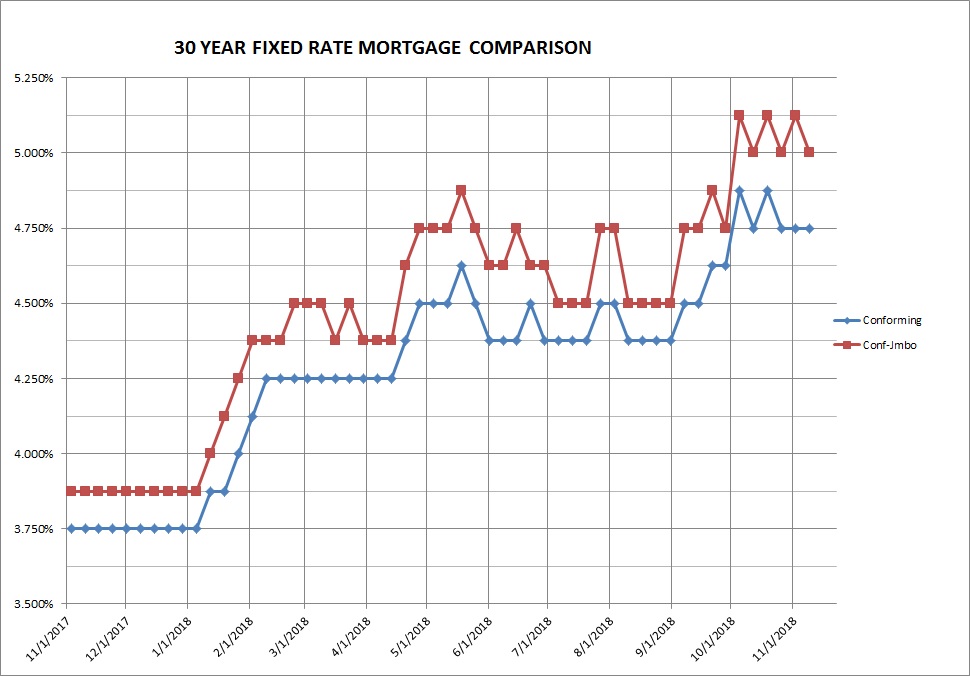
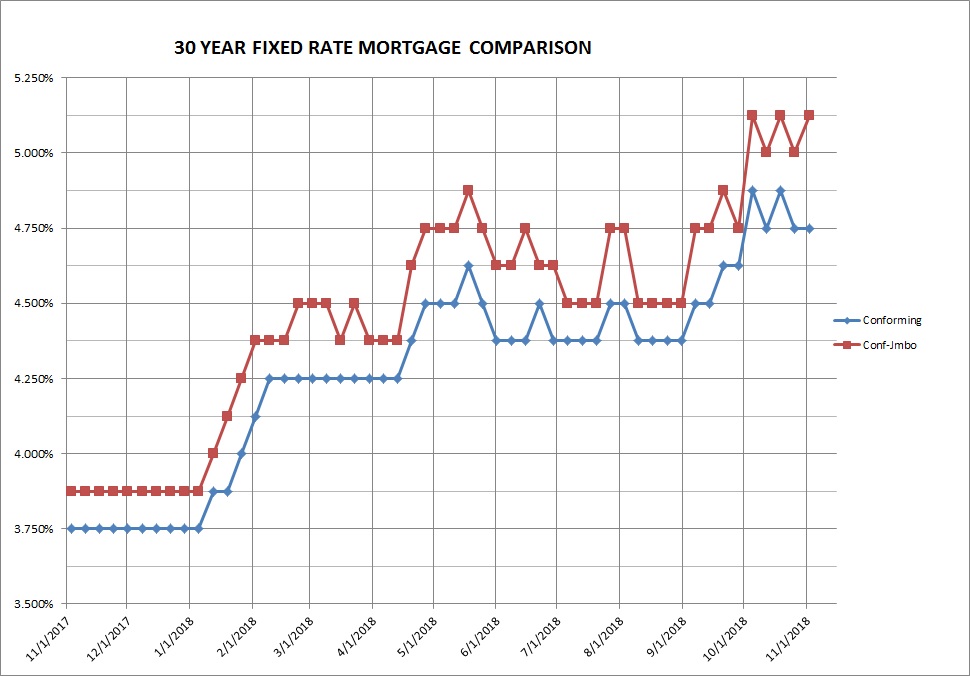
Rates for Friday November 9, 2018: Mortgage rates bounced around a bit this week but we finish with the conforming rate being flat from last Friday and the high-balance rate declining one-eighth (0.125%). Rates have been within a tight range of one-eighth of a percent for the past six weeks, any news positive or negative could prompt a break out of to higher or lower rates. In other words we continue to have a volatile somewhat unstable rate market.


FIXED RATE MORTGAGES AT COST OF 1.25 POINTS LOCKED FOR 45 DAYS:

30 year conforming                                            4.75%       Flat

30 year high-balance conforming                   5.00%      Up 0.125%


Please note that these are base rates and adjustments may be added for condominiums, refinances, credit scores, loan to value, no impound account and period rate is locked. Rates are based on 20% down with 740 FICO score for purchase mortgages.


Another milestone in the Smith household as our youngest passed her driver’s test and drove herself to school on Tuesday instead of taking the bus. It also has resulted in the big car shuffle as she took my 2006 Pilot, I am now in the 2010 Odyssey and Leslie moves into what was our oldest daughter’s 2001 Infinity until we decide it is time to get her a more recently manufactured set of wheels. We’re not real big on buying new cars in our family on a very frequent basis.


Have a great week, and drive carefully—especially around Bixby Knolls!


Dennis


Past Weekly Rate & Market Updates can be found on my blog page at my website www.DennisCSmith.com

11-7-18 Should I refinance and payoff my HELOC?

Question of the week:  Should I refinance and payoff my HELOC?


 Answer:  My most frequent response to questions of the week definitely applies to this question: It depends.


There are several factors to consider when deciding if now is the time for you to refinance and fix the rate on you Home Equity Line of Credit (HELOC).


Before we get into various factors to discuss, let’s take a quick look at why the question is being asked. Your HELOC has three components that determine your current payment, the balance, the prime rate and the amount added to the prime rate (called the margin) that results in the rate you are being charged.


Of the three factors the only one you somewhat control is the balance; you can impact your payment by paying down the balance on the HELOC. Obviously, the more you pay towards the balance the lower your payment will be on a monthly basis. Most HELOCs have two periods of repayment. The initial payment period usually has a minimum payment requirement that is the interest accrued on the loan since the last payment. The next stage of payments is usually a fully amortized period for the remaining life of the loan; if you may have a HELOC that is a twenty year loan, in this case typically the first ten years of the loan have an interest only payment, at the start of the eleventh year the loan will be fully amortized based on the remain ten years of the loan.


Example: You have a $150,000 balance on your HELOC that you obtained in December 2008 and the current rate is the prime rate, currently 5.25% plus one-half of one percent (0.500%) for a payment rate of 5.75%. Your minimum payment for November is the interest on the balance, $718.75 (balance times rate divided by twelve months). Next month you begin your eleventh year and the loan payment is now fully amortized using the rate that month plus the remaining term of 120 months. The rate for the December payment is the same as November, since the prime rate has not moved, at 5.75%, since you paid the interest only payment in November balance is still $150,000 but now instead of interest only the payment is amortized to include principal reduction and the payment will be $1646.54. Since the Federal Reserve is expected to increase its funds rate by 0.25% in December that means the prime rate will increase by 0.25% as well so the January payment will be calculated at 6.00%** and your payment will be $1655.00 for the month.  **Since the Fed will increase rates into the month the rate will only be for part of the month with the earlier part of the month being calculated at the 5.75% rate, but for demonstration purposes easier to show as one complete month.


The lower your balance when you enter the fully amortized payment portion of the repayment of your HELOC the lower your required payment will be.


If you have a HELOC for three years or more you have seen your rate increase by two percent since 2015 and one percent since last November. The chances are you will see at least another one percent increase in the next year, with a 0.25% in December when the Fed is expected to increase rates again.  (To see why the Fed increasing rates impacts your HELOC rate here is link to WR&MU from a few weeks ago addressing the issue.)


With rates having climbed one percent or more in the past twelve months the decision to refinance is a lot harder than it was one year ago, or even two to three months ago and moving forward the decision might not get easier.


The first consideration is if you are risk averse or not. The risk averse individual would be more inclined to want to refinance to avoid future increases in rates on their HELOC as well as for long term fixed rate mortgages that would be used to refinance. The person more comfortable with risk might be less inclined to refinance. Why?


The person who is willing to accept more risk may take the stance that their underlying primary mortgage has an interest rate that is lower than the rate available to refinance their primary loan plus their HELOC and will accept the higher rates on their HELOC in the future and if need be make interest only payments with the hope that rates decline in the future so refinancing makes more sense, or to enable easier paying down of the mortgage.


The risk averse person does not want the uncertainty of not knowing how high their rate and payment will go on their HELOC and is more willing to trade off what would probably be a higher payment in the short term for what may be a lower payment in the long run. The risk averse person knows if rates do drop in the future they can likely refinance and lower their payment.


What are the factors in terms of payment that need to be considered? First and foremost is the payment differential between doing nothing and refinancing. There are four primary factors that will determine the payment at which the interest rate for your refinance will be calculated: balances, credit score, loan-to-value and whether the transaction would be considered cashout or not.


The first three factors are pretty elementary; the combined balances of your existing primary mortgage and your HELOC will determine the refinance loan amount, your credit score is determined when we pull a credit report, the loan-to-value is determined by the estimated value of your home and the refinance loan balance.


The fourth factor, whether the refinance transaction is considered a cashout transaction or a rate and term transaction. For conventional mortgages unless the HELOC can be proven to be part of the purchase price of the property the transaction is considered to be a cashout transaction, if your HELOC was used to purchase your property the transaction is considered to be a rate and term refinance, and will have lower costs than the cashout. If the loan is a jumbo loan we have several programs that will consider the refinance a rate and term transaction is you can prove you have not accessed any funds from the HELOC in the past twelve months.


Once we know the four factors we go to our rate sheets and determine the rate, and also your what your new payment would be after refinancing. With this information you can determine if you want to refinance and payoff your HELOC into a fixed rate mortgage, or continue as you are with your current primary mortgage and HELOC.


Since the minimum payment for most HELOCs is interest only even if you were able to refinance near what your current mortgage rate is the chances are you will see some increase in total payment as you move from interest only to paying down principal on your HELOC. With rates higher and most homeowners with rates closer to 4.00% than today’s rates the chances are that your payment will likely increase a few hundred dollars per month, or more, when refinancing to pay off your HELOC. And this is the basis for the hard decision, is the extra monthly payment worth it to remove future risk based on rising interest rates, or is the cost too much for you to want to remove the risk?


This is a question I am very willing to help you answer by running the numbers and options for you and your particular situation. For several years we have been encouraging homeowners with HELOCs to refinance to fix their rate and payment on their mortgage debt, while I still feel it is a good idea for most homeowners, it may not be your choice, however I encourage you to run the numbers and know the options. If your HELOC is converting from an interest only payment to fully amortized in the next few years you may want to give refinancing even more consideration due to the sharp increase in your monthly payment when that occurs.


If you, or someone you know, has a Home Equity Line of Credit please contact me to go through your information so you have the information needed for making a decision on whether to refinance.


Have a question? Ask me!


Better economy, higher rates. That correlation is something long time readers of the WR&MU have learned over the years. This week we have positive economic news released every day, some data a lot more positive than others. Here are the data releases that have the greatest impact on rates.


Households made more and spent more in September. Income growth for the month was slower than August but still positive at 0.2% matching the core inflation rate for the month. Holding back income growth was a slow down for self-employed businesses. Savings rates dropped as consumer spending increased in September by 0.4%, the seventh month in a row with spending increasing by 0.4% or more. The disparity in spending and income growth may have been impacted by Hurricane Florence. The very good news for the economy inside the data is that there was a sharp increase in the purchase of new cars and recreational goods—the sort of spending that occurs when the economy is strong and consumers are optimistic. The news is not good for interest rates, though tempered a bit as the year over year inflation index of 2.0% is in line with the Federal Reserve’s target.


My oldest was one the last time the American consumer was has confident as s/he was in September, as the consumer confidence rose to its highest level since 2000. The cutoff date for the survey was mid-October, before the stock market slump so the expectation is that the index will drop in November. This news also puts upward pressure on interest rates.


Continuing the short term historic gains was the Employment Cost Index which showed wage gains in the private sector reached their highest level in ten years in the third quarter, with wages, salaries and benefits increasing 0.8% for the period. The gains reflect the lowest unemployment rate since 1969. A very big concern for economists is wage inflation, higher prices driven not by demand but by the cost of production of goods and services being driven higher by employment costs. The ECI report puts that concern very much in the center of the inflation and rate conversation. While this news is good for workers it is bad for those wanting lower interest rates.


Today’s data just piles on. The jobs report was released by the Labor Department today showing the labor situation in September. The news shows a very strong labor market, stronger than expected. Nonfarm payrolls increased by 250,000 in September, well above the forecast of 208,000 jobs. Included in the report was year over year growth in wages of 3.1%, the highest gain in one year since 2009 when the recession ended, the average hourly pay is now $27.30. This report fully supports future rate hikes from the Federal Reserve and continued upward pressure on mortgage and other long term rates.


Rates for Friday November 2, 2018: Despite the quantity and quality of positive economic news conforming rates hold on from last Friday, high-balance loans ($453,101 to $679,650) increased from last week back to seven year high first reached in early October. The only reason I can see for rates to undergo a migration down would be a catastrophic event causing investors to flee to the safety of long term fixed rate returns available in U.S. Treasury bonds and mortgages.


FIXED RATE MORTGAGES AT COST OF 1.25 POINTS LOCKED FOR 45 DAYS:

30 year conforming                                                4.75%       Flat

30 year high-balance conforming                       5.125%     Up 0.125%


Please note that these are base rates and adjustments may be added for condominiums, refinances, credit scores, loan to value, no impound account and period rate is locked. Rates are based on 20% down with 740 FICO score for purchase mortgages.


As many of you know I love baseball. During the season most afternoons I have the Phillies radio broadcast, or some other game back east playing on my computer and on weekends I listen to games from Philly or around the country while driving around or doing chores. Last Friday night’s game between the Dodgers and Red Sox that went 18 innings was pure heaven for me and I was thrilled the way it ended, not necessarily because the Dodgers won but that it was won on a great home run and not an error. Every inning was thrilling and had fans on the edge of their seats. While mildly upset the Red Sox won another championship and the Dodgers drought is now thirty seasons, I admire the Sox for the way they played this season and through the playoffs; the best team hoisted the trophy to end the season.


Now we wait until the end of February when Spring Training starts!


Have a great week,

Dennis


Past Weekly Rate & Market Updates can be found on my blog page at my website www.DennisCSmith.com
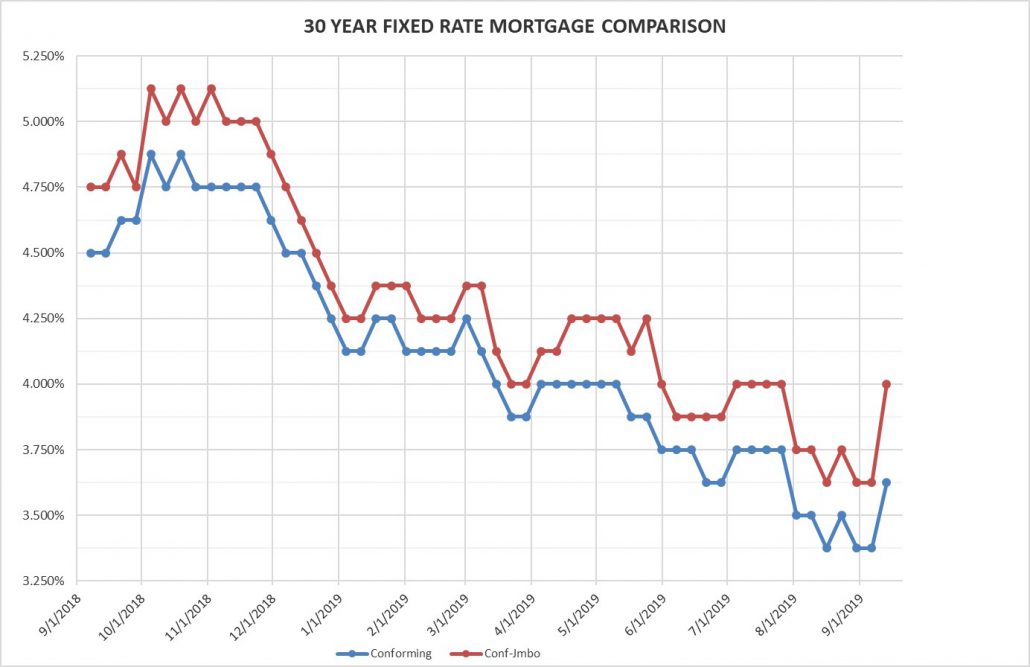
10-26-18 Why can’t you use my bonus income to qualify me for my new home?

Question of the week:  Why can’t you use my bonus income to qualify me for my new home?


 Answer:  Income must be of a constant and continuing nature.


What constitutes “constant and continuing?” Generally, at least a two year history of receiving the income fulfills the requirement. There are some exceptions which I will cover below, but the question of the week specifically addresses bonus income, and much of this will apply to overtime and commission income as well.


Bonus income typically fluctuates from year to year depending on the matrix upon which the bonus is based. Because of the fluctuation there must be a guideline for the lender to consider the income for qualification purposes for your mortgage application. The industry standard is that if you have received a certain type of income for two years are more then we have reached the threshold of constancy. To reach the continuing nature policy we generally need a statement from your employer that the bonus will in all probability continue; this guideline is usually met with a letter from the employer or with a Verification of Employment (VOE) that we send your employer to complete. The VOE has sections for your employer to complete stating the length of employment, income for each of the past two years plus year to date broken down into base, bonus, overtime and commission. As well there is a place to indicate whether the continued payment of bonus, overtime and commission is likely to continue in the future.


Whether your bonus is paid annually, quarterly, monthly or per pay period does not matter for qualifying, we will convert the amount received into a monthly amount based on the amount received for the past two years, and if applicable year to date. The rule of thumb for bonus income, as well as overtime and commissions, is to use at least a two year average, unless the most recent year is lower than the prior year in which case the lower amount is taken.


Example: You have been with your company for five years and have received bonuses every quarter for the past three years and the bonus is paid on the first paycheck after the end of the quarter. In 2016 your bonuses totaled $12,000, in 2017 $12,600 and on your October 15th pay period your total bonuses year to date including September totaled $9700. The total amount received in bonuses is $34,300 over the past 33 months (two full years plus nine months in 2018), so we divide the total amount received by the time period over which it was received and get $1039.39, this is the amount of bonus income we will use for your qualifying for your mortgage—provided your employer verifies that you are likely to continue to receive bonuses in the future.


Example 2: Same employment scenario as above, however in 2016 you received $12,000 bonus, in 2017 you received $10,000 bonus and through September you have received $9000 in bonus income as reflected on your recent paycheck. It is evident you received $1000 per month in 2016 and so far in 2018. However, in 2017 your bonus was $833.33 per month—this is the bonus income that most lenders will use for income qualifying as it follows the standard guidelines from Fannie Mae and Freddie Mac. Even with a letter from your employer regarding 4th quarter bonus the lender will take the worst case scenario when calculating income.


All this covers how we do calculate and count your bonus income, back to our question, why is your bonus income not allowed? Reading through the above it is likely because of any or all of the following:


  • You have not received your bonus for at least two years
  • Your bonus has been inconsistent, i.e. you received bonus income in 2016 but not 2017
  • Your employer will acknowledge that your bonus is likely to continue, which we saw not infrequently during the recession with employers very hesitant to put in writing bonuses are guaranteed or likely to continue creating a legal document an employee may use against the employer should bonuses be canceled.


Any non-wage employment income is generally treated in a similar manner, most prevalent being overtime, commission and self-employment income.


As mentioned above there are some exceptions to the two year income rule:


New job—If you are starting a new job, depending on the circumstances, we can generally count your income with a short, or perhaps no, history of employment at the new job. Typically, showing at least thirty days of income is needed. If you are transferring from working for Dennis Sprockets to Smith Widgets and in somewhat the same type of work, we can use your new income—but not overtime or bonus unless expressly addressed and quantified in an employment contract and if you received similar amounts in your prior job. New professionals can also have “young” income used for qualifying with proof of education in the field and an employment contract. If transferring geographically and a new job with a new company we can usually use your new employment income before you start on your job with an employment contract and separate letter from a senior executive at the company.


Spousal support—If you have a divorce decree or separation agreement that is recorded that includes your receiving alimony or child support we can use that income once you can prove you have received six monthly payments in a timely fashion. Note the income must be received as one payment every six months and not six months’ worth of payments upfront. As well the agreement must indicate the income will be received for at least three years after the date of your mortgage application; for instance, if you are receiving $800 per month for each of your two children until they are 18 and your son is 16 then we will only accept $800 for qualifying for your youngest child.


Retirement income—If you receive a pension or social security income you do not need to show a two-year history. Provide your award letter stating the amount of income you are to receive and we will use the current income for social security; for a pension, we must show that the pension income will continue for at least three years.


Asset accounts—Most individuals and couples have their financial assets in a retirement account and/or taxable investment and bank accounts. Depending on several factors these accounts could be used for qualifying income. Retirement accounts can be used for income if you are taking regular withdrawals from the account. Depending on your age and the type of retirement account you may be having to take mandatory distributions on an annual basis, this can be used for income. Or if you are taking regular distributions we can use those amounts as income as well. If you have funds in non-retirement accounts there are some cases where we can perform a calculation called “asset depletion” so we can achieve qualifying income.


Rent—If you are purchasing a new home and renting out your existing home there are guidelines we can follow to use the rental income from your current residence as qualifying income to offset the mortgage, tax and insurance payments.


Bonuses, commissions, retirement, wages, there are many different sources of income; whether yours is eligible for use as qualifying income can depend on different factors. If you, or someone you know, if looking to purchase or refinance property please contact me to ensure you are fully qualified for the transaction you want to make.


Have a question? Ask me!


Don’t bury the lead. A couple of big pieces of economic news, since weekly update is primarily about mortgages and real estate we will start with the major news on home sales. This week the California Association of Realtors released its housing report for September. Based on the data I am of the opinion the real estate markets have become a buyer’s market. Los Angeles County saw the median home price increase 4.5% from August and 4.7% from 2017 to a value of $634,680. While the median price increased there was a dramatic drop in total sales. Sales volume for the month was down 18.3% from the prior month and 22% from last year. Neighboring Orange County saw both the median price and total sales volume drop in September. The county median price of $825,000 was down 1.6% for the month and 3.3% for the year, total volume was down 20.3% from August and 21.8% from September 2017. The data that supports my contention of our regional market being a buyer’s market is the increase in the number of active listings on the market and the time a home is on the market before it is sold and enters escrow. Basic premise, more supply leads to lower prices. Supply is growing and demand is not due to several factors, primarily higher interest rates.


Impacts sales and refinances. The softening market not only impacts sellers as they see values slowly erode, but also can have an impact on homeowners looking to refinance to lower payments, consolidate equity lines or obtain equity for various reasons. How? With a softer market there is more downward pressure on appraisals and therefore values needed for refinancing, or the rate and cost of the refinance due to potentially higher loan to value based on potentially lower appraised values.


The national economy is not following housing. This morning the initial estimate for the Gross Domestic Product was released and it showed growth in the quarter of 3.5%, slower than the 4.2% GDP growth in the second quarter. The expectation is that 2018 will end with total economic growth of 3% or greater, the first year with such growth since 2005. The report was, as you can expect, sprinkled with good news most notably the decline in inflation from 2% in the second quarter to 1.6% in the third quarter. That is good for consumers, but is it good for the economy? With some weakness in business spending and investment, slowing inflation and the equity markets dropping in recent weeks the signals are there for economic growth slowing, or reversing in 2019. It is quite possible, probable?, that a mild recession will begin in the third or fourth quarter of 2019. Overall the GDP news was market neutral as the growth figures met expectations.


Rates for Friday October 26, 2018: With stocks falling this week investors have been moving their funds to bonds and mortgages resulting in rates falling from last Friday. We remain in a volatile market and caution is strongly advised when thinking about floating your rate.


FIXED RATE MORTGAGES AT COST OF 1.25 POINTS LOCKED FOR 45 DAYS:

30 year conforming                                            4.75%     Down 0.125%

30 year high-balance conforming                       5.00%     Down 0.125%


Please note that these are base rates and adjustments may be added for condominiums, refinances, credit scores, loan to value, no impound account and period rate is locked. Rates are based on 20% down with 740 FICO score for purchase mortgages.


Few things are better than a short trip that feels like a very long trip. That was the experience Leslie, our daughter and I had last week when we flew out to Boston to see our college freshman. Leslie and I walked about 13 miles on Saturday, mostly up the Charles River while the internationally famous Head of the Charles rowing regatta was going on, watched a performance by the marching band, where ironically our daughter is the tallest in the flute section as she was in high school, then we all enjoyed a fantastic and leisurely lunch/dinner at an Italian restaurant, topped off with the ubiquitous visit to Mike’s for some pastries. Another long walk to LL Bean to get our girl squared away with duck boots for the coming winter and it was back to our hotel for a few hours of catching up and just being together. A packed day, with plenty of needed hugs, mostly for me, and just seeing how happy she is with her friends, college and new city and mom and dad have come home at ease.


Now we are looking forward to our next time seeing her when she is home for four weeks at Christmas!


Have a Happy Halloween and don’t get too spooked by the gremlins and goblins showing up on your doorstep…I’ve noticed they leave you alone if you bribe them with some sugary treats!


Have a great week,


Dennis


Past Weekly Rate & Market Updates can be found on my blog page at my website www.DennisCSmith.com

9-14-18: Can we afford this payment?

Question of the week:  Can we afford this payment?


 Answer:  Statistically, yes you can.


Statistics dictate the underwriting guidelines when determining how much of a mortgage and housing payment a family can afford to get loan approval to purchase a new home, or refinance an existing home. The key number is the debt-to-income (DTI) ratio which is your new housing payment (mortgage, property taxes, insurance and homeowners association dues if applicable, collectively referred to as PITI) divided by your adjusted gross income (income before taxes). Depending on the loan program this percentage of your total income for your total new debt obligations inclusive of housing payment cannot exceed between 43 and 50% of your gross income. (Note, VA mortgages do not adhere strictly to DTI guidelines for qualifying.)


For instance, if you are purchasing a new home and the total housing payment is $3,000 and you have car payment, student loan payment and credit cards with monthly payments reported on your credit report totaling $1275 per month, your total obligations are $4275 per month. If your gross monthly income is $10,000 per month you have a DTI of 42.75%, generally good enough to qualify for most programs.


Statistically. The debt-to-income guidelines were created based upon data from millions of property owner’s history of making payments in a timely fashion, and more important those that have not. Mortgage data is analyzed to see the percentage of defaults for debt-to-income ratios and there is a breaking point at which the percentage of defaults become untenable risk for lenders and that is where the DTI guidelines are set. It is important to note that the default data is also analyzed for occupancy, type of property and credit scores among other criteria and this is how rates are priced (sounds like a good question for next week).


Back to if you can afford the payment that we have given you which would be approved by underwriting.


I tell almost all clients purchasing a new home when we are going through the qualification process, “there are three things that are very true regarding your new home purchase. One, I will not use my savings to purchase the home. Two, I will use my income to help you make the monthly payment. Three, I will not spend any time sleeping or living in your home.” This is to say, while I may feel comfortable with the payment I am giving you for your potential new mortgage, property taxes and insurance, I am not making the payment so it is important that you are comfortable with what you feel you can afford.


That said it is also important to stretch a little of your comfort if your comfort level is well below your income ability, unless there are some exceptions. One gauge many first-time buyers, and some move up buyers, use for their new housing payment is what they are currently paying in rent. If you make $10,000 per month and are paying $2200 per month, using the $2200 per month to be what you would like your new housing payment to be you will be looking at homes that are significantly below your ability to qualify, and from my experience frustrated in the homes you will be looking to purchase as few, if any, will feel “right” for you and your family.


If the payment I am quoting feels too high for a client I ask that they take a look at where they spend their money, and is this likely to continue once they become homeowners. Purchasing a home is not just purchasing a place to live, it is also entering a new lifestyle, that of homeowner. For most first-time buyers, purchasing a home occurs before they start a family, or with younger children. This changes your lifestyle dramatically and the stability of owning a home and fixing your housing payment pairs perfectly with a growing family. Most meals will be made at home, changing your budget if you eat out a lot. Weekends will likely be spent with the family at different events, games and activities involving the children, which means fewer weekends travelling to the wine country or Vegas.


Essentially, is your expectation that your lifestyle and spending habits that make your potential new housing payment seem uncomfortable to remain the same? Chances are very, very high that it will not. When considering your new home and the cost also consider the changes you will be making in your lifestyle, and therefore expenses.


Finally, why are you buying a home? Is it to change your life in a positive manner? If so what other changes are you willing to make so you can experience the value of homeownership?


Pretty much everything decision in life has trade-offs and consequences, even not making a decision. One area at which I will immodestly say I do very well is explaining to my clients the positives and negatives of the options available to them when purchasing a home. If you think owning a home is not in your budget please contact me so we can discuss your financial situation and options.


Have a question? Ask me!


August economic data was interesting. The Producer Price Index dropped 0.1% in August, the first month over month decline in 18 months and read by many as a sign that inflation may be easing. Supporting the read was the Consumer Price Index for August that showed prices rose 0.2% for the month, however up only 0.1% for the “core” rate (minus fuel and food). The monthly increase was the fifth straight increase, however the size of the CPI increase lowered the year over year inflation for the core index to 2.2% from 2.4%. Gas and rent were the primary factors putting upward pressure on the index, many other consumer sectors fell, primarily clothing which saw prices drop for the third month in a row—good news if you have growing children. The news is mostly positive for interest rates as any easing of inflation releases pressure for rates to go higher.


Retail sales also grew at a slower pace in August from the prior month, however the slow down was not unexpected given the surge in sales in July. Supporting future increases in sales was the Michigan Consumer Sentiment Index which continues to rise, reaching it second  highest level since 2004, and highest since March of this year. Positive consumer sentiment leads to consumer spending, which drives the economy and can lead to higher rates.


Rates for Friday September 14, 2018: A large drop in Mortgage Backed Security (MBS) prices in the middle of the week put strong upward pressure on rates. Some easing later in the week saw us with rates this Friday flat from last Friday. I have been asked a lot lately what I thought rates will do, my standard response is that I feel they should be higher than they are currently given the economic data.


FIXED RATE MORTGAGES AT COST OF 1.25 POINTS LOCKED FOR 45 DAYS:

30 year conforming                                            4.50%             Flat

30 year high-balance conforming                      4.75%      Flat


Please note that these are base rates and adjustments may be added for condominiums, refinances, credit scores, loan to value, no impound account and period rate is locked. Rates are based on 20% down with 740 FICO score for purchase mortgages.


Thankfully Hurricane Florence started losing power earlier in the week and when it made landfall this morning in North Carolina had lost enough power to be designated a tropical storm instead of a hurricane. Even with the winds at less power the amount of water that will be dropped in the southeast will be significant, especially if the storm remains in place. As always when nature becomes fierce the Red Cross is there to help residents through the event and after. We are truly fortunate to have such a wonderful organization looking after people negatively impacted around the globe by human and natural acts that displace and harm people.


Many communities are also grateful they have a Waffle House or two in their communities. The butt of many jokes, mostly from those not in the Waffle House regions, the company does great work when disasters are about to hit. So great in fact that FEMA follows the company’s “Waffle House Index” to help determine the severity of a storm. Waffle Houses rarely close, they want to stay open as long as possible as the company knows in many communities it may be the only place for residents and emergency personnel to get a meal. The company also assists with employees from other stores in nearby, less effected, regions to go into disaster zones and fill the jobs at Waffle Houses so those employees can take care of their families and situations as a result of the hurricane, tornado or other event.


Here is a good article on the Waffle House Index. Just so you know, Stage Yellow probably means no bacon—you can get sausage because it takes up less grill space and takes less time to cook so the restaurant can serve more people faster by taking bacon of the restricted menu.


Have a great week,


Dennis