
Why are there different rates or costs for the same mortgage product?
Question of the week: Why are there different rates or costs for the same mortgage product?
Answer: This is a question that is asked often, and one I typically answer every year to eighteen months in the Weekly Rate & Market Update.
Essentially why does a 30 year fixed rate mortgage of $400,000 have different costs for the family buying a condo versus a family purchasing a single family home versus a family refinancing and paying off an equity line versus….whatever other mortgage scenario is occurring?
Using the conforming mortgage as an example, defined as a loan that is eventually sold to Fannie Mae or Freddie Mac and that has been underwritten to their guidelines, the simple answer is “tiered pricing.”
If the most basic economic principle is supply and demand to determine prices, the second most basic investment principle is the greater the risk, the greater the return (the first most is fairly obvious, buy low and sell high); if there is little risk then you should not expect a very great return, conversely if there is greater risk then you should expect a greater return. If you have a $10,000 deposit in a savings account at a federally insured bank that guarantees you will will get your money back if the bank collapses you should expect a very small return; if you invest your $10,000 in a start-up typewriter company you should expect a very high return should the venture become profitable.
Mortgages are investments. Your conventional mortgage is funded by a lender. The lender bundles your mortgage with others totaling tens of millions of dollars in mortgages. This bundle is then sold to Fannie Mae or Freddie Mac. Fannie or Freddie then puts the bundle with other bundles and issues investment vehicles called Mortgage Backed Securities (MBS). Investors across the country and around the world purchase MBS as part of their portfolios and investment strategies receiving regular payments, that are your interest payments, when you loan payoffs off investors receive a portion of the payoff in proportion to the investment.
The greater the risk the greater the return. Some mortgages are riskier than others, so investors in MBS will want a higher return on those mortgages.
What makes one mortgage more of a risk than other if they are being underwritten to the same guidelines? This is where tiered based pricing comes into play for mortgage consumers.
For different aspects of risk Fannie and Freddie charge more for the same rate. For example, a loan applicant for a loan with 5% with a very low credit score may pay up to two points (two percent of the loan amount) more for his mortgage than an applicant for a loan with 5% down who has an extremely high credit score. The lower credit score indicates a history of making credit payments on time, hence a higher risk, hence a higher cost for the loan than someone with outstanding credit.
Credit scores are just one of several risk factors that go into pricing a loan. Risk and risk pricing is determined by the historical defaults for mortgages with similar factors. Over the years, mortgagors with lower credit scores have defaulted on their mortgages more frequently than mortgagors with high credit scores, there for they are a greater risk, therefore their costs for the mortgage will be higher.
Here are the most common factors that result in tiered pricing:
- Owner Occupancy: If you are living in the property being collateralized you will have lower pricing than someone purchasing for investment, an owner occupant is less likely to let a property go to foreclosure than an investor.
- Number of Units: Most multi-unit properties purchased as primary residences eventually become investments, and multi-unit properties have a higher incidences of foreclosure as the mortgage payments are usually dependent ontenants making payments. Multi-unit properties have higher costs than single family units.
- Condominium: Condominium owners are business partners with everyone else in their homeowners’ association, the quality of the complex is dependent on the HOA maintaining the property and a high degree of owner occupants living in the complex. Historically, condos have higher incidence of foreclosure. Because of these factors condos with greater than 75% loan-to-value (LTV) have higher costs than single family detached residences (i.e. a traditional house) or loans on condos with less than 75% LTV.
- Loan-to-Value (LTV): The tiered pricing on LTV gets interesting. The common wisdom would be that the less equity a homeowner has in their property the greater the risk he will walk away and let a property go to foreclosure. And this is true, therefore with one exception the higher the LTV the higher the cost of the loan. The exception is LTVs between 75.01-80.00%, which have a higher cost than loans less than 20% equity. The reason is because loans with LTVs greater than 80% have mortgage insurance which covers the investors should the property go through foreclosure, properties with LTVs of 80% or less do not. If a borrower with 10% equity and a borrower with 22% equity both go through foreclosure, the loss for the investor is greater for the latter due to the lost interest and costs of foreclosure not being insured, as opposed to the 10% equity borrower who would have had mortgage insurance covering the losses.
- Credit Score: We covered this above but to add to the cost, there is a matrix that has loan-to-value down one axis and FICO credit scores across the other. The higher the LTV the more the cost as credit scores drop, conversely the lower the LTV the lower the impact of the lower FICO score. In the example above the difference in cost for very low FICO borrower was two points higher than a very high FICO borrower if both were putting 5% down. The same very low FICO borrower putting 40% or more down payment would have loan costs that are two and a quarter points (2.25% of the loan amount) lower than the very low FICO borrower putting just 5% down. Your credit score impacts your mortgage costs depending on the LTV of the mortgage.
- Cash-Out Refinance: Like credit scores the impact of the cost of pulling cash out of your property is dependent on the LTV of the mortgage. The higher the LTV the higher the cost of the mortgage. It should be noted that purchase and rate and term refinances are treated the same and both have lower costs than cash-out refinances.
- Term of the Rate Lock: After all the factors have been sifted through the final cost differential is how long will the loan rate be guaranteed, how long is the rate locked. The longer the lock period the more expensive the loan, which makes sense as the lender is guaranteeing the rate if all factors input for the rate lock are shown to be valid for a longer period of time, protecting against higher rates. Most rate lock periods are in 15 day increments and the vast majority of our locks are either 30 or 45 days depending on the transaction type, complexity of the transaction and volume of business in the mortgage industry pipelines.
The costs are not paid in cash by the borrower, for instance if someone with a lower FICO score is purchasing a three unit building to rent with 25% down for a mortgage of $500,000 and the costs added by Fannie Mae are 4.125 points the borrower will not, probably not, come in with $20,625 more to close, but rather the interest rate would increase to off-set those additional costs, today that would be close to 5.5%.
The lowest cost mortgage is going to be a low LTV, high FICO purchase or rate and term refinance of a primary single-family residence; among the highest would be a low FICO, maximum LTV, cash-out non-owner occupied refinance. The first is relatively low risk, the second is relatively high risk.
There are more factors that go deeper into the weeds than I have gone with my examples, but you can see that with so many factors in play rate quotes can be risky proposition unless all the details and factors of the borrower and property are known. This is why when someone asks, “what are interest rates?” my response is, “well that depends….”
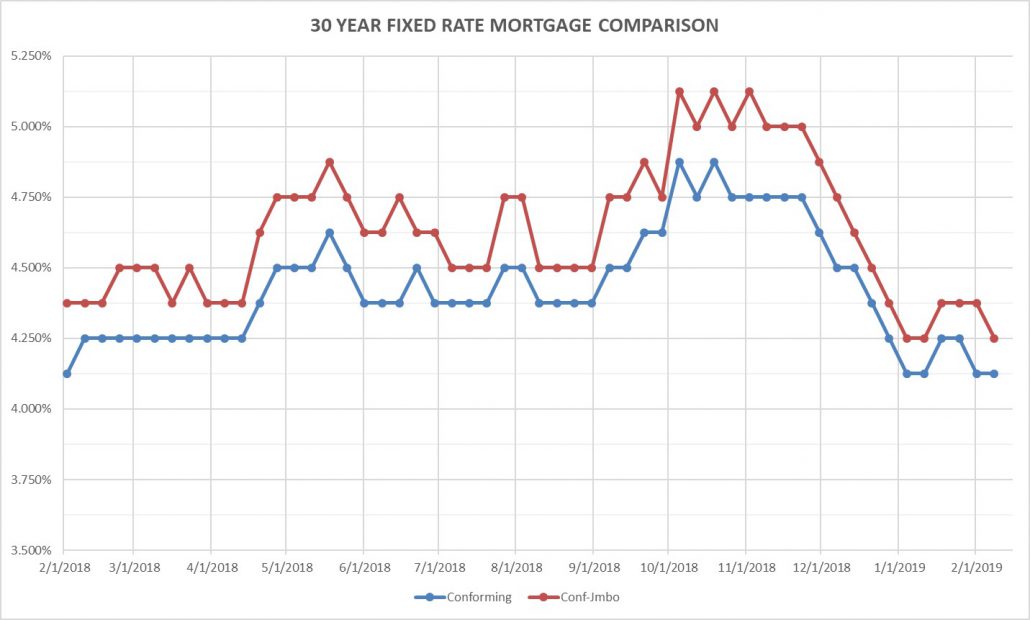
My weekly rate chart is based on the purchase of a detached single-family home for a borrower with a 740 FICO score putting 20% down payment into the transaction and locked for 45 days; a fairly normal transaction. If you have any of the factors above that are different then your rate may be different.
Let me know what your mortgage need is and allow me to provide you an accurate rate and cost for your transaction.
Have a question? Ask me!
Rates for Friday February 8, 2019: Very little economic data of interest to rate markets released this week, as a result mortgage rates were fairly flat for the week. Had the Treasury not had three large sales of bonds rates likely would have dropped. Note that high-balance rates have drifted back closer to the conforming rate, which was flat from last Friday. Next week we get data on inflation, expectations are for very low increases in prices, should that not be the case and prices increased more than expected we may see a bounce in rates. Of greater impact on rates could be the negotiations with China on trade policies, if talks turn sour rates may react by climbing. For now the market is quiet and stable.
FIXED RATE MORTGAGES AT COST OF 1.25 POINTS LOCKED FOR 45 DAYS:
30 year conforming 4.125% Flat
30 year high-balance conforming 4.375% Up 0.125%
Please note that these are base rates and adjustments may be added for condominiums, refinances, credit scores, loan to value, no impound account and period rate is locked. Rates are based on 20% down with 740 FICO score for purchase mortgages.
Did whomever had 3-3 in your office pool buy lunch for everyone? For those with those numbers in the Super Bowl pool, especially a forward and backward score pool, the final minutes of the fourth quarter resulted in a nice payday. In recent years, we have been fortunate to have very exciting Super Bowls with fantastic finishes; for much of the history of the big game this was not the case and unfortunately Sunday’s NFL finale reverted to history with a dull game. What really aggravated many more than the punting contest on the field was the lack of excitement in the commercials. The only one I liked was the NFL’s ad with the Hall of Famers and All-Pros playing a game through the fancy dining room. What I really liked was the follow up on the commercial, a piece on Sam Gordon, the young lady seen towards the end of the advertisement. Click on the links and check them both out.
Now that football is over we can turn to baseball. Pitchers and catchers report to their teams’ training camps this week, to be followed four to five days later by position players. I am looking forward to my prediction of a few years ago of the Phillies having completed their rebuilding process and competing for their division title and hopefully making the playoffs—it all starts this coming week!
Have a great week,
Dennis
Past Weekly Rate & Market Updates can be found on my blog page at my website www.DennisCSmith.com/my-blog