
What do you think will happen to housing prices?
Question of the week: What do you think will happen to housing prices?
Answer: This is a question I, and anyone even tangentially involved in real estate, get asked all the time no matter the economic environment. When we are in abnormal economic times the question is comes up more frequently.
It is an obvious question, and one being asked by everyone, homeowners, potential homeowners, real estate agents, mortgage professionals, economists, media pundits. The answers vary from collapse to boom, depending on the how the answer is approached, and in the case of the media how many clicks they are trying to get for their advertisers.
Prices in any market are determined by the most basic economic equation of supply and demand. If there is more supply than demand prices will fall, if there is more demand than supply prices will increase—go to Amazon and check out the price of Lysol disinfectant spray. Oops, there is no price because the nation’s biggest retailer has none in stock. It is available Ebay, the leading secondary market in the country, at about $30 per can, plus shipping which pushes the cost to around $40.
The overwhelming majority of homes that are sold are in the secondary market—homes that are “pre-used” in developed neighborhoods as opposed to homes newly built. As such, the majority of real estate markets are very sensitive to supply and demand pricing.
Supply and demand are often influenced by outside factors, consider the plot device in the movie Trading Places. The main plot is the social experiment to ruin one successful man and make another man who is on the fringe of society economically and otherwise a big success. The device used bring the story to conclusion is the cost of frozen concentrate orange juice, more specifically future prices. The government is issuing a crop report for Florida oranges. If the crop is very good then there will be an abundance oranges and the price of orange juice will drop; if the crop is bad there will be a scarcity of oranges and the price of orange juice will climb.
Outside factors determine the quality and quantity of the Florida orange crop, primarily weather. Other factors can include labor, cost of fuel for harvesting oranges, distribution chain to get oranges to market, government regulations that determine if it is profitable to harvest oranges, are just a few.
Trading Places shows what happens when people act on poor information that would determine supply.
A factor that enters real estate markets that impacts the price formula is interest rates for mortgages as they help determine demand. Lower interest rates mean lower housing costs mean more families can afford to purchase homes, or families can afford higher priced homes. Higher rates mean the opposite, less affordability or able to purchase lower price homes.
A quick example for a family making $90,000 per year. We will assume that the mortgage payment will be 33% of their gross income. For mortgage qualifying we break all the numbers down to monthly instead of annual amounts.
This family’s income is $7500 per month, if they are to pay 33% of their income just for the monthly mortgage to purchase a home that is $2475 per month.
If the 30-year fixed rate 5% the total mortgage amount for a payment of $2475 per month is $461,000.
If the 30-year fixed rate is 4% the mortgage climbs to $518,400. At 3% the mortgage is $587,000.
Less than 20 months ago the 30-year fixed rate for high-balance conforming mortgages was at 5%, today it is at 3%. A family that purchased a home in late 2018 with a $461,000 mortgage can buy a home today that is worth at least $126,000 more (I say at least because we are leaving down payment out of the equation) with the same monthly mortgage payment.
That drives demand, drives it very fast.
Housing supply is also impacted by interest rates. As mentioned above, if rates are low current homeowners discover they can purchase a bigger home or a home in a better area. Another option is to refinance their existing home to save money every month on their housing costs, and/or reduce the term of their mortgage debt without significantly changing their monthly payment.
Currently, the coronavirus is an outside factor that is impacting the supply of homes coming to market. Many families who would had planned to sell their homes this Spring and Summer have decided to delay their plans to relocate because they do not want people coming through their homes who may be infected, as well, they do not wish to walk through other people’s homes as they search for their new home.
Leading into the pandemic housing supply was already low, many articles in February had data showing declining housing supply, which combined with dropping rates in early 2020 started a rise in home prices.
Now, five months into the pandemic, supply has constricted to two months or less in several markets and six months or less in most.
Low interest rates and limited supply have created more than supply in the housing markets. Rates are the primary factor, but rates are not the only factor driving families into the real estate market.
Surveys have shown that many families, after spending several months working, studying, living, at home since stay-at-home regulations went into effect in March are finding they want, and need, more room for their families. The pandemic has changed how we picture the use of our homes in the future. Instead of being a place the family is all together from after work to before work and on weekends, it is now a place where we are together 24/7 and it is hard to close a sale on Zoom while your spouse is conducting a webinar on Zoom, both of which are interfering with a child’s math test.
Conclusion to the short story made long, prices are climbing as new listings are bid on sight unseen (grammarians help me, sight or site?), multiple offers are being made and very often homes are selling over list price. Anecdotally, my clients looking to buy have experienced losing out on their offers due to multiple overbids in Lakewood, La Mirada, Corona, Mission Hills, and the Los Altos, Los Cerritos, Belmont Shore and Plaza areas of Long Beach in the past few months.
The question was not what is happening to prices, but what will happen to home prices?
In March and April, the media was full of articles stating that the pandemic would severely impact housing markets, in a negative way. At the time the CARES Act had passed enabling homeowners to obtain forbearances on their mortgage payments just by making the request. The common wisdom by the media was that this would lead to a spate of foreclosures in the future creating over-supply. Also contributing to harming the market would be the tremendous rise in unemployed workers creating an under-supply of buyers.
Now that the pandemic has aged several months there are several factors that I see that will result in most real estate markets not crashing nor seeing significant decline in prices (I equate 10% or more decline in prices as significant).
First, regarding the forbearance issue. Traditionally if a lender agrees to a forbearance the agreement with the borrower is that at the end of the forbearance period the borrower will make up the amount of payments that were deferred in a lump sum. This policy would certainly create tremendous challenges for most families and result in the mortgage going into default. What I have seen is that most mortgage services have been extending the term of the mortgage for the number of months payments that are deferred. If you have a six-month deferment on a mortgage that was due to be paid off in April 2040 the forbearance agreement extends the loan so it will be paid off in October 2040. This lessens the economic hardship on the borrower to bring their deferred payments current in one payment.
Second, regarding foreclosures increasing nationwide. Many of those who predicted, or are predicting, a large increase in foreclosures are using the 2008 housing crash as the basis of knowledge and prediction.
The increase in home prices leading into the crash was fueled by cheap money, which we have now, but more importantly cheap underwriting. Fannie Mae and Freddie Mac underwriting guidelines enabled borrowers to purchase homes and/or refinance pulling out equity their homes with no money down, no income qualification, no asset verification and in many instances no appraisals. As a result, millions of families owned homes with loans that they could not afford and in which they had no equity. When they fell behind on their payments they had no ability to sell their home and pay off their mortgages (it costs between 7-8% to sell your home in most markets).
As the economy spiraled down it wiped out jobs that are the foundation of the housing markets, causing a hole in the demand side of the market. The result was over-supply as homeowners had homes for sale that required short-sales, or foreclosures being priced low by lenders to get rid of inventory. At the same time there was an under-supply of demand are supervisors, managers, high wage hourly workers and others were out of work and unable to qualify for mortgages.
Finally, with little to no money invested in their homes, many families found it easy to hand their keys to the bank and find a place to rent.
The profile for the overwhelming supply of homes sold since 2010 is buyers who not only qualified for their purchase mortgage with verifiable income, but likely qualified for a higher mortgage. The average down payment on a home purchase has been around 12%, closer to 6% for first-time buyers. Homeowners are staying in their homes longer, which combined with steady increases in prices, has resulted in equity growth.
Because of the interest rate environment, the past several years most homeowners have very low interest rates, and presuming their incomes have been increasing, even modestly, during their tenure of homeownership their monthly payment is more affordable today than it was a few years ago.
What does this all this mean? The initial equity at time of purchase, plus steady increase in prices while paying down mortgages means that if a family is in trouble and needs to sell their home they can do so and likely receive some equity from the sale. At worst, most would break even and avoid a foreclosure.
The lower rates make it somewhat easier for a family that has a job loss of one spouse, or a reduction in income, to retain their home and continue making payments.
Third, the majority of those who have lost their jobs due to the pandemic do not have the income to purchase homes. Looking at the jobs reports, as the employment numbers have dropped average weekly wages have increased. Why? Because the job losses are coming at the entry level wage jobs not the middle and upper level wage jobs. Conversely, when we have seen employment spikes after the economy opened up we saw the average weekly wages decline because those being hired are the entry level wage positions. We are seeing job losses creeping into higher wage jobs, the airlines for instance are laying off workers, most of whom earn more than minimum wages. Should job losses spread to industries not dependent on travel, entertainment, dining, we will see an impact on the supply of qualified buyers. At this time, however it appears that the areas of the economy most impacted remains industries largely dependent on consumers discretionary spending.
Fourth, the is such an imbalance now between demand and supply that it would take a major shift, a very major shift, in either supply increasing tremendously and/or demand declining tremendously for home prices to decline significantly.
Because of these factors I do not see a significant decline in home prices occurring in most markets. Across the Southern California region there may be pockets of decline, most likely the upper ends of the markets as jumbo mortgages are still in short supply, lack of foreign buyers and smaller pool of eligible buyers that always exist for this range of the market. For the rest of the price ranges, when we have widely available vaccinations for Covid-19, when the economy re-sets to its new normal, we will likely have the same or increased demand and a growth in supply as those families who have delayed selling their homes come to market. The increase in supply however, should be met by demand.
The outside factor that could alter my opinion, and the actual actions in the markets, is the length of the pandemic and how soon we are able to achieve the new normal with few, if any, segments of the economy being restricted due to the coronavirus.
Have a question? Ask me!
The big economic news this week was the data on 2nd quarter Gross Domestic falling at an annualized 32.9%, the largest single quarter drop since the government started tracking GDP following World War II. On a quarterly basis the decline was 9%, and was less than anticipated by Wall Street. Combined with a drop in the 1st quarter GDP, the decline puts the economy in a recession (defined by two consecutive quarters of declining GDP). The news had little to no impact on mortgage rates due to the expectation of a historic decline, and that there is little economic news at this point that can push rates much lower.
A bit of a bright spot in economic news was that consumer spending in June provided the second consecutive monthly increase, growing 5.6% from May’s spending. July may show another increase in spending, even with many states re-shutting businesses due to increases in infections. All eyes will be on August as the additional unemployment compensation of $600 per week that was part of the CARES Act expires today.
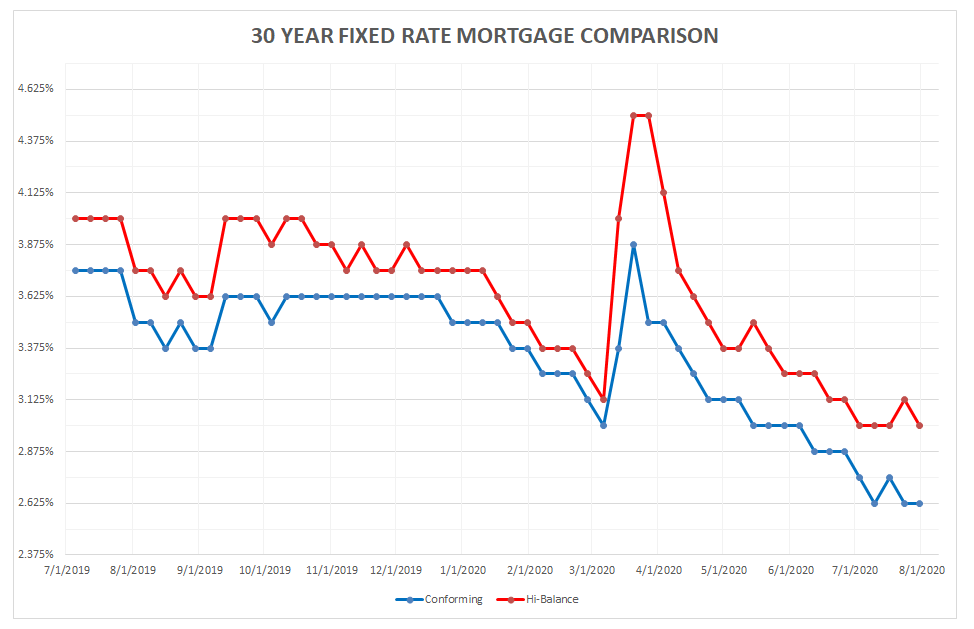
Rates for Friday July 24, 2020: Rates remain flat from last Friday, it appears we have reached our range for the current market as since the beginning of the month the conforming rate has drifted between 2.625-2.75%, while the high-balance has been between 3-3.125% for purchases with variables listed below.
The rate spread for cash-out, no point, higher loan-to-value and other factors for refinances still are historically higher than normal. Call for details and quotes as rates can vary significantly depending on the situation.
FIXED RATE MORTGAGES AT COST OF 1.25 POINTS LOCKED FOR 45 DAYS:
30 year conforming 2.625% Flat
30 year high-balance conforming 3.00% Flat
Please note that these are base rates and adjustments may be added for condominiums, refinances, credit scores, loan to value, no impound account and period rate is locked. Rates are based on 20% down with 740 FICO score for purchase mortgages.
It appears Mollie’s suggestion to include the question of the week is very popular based on the feedback I received—such a good suggestion I wish she had made it several years ago!
The beginning of August is usually when families start getting ready to send their kids off to college—especially if their son or daughter is heading off to their freshman year. With many colleges and universities cancelling many, most or all in-class classes and moving to on-line, a lot of students who were part of the high class of 2020 are opting to take a “gap” year. With the high costs of attending college they are deciding that it is not worth the cost to sit in a dorm room watching classes on a screen, not being able to have social interactions to meet other students and benefit from the overall college experience. We have first hand knowledge of the colleges trying to sell that the education, even if on-line and not live in classrooms, is still worth the cost to attend, but it is apparent that the sell is hollow and almost desperate.
Next year will be interesting as there will be a good portion of the class of 2020 re-applying to schools while the class of 2021 will also be submitting applications—depending on the learning environment that will be available. This will make an already challenging process even more so. What will be the long-term impact on these young adults who have seen their high school and college years disrupted? How will it impact our labor markets, future leadership, and society and the economy as a whole? We will know in a decade or more as the sociologists and economists study this era and those involved.
Have a great week,
Dennis
Past Weekly Rate & Market Updates can be found on my blog page at my website www.DennisCSmith.com/my-blog