
Is refinancing worth the short- or long-term cost?
Question of the week: Is refinancing worth the short- or long-term cost?
Answer: With rates remaining very low we have been busy doing calculations for clients to determine if a refinance to lower their current mortgages rate and payment makes sense. This is a bit of a follow up from the WR&MU of August 30, 2019 (“When can we, should we, refinance?”) in which we discussed not only a refinance to lower the payment (a rate and term refinance) but also refinancing your current mortgage to consolidate a HELOC, other debt or pull-out equity for other purposes (a cash-out refinance). This week we will keep our discussion to a rate and term, or rate reduction, refinance.
Every transaction has costs, the question we explore with clients is how are the costs paid. The mortgage costs incurred when purchasing a home are similar to the mortgage costs incurred when refinancing a mortgage. There are several services that are involved, and no one works for free. Escrow, lender and title companies have fees. The transaction will have to be recorded so there will be fees paid to the county recorder. Not always but in most instances, there will be an appraisal, which requires a fee. Credit companies, companies that inform lender if your taxes are being paid on time and in the correct amount, companies that certify if your property does or does not require flood insurance, all have fees that need to be paid.
These are all known as “non-recurring costs,” the happen once and only happen because you are obtaining a mortgage. Depending on your loan amount and a few other variables, these costs range from about
Other costs involved are “recurring costs,” as you have guessed these costs recur over the life of your mortgage. Also known as “pro-rations,” these are amounts due to mortgage interest, property taxes and insurance that are prorated to the date of closing based on what has been paid or what will need to be paid.
There are three ways these costs can be paid in a refinance transaction (see below for fourth in a purchase). The costs can be paid with the borrower bringing funds to escrow at closing. The costs can be paid by adding them to the current mortgage amount, increasing the total amount of the new mortgage. The costs can be paid by the lender by increasing the rate on the new mortgage. (The fourth method of paying the costs in a purchase transaction is to have a credit from the seller or agent(s) for some or all of the costs you will be incurring.)
These costs are the short-term cost of refinancing, long-term if you add them to the loan amount. The question we answer is, do the costs associated with the refinance make sense? How do we determine what “makes sense?”
We have two litmus tests we use to determine if refinancing your current mortgage makes sense. First, your payment needs to drop by at least 5%. Second, if we divide the costs of the refinance by your monthly savings is the “pay-back” less than 36 months? The higher the percentage of savings and the lower the “pay-back” period the more it makes sense to refinance.
Real numbers: Client purchased a home in 2016 with a mortgage of $535,000 with a rate of 3.875% and a monthly payment of $2517 per month. The current balance on the mortgage is $500,000 and we are looking at a refinance at 3.5% with total costs for all fees of about $3500.
Client chooses to add the fees to the current loan balance so we have a loan for $503,000. The payment for a 30 year fixed rate $503,500 mortgage at 3.5% is $2261. This will lower the monthly payment by $256 per month, a savings of 10%–we meet the litmus test for monthly payment savings.
If we take the costs of $3500 and divide by the $256 monthly savings we get 13.67 months, which means that by the 14th payment the refinance has paid for itself.
After going through the math the client says, “but I have already paid on the mortgage for about 40 months, now I am starting all over again.”
There are several points to consider when extending your current mortgage with a refinance. How long will you be in the property? Will you be able to utilize your monthly savings to pay off other debt, increase your retirement savings, put aside for children’s college fund(s), or some other use that will benefit you?
Taking our client above, who says they intend on being in the home beyond thirty more years. Let’s look at the math between saving $256 per month versus adding 40 months to his payment. The next 320 months will be the time frame in which the original loan will be paid off if let alone. The savings during the 320 months from refinancing will be almost $82,000 (320 x $256 savings per month) and the payment on the additional 40 months due to refinancing is about $90,000 (40 x $2261 monthly payment from refinance). Over thirty years he will pay about $8000 more.
Is saving a total of $8000 over 30 years worth not saving almost $3100 per year for over 25 years? In economics there is a saying, “a dollar today is worth more than a dollar tomorrow;” essentially what you can buy with a dollar today is worth more than buying something for a dollar tomorrow for several factors, most importantly inflation eroding the value of your dollar over time. Having $256 more per month today and in the near future is worth more than spending $$2261 per month in twenty-five years.
If the client does not intend to stay in the home for more than the 320 months remaining on his mortgage the additional term is mute, the home will be paid off through your selling it before the final payment would be due, why spend more each month until you sell?
If the plan is to stay and keep the home then the better financial decision is still to refinance. Just keep making your same payment and your home will be paid of in about 300 months instead of the 320 months you have left on your mortgage. This will save you about $50,000 from not having any payments for 20 months at the end of your current mortgage. That said, I and many others contend that financially you would better off investing the monthly savings into an account for some future expenditure needs such as college tuition or retirement due to the economic principal of compound interest and dividend reinvestment and the tax deductibility of your mortgage interest.
Yes, there are short-, and possibly long-term costs to refinancing. There are also short- and long-term benefits from doing so. Doing the math will determine whether the benefit outweigh those costs for you and your family.
If you would like to do the math on your current mortgage as to whether it makes sense to refinance or not please give me a call!
Have a question? Ask me!
Slow news week, for economic data anyway. The primary news that impacts mortgage rates is the monthly jobs report released on the first Friday of every month. Today’s release shows that 225,000 jobs were added to the economy in January, well above the consensus estimate of 164,000 additional jobs. For the past three months the average has been 211,000 new jobs added per month. Some good news for workers, signifying how tight the labor markets are, wages increased 3.1% over the past twelve months, with inflation under 2% wage growth is outpacing prices for goods and services creating more disposable income for wage earners. More individuals entered the job search market in January resulting in the unemployment rate increasing in January from 3.5% to 3.6%. Overall the news is mortgage rate unfriendly as the data supports more economic growth and wages at some point pushing prices higher from the producers side.
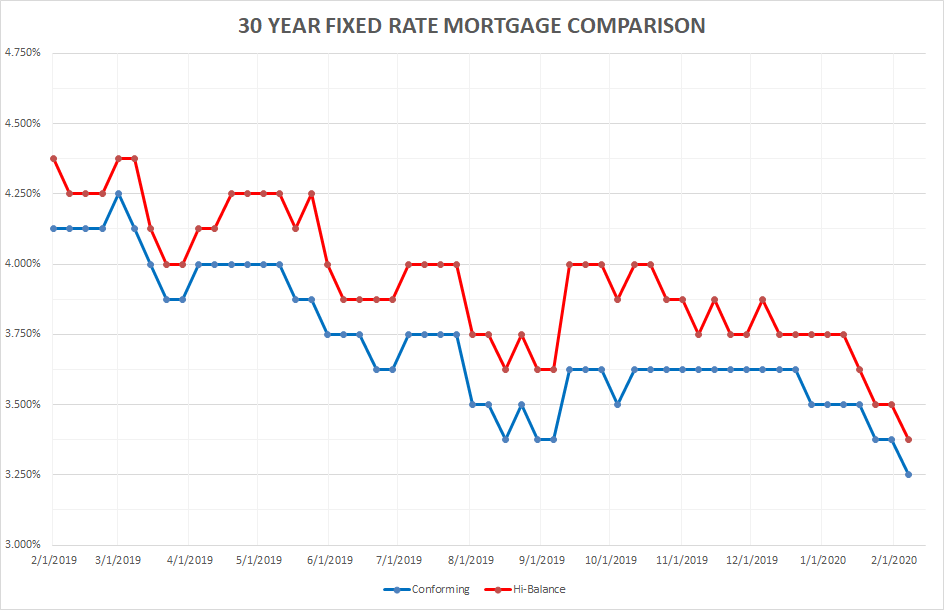
Rates for Friday February 7, 2020: Despite economic news that should put upward pressure on rates we dip this Friday from last to the lowest Friday rate we have had since October 2016—I had to adjust our rate chart as we were hitting bottom. How long they will stay at this level is not known, take advantage while you can.
FIXED RATE MORTGAGES AT COST OF 1.25 POINTS LOCKED FOR 45 DAYS:
30 year conforming 3.25% Down 0.125%
30 year high-balance conforming 3.375% Down 0.125%
Please note that these are base rates and adjustments may be added for condominiums, refinances, credit scores, loan to value, no impound account and period rate is locked. Rates are based on 20% down with 740 FICO score for purchase mortgages.
Now that football is over, and I was right the red-team won!, many of us turn our sights to baseball. Spring training starts this coming week as pitchers and catchers report to major league camps in Arizona and Florida to get ready for the season. Underlying all the preparation and games will be the sign-stealing scandals that have embroiled World Series’ winners in Houston and Boston. My question as this has unfolded is how is it they are the only two teams that have done this? Sports are notorious for a) being copycats and b) trying to find any edge that can be had to get an extra bit of chance to succeed. Is using video to steal signs the steroid-advantage of this era and there are more instances of teams doing so yet to be discovered?
In the meantime, hoping this is the season my Phillies make it back to the playoffs and they are playing in November!
Have a great week,
Dennis
Past Weekly Rate & Market Updates can be found on my blog page at my website www.DennisCSmith.com/my-blog