
What happened this year?
Question of the week: What happened this year?
Answer: It has been an interesting year, and a boring one depending on what issues and factors we are observing over 2019.
Since I am in the mortgage business let’s start our 2019 look back with interest rates.
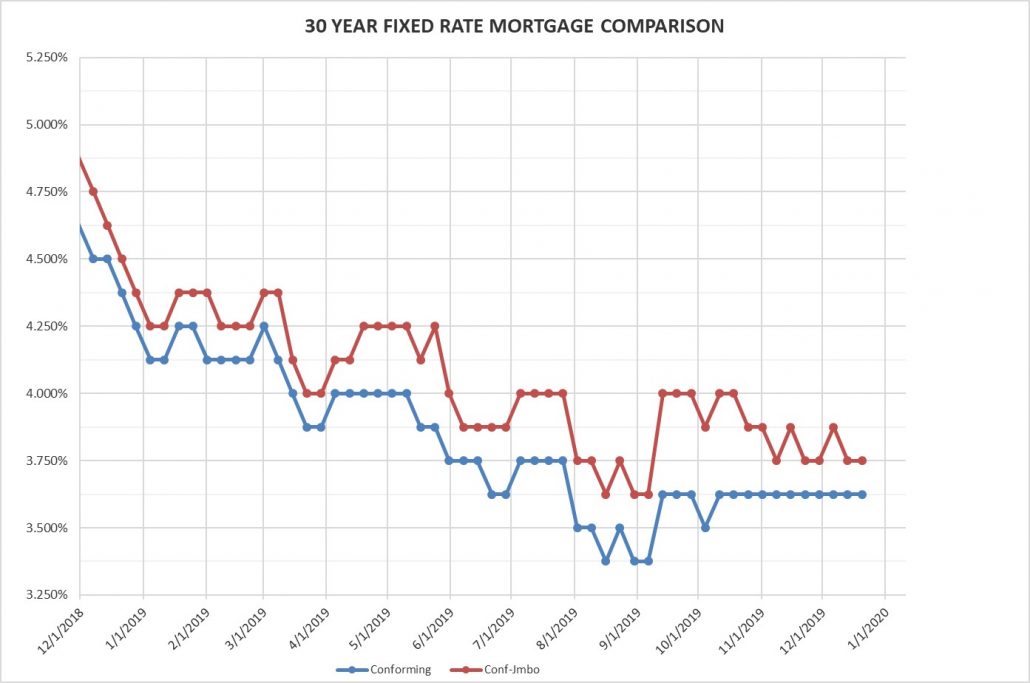
After a run up of one-half of one percent (0.50%) in the conforming 30 year fixed rate from the beginning of September to early October in 2018 rates began to fall as 2018 came to a close. The downward trend caused 2019 to open the year with the conforming rate used for the Friday rate in the WR&MU (30 year fixed conforming with 20% down purchase of a single family residence with a cost 1.25 points and a borrower FICO of 740) at 4.125%.
Rates bounced around between 4.125-4.25% through February, then in March rates declined to reach 3.875% for a few weeks before spending most of April and into May at 4.00%. In mid-May rates started to drop again until reaching 3.625% briefly to end June before spending July at 3.75%.
July ended with the largest Friday-to-Friday drop in conforming rates, one-quarter of one percent (0.25%) since October 3rd to October 10th 2014. Weekly Rate & Market Update readers will eidetic memory will recall that on the first Friday in August I was sending the WR&MU from Milwaukee, letting readers know that earlier in that week the Federal Reserve announced a reversal of its rate policy. In previous announcements the Fed had stated it would lower its Fed Funds rate by three-quarters of one percent (0.75%) in 2019, after four rate increases in 2018. Following its meeting in the final week of July, Fed Chair Powell announced that the rate drop that day would likely be the final rate change the Fed would make in 2019. Markets reacted by snapping up bonds and mortgages causing the extraordinary move down in mortgage rates that week.
Entering August, following the Fed rate move and announcement on July 31st, the conforming fixed stood at 3.375%, the lowest since November 2016. The historic lows lasted about three weeks, until the Fed went against Powell’s announcement in July and lowered rates again in mid-September and rates rose to 3.625%, where they have stayed every Friday but one (October 4th when we dipped to 3.5% for a few days) since. This is our tenth week in a row, and thirteenth of the last fourteen, that our conforming fixed rate has remained at 3.625% from Friday to Friday.
Summing up rates in 2019, they have dropped one percent (1.00%) since the start of the year and have been virtually unchanged for the last quarter of the year.
With rates being so positive for borrowers it is no surprise that housing markets in most of California and especially Southern California saw positive gains in values and transactions.
Using data from the California Association of Realtors from sales in November, the most recent month available, sales of single family residences across the state were up 5.6% from November 2018 and the median price went up 6.4% from $554,240 in November 2018 to 589,770 in 2019. Condos statewide also faired very well, up 7.3% in sales from a year ago and an increase in median price from $458,00 to $485,110.
More locally, Los Angeles County, despite seeing a drop in prices and number of units sold from October to November, had an increase of 5.1% in sales and a 7.4% jump in prices from $553,940 last November to $594,840 last month. Neighboring Orange County saw a decline sales from October and an increase in the median sales price, but also saw gains from last November in sales and prices. The median price in Orange County for a home in November 2018 was $795,000, after a 3.4% increase in prices the November 2019 median price was $822,000, the increase in prices was driven by a 6.9% increase in the number of sales.
Investors in the equity markets had a very good year in 2019. Whether an institutional investor managing pension funds or mutual funds, or workers with retirement accounts, or retirees receiving income from their accounts, everyone benefited.
As is frequently mentioned in the WR&MU, there is a strong relationship between equtity (stocks) markets and fixed-rate investment (bonds and mortgages) markets. Historically as the price of one goes up the price of others goes down. This year saw both fixed rate and equity markets see higher prices. (Refresher, when the price of bonds, and similar investments, go up their yields go down. So, when the price of Mortgage Backed Securities rise then interests go down.) As mentioned above, 30 year mortgage rates have dropped one-percent (1.00%) since January, which means the prices investors have paid for a 30 year fixed rate investment has gone up. The result was whether an investor had all their funds in equities or bonds, or a mix, they almost certainly saw a positive return through the year.
Investors were reacting with their consistent investing in all markets to an economy that has had incredibly consistent growth since the Great Recession ended in June 2009. Pushing the economy has been consumer spending, which has grown each month of the year with the exception of a dip in October from September. Consumer spending is 65-70% of our economy, if consumers continue to spend on goods and services our economy will continue to expand.
The expanding economy is directly related to the strongest labor market in decades. The year started with the unemployment rate at 4% in January, and for the rest of the year has declined to November’s rate of 3.5%. With the low unemployment rate has been a steady increase in wages, which outpaced consumer spending almost every month of the year through November. With wages increasing 0.54% in November from October, the annualized rate of increase in paychecks has been about 4% the first eleven months of 2019.
Workers have kept more of their paychecks as well as inflation has been at or below 2% month after month. With paychecks growing faster than spending and inflation the result has been that American families rate of savings has also been increasing.
None of the numbers showing growth in any sector in 2019 have been outstanding. Everything has grown in moderation, and has been for several years. Towards the end of 2018 and early in 2019 the “experts” were predicting that our economy would be in recession by now. Obviously they were wrong, in part because economists are very slow to change and most are still using old models and economic theories to try to predict future events.
Historically very low unemployment, raising wages, increase spending, leads to higher inflation which would lead to higher and higher interest rates. Our economy the past several years has bucked historical data. The constant economic growth has not resulted in high inflation and high rates. In large part because the growth has been so moderate.
As an analogy, think of a track meet. The fast race is the 100 yard dash. The runners go as fast as they can from the start and when they finish, they are completely spent, bent over gasping for breath and it takes a while for them to catch their breath and stumble around gasping. The middle distance runners start at a medium pace and then sprint to the finish line, they can run longer because they don’t push hard until the end. After their race the runners are tired and it takes a while for them to catch their breath. Marathoners run a very long distance at a measured pace, trying to keep their times per mile consistent to ensure they finish the race. When they are finished they are certainly very tired, all their muscles have been used and they are certainly in need of a rest, but do not appear to be gasping for breath as you see with the sprinters. Finally, we have the long distance walkers. Their strides look funny but their pace is quick and measured. When they finish their race they are also tired from their exertion, but their recovery is fairly quick compared to contestants in other events.
When an economy grows at a very fast pace over a short, or medium, period of time is it prone to falling quickly into recession and have that recession last for a long period time. When an economy grows strongly over a longer period of time it will generally shrink into recession slowly and the recession will not be as deep or long as the recession that comes quickly. When an economy grows very moderately over a very long period of time it does not have a lot of shrinking that needs to occur to enter recession, and when it does enter recession it will likely be shallow and short lived before recovery back to growing again.
I think the last statement is true because we have never had an economy grow for so long at such a measured pace benefiting so many sectors of the economy. Theoretically, the less an economy needs to lose to enter recession the less the damage to the economy as it shrinks and is in recession, therefore the less repair needed to pull out of the recession.
Because of the pace and breadth of growth in our economy, I feel 2020 will see more of the same, with moderate growth in GDP, wages, spending and inflation. The greatest risk to our economy entering a recession, in my opinion, is outside influences, such as a major recession in China or Europe.
Home prices in California should continue to grow at a modest pace and rates should continue to be below, or near, 4% for the coming year.
Next week: What happened this decade? A look back at the 2010’s in mortgages, real estate and other areas that impact housing.
Have a question? Ask me!
Rates for Friday December 20, 2019: The positive economic news this week would normally put upward pressure on rates, but investors are perhaps reflecting on the Fed stating no intention to raise rates in not reacting as expected. This time of year is weird with holidays in the middle of the week, senior traders and fund managers taking time away from the office leaving their juniors at the desks with the instructions, “don’t mess up,” which leads to conservative actions—like moving money into cash. As well, many may be selling some holdings to take some capital gains which could lead to drops in market prices over the next five or six trading days in 2019. Rates are flat from last week.
FIXED RATE MORTGAGES AT COST OF 1.25 POINTS LOCKED FOR 45 DAYS:
30 year conforming 3.625% Flat
30 year high-balance conforming 3.75% Flat
Please note that these are base rates and adjustments may be added for condominiums, refinances, credit scores, loan to value, no impound account and period rate is locked. Rates are based on 20% down with 740 FICO score for purchase mortgages.
A very exciting few days for the Smith home as our oldest comes home this afternoon from Boston. We haven’t seen her since August and looking forward to a few weeks with her before she’s off to Grenoble, France for her next semester. Her arrival is the best birthday present Leslie will receive for her big day tomorrow—which will be a “Leslie Day” as we do her favorite things, see the new Star Wars movie, having Mexican food for dinner and then going to Color Me Mine to chat and do a crafty project. She loves all three, Star Wars, Mexican food and crafts.
I hope Santa is nice to you all, filing your stockings with joy, love and friendship.
Have a great week,
Dennis
Past Weekly Rate & Market Updates can be found on my blog page at my website www.DennisCSmith.com/my-blog