What is title insurance and why do we need it?

Question of the week:  What is title insurance and why do we need it?

Over the past few weeks I have had several questions regarding the various insurances involved in a real estate transaction. I have decided the best way to address the questions for the next several weeks to have a series on insurance in the Weekly Rate and Market Update, this series will cover home warranty, homeowners’, title, mortgage, and finally mortgage life/disability insurances.

Answer:  Title insurance is the least understood insurance products homeowners pay for as part of a real estate transaction.

In very simple terms title insurance protects your ownership. In a real estate transfer transaction, the title insurance policy will ensure, and insure, that when the transfer occurs you will have “clear” title. In a transaction where a new mortgage is being filed as a lien against the property a title policy will cover that the liens known at the time of closing are the only liens against the property.

Let’s dig a little deeper. Using a sale transaction in which the buyer is obtaining a mortgage will give us a chance to look at the two title policy premiums paid in the transaction.

The two title policies issued in a typical real estate sale transaction are a ALTA (American Land Title Association) policy and a lender’s title insurance policy. Of the two the ALTA policy is more expensive and is paid by the seller, the lender’s policy is lower cost and is paid by the buyer. It should be noted, that title premiums are paid one time, at closing, and are not recurring like your auto or homeowner’s insurance premiums.

Side note, when refinancing your new lender will require a lender’s policy, which is generally at a reduced rate as you have previously paid for a lender’s policy on the mortgage being refinanced.

The ALTA policy covers the title. During the escrow period the title company is researching the history of ownership for the property and when it issues its policy it is protecting the new owner against any claims against the title. The title company is claiming that the title is “clear” or “unclouded,” and that you own the property. If the property had gone through probate in the past, or previous owners had divorced, perhaps the property had been created through the result of dividing a larger parcel of land, the ALTA policy protects your title against any claims from prior heirs, spouses or developers who file a claim because an attorney or a clerk made errors in the transfer. If there is a claim, the title company will cover legal bills and any costs to cure to ensure you retain title.

The ALTA policy also protects your title as to the stated boundaries, who has access and other matters that may impact your enjoyment of the property. When you are purchasing a property, you will receive a preliminary title report that will list all the current liens against the property, such as the current mortgage(s), taxes, if there are any mechanics liens or claims by tax authorities beyond the standard property taxes payable to the county. It will also provide the legal description of the property, which will determine the lot lines that define the land you will own. Easements will be listed as well. An easement is permission that is granted to others to access the property, for instance an easement for power lines, or an easement for a neighbor to have access to five feet along the eastern border of the property for a driveway to their home, and parcel, located behind your home from the road. In many Southern California cities, there are easements for the city for the alley that runs behind your home.

When you move into your new home and discover that the fence between you lot and your neighbor’s is four feet on your lot you can contact your title company and tell them the issue. They will then initiate an investigation and if there is any cost to cure, including legal fees, the title company will cover the costs.

If you are the buyer the lender’s policy you pay for protects your property from any undisclosed liens. The lender desires this policy so its claim to title in the event of foreclosure is not subordinated to another claim. Suppose the current owner of the property went through a remodel or renovation. Early in the project there was a dispute with a contractor not doing the work properly, or abandoning the project. The homeowner fired the contractor and engaged a new contractor who completed the job. Three years later as the property is in escrow the original contractor files a mechanic’s lien for money he feels is owed for the work he put into the property. The lien is filed and not caught by the title company before closing.

A few years after closing you decide to get an equity line of credit using your home as collateral. The title company, that you obtained a policy from when purchasing the home, is notified of this mechanic’s lien. They investigate and determine the claim is not valid, but re-issue a new policy for you to complete your equity line transaction and they deal with the contractor and the mechanic’s lien issue.

Title policies are not just for when purchasing or refinancing a home. Many attorneys recommend that ALTA policies are obtained when property transfers through probate, a transfer through a trust or inheritance, or divorce.

Having a title claim is extremely rare, so rare that in over thirty years in the industry I can recall only four such instances. That said, when there is a title claim it is very expensive to resolve the issue and it can take a very long time—which ties up the ability to engage in any transaction with the property until the issue is resolved. Because of this cost to cure title issues, the premiums paid for policies when purchasing or refinancing are worth the cost…just in case.

Next week we will discuss mortgage insurance and what it covers.

Links for prior posts in our insurance series:

Home Warranty Plans

Homeowner’s Insurance

Have a question? Ask me!

Looking for good and bad in the September employment report released this morning by the Department of Labor we find a bit of both. The economy added 136,000 jobs for the month, and hiring numbers for July and August were increased by 45,000 jobs. The headline unemployment rate dropped to 3.5%, the lowest since December 1969. Those are positives. Less than positive is that hourly wages did not increase in the month and shrank in overall growth on an annual basis from 3.2% to 2.9% growth. As well, manufacturing and retail sectors saw a net loss in jobs. Overall the news is news is negative for lower mortgage rates as it takes off the table a Fed drop in rates this month and shows a the labor market is still growing and employing more Americans.

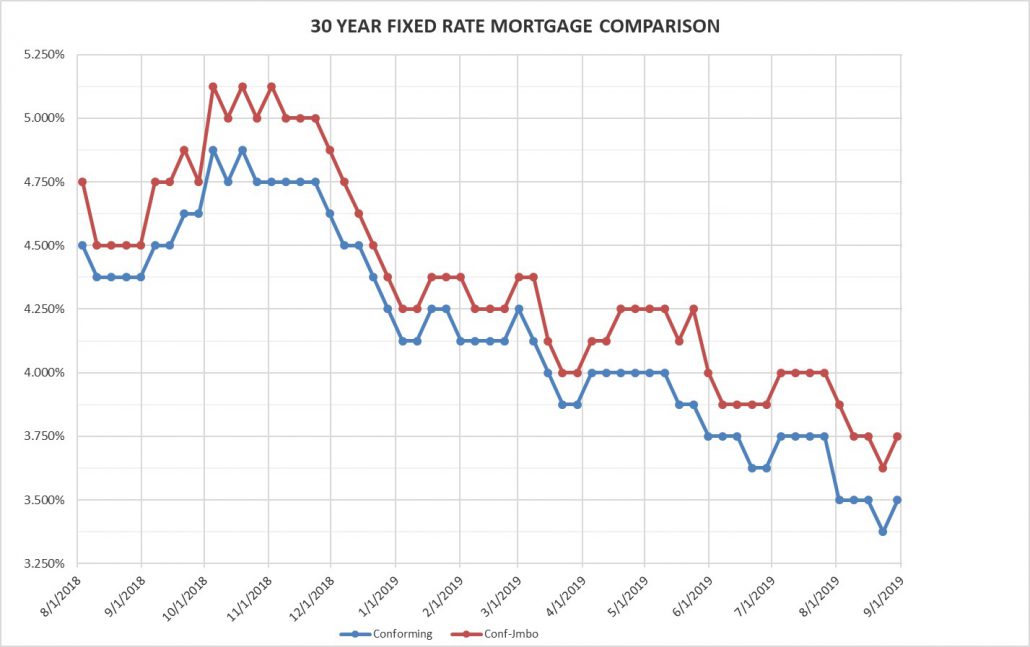
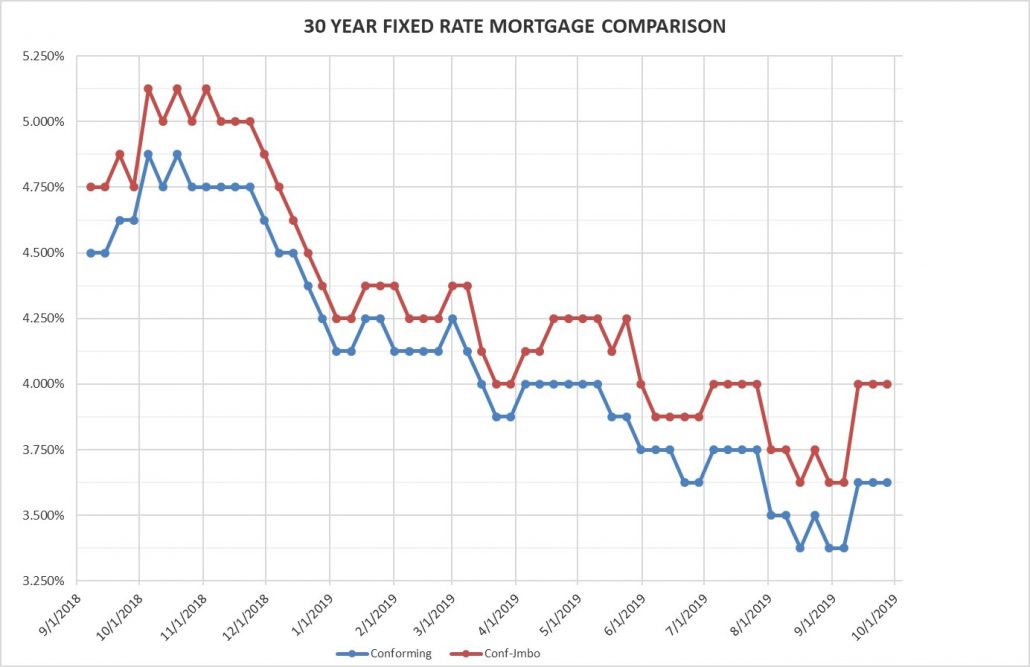
Rates for Friday Ocotber 4, 2019: The mortgage markets have slowly been clawing back from the spike in early-September. While rates have been pretty flat since the spike, prices of Mortgage Backed Securities (MBS, which determine rates) have been slowly climbing—putting downward pressure on rates. When this market movement occurs lenders are very slow to lower their rates until they see a trend, which is what has happened this week. Lenders have pushed rates down a tad, our first weekly drop since August. Is this a new trend or a one-off this week? We won’t know for several weeks.

FIXED RATE MORTGAGES AT COST OF 1.25 POINTS LOCKED FOR 45 DAYS:

30 year conforming                                            3.50%     Down 0.125%

30 year high-balance conforming                    3.875%   Down 0.125%

Please note that these are base rates and adjustments may be added for condominiums, refinances, credit scores, loan to value, no impound account and period rate is locked. Rates are based on 20% down with 740 FICO score for purchase mortgages.

Frequent readers know that earlier this month Leslie and I celebrated our 25th anniversary and a few weeks ago our daughter’s 20th birthday. This past Sunday, September 29th, Stratis Financial also turned twenty! It does not seem that long, but then we start working with our clients’ children, in some cases grandchildren, and it twenty years makes more sense.

We have been so fortunate to have so many wonderful referral partners who have entrusted us with their clients’ business, and of course thousands of families who let us help them purchase or refinance—or both—their homes and investment properties. At the heart of it all is the wonderful people who work so very hard, and smart, to ensure our clients receive the best in service and care.

Thank you to everyone who has supported Stratis Financial with your referrals and business for the past twenty years!

Have a great week,

Dennis

Past Weekly Rate & Market Updates can be found on my blog page at my website www.DennisCSmith.com/my-blog

What is difference between homeowners, hazard and fire insurance?

Question of the week:  What is the difference between homeowners, hazard and fire insurance?

Over the past few weeks I have had several questions regarding the various insurances involved in a real estate transaction. I have decided the best way to address the questions for the next several weeks to have a series on insurance in the Weekly Rate and Market Update, this series will cover home warranty, homeowners’, title, mortgage, and finally mortgage life/disability insurances.

Answer:  Nothing. Well, technically there are separate policies that cover loss due to fire, other hazards and protection of personal property. Less technically, in our industry any of these can refer to the insurance that covers your home, and possessions, and if you have a mortgage is required.

Since your home is the collateral for your mortgage the lender will require that the collateral is insured to protect the loan. Because of this, as part of the closing of your mortgage you must have sufficient coverage with a homeowners’ policy to either payoff the mortgage or rebuild the property if it burns down.

Most homeowners’ policies besides protecting for property damage or loss also have liability coverage, in case the neighbor’s kid climbing your orange tree to pilfer fruit falls and breaks his leg, and personal property such as furniture and jewelry, covered should it be damaged or stolen.

Insurance carriers tend to offer discounts on premiums if you bundle policies; when calling for quotes and coverage options also ask what the premiums will be if the insurer also handles your auto insurance.

Before calling your insurance agent and saying, “I need a homeowners’ policy…” make sure you are asking for the right amount of coverage. There is a formula that is used for the minimum required coverage based on the appraisal of the property and the “cost to rebuild new” amount located in the report. It is also important to note that you do not want your policy to cover the purchase price of your home. A very large percentage of your home price is the land, dirt does not burn so you should not insure it.

Two other property protection coverages that are available are flood insurance and earthquake insurance. Do you need them? Should you get them?

It is important to note that standard homeowners’ policies do not cover “water from below,” i.e. rising water, flood policies do. Flood insurance is required for borrowers with mortgages in designated federal flood zones. Flood insurance is very expensive, because of this most homeowners do not get flood insurance unless it is required. Some winters in Southern California we get a lot of rain and flooding occurs. If you are in an area that is prone to flooding and is not in a flood zone you may consider obtaining a policy if abnormal amounts of rain are forecast for any particular winter, and then cancelling the policy once the rain season is over.

Earthquake insurance is not required by lenders. This means that if you have earthquake insurance you should not put your lender on the policy as loss payee—meaning that the lender has no input on what you do with the proceeds from your earthquake policy if you need to collect on the policy. Earthquake policies have very high deductibles, and premiums. If you do not have a lot of equity in your home you may not benefit from an earthquake policy—your deductible could be more than the equity in your home. If you have a lot of equity in your home you should give serious consideration to obtaining an earthquake policy to protect your equity.

Next week we will discuss title insurance and what it covers.

Links for prior posts in our insurance series:

Home Warranty Plans

Have a question? Ask me!

Home sales were mixed in August, per the monthly housing report released by the California Association of Realtors. Statewide the median price is up 1.5% from July and up 3.6% from last August at $617,400. The increase in price was partly responsible for sales volume to be down in the state 1.3% from July, but overall sales were up 1.6% from 2018. In Southern California, the two major counties showed mixed results in August. In Los Angeles County sale were down 0.8% from the prior month and down 1.5% from last year. The median sale price in LA County of $627,690 in August was 2.7% higher than July and 3.3% from last August. In Orange County, the median sales price was down 3.5% from July and 3.4% for the year at $810,000. Sales in the OC dropped 7.0% from July, but were up 2.1% from 2018. Prices and sales are choppy in the region from one neighborhood to another, one city to another and one price range to another, showing no clear market direction one way or the other.

Looking for direction, C.A.R. released its 2020 housing forecast for the state, and it is a bit optimistic predicting home sales to increase 0.8% statewide for the year and the median home price to increase 2.5%. This forecast is consistent with estimates of GDP growth in 2020 to be less than 2% for our national economy—continuing the consistent but not booming growth of the past decade.

Which leads to Thursday’s release of the final estimate of our national economic growth for the 2nd quarter of the year, also known as the Gross Domestic Product. The final revision of GDP was unchanged from prior estimates with 2% growth for the quarter. Consumer spending was strong in the quarter, up 4.6% from the prior quarter, but the household spending activity was dampened by the trade conflict with China and reduced investment from businesses. Overall the news had little to no impact on rates as the 2.0% growth was the expected estimate.

Digging into the economy, today data on personal income and spending was released along with inflation figures, for August. Consumer spending increased 0.1% in August, the lowest increase in six months. The almost zero growth in spending can be partly attributed to the spending spree consumers went on in July, or it could be a signal that they are wary for the future; we will know when September spending data is released in a month and how much was spent on back to school supplies. Spending was definitely not impaired due to paychecks. Income increased in August by 0.4%, matching the gains in five of the past six months. With incomes far outpacing spending it is no surprise that there was a surge in the savings rate, up to 8.1% for the month. Also not posing a barrier to consumers was prices as the Fed’s benchmark inflation metric, the PCE (Personal Consumption Expenditures) rose a scant 0.1% for the month and prices have gone up only 1.4% from last August—well below the 2.0% target for the Fed. Overall the news is mortgage rate neutral, the spending and inflation data are positive for rate decreases and the income increase is slightly negative.

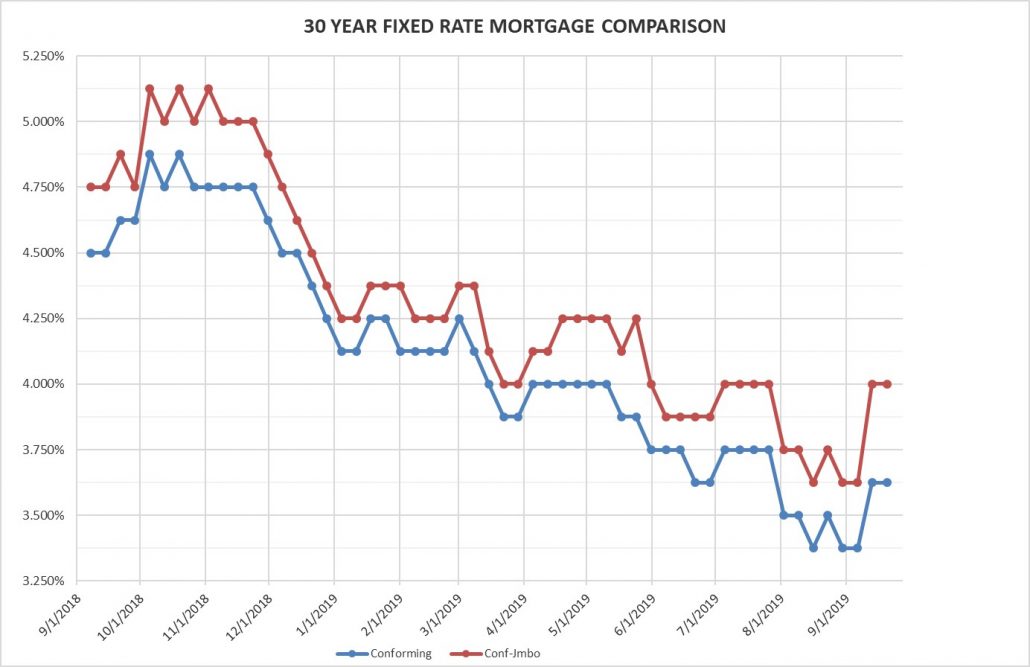
Rates for Friday September 27, 2019: Several factors impacted rates this week, among them the Federal government selling $133 billion in debt this week—increasing supply of fixed rate investment opportunities which compete with mortgages, thereby if not pushing rates up some at minimum not enabling them to drift down. Politics influences rates and the circus in Washington has investors wondering which way the market winds will blow adding uncertainty to the stocks or bonds decision, resulting in many sitting on the sidelines. Despite all this, once again, we finish the week flat from the prior Friday after gyrations through the week in the rate markets. Since rates popped up a quarter of a percent (0.25%) three weeks ago they have tried to go lower, and higher, with neither direction showing any momentum.

FIXED RATE MORTGAGES AT COST OF 1.25 POINTS LOCKED FOR 45 DAYS:

30 year conforming                                            3.625%     Flat

30 year high-balance conforming                      4.00%       Flat

Please note that these are base rates and adjustments may be added for condominiums, refinances, credit scores, loan to value, no impound account and period rate is locked. Rates are based on 20% down with 740 FICO score for purchase mortgages.

I love fall, or autumn if you prefer. Growing up in other parts of the country and abroad fall was a bit more noticeable than it is in Southern California—after all palm tree fronds do not change color with the season and our fall temperatures rarely call for more than a light jacket. I like the cooler temperatures, I like the foliage, I like the late afternoon sunlight and I really like that until the end of next month all the major sports are in action! Playoff baseball and the college and pro football seasons hitting their stride make for great opportunities to get together with friends and neighbors on the weekends to root for your teams and enjoy each other’s company over crocks of chili and perhaps an adult beverage.

Are you a fall person? Summer? Spring? Winter? There is a season for everyone!

Have a great week,

Dennis

Past Weekly Rate & Market Updates can be found on my blog page at my website www.DennisCSmith.com/my-blog

What is a Home Warranty Plan?

Question of the week:  What is a Home Warranty Plan?

Over the past few weeks I have had several questions regarding the various insurances involved in a real estate transaction. I have decided the best way to address the questions for the next several weeks to have a series on insurance in the Weekly Rate and Market Update, this series will cover home warranty, homeowners’, title, mortgage, and finally mortgage life/disability insurances.

Answer:  In Section 7, Part D, subsection 10 of the California Association of Realtors Residential Purchase Agreement and Joint Escrow Instructions (aka the Offer) the buyer has the option of checking whether, as part of the terms of the offer to purchase the property, the buyer or seller shall pay costs not to exceed a certain amount for a one-year home warranty plan. The section also contains a place for the buyer to indicate which company shall issue the plan and what additional coverage beyond “normal” the warranty may cover, such as air conditioning or pool equipment. If the buyer does not complete this section the next clause on the purchase agreement form is checked, which is an acknowledgement that the buyer is waiving the purchase of a home warranty plan.

As a side note, congratulations to the home warranty industry for have their product embedded into the contract used for almost every residential purchase in the state.

Back to our question, what is a home warranty plan? It is essentially an insurance policy that covers a lot of things a homeowners’ policy will not cover if something needs repair or replacement. Appliance, electrical and plumbing systems, if there is an issue and you have a home warranty plan, contact the carrier, let them know the issue and they will send someone out to repair or fix the issue.

From dripping sinks and clogged pipes, to burned out water heaters, to faulty central heating and air, if you have a home warranty plan in place the chances are you are covered for repair or replacement. Most plans will not cover roofs and leaks from above or below, nor flooring, walls or built-ins like cabinets.

The cost of the plan depends on the service call fee you choose for a professional to come out and either fix or replace the issue. This is like a co-pay for health insurance. The lower your co-payments per visit to a medical professional the higher your premium will be; the same for home warranty plans, the higher your service call fee the lower your annual, or monthly, fee will be for the plan.

It is important to note that you do not need to be purchasing a home to obtain a home warranty plan. Nor do most home warranty companies require a home inspection prior to issue a coverage plan. If you have lived in your home for two, five, fifteen years or longer you can obtain a home warranty plan that covers your appliances and systems.

It is important to note that the professionals who are dispatched to inspect and correct your issue are contracted to the home warranty company, you cannot choose a local plumber or electrician that you have worked with before to correct the issue and then bill the home warranty company.

Over the years I have had clients rave about having home warranty coverage and those who have had poor experiences due to the quality of the service professionals dispatched for issues needing fixing.

Before purchasing a plan I suggest you do some research. Contact your real estate professional and ask which companies that have generated positive or negative experiences with clients. Go on-line and research the various companies available and search for reviews—keeping in mind most people bothering to post reviews on-line tend to do so to vent about a negative experience. What are the prices, service call fees and coverages for the different plans from different companies, and what do you feel you need for your home?

One final note, home warranty plans are not just for owner-occupied homes, if you have a rental property there are coverages available to cover the wear and tear that occurs over time and use.

Next week we will discuss homeowners’ insurance and what it covers.

Have a question? Ask me!

Rate cut no surprise. On Wednesday, the Federal Reserve Open Market Committee (FOMC) voted to cut its benchmark interest rate by one-quarter of one percent (0.25%). This action was expected and had been priced into all the financial markets weeks ago. Most rate moves by the Fed are expected so it is the details of the meetings that are market movers as investors try to anticipate the Fed’s next move by what was news comes out of the FOMC meetings.

What we may have learned from the information released Wednesday is that the FOMC is divided. The vote to lower rates was not only not unanimous but had three dissenting votes; the first time in three years there have been three “no” votes for the committee. Two of the negative voters did so because they felt there should be no change in rates; the third voted “no” because he felt that the 0.25% rate cut was not enough and the cut should have been 0.50%. What does this mean for future actions by the Fed? Complicating the answer is that seven of the twelve members of the FOMC say they anticipate one more rate decrease this year. Since that would be a majority of the voting members the expectation is for one more rate cut. This meets expectations from earlier in the year, three rate cuts between August and December, and a future rate cut is pretty much priced into rates.

Rates for Friday September 20, 2019: This was another volatile week for mortgage rates as the Mortgage Backed Securities (MBS) prices fluctuated quite a bit every day—especially on Wednesday following the Fed announcement. Over all for the we end up very close to where we were last Friday despite a spike in rates on Monday that slowly disappeared through the week. The charts show that MBS prices may be approaching an interim high (higher prices mean lower rates), which portends a possible up tick in rates again in the next few days. The market is volatile, my advice is do not float your rate, lock it when you can through your escrow period.

FIXED RATE MORTGAGES AT COST OF 1.25 POINTS LOCKED FOR 45 DAYS:

30 year conforming                                            3.625%     Flat

30 year high-balance conforming                    4.00%       Flat

Please note that these are base rates and adjustments may be added for condominiums, refinances, credit scores, loan to value, no impound account and period rate is locked. Rates are based on 20% down with 740 FICO score for purchase mortgages.

My personal note this week is a challenge. On the one hand I acknowledge our oldest turned twenty yesterday—I guess that makes sense since Leslie and I just celebrated our 25th, but while I recognize her as being 20 I still see the little girl and probably always will.

On the other hand, after I finish writing the WR&MU this week and post it to my webpage, Facebook and LinkedIn I will be attending a funeral for an incredible woman who has done so much for our community, mostly behind the scenes and without wanting much attention for what she has done. The everyday role models are the ones that I want for my daughters. Not the Oprahs, or Michelles, or Taylors, but the strong women who live and work in our community who take the time from themselves and their families to help others. That was Connie who will be mourned and celebrated later today. She was always smiling, and raising her hand to say, “I can help with that.” And she did help, a lot. So many people in our community are just that much better off because Connie rose her hand, and they never know this is the case or her name.

The wonder, beauty and experience of life is the juxtapositions of joy and heartache amongst other emotions and experiences.

Call or visit someone you haven’t seen or spoken to in a while, say hello and say thank you for being them and letting you be you.

Have a great week,

Dennis

Past Weekly Rate & Market Updates can be found on my blog page at my website www.DennisCSmith.com/my-blog
Did I miss it; did I miss the bottom for rates?

Question of the week:  Did I miss it; did I miss the rates bottom?

Answer:  Maybe.

As you will see below rates this week went up the most in one week since the week ending October 5, 2018. When rates climbed at the end of last September they ended up peaking for about a month before we had a long slide down (down every Friday for five of six weeks).

Rate increases this sudden and this high are rare but they do happen. Why? Usually rates jump up on very positive economic news, political news, or a geopolitical event. This week the trigger for the rate jump appears to be the nice-nice talk between China and the United States on tariffs and trade agreements. This made investors positive about American businesses and removal of a drag on the economy and they left the safety of bonds and mortgages and bought equities, i.e. stocks in corporations.

Further pushing rates higher was today’s news that August was a very strong month for consumer spending as retail sales climbed 0.4% with a very large 1.8% increase in vehicle purchases. Consumer spending is 65-70% of our economy and if the cash registers continue to ring at a growing pace the economy will grow as well.

Also in the reports today was that hourly earnings are up 3.2% year over year, well above inflation which provides support for continued consumer spending.

All this good news in negative for lower rates for several reasons, primarily they show an economy that would be further away from the recession many pundits and media outlets have been used to fill the airwaves, interwebs and newsprint. Secondly, the potential of the trade war with China cooling down adds more support to pushing out any possible recession even further.

Currently the mortgage markets have priced in a rate cut of 0.25% by the Federal Reserve when it Open Market Committee meets, what is uncertain is whether there will be more rate cuts later this year. The economic and political news is making further cuts somewhat more unlikely—which investors have also been reacting to as some have been making decisions based on at least one further cut after next week.

If, for some reason the Fed does not cut its benchmark rate next week be prepared for another spike in rates.

So, did you miss the bottom? For the short term it appears that it is likely you did. For the medium term the answer is unknown as the current spike could be a sell-off to protect profits, in which case they will slowly move back to bonds when they feel equity markets are peaking, or near peaking.

All that said, even if you missed the bottom rates are really, really good. The current rates are where they were in July, which were near multi-year lows. If you have been considering making a purchase or refinance for the bottom of the market, you may want to consider doing so from the perspective of rates bouncing off what may have been the bottom.

Have a question? Ask me!

Typically this section of the WR&MU covers what is happening in the economy that impacts rates, today that was the first section!

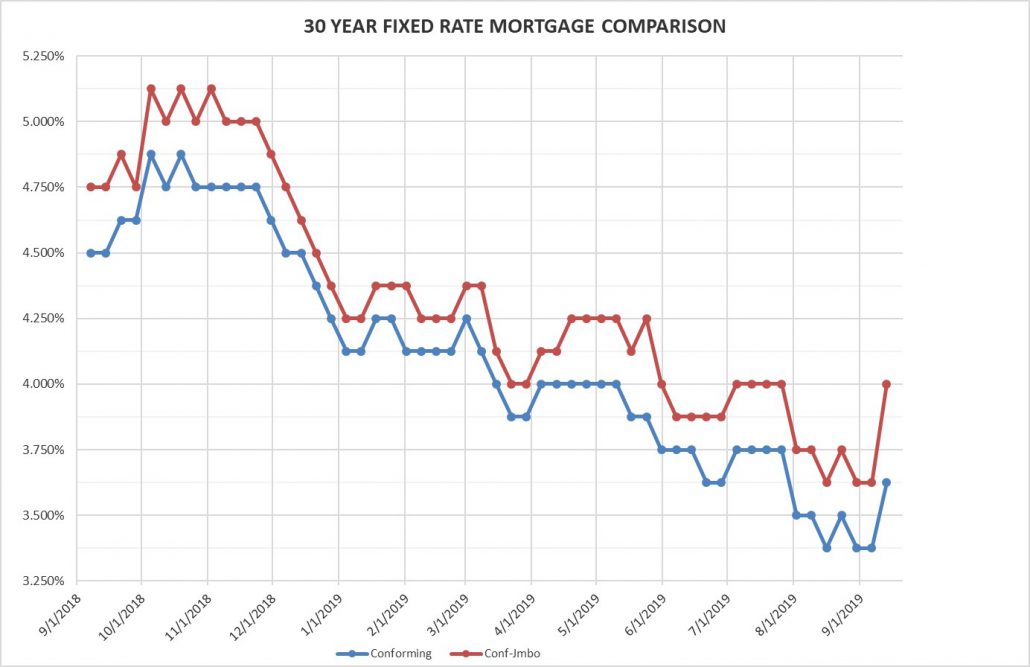
Rates for Friday September 1, 2019: We will see over the next week or two if the spike in rates is a blip or a trend. I suggest not floating your rate and locking when you are able to avoid further rate loss should rates bump up more.

FIXED RATE MORTGAGES AT COST OF 1.25 POINTS LOCKED FOR 45 DAYS:

30 year conforming                                            3.625%     Up 0.25%

30 year high-balance conforming                     4.00%       Up 0.375%

Please note that these are base rates and adjustments may be added for condominiums, refinances, credit scores, loan to value, no impound account and period rate is locked. Rates are based on 20% down with 740 FICO score for purchase mortgages.

Thank you to everyone who sent happy anniversary issues to us last week. We had a great time scheduling nothing to do every day and knocking that important item off our to-do lists!

Have a great week,

Dennis

Past Weekly Rate & Market Updates can be found on my blog page at my website www.DennisCSmith.com/my-blog

Vacation Update

Question of the week:  No question this week…why?

Answer:  As mentioned in last week’s WR&MU, Wednesday was our 25th Anniversary, which we celebrated in Kauai. We are still here, having arrived on Sunday and leaving for home this Sunday, enjoying much of nothing but relaxing—and a few phone calls and emails mixed in, we are both self-employed after all!

For those concerned, which is sweet of them, about my/our working while on vacation, two factors. One, for those who have seen me, my pallor is somewhat to the very light sight so tropical sun must be taken in doses—no sitting pool side with no cover for hours and hours. Therefore, some sun relief time in our lodgings is needed so a bit of time checking in has no adverse impact on my relaxing. I will an endorsement for Coppertone 30 which through the week has done a great job maintaining my near translucence over most of my exposed skin. Two, if something is going on with a client or transaction and I am not checking in I relax a whole lot less wondering what is happening, formulating solutions and general concern than if I am aware and engaged, even if minimally.

We are back late Sunday night and booted-n-suited for the office Monday morning.

Have a question? Ask me!

Who says? Today the Labor Department released the jobs data for August which showed 130,000 net gain in employment across the country. Since this number is lower than expectations, and July’s job increase, some (many) pundits are saying the news supports the Fed cutting rates later this month. Not factored into this analysis are a few factors. In seven of the last ten years the August job forecast was higher than actual data by 43,000 jobs. August tends to be the lowest month for the job survey as many respondents are on vacation. An estimated 571,000 people entered the job market in August and 590,000 found work, an 18 month high in this data bracket. Finally, jobs are filled where there are available vacancies, wages rise when there is more demand for workers than workers available. Average hourly earnings increased 0.4% for the month and are up 3.2% year-over-year, well above the inflation rate of 1.2% last reported.

But…Yes, but…I have had a few regular readers of the WR&MU argue that I seem to be an apologist of a weakening economy because I find contrary data in the reports that are not addressed by many (most) commentators, or if they are the information is buried in the story. My position has been and remains that the economic data shows an economy that is growing at the same measured pace for a decade, not big peaks and no big valleys. If a marathon runner averages nine minutes a mile the first half of the race and nine and a half minutes a mile the second half are they weakening or sustaining a pace that will last over a long distance? That is what has happened with our economy the past decade, the pace of growth has been extremely steady, and constant. I continue to maintain that the Fed should leave rates alone due to the strength in the labor markets and continued consumer spending which are more inflationary than not.

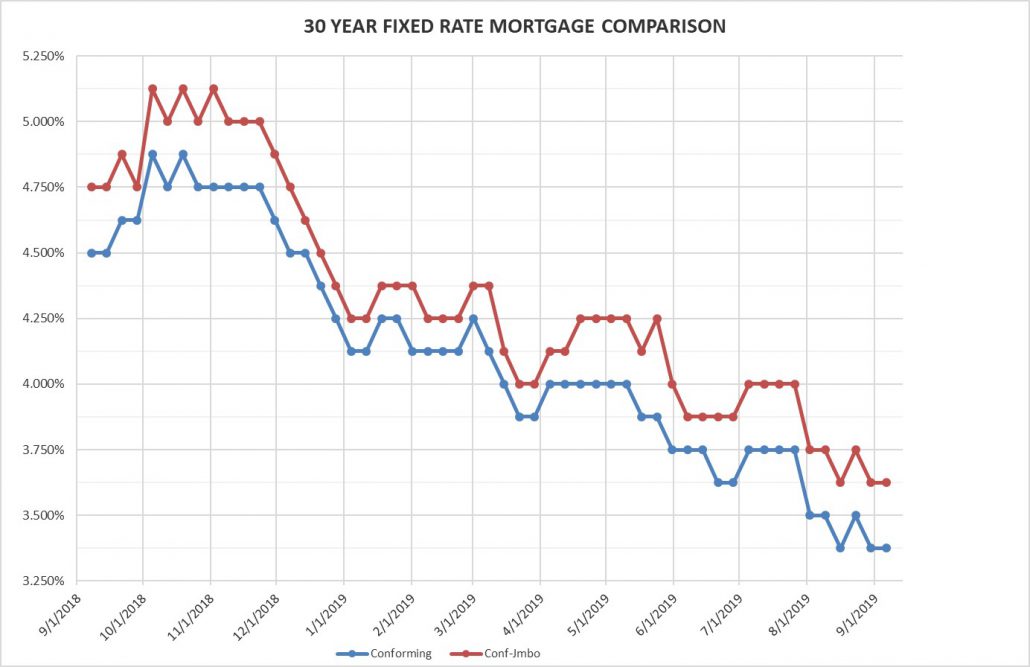
Rates for Friday September 6, 2019: Rates hold constant from last Friday. The speculation that the Fed will lower rates later this month has been priced into the markets some time ago and today’s data does not impact rates.

FIXED RATE MORTGAGES AT COST OF 1.25 POINTS LOCKED FOR 45 DAYS:

30 year conforming                                            3.375%     Flat

30 year high-balance conforming                    3.625%     Flat

Please note that these are base rates and adjustments may be added for condominiums, refinances, credit scores, loan to value, no impound account and period rate is locked. Rates are based on 20% down with 740 FICO score for purchase mortgages.

Off to sit by the pool, perhaps go to the beach, maybe have a beverage or two…Aloha…

Have a great week,

Dennis

Past Weekly Rate & Market Updates can be found on my blog page at my website www.DennisCSmith.com/my-blog
When can we, should we, refinance

Question of the week:  When can we, should we, refinance?

Answer:  A very popular question recently and it was part of a lunch discussion I had yesterday with two friends.

As for “when” you can refinance, there is no time limit. I say that with some trepidation as many lenders are faced with stiff penalties from the lender being paid off if the payoff is too soon after the close of the loan. Unless you have a pre-payment clause in your contract that has a fee if you payoff before a certain date you can refinance when you are able.

It should be noted that if you are paying off and closing a Home Equity Line of Credit (HELOC—see below for more details on refinancing HELOCs) with your refinance you may face an “early closure fee,” the amount and time limit for such a fee varies from lender to lender.

As to the “should” you refinance, it depends…does it “make sense” for you?

There are two types of refinances, rate and term or cash-out.

A rate and term refinance is one where you are not pulling any money out of the property and are refinancing to reduce your monthly payment, change the terms of the loan from an adjustable to a fixed rate or possibly from a 30 year to a 15 year or vice-versa, or possibly reduce the monthly payment and eliminate mortgage insurance—in some cases lower the monthly payment on mortgage insurance if it cannot be eliminated.

The most common refinance is a rate and term refinance from one 30-year fixed rate mortgage to a new 30-year fixed rate mortgage. For these types of transactions, the “make sense” filter we use is what is your tangible benefit? Will your monthly payment decrease by 5% or more? What will be the total cost of the refinance divided by the monthly savings, is it less than 3 years?

Many reading the last sentence are thinking, aren’t there ‘no cost’ refinances?

Everything has costs, including “no cost refinances,” the question is how are the costs paid in a no cost refi? In the March 29, 2019 Weekly Rate & Market Update we answered the question, “Do we have to pay closing costs?” I do not want to recap the entire answer, but briefly closing costs for a refinance can be paid by adding to the loan amount, your bringing funds to escrow to pay them, or by your taking a higher interest rate and the lender will pay them, or a portion some or all of these options.

What if you want to convert your 30 year mortgage to a 15 year mortgage? This is a refinance some homeowners like to consider prior to retirement so they will have their home paid off when they retire, or shortly thereafter. The decision is usually not as easy to make as it is when refinancing from one mortgage to another that has the same term because a 15 year mortgage will have a much higher monthly payment than a 30 year mortgage. Is it worth the costs to refinance to a mortgage with a higher payment, or does it make more sense just to make larger payments on your existing mortgage—or to put extra money into savings and investments and use those funds to pay down or assist on payments when you do retire?

For a rate and term refinance the answer to “should we refinance” is very easily answered with math and the assistance of my trust HP12C calculator to determine your new payments and comparing them to your current payments.

Cash-out refinances involve a different set of circumstances and therefore the decision is usually a bit more challenging.

Why would someone take cash-out of their property? There are many reasons, payoff debt, gift children money to purchase their own home or for college, buy-out a partner in the property or a business, use for remodeling, or perhaps for down payment on a second home or income property.

One form of cash-out refinance is paying off a HELOC*. The guidelines for conventional mortgages (Fannie Mae/Freddie Mac) are that unless the HELOC, or other 2nd lien, was used to purchase the property a refinance that includes paying off a HELOC is considered “cash-out.” For many jumbo programs, if you have not accessed the line of credit in the past 12 months they will consider the refinance a rate and term transaction. Note that many jumbo lenders will loan down to the conforming loan limit plus one-dollar (total $484,351) so homeowners with a high-balance loan amount can benefit from the more generous jumbo guidelines if paying off a HELOC that has not been accessed for a year or more.

Does it make sense to refinance to consolidate your HELOC into a one mortgage with your current primary mortgage? It depends on the math, your comfort with likely having your payment increase, how risk averse you are to potential/probable higher rates on the HELOC in the future and your ability, willingness and actions in paying down the HELOC.

A typical transaction on a refinance to payoff a HELOC can look like this. A couple have a home worth $650,000 and have a primary mortgage of $350,000 at 3.75% that was $400,000 when they bought the home and has a payment of about $1800 per month. They have a HELOC with a $100,000 balance that was used to remodel their kitchen, the rate is currently Prime (5.25%) plus 1.5% for a rate of 6.75%. The payment on the HELOC is interest only, about $560 per month. Every month they intend to make payments to pay down the balance but never really do. Should they refinance?

If they get a 4.25% rate (a sample rate, not today’s rate which may be higher or lower depending on many factors) for a $450,000 mortgage ($400,000 primary + $100,000 HELOC), the payment would be about $2215 per month. Currently the couple is paying $2360 per month with no reduction in the HELOC balance—this makes sense.

But what if the math was different, they are paying $2500 per month now and a refinance would be $3000 total per month, does that “make sense?” Now we discuss with the client how comfortable they are with the adjustable aspect of the HELOC, when and how they intend to pay off the balance. Eventually the HELOC will no longer be interest only and be amortized over a ten or fifteen year period (much higher payments) or a balloon payment will be due and it will need to be paid with cash or a refinance. Now the decision is not so easy.

Like most Questions of the Week, there is no standard answer of “should we refinance?” The math often provides the clearest answer, but some situations are more complicated than others.

Making the decision easier for many homeowners is the very low interest rates currently available.

If you have been asking yourself, or others, the question as to whether to refinance or not, call me and I’ll do you math and go through your options.

Have a question? Ask me!

Not so fast…That is the message from the first revision to the Gross Domestic Product (GDP—essentially the measure of the U.S. economy) revised economic growth in the 2nd quarter down from 2.1% to 2.0%. The more detailed report than the initial GDP estimate was interesting in that it showed very robust consumer spending in the quarter and GDP growth has dampened by fewer exports and less business investment. Between the lower investments and higher consumer spending U.S. businesses saw profits grow pre-tax by 5.3% in the quarter—the largest increase in five years. Overall the revision has no impact on mortgage rates.

Buy big. That was the sentiment for the American consumer in July as consumer spending increased 0.6% in July from June, such grow can be described as “robust.” Leading the way in spending was a strong increase in new car and truck sales—and RVs! To make their purchases consumers dipped into savings (the savings rate falling from a high of 8% to 7.7%) as personal income rose only 0.1% for the month—giving employers a breather in the steady wage increases seen over the past year or so due to the tight labor markets. Inflation for the month saw prices increase 0.2% with prices up 1.4% from last July; well below the Fed’s 2.0% target giving some support to those in the Fed who want to lower rates in September. The news is mixed for mortgage rates; the consumer spending is negative for rates as spending is 65-70% of GDP, the inflation news is positive for rates as it fuels speculation the Fed will lower rates and investors will act accordingly.

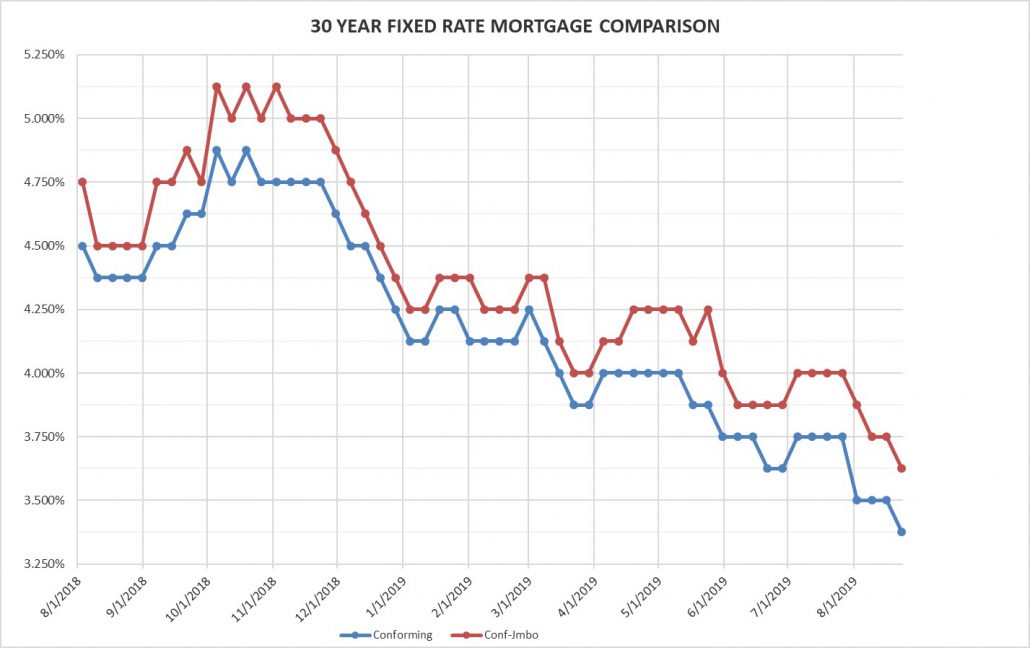
Rates for Friday August 23, 2019: Early in the week rates paired the pop in rate last week and we touch our multi-year low once again this Friday.

FIXED RATE MORTGAGES AT COST OF 1.25 POINTS LOCKED FOR 45 DAYS:

30 year conforming                                            3.375%     Down 0.125%

30 year high-balance conforming                    3.625%     Down 0.125%         

Please note that these are base rates and adjustments may be added for condominiums, refinances, credit scores, loan to value, no impound account and period rate is locked. Rates are based on 20% down with 740 FICO score for purchase mortgages.

Twenty-five years ago on Labor Day weekend I was playing golf with some friends and relatives on Saturday, then a nice family dinner. Monday, I woke up late, which is unusual, and heavy headed but very happy. In between, on Sunday, I spent the morning and midday trying to relax because I had a 4:00 appointment with Leslie in the backyard with about 25-30 others. Somewhere close to 4:00 Leslie’s dad escorted her across the lawn where he dropped off next to me and in front of the minister.

Our anniversary is this coming Wednesday, but Labor Day weekend is always memorable for me for one of the shortest sentences I have ever uttered, and by far the wisest, “I do.”

Have a great week,

Dennis

Past Weekly Rate & Market Updates can be found on my blog page at my website www.DennisCSmith.com/my-blog

What can I do about my credit?

Question of the week:  What can I do about my credit?

Answer:  This is a question that has been asked several times over the past month or so as we have received more inquiries from clients looking to purchase a new property or refinance one they currently own and have some issues on their credit report.

Credit report “issues” can vary from having derogatory reporting to credit scores. If you have negative credit issues many of them can be rectified, depending on severity. Let’s look at various credit issues and what you may be able to do to improve your credit.

The interest rate you are offered on credit, be it for credit cards, auto loans or a home mortgage, is impacted by your credit score. The lower your score the higher the interest rate; and you may be declined credit if your score is below a certain level. There are five elements that have the biggest impact on your credit score: payment history, credit utilization, length of credit history, new credit and the mix of your credit. Some of the elements you may be able to work on to improve your credit score, other items you will have little to no ability to influence.

The most important element by a long shot is your payment history. The more recent a late, or derogatory, payment is reported the larger the impact on your credit score. As well, the more serious the delinquency the larger the impact. For instance, a 30 day late on a credit card from December 2012 will have a lower impact than a 90 day late on a house payment from June 2019. Depending on the severity of the derogatory reporting, you may be able to have the reporting creditor agree to change the way the account is being reported.

While a 30 day late payment on a credit card is the most benign of derogatory payments they are also some of the hardest to have removed from your credit report, especially if the account is with a major bank. Typically to have late payments removed you will need to provide proof that you were not more than 30 (or 60, 90…) days late on your payment. This will entail providing a series of bank statements or cancelled checks to show your payment history and no payment being late. If you have an excellent history with the creditor and have on 30 day late they may (key word “may”) agree to remove the reporting of the late payment to retain you as a customer.

If you have late payments on a mortgage you will have to show that you have made your payments on time from before and after the late payment reported. While it does not happen often it is not that rare that borrowers who have been making on time payments and have had their servicing transferred to a new lender may be reported late due to misapplication of payments by the new lender or issue with the previous lender transferring records. It may take some patience and time, but if you have had a derogatory reporting on your mortgage for which you have made on time payments provide the records showing you have made the payments and the lender(s) accepted them. In May our Question of the Week was what you should do if your mortgage servicing has been transferred.

If you have collection accounts on your credit report, depending on their status they may be able to be removed and therefore have any negative impact removed as well. Collection companies purchase delinquent accounts at a discount and begin charging fees and interest on the obligation. Some collection companies will work with clients and agree to remove the accounts. Typically, if the account has been paid off already the collection company will not agree to remove the account—they have already received their money and you have no leverage. If you owe a balance the collection company may agree to provide you with a letter stating that no money is owed and the reporting of a collection was made in error. If you have an account that is reported in collection my advice is to contact the collection company, always being very friendly and nice as most of customer service people get yelled at and abused most of the time, and apologize for having the balance, ask how much is owed, and then ask if it is possible for you to obtain a letter saying nothing is owed and the account is reporting in error if you pay off the balance today. They may say yes and they may say no. If they say no, tell them thank you, ask if they can send you a written itemized bill and that you will work on paying the debt. Wait a day or two and call back. If there are not notes in your file and you receive another customer service representative, s/he may be in a more generous mood to your request and work with you.

Whether they agree to remove the reporting or not, if you have an outstanding collection account the impact on your report is more than a paid collection. The paid collection will stay on your report for seven years, so it is worth it to contact accounts that have been paid every six months or so to see if they will agree to remove the account from your credit bureau reports. If they do agree to do so ask if you can get a letter to the effect and send it to the credit bureaus yourself in case they do not follow up with the bureaus.

If you have a county, state or federal tax lien or judgment on your report the chances of you getting it removed are extremely slim. On the taxes the only way to get them removed is for the taxing entity to acknowledge to you that your taxes were paid as agreed and not in default, and they have to contact the credit bureaus directly. Like a collection account, unpaid tax liens on your report are more harmful than liens recorded against you but reporting paid. These recorded liens will report on your report for seven years.

Note that it takes a while for most tax agencies to file a lien against you. If you owe back taxes and are notified it is best to negotiate a payment agreement and begin payments. Most tax agencies will not file a lien as long as you are making timely payments towards paying off the obiligation.

Civil judgments, such as from small claims court, will either show an amount owed or that the obligation has been satisfied. If you lost a civil judgment and have paid it off it is very important that you receive a  notice that the plaintiff has file a “satisfaction of judgment” with the court. Once  you make the payment for the amount owed make sure you get a copy of the satisfaction of judgment and communicate to the court the judgment has been paid. If you do not receive a satisfaction of judgment contact the court and show them you have paid off the amount owed so they can either get the plaintiff to file the satisfaction or the court can file one showing no debt is owed.

The next most impactful element on your credit score is “credit utilization,” i.e. how much you owe. Not only is this the total amount of credit you owe but what kind of credit you owe and how much do you owe in relation to how much you can borrow. For many borrowers with scores that are lower than what is needed to either be eligible for a mortgage program, or what is needed for the next best interest rate, paying down or off some credit accounts can improve their score.

If you have a credit card with a $10,000 credit limit and owe $9500, this will have a negative impact on your credit score. If you are able to pay down the balance to $7000 your score will improve. What we do with many clients with high balances on revolving credit accounts to run a report and asking “what if?” What if different balances are lower and by how much, how will the score improve? What if an account were paid in full? Sometimes when we run these reports the scoring model suggests a new account be opened with a certain limit and a small balance is put on the account.

Credit utilization is much more fluid than payment history in how it impacts credit scores. We have tools to use with our clients that can show how much credit scores can be raised if certain actions occur.

I have found over the years than many people with some credit challenges are reluctant to address them, sort of like those who are hesitant to go to the doctor when they have a pain or probable medical condition—they are worried about what they will learn. However, until you have the condition looked at a remedy cannot be provided; and just because you do not have the condition looked at does not mean it will go away.

The sooner you have any credit issues addressed the sooner you are getting closer to having them resolved. Some issues can be corrected in a short period of time, and others make take quite a while. I have had several clients over the years with significant credit issues. We put together a plan and the clients followed the plan we agreed upon and after, in a few cases, a few years they were finally able to purchase a home. Had they done nothing they would have had to wait five, six or more years to purchase a home.

Finally, before you say, “I want to wait to buy a home until my credit score is higher,” let’s take a look at your credit report and score and see what rate and cost a mortgage will be with your current score, what the time and cost will be to increase your score, and what your rate and cost would be with that higher score. For many clients the cost in monthly payments is not as significant as they think to purchase a home today with their current score as opposed to spending time and money to try to raise their score for an incrementally better rate.

If you think you have credit issues and this thought is preventing you from exploring the opportunity to purchase a new home please contact me so that we can assess your credit situation and options for purchasing a new home. Rates are very low, waiting to increase your score may end up costing you more if rates go higher by the time your score has improved than if you were to purchase today with the score you have.

Have a question? Ask me!

What’s next? That is the question investors and business owners are looking for the Fed to answer. Last year the Fed policy was to raise rates two to three times in 2019 after raising rates four times in 2018. This was because the Fed was concerned about the economy growing too fast as indicated by every tightening labor markets, consumer spending and inflation hovering around its 2% target. The first quarter came and went with no rate increases and at the end of the second quarter the minutes from the Federal Open Market Committee (FOMC—the gang that determines the Fed’s interest rate charged to member banks) indicated many wanted to lower rates a few times through the remainder of the year. Earlier this month the Fed lowered its benchmark rate by 0.25% (one-quarter of one percent) because of concerns that the economy was not growing fast enough and concerns there might be a recession in the offing. This minutes from the meeting where rates were lowered were released, and comments from Fed Chair Jerome Powell indicated that the rate drop in early August was a “mid-cycle adjustment” and not part of a long-term policy.

Investors, business owners, elected officials, almost everyone, who makes long term decisions with money do not like uncertainty. Uncertainty makes planning difficult, close to impossible. Uncertainty leads to short term decisions and rapid and multiple changes of direction. Uncertainty leads to bad decisions and bad results. The Fed with its words and actions have created uncertainty in our markets and in the economy. As I have stated several times over the past few months, it appears the Fed has been acting on “what-ifs,” “mays,” “coulds” and “perhaps.” Our economy has been growing since 2010 at annual rates of 1.6% to 2.9%, to slow for some and worrisome that it may grow too fast for others. There is nothing wrong with this long, slow and sustained growth for nine years, likely ten. The Fed needs to sit on its hands and ignore the calls to “do something” in reaction to the news of the minute and instead look at the economic data that has accumulated.

Rates for Friday August 23, 2019: Rates bounced this week off last week’s multi-year low. Mostly in reaction to the Fed speak as well as the news cycle that we are heading into recession in 2020. With a rebound today in the mortgage markets we have paired some of the losses.

FIXED RATE MORTGAGES AT COST OF 1.25 POINTS LOCKED FOR 45 DAYS:

30 year conforming                                            3.5%     Up 0.125%

30 year high-balance conforming                    3.75%    Up 0.125%       

Please note that these are base rates and adjustments may be added for condominiums, refinances, credit scores, loan to value, no impound account and period rate is locked. Rates are based on 20% down with 740 FICO score for purchase mortgages.

Our home is slowly returning back to the “new normal” established last year when our eldest went off to Boston to get some learnin’ in bio-engineerin’. She flew off East early this morning putting us almost on normal footing—which will occur next week when Long Beach Unified opens its doors for students and our youngest begins her senior year at Poly High (Go Jackrabbits). I consider the school year “normal” as there is a set routine daily and I am a person who thrives on routine. Summer and holiday schedules throw me for a loop.

Not sure what I will do in a year when they are both away at college and there is no set routine of a school bell to meet every week day from September to June; the schedule we have followed for fourteen years.

Have a great week,

Dennis

Past Weekly Rate & Market Updates can be found on my blog page at my website www.DennisCSmith.com/my-blog
What is Escrow?

Question of the week:  What is escrow?

Answer:  We have a lot of first time buyers entering the real estate market, which means a lot of people unfamiliar with the terminology and different services in the industry. This question was asked to me this week by a young couple purchasing their first home. They have heard, “when you open escrow, when you close escrow,” but what is this “escrow” they will be opening and closing? 

Dictionary.com defines escrow as “a contract, deed, bond, or other written agreement deposited with a third person, by whom it is to be delivered to the grantee or promisee on the fulfillment of some condition.” 

By this definition escrow is a third person with whom a contract is deposited.  For a contract to be valid it needs two parties, so part of the contract must be that both parties agree who will be the escrow, the holder of their contract.

In real estate, escrow is a third party that buyer and seller, or in the case of a refinance the borrower and the lender, use to transact funds from one party to the next; escrow is also referred to as the settlement agent.  Given instructions agreed to by both parties, the escrow holder agrees to accept funds from the buyer, and the buyer’s lender if necessary, and then after paying costs for other services involved in the transaction, deliver the funds to the seller once all promises are fulfilled in exchange for a grant deed from the seller that is delivered to the buyer.

Escrow is neutral and has no agency contract with the buyer or seller, its agency is with the transaction.  A simpler way to look at this is that the Smiths are selling their home to the Joneses.  The Smiths are represented by Mary as their real estate agent and the Joneses are represented by Joe as their real estate agent.  Once an agreement to price and terms is made an escrow account is opened with Sally at the escrow company, at that point Sally is the agent of the transaction representing the agreement the Smiths and the Joneses made.

If the Joneses wish to make a change to the agreement, say have $3000 credited to them to off-set some repair costs discovered during their home inspection, they notify Sally at the escrow company.  Sally cannot just change the terms of the transaction, she first must get consent from the Smiths for the credit.  Once both parties agree to any changes then Sally can amend the transaction.

Escrow plays a vital role in real estate transactions.  Large sums of money flow through escrow companies on a daily basis for purchase and refinance transactions.  Escrow is not only charged with making sure the initial instructions are followed but also that neither party is able to change the transaction without the consent of the other.  At closing, escrow is responsible for disbursing funds to all the parties and services involved in the transaction, refunding overages to buyers or borrowers, pay fees to termite, title, home warranty, lender and themselves, payoff any liens currently on the property such as the seller’s mortgage or tax obligation and transmit the net proceeds to the seller.  After the closing escrow provides a very detailed accounting of all funds received and disbursed to all parties.

Escrow companies and officers in California can be independent of any other affiliation or may be part of a title company or owned and operated by a real estate brokerage.  If the escrow company for a purchase transaction is owned by the real estate broker representing the buyer or seller this must be disclosed to all parties.

Agents and lenders cannot require that a particular escrow company be used on any transaction; buyers and sellers have the opportunity to request a specific company if they choose, though it is customary in our marketplace the seller, or the seller’s agent, is given the choice of this service.

A good escrow officer and company is like a good umpire in a baseball game, you don’t always know how good they are until you get a bad one; thankfully the latter are very few and far between these days.

For the first-time buyers, all buyers, opening escrow is great news as it means your offer to purchase your new home was accepted. Closing escrow is even greater news as it means you now own your new home!

Have a question? Ask me!

No worries here. The Consumer Price Index for July showed that prices for consumers rose 0.3% for all goods and services and also for the “core” rate (gas and food are stripped out). For the past twelve months, the CPI is up 1.8%, which could be labelled a very benign inflation number. If price growth continues to decline there will be more support for the Fed to lower rates, however the last several CPI releases have shown a pretty steady rate of price growth just below 2%. The news is mortgage rate neutral.

What me worry? Says the American economy after the Commerce Department released retail sales data for July. July saw the largest one month increase in retail sales in four months at 0.7% above June’s sales. Taking out car and gasoline sales for the month and sales increased 0.9% for the month, with on-line sales jumping a staggering 2.8% from June—likely boosted (shoved up?) by Amazon’s Prime Day and its competitors also pushing their own deals available. Evidently the trade dispute with China is not preventing consumers from buying products, nor is it increasing the prices paid for those products. Overall the news should be negative for lower interest rates as consumer spending is 65-70% of our economy and strong retail sales should portend economic growth and higher rates.

Rates for Friday August 16, 2019: Look at the pretty charts! Chart makers who track stocks and bonds had a fun week as they created what looked like silhouettes of mountain ranges with peaks and valleys. As I write this the Dow is down about 0.875% for the week and the S&P is down 3.67% since Monday’s open. In between we say a large peak on Tuesday and a deep valley on Thursday. All the while the rate on the 10-year Treasury dropped into mid-week before bouncing a bit today. Why all the activity? Concerns about a recession and European economies caused investors to sell of their equity holdings and purchase bonds and fixed rate investments—engaging in flight to safety (as discussed in the July 26th WR&MU). As discussed above, the concerns appear to be unfounded, however the result of the recession concerns is a dip in rates this week from last Friday, and the conforming rate at its lowest since the week ending December 9, 2016. Can they go lower?

FIXED RATE MORTGAGES AT COST OF 1.25 POINTS LOCKED FOR 45 DAYS:

30 year conforming                                            3.375%     Down 0.125%

30 year high-balance conforming                   3.625%     Down 0.125%       

Please note that these are base rates and adjustments may be added for condominiums, refinances, credit scores, loan to value, no impound account and period rate is locked. Rates are based on 20% down with 740 FICO score for purchase mortgages.

Long time readers of the WR&MU know that this is the space I use to comment on personal events in me and my family’s life—for some I know this is the only part you read! (As an aside, my dad was very old school and could not understand why I always wrote this final segment—when I informed him it was probably the most read section, “Oh, then you should probably keep it.” Good advice.) This week these section is for parents of new adults.

Do you have a son or daughter who recently turned 18, or any children you still provide for over 18? Then please read on. Last year when our oldest daughter, then 18, flew off to Boston for college, before she left I had her sign two copies of a HIPAA Release Form (link below). Because she is an adult, no medical provider can provide either my wife or I any medical information about her. Should she have an accident or emergency and we are contacted that an event has occurred, federal law prohibits the medical provider from releasing any details.

With she and us each having signed copies of the HIPAA release form that we can provide the medical provider authorizing them to communicate with Leslie and I, they will be able to provide us with details of her condition, etc. We also have an electronic copy that we can quickly send to a healthcare facility across the country to expedite the information collection.

If you have any children 18 or older I encourage you to have them complete the form linked below and provide you with an original or copy. As well, if they are in college and/or living with roommates, encourage them to inform their roommate(s) of the form and where it is located (and to have them complete one for their parents). Privacy laws are very important to protect us, the HIPAA laws however can be detrimental for parents who need information and be able to be pro-active in their adult children’s healthcare.

Here is a link to the HIPPA Release Form we use. I hope none of us ever need to use it.

Have a great week,

Dennis

Past Weekly Rate & Market Updates can be found on my blog page at my website www.DennisCSmith.com/my-blog

Where are you?

Question of the week:  Where are you?

Answer:  On I-94 West leaving Milwaukee and heading to Steamboat Lake, Minnesota (near Walker, near Bimidji).

Leslie has command of the rental Hyundai Tuscon at 7:45 local time while I spend a few minutes getting out the big economic news this week and rate shift.  

Have a question? Ask me!

As expected, the Federal Reserve cut its benchmark rate by 0.25% on Wednesday—that move was already priced into the markets. After the announcement Fed Chair Jerome Powell held a press conference and his answers to some of the questions set the markets into a tizzy. The general expectation has been that the Fed would lower rates up to three-quarters of one percent this year (0.75%). At his news conference Powell indicated that Wednesday’s rate move could be a one-and-done, made to put some confidence into the economy. Sensing no more cheap money to borrow to buy, investors dumped their stock holdings and purchased bonds (see last week’s WR&MU for brief overview of relationship between stocks and bonds). This sent stocks prices and bond and mortgage rates tumbling. It should be noted this is the first time since the financial crisis of 2008 that the Fed has increased rates, the second longest period in history—the longest being from 1942 to 1954.

But wait, there’s more! In reaction to the markets collapse in 2008 the Fed began a policy known as “quantitative easing” during which it purchased U.S. Treasury bonds and Mortgage Backed Securities (MBS) to soak up supply and keep rates low. Last year the Fed announced a policy of “quantitative tightening.” Under this policy the Fed would start to sell its holdings of U.S. Treasury debt and mortgages. The impact of this policy is to tighten interest rates by lowering the prices on fixed rate assets, which as we learned last week pushes rates up. Originally the policy was to stay in effect for two more months, but the Fed cut the cycle by two months.

In other news…Economic data this week was counter to the Fed’s position of an economy that needs outside stimulus with lower rates. Positive economic news should lead to higher interest rates, ahead of the Fed rate cut we learned that consumer spending (65-70% of our economy) increased 0.3% in June and for the fifth month in a row personal income showed growth, increasing 0.4% for the month and up 3.2% from last year. With the gap between personal income growth and spending growth it is not a surprise that personal savings also increased, to 8.1%. Inflation concerns, a key factor for interest rates, are non-existent as prices increased a scant 0.1% in June and are up only 1.4% from last June; well, well below the Fed’s 2.0% inflation target. The inflation number is the only number that would hint at a rate increase, the other data all suggests an economy that is on track to continue record expansion that began in June 2009.

Lost in all the chatter about the Fed announcement will be today’s report from the Labor Department that the economy added another 164,000 jobs in July. More news that would suggest rates stay steady or face some upward pressure.

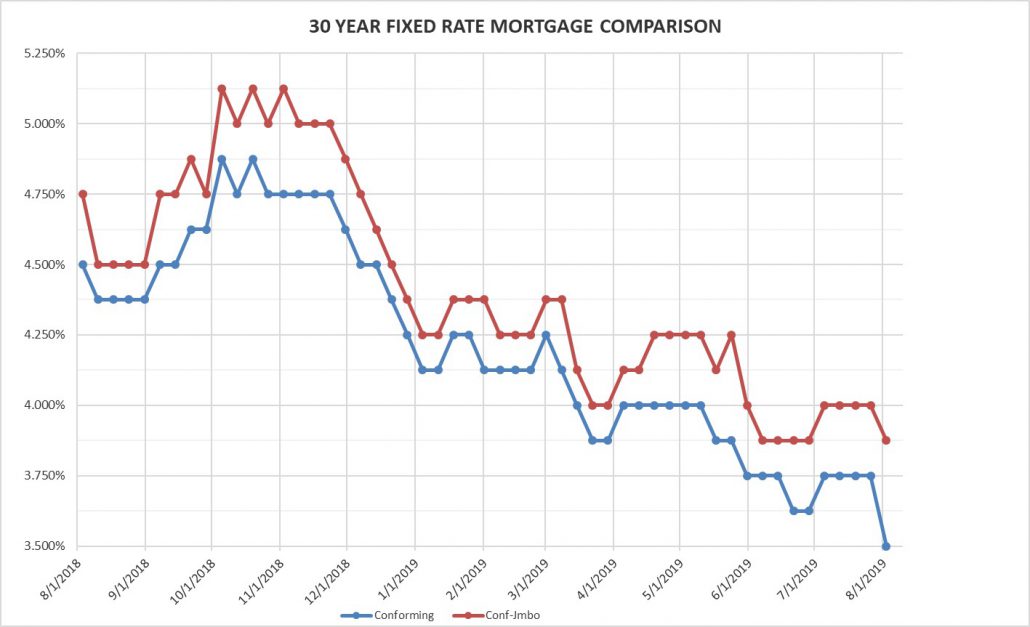
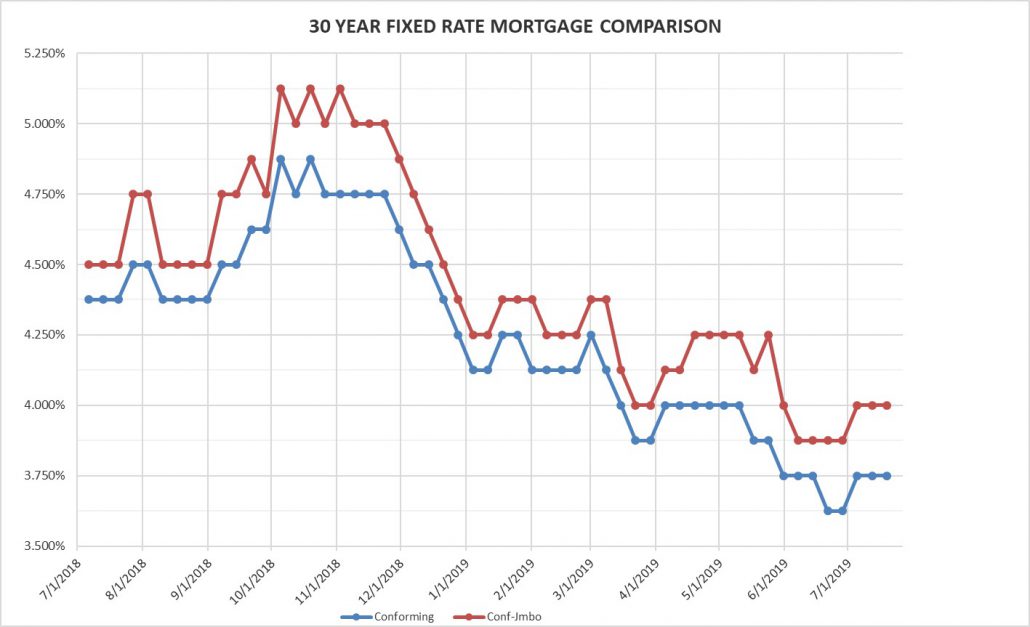
Rates for Friday August 2, 2019: The conforming rate is the lowest it has been since October 2016, hitting 3.5% this week following the Fed move and more importantly Powell’s comments. Will they last? Economic principles say no, and that they should not be this low.

FIXED RATE MORTGAGES AT COST OF 1.25 POINTS LOCKED FOR 45 DAYS:

30 year conforming                                            3.50%     Down 0.25%

30 year high-balance conforming                  3.75%     Down 0.125%  

Please note that these are base rates and adjustments may be added for condominiums, refinances, credit scores, loan to value, no impound account and period rate is locked. Rates are based on 20% down with 740 FICO score for purchase mortgages.

Why Milwaukee? Why not? Leslie and I are having a Planes, Trains and Automobiles summer trip. We flew to Oakland last Saturday evening and the next morning board the California Zephyr train headed for Chicago. The trip was beautiful, though a bit challenging at night as we opted for the small “sleepette” compartment rather than a sleeper. We crossed the Sierras and Rockies during the day and we really enjoyed the ride. Two nights in Chicago which included a fantastic meal with friends one night and “obstructed view” seats the next night to see Hamilton—a huge discount in price for seats near the back of the mezzanine that blocked the upper part of the stage—rarely used and no negative impact on our enjoyment.

In plotting our trip with the ultimate destination being Camp Birchwood, where one daughter has been since May as a counselor and the other there since early July as a camper, we saw Milwaukee was not out of the way for our automobile leg of the trip. Since neither of us had ever been we decided to make a stop. We are glad we did! A nice lunch river side, a great walk through the lake side part of the city to a fun and tasty Irish pub, then a walk back to our hotel had us wishing we scheduled a bit more time in the city.

The next two nights a Camp Birchwood, which is owned and run by a man who was my counselor at the camp when I was young, and was started by his father who was my dad’s counselor when he was a kid. We fly home from Minneapolis on Monday with our girls to complete the trip.

Signing off from I-94 a bit southeast of Madison.

Have a great week,

Dennis

Past Weekly Rate & Market Updates can be found on my blog page at my website www.DennisCSmith.com/my-blog
Have you reviewed your…?

Question of the week:  Have you reviewed your…?

Answer:  In last week’s Weekly Rate & Market Update we asked “Do you have a will and a trust? The early returns are that it was timely as some replied to me that they had made appointments this week with attorneys to either review their current plans or to create a new one. I am hoping many more have done so and just not let me know.

Following up on the estate planning and review, a reminder to have other important items and documents reviewed.

Life Insurance Do you have enough coverage? Many families had life insurance policies for both spouses, others just for the spouse who is the sole, or primary, wage earner. Typically policies are purchased when purchasing a first home, or not long after marriage. Also typically, the policies are rarely reviewed or adapted to increase coverage as children are born, bigger and more expensive houses are purchased and wages increase. Review your coverage and assess what the needs would be should one, or both, get hit by the proverbial bus—will there be sufficient funds to ensure your family can retain the home, cover future education needs and other necessary living expenses.

Home Insurance Are you over or under covered? Most insurance companies are pretty good at adjusting coverages as costs of replacement increase over the years. Some are a bit too aggressive and others are not as adept at increasing coverages. Review your policy with your agent to determine if you have the proper coverage for your home, possessions and liability.

Auto Insurance While you are reviewing your homeowner’s coverage you should review the auto insurance as well. Do you have a child or two in college? Do they use a car? If not have them removed from your policy while they are at school and add them back when they return for vacations and breaks. Is the replacement coverage too much or not enough? Cars lose value pretty quickly and it is easy to over insure their value, at the same time if you have a lease or auto loan the coverage may not enable you to payoff the amount due should the car be totaled.

Credit Cards Do you have several credit accounts that are open but have no balance and you do not use them very often, or ever? I am an advocate for having one card with a fairly decent credit limit that is not used and available for emergencies. That said, I am not an advocate for having several different open accounts that are either rarely or never used, especially for department stores or oil companies. An open account that is rarely used is an opportunity for someone to hack the card and use it without your being aware for some time. Yes, the issuing company will likely reimburse you should this happen, but it is a painful process and the result will be that card being closed out—why not close it before this potentially happens?

Retirement If you have a 401(k) are you having enough withheld from your salary? Have you had raises in your pay but have not increased the amount you are saving for retirement? Likely you have a set percentage of your pay deducted every pay period for your retirement, which means as you get paid more you have more in dollars going into your account—but can you afford another one or two percent to be withheld if you are not yet maxed out on the amount you can put away? The same goes for those who are self-employed or make IRA contributions because your employer does not have a retirement program. Your retirement is getting more expensive every year because of inflation, money put away today—tax free—will be needed in your future so put away as much as you can.

Spending Habits Summer is a hard time to evaluate where you spend money as you are taking vacations, spending time with your kids and family are the beach, amusement park and likely going out to dinner more frequently. That said, thinking about the “normal” routine for when school is back in and what your spending habits are that could be changed to save money, such as to increase your retirement contributions, makes changing habits and routines easier when the summer schedule ends. Are you a buy a cup of coffee on the way to work person? Spend the summer making coffee at home and enjoying it in your kitchen before you leave or putting in a travel cup to drink in the car. You will save money, a lot since the $4.00 cup at the coffeeshop costs about thirty cents to make at home, and time since you will not have to pull into the drive-thru or stand in line at the coffee shop which may or may not be directly on your route. Coffee, lunch, dinners at home, a pair of shoes you like but don’t need or a new putter or driver that will look good in your golf bag but you will still likely shoot in the mid-90’s without spending the hundreds for the club.

Exercise Less than twenty percent of adult Americans get sufficient exercise. Can you set a routine in the summer for daily exercise that will carry over to the rest of the year? Are you a morning person? If so can you practice now to get the routine and habit of getting in your exercise before the kids usually get up for school? Are you an evening night person? If so can you find a routine that may have dinner be a bit later for the family but you are able to get in your exercise? A regular exercise routine will not only make you feel better today, and tomorrow, but will like cut down on future health issues, saving you money in expenses and potential loss of income.

These are just a few areas to think about making changes or reviews as you sit on the beach or by the pool on vacation watching your kids play. Set a plan in your mind and then execute the steps, most of them very easy, to implement your plan. You may find that all is in order, you have proper insurance coverage, your family spending habits are somewhat frugal without taking the fun out of life and you are in good health—if this is the case well done and you will find yourself at ease that you are on the right course. If you do feel you need to make some tweaks here and there, getting them accomplished will make you feel better and silence the voice in your subconscious that may have you at unease or feeling some guilt over “I know I should but…”

Off my soap-box.

Have a question? Ask me!

Consistently good. That would be my description of retail sales the past several months. June was the third month in a row retails sales grew 0.4% from the prior month. If gasoline sales are stripped out of the data the increase in sales is a very large 0.7%, but consumers benefited from lower gas prices in June which lowered their impact on total retail sales. Department stores continue to see declining sales as internet sales continue to increase about equal to the brick and mortar losses. Also, up for the month were sales at restaurants, home furnishings and clothing stores. Last week I expressed my opinion that the Fed should not lower rates this month, or in the next few months. The retail sales data for June supports my position. Higher retail sales should be negative for rates as consumer spending is 65-70% of economic activity, higher sales should lead to  higher economic activity and growth which historically leads to higher rates.

Rates for Friday July 19, 2019: With the Fed likely to decrease rates next week it is a good time to lock in rates if you can. In the past when the Fed decreased rates there was a spike in mortgage, and other, rates as investors think, they have decreased rates and may not need to again so we are at the bottom, so rates should rise later—causing them to invest in a way that leads to higher rates. Keep in mind, mortgage rates are not directly tied to the Fed’s interest rate, but are determined by investors anticipating future economic, monetary and political events. Rates are great, take advantage of them!

FIXED RATE MORTGAGES AT COST OF 1.25 POINTS LOCKED FOR 45 DAYS:

30 year conforming                                            3.75%     Flat

30 year high-balance conforming                    4.00%     Flat      

Please note that these are base rates and adjustments may be added for condominiums, refinances, credit scores, loan to value, no impound account and period rate is locked. Rates are based on 20% down with 740 FICO score for purchase mortgages.

Last week I outed myself as a nerd for musicals (one of my all time favorite movies is “Singing in the Rain” for example) and it is from this nerdness that I will pass along a movie review this week. Last weekend Leslie and I saw “Rocketman,” which if you are not aware is about Elton John. We had both read several reviews of the film and many were not exactly positive, especially those that tried to equate the movie to last summer’s “Bohemian Rhapsody” about Queen’s Freddie Mercury. The two films should not be compared as they are completely different formats and styles. “Rhapsody” was a biopic of Mercury with many scenes of the members of Queen, the actors, performing their music. “Rocketman” is much more of a musical, with Elton John’s songs being sung in the middle of a scene by various members of the cast. The movie is a bit dark, tells the story very well, is well acted and written. I encourage you to see it.

Have a great week,

Dennis

Past Weekly Rate & Market Updates can be found on my blog page at my website www.DennisCSmith.com/my-blog