What are loan limits?

Question of the week:  What are loan limits?

Answer: Every mortgage program has limits as to how much of a loan the program is eligible to fund. The limits are dependent on several factors, depending on what type of mortgage is being approved. For example is it what is termed a “conventional” loan, is it a “government” loan, is it “non-conforming” or “jumbo?” Another factor is geographic location of the subject property, some programs will have higher loan limits in Long Beach, California than Long Beach, Mississippi. One more factor is what is the loan-to-value, i.e. what percentage of the value of the property is covered by the loan.

Conventional mortgages “Conventional,” or “conforming” loans refer to mortgages that are funded using guidelines established by Fannie Mae or Freddie Mac. These loans are funding by lenders who then sell the loans to Fannie or Freddie, who then package the loans into bundles and sell them as investments called Mortgage Backed Securities (MBS).

The conforming loan limits are set by Federal Housing Finance Agency (FHFA) based on the percentage increase, or decrease, in the average housing price. Mortgages that meet either Fannie or Freddie underwriting guidelines and fall within the established loan limits are eligible to be purchased by either entity depending which guidelines were used for approving and funding the mortgages.

Following the housing and mortgage markets melt-down starting in 2008 a “high-balance” loan limit was established for high cost areas across the United States. This enabled home buyers and owners in areas such as Los Angeles or Boston, where the median home price is higher than the conforming loan limit, to have easier access to low rate mortgages supported by Fannie and Freddie’s funding guidelines.

The high-balance loans have higher rates and pricing than standard conforming loans, as well as stricter underwriting guidelines.

For 2020 the conforming loan limit nationwide is $510,400. The high balance loan limits vary by county with the maximum being $765,600, which is the maximum limit for Los Angeles, Orange and several counties in Northern California. Here is a map that shows loan limits by county across the country.

Note that these are the limits for single family residences, there are different loan limits for two-, three-, and four- unit properties.

When I started in the mortgage industry in 1987 the maximum conforming loan amount was $153,100.

Government Loans that are insured by either the Veteran’s Administration (VA) or Federal Housing Authority (FHA) have separate underwriting guidelines. It should be noted that while conforming loans are sold to either Fannie or Freddie, government loans are insured by government entities.

VA loans are unique in that there is no limit on loan amounts based on location or imposed by the VA. The primary limit is the amount of the entitlement the veteran has from the VA, his/her ability to qualify, and what, if any, down payment or equity is in the property.

FHA has loan limits by county, the maximum loan in Tulare County is lower ($331,760) than the loan limit in Orange County ($765,600).

You probably noticed that the maximum loan limit in Orange County for FHA mortgages is the same as it is for conforming mortgages. Like the conforming high-balance mortgages, the FHA Jumbo mortgage is for those loans over $510,400 and have higher rates and prices with slightly different underwriting guidelines.

Non-conforming Generally labelled as “jumbo” mortgages, those loans that are funded outside of conventional or government channels have many different programs, and therefore limits and underwriting guidelines.

The most common non-conforming mortgages are traditional jumbo loans, which means they are used for applicants using underwriting standards that are close to those used by Fannie or Freddie; i.e. decent credit, verified income and funds to close, and properties that are “traditional.”

Non-conforming mortgage programs are funded by lenders and then sold to specific investors who establish the guidelines for underwriting and funding the mortgages. There are hundreds of different such investors who purchase mortgages from lenders, from major brokerage houses, to equity firms, to insurance companies, to regional banks. They establish mortgage products that run the gamut from traditional 30 year fixed mortgages to what are termed “hard money,” or “alternative” mortgages for those with credit or other challenges.

Most jumbo programs will fund mortgages under their guidelines down to the conforming loan limit plus one dollar. For example, if you are purchasing or refinancing a home with a loan amount of $525,000, because it is higher than the conforming $510,000 limit, you have the option of using either a high-balance conforming mortgage or a jumbo mortgage. Why would a borrower choose a jumbo loan instead of high-balance conforming? Some days the rates are lower on the jumbo option, or there may be something in the qualifying guidelines with a jumbo program that is more lenient and enables the borrower to qualify.

Most non-conforming loan limits are based on loan to value limits. For instance, a lender may go to 90% LTV to $1,000,000; 80% to $1.5 million, 75% to $2 million and 70% LTV to $2.5 million. Another lender may not lend above 80% LTV but at that limit lend to $2 million.

Loan limits come into play when we are working with clients as the loan amount, loan to value, and very importantly their ability to qualify, are factors as we determine loan product options and what rates and costs are associated with those options.

Want to know your loan limit? Give me a call!

Have a question? Ask me!

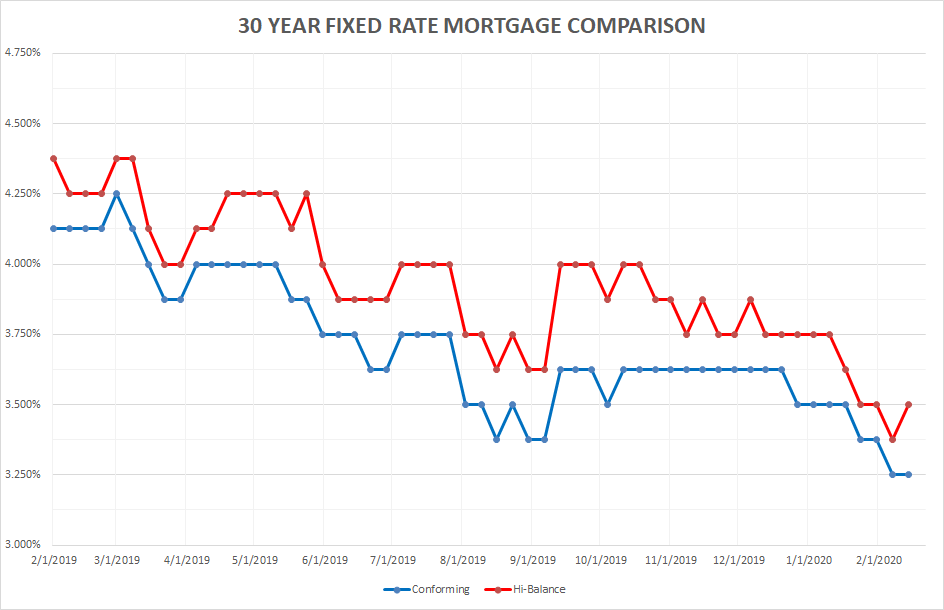
Rates for Friday February 21, 2020:  Rates are a little softer from last Friday, while the conforming rate is flat for the week the price is a bit lower, with either some closing credits or lower origination fee. The coronavirus still looms over markets as the length and breadth of its impact on commerce and populations is still not known.

FIXED RATE MORTGAGES AT COST OF 1.25 POINTS LOCKED FOR 45 DAYS:

30 year conforming                                            3.25%    Flat

30 year high-balance conforming                   3.375%  Flat

Please note that these are base rates and adjustments may be added for condominiums, refinances, credit scores, loan to value, no impound account and period rate is locked. Rates are based on 20% down with 740 FICO score for purchase mortgages.
We became childless this week. Our youngest had her eighteenth birthday and is now a legal adult. So, while we have adult children, we no longer have children that are childs!

Looking through the pictures of she and her sister through the years I get, as most parents likely do, a sense of how long ago it was she had her Dottie stuffed elephant and princess gown on, and also how it seems like just a year or so ago the picture was taken.

The passage of time is our blessing and curse. Blessed to be experiencing new adventures, relationships and, hopefully, more wisdom. Cursed as the experiences increase the time left to create more is lessening. We do not know how long we have for our new experiences, enjoy them and those you share them with every moment of every day!

Have a great week,

Dennis

Past Weekly Rate & Market Updates can be found on my blog page at my website www.DennisCSmith.com/my-blog

How does a virus in China impact mortgage rates in America?

Question of the week:  How is it that a virus in China impacts mortgage rates in the United States?

Answer: This week’s answer may get a little bit wonky in regards to economics but I will try to stay un-wonky.

Long time readers of the WR&MU know that in economics there is a principal that the better an economy does the higher interest rates should be, conversely a slowing or shrinking economy should result in lower interest rates. Because of this, whenever there is strong economic news that shows strong growth happening, or about to happen, rates tend to rise; poor economic data results in rates dropping.

In the United States we have a fairly free economy. There is government regulation that impacts most industries, but compared to other forms of government and economic systems ours is pretty free. Just as the government does not set stock prices for corporations, neither does it set the interest rates for any non-government bond or fixed rate security. These prices and rates are set by the open market and investors.

Investors make their decisions on whether to buy or sell based on the available data and their belief as to what will happen to a certain company, a certain industry or sector of the economy, and the economy as a whole.

One of my favorite movies is “Trading Places” with Eddie Murphy and Dan Aykroyd. The core of the movie is the principle that information available to investors determines whether they buy or sell a stock. I won’t spoil the movie for those who have not seen it, but insist you must, but knowing whether the cold weather in Florida will have an impact on the price of orange juice in the future will determine if you want to buy orange juice futures or sell them short.

If there are major strikes in the coal industry investors will presume that steel companies will have a hard time making profits in the near future and will sell holdings. If a company has patents approved for a new technology that will give its products an advantage in cloud service investors will buy that stock. Good news is an indicator to buy, bad news is an indicator to sell. Of course, it gets a bit more complicated, but these are basic principles.

Fixed rate assets are those which pay a fixed rate of return for a certain period of time. These types of assets are bonds, either government or corporate, and also mortgages. When making a decision to purchase fixed rate assets investors way the return on their money for each investment compared to the risk that they will not get their money back. The United States government is the safest investment in the world, it has never defaulted on any of its debt. As a result, U.S. Treasury bonds and bills have lower interest rates provided to investors than similar type of offerings from corporations, or mortgages.

When investors are deciding whether to buy or sell bonds, or similar options, they are making the decision based on many factors but the two most important are either their perception of what the economy as a whole will be doing in the future, and what is the risk of not investing in fixed rate assets.

One more factor regarding bonds and mortgages, there is an inverse relationship between the price and the rate of return. If bond prices rise that means rates are dropping and vice-versa.

If there is very positive economic news that indicate the economy should be very robust and growing investors will anticipate higher interest rates in the future. This is for a few reasons. First and foremost, every other investor will anticipate higher rates and with the herd mentality their actions will push rates higher. Second, if the economy is growing then private companies will be making higher profits and investors will want to have their money invested in stocks instead of bonds. Third, in the United States the Federal Reserve will increase the rates it charges banks to borrow money in an effort to put some brakes on growth to control inflation.

As investors sell their bond and other fixed rate holdings the price of those assets will drop, which results in higher interest rates. They will use the cash they get from these sales to purchase equities (stocks), causing those prices to rise.

If there is bad economic news the reverse happens, investors sell equities causing those prices to drop and buy bonds and mortgage, causing those prices to increase and rates to drop.

Sometimes we see the phenomenon called, “flight to safety.” This is when there is a significant event that causes investors to want to leave the uncertainty of equities and put their money into investments that have a certain fixed return; in other words sell stocks and buy bonds.

What would create flight to safety activity? A war, or strong threat of a war involving the United States or an area of economic importance. A sudden disruption in an industry that may impact the whole economy or several industries. A major natural disaster or any event that negatively impacts the country or economy.

China is the largest economy in the world. Wuhan is a major city in China with over eleven million people. It is a major economic engine for central China with manufacturing, scientific and technological research and development, and transportation industries generating substantial economic output for domestic and international consumption and use.

Wuhan, as you may know if you have been even slightly engaged in consuming traditional or social media, is ground-zero for the coronavirus which is spreading world wild.

If there is an event that impacts one of the biggest economic regions of the biggest economy in the world, is that a positive or negative for other economies?

A slow down in economic activity in Wuhan impacts other economic activity in China and its trading partners. Companies in Vietnam, Japan, Australia, India, the United States and other nations that are economically tied to companies in Wuhan, or tied to companies tied to companies in Wuhan are impacted when the workers in Wuhan are not going to work that impacts output.

Throw a pebble, the coronavirus, in the pond, the global economy, and where it lands, Wuhan, starts the ripples outward.

The coronavirus is a double impact event for investors. First, it is an indicator for economic slowing in China and around the globe. Second, because of the unknown duration, spread and impact of the virus it creates a sentiment of flight-to-safety. Both of these are reasons for investor to invest in fixed rate assets. Which should put downward pressure on interest rates.

And that in several nutshells is how a cough in Wuhan, China can impact the mortgage rate for a couple in Long Beach, California purchasing their first home.

Have a question? Ask me!

Meyh, is the term to the start of 2020 with early economic data. This week price and purchase data were released, and both saw some growth but not enough to get excited about or impact rates. Consumer prices increased 0.1% in January and year over year the CPI is up 2.5% the highest annual rate since the Fall of 2018. The biggest factor in the increase was housing, especially higher rents. Consumers in January were hot to spend in home centers like Lowes and Home Depot, and then visiting bars and restaurants as those sectors saw strong growth in the retail sales report. What consumers did not do was buy clothing as apparel sales were down considerably. Overall the economic news this week was mortgage rate neutral.

Rates for Friday February 14, 2020:  Conforming rates are flat from last Friday and high-balance rates have bumped back up after hitting a multi-year low last week.

FIXED RATE MORTGAGES AT COST OF 1.25 POINTS LOCKED FOR 45 DAYS:

30 year conforming                                            3.25%    Flat

30 year high-balance conforming                   3.5%      Up 0.125%

Please note that these are base rates and adjustments may be added for condominiums, refinances, credit scores, loan to value, no impound account and period rate is locked. Rates are based on 20% down with 740 FICO score for purchase mortgages.

I hope everyone is having, and will continue to have a happy Valentine with their sweetheart*. Leslie and I will be spending the evening alone, our 17 years and 360 days daughter has decided spending Valentine’s Day evening with her parents is not that cool. I’ll make her favorite dinner, grilled steaks, and evidently, she has some painting project, involving canvas not walls, for us to do after dinner. A nice quiet evening in, which is perfect for me. I hope your evening is a quiet or unquiet as you wish it to be.

*Many of you have likely noticed, I am not the best grammarian, nor speller. I initially wrote sweethearts, and then thought, “is this implying some of the WR&MU readers have multiple sweethearts, or is it correct to use the plural since I am addressing multiple people?” I’m playing it safe and will check with my resident professional grammarian later as to which way I should have gone.

Many businesses are closed on Monday for President’s Day, ours will be as well, however I will be in and working if you or anyone you know needs mortgage assistance or advice.

Have a great week,

Dennis

Past Weekly Rate & Market Updates can be found on my blog page at my website www.DennisCSmith.com/my-blog

Is refinancing worth the short- or long-term cost?

Question of the week:  Is refinancing worth the short- or long-term cost?

Answer: With rates remaining very low we have been busy doing calculations for clients to determine if a refinance to lower their current mortgages rate and payment makes sense. This is a bit of a follow up from the WR&MU of August 30, 2019 (“When can we, should we, refinance?”) in which we discussed not only a refinance to lower the payment (a rate and term refinance) but also refinancing your current mortgage to consolidate a HELOC, other debt or pull-out equity for other purposes (a cash-out refinance). This week we will keep our discussion to a rate and term, or rate reduction, refinance.

Every transaction has costs, the question we explore with clients is how are the costs paid. The mortgage costs incurred when purchasing a home are similar to the mortgage costs incurred when refinancing a mortgage. There are several services that are involved, and no one works for free. Escrow, lender and title companies have fees. The transaction will have to be recorded so there will be fees paid to the county recorder. Not always but in most instances, there will be an appraisal, which requires a fee. Credit companies, companies that inform lender if your taxes are being paid on time and in the correct amount, companies that certify if your property does or does not require flood insurance, all have fees that need to be paid.

These are all known as “non-recurring costs,” the happen once and only happen because you are obtaining a mortgage. Depending on your loan amount and a few other variables, these costs range from about

Other costs involved are “recurring costs,” as you have guessed these costs recur over the life of your mortgage. Also known as “pro-rations,” these are amounts due to mortgage interest, property taxes and insurance that are prorated to the date of closing based on what has been paid or what will need to be paid.

There are three ways these costs can be paid in a refinance transaction (see below for fourth in a purchase). The costs can be paid with the borrower bringing funds to escrow at closing. The costs can be paid by adding them to the current mortgage amount, increasing the total amount of the new mortgage. The costs can be paid by the lender by increasing the rate on the new mortgage. (The fourth method of paying the costs in a purchase transaction is to have a credit from the seller or agent(s) for some or all of the costs you will be incurring.)

These costs are the short-term cost of refinancing, long-term if you add them to the loan amount. The question we answer is, do the costs associated with the refinance make sense? How do we determine what “makes sense?”

We have two litmus tests we use to determine if refinancing your current mortgage makes sense. First, your payment needs to drop by at least 5%. Second, if we divide the costs of the refinance by your monthly savings is the “pay-back” less than 36 months? The higher the percentage of savings and the lower the “pay-back” period the more it makes sense to refinance.

Real numbers: Client purchased a home in 2016 with a mortgage of $535,000 with a rate of 3.875% and a monthly payment of $2517 per month. The current balance on the mortgage is $500,000 and we are looking at a refinance at 3.5% with total costs for all fees of about $3500.

Client chooses to add the fees to the current loan balance so we have a loan for $503,000. The payment for a 30 year fixed rate $503,500 mortgage at 3.5% is $2261. This will lower the monthly payment by $256 per month, a savings of 10%–we meet the litmus test for monthly payment savings.

If we take the costs of $3500 and divide by the $256 monthly savings we get 13.67 months, which means that by the 14th payment the refinance has paid for itself.

After going through the math the client says, “but I have already paid on the mortgage for about 40 months, now I am starting all over again.”

There are several points to consider when extending your current mortgage with a refinance. How long will you be in the property? Will you be able to utilize your monthly savings to pay off other debt, increase your retirement savings, put aside for children’s college fund(s), or some other use that will benefit you?

Taking our client above, who says they intend on being in the home beyond thirty more years. Let’s look at the math between saving $256 per month versus adding 40 months to his payment. The next 320 months will be the time frame in which the original loan will be paid off if let alone. The savings during the 320 months from refinancing will be almost $82,000 (320 x $256 savings per month) and the payment on the additional 40 months due to refinancing is about $90,000 (40 x $2261 monthly payment from refinance). Over thirty years he will pay about $8000 more.

Is saving a total of $8000 over 30 years worth not saving almost $3100 per year for over 25 years? In economics there is a saying, “a dollar today is worth more than a dollar tomorrow;” essentially what you can buy with a dollar today is worth more than buying something for a dollar tomorrow for several factors, most importantly inflation eroding the value of your dollar over time. Having $256 more per month today and in the near future is worth more than spending $$2261 per month in twenty-five years.

If the client does not intend to stay in the home for more than the 320 months remaining on his mortgage the additional term is mute, the home will be paid off through your selling it before the final payment would be due, why spend more each month until you sell?

If the plan is to stay and keep the home then the better financial decision is still to refinance. Just keep making your same payment and your home will be paid of in about 300 months instead of the 320 months you have left on your mortgage. This will save you about $50,000 from not having any payments for 20 months at the end of your current mortgage. That said, I and many others contend that financially you would better off investing the monthly savings into an account for some future expenditure needs such as college tuition or retirement due to the economic principal of compound interest and dividend reinvestment and the tax deductibility of your mortgage interest.

Yes, there are short-, and possibly long-term costs to refinancing. There are also short- and long-term benefits from doing so. Doing the math will determine whether the benefit outweigh those costs for you and your family.

If you would like to do the math on your current mortgage as to whether it makes sense to refinance or not please give me a call!

Have a question? Ask me!

Slow news week, for economic data anyway. The primary news that impacts mortgage rates is the monthly jobs report released on the first Friday of every month. Today’s release shows that 225,000 jobs were added to the economy in January, well above the consensus estimate of 164,000 additional jobs. For the past three months the average has been 211,000 new jobs added per month. Some good news for workers, signifying how tight the labor markets are, wages increased 3.1% over the past twelve months, with inflation under 2% wage growth is outpacing prices for goods and services creating more disposable income for wage earners. More individuals entered the job search market in January resulting in the unemployment rate increasing in January from 3.5% to 3.6%. Overall the news is mortgage rate unfriendly as the data supports more economic growth and wages at some point pushing prices higher from the producers side.

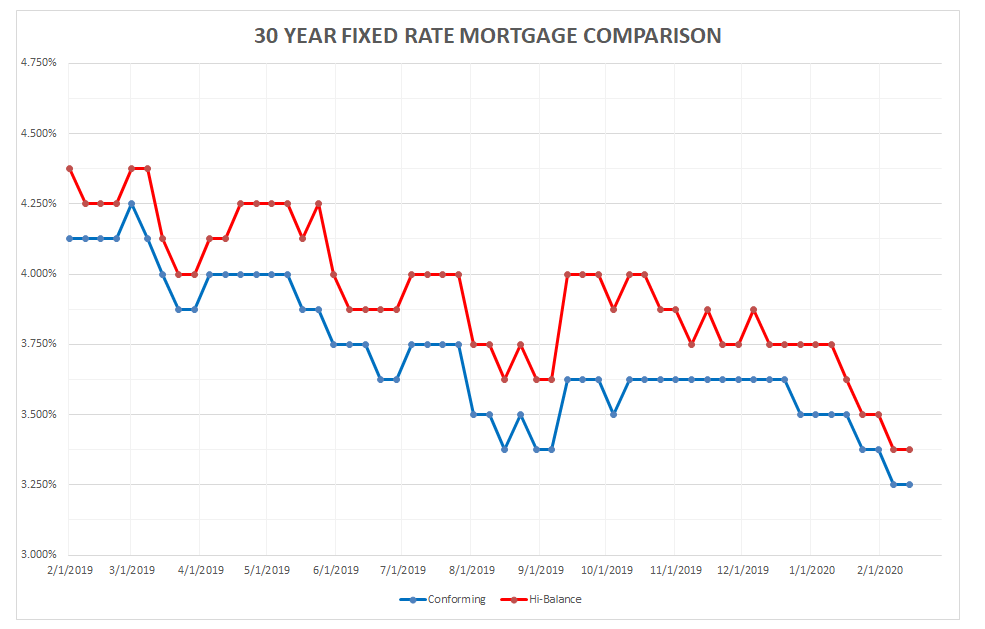
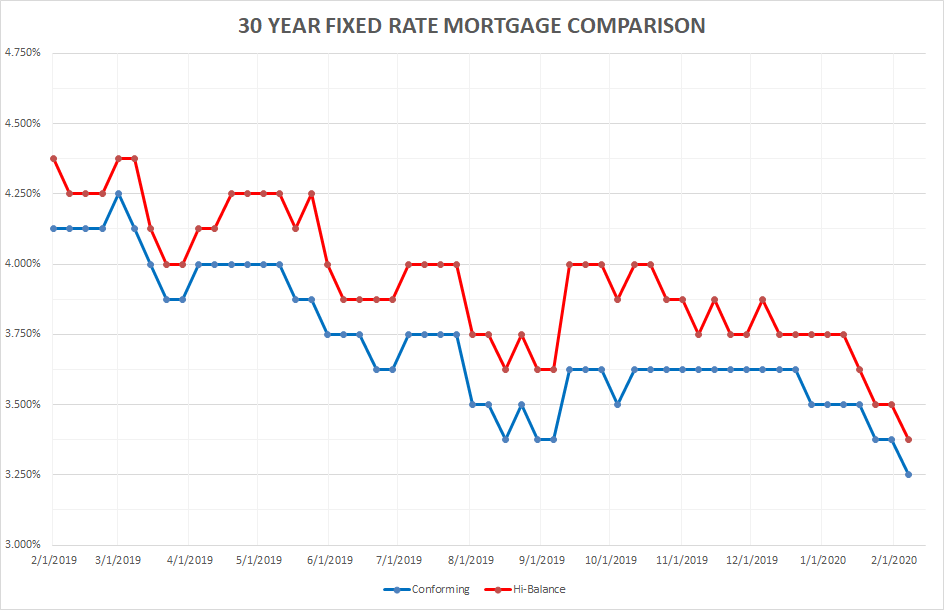
Rates for Friday February 7, 2020:  Despite economic news that should put upward pressure on rates we dip this Friday from last to the lowest Friday rate we have had since October 2016—I had to adjust our rate chart as we were hitting bottom. How long they will stay at this level is not known, take advantage while you can.

FIXED RATE MORTGAGES AT COST OF 1.25 POINTS LOCKED FOR 45 DAYS:

30 year conforming                                            3.25%   Down 0.125%

30 year high-balance conforming                  3.375%  Down 0.125%

Please note that these are base rates and adjustments may be added for condominiums, refinances, credit scores, loan to value, no impound account and period rate is locked. Rates are based on 20% down with 740 FICO score for purchase mortgages.

Now that football is over, and I was right the red-team won!, many of us turn our sights to baseball. Spring training starts this coming week as pitchers and catchers report to major league camps in Arizona and Florida to get ready for the season. Underlying all the preparation and games will be the sign-stealing scandals that have embroiled World Series’ winners in Houston and Boston. My question as this has unfolded is how is it they are the only two teams that have done this? Sports are notorious for a) being copycats and b) trying to find any edge that can be had to get an extra bit of chance to succeed. Is using video to steal signs the steroid-advantage of this era and there are more instances of teams doing so yet to be discovered?

In the meantime, hoping this is the season my Phillies make it back to the playoffs and they are playing in November!

Have a great week,

Dennis

Past Weekly Rate & Market Updates can be found on my blog page at my website www.DennisCSmith.com/my-blog
We are buying a property with an ADU, how can we finance our purchase?

Question of the week:  We are buying a property with an ADU, how can we finance our purchase?

Answer: ADU, Accessory Dwelling Unit, is the new “thing” in California, and other states, that governments have enabled to be built in areas previously zoned for only one unit believing it will provide relief to higher housing costs and homelessness.

Leaving the political aspect out of today’s Q&A, what is an ADU?

Depending on your city or county, you may be able to build a small living unit on your property that can be occupied full-time, and if you so desire become a rental unit. When the ADU option first became a popular option, many municipalities and government entities changed their zoning requirements to enable, or to restrict, residential property owners to build ADU’s on their properties. Many localities passed zoning laws with minimum lot size and maximum square footage requirements for ADUs, thereby restricting where they could be built.

Some localities outright banned ADUs to protect their density and character, think of some gated communities.

In October the California legislature passed a myriad of laws designed to “cure” homelessness, housing costs and number of housing units that took away control of ADU zoning from local governments. One of the new laws eliminated the ability of local zoning regulators to place restrictions on lot and square footage sizes, enable up to two ADUs to be built on current single-family zoned lots and for multi-unit buildings to convert storage and other non-dwelling areas (i.e. utility rooms, electrical/mechanical rooms) into ADUs. Finally, the owner need not be an occupant of the primary, or any, of the units on the property.

The new law went into effect on January 1st. One of the many attorneys who are regular readers of the WR&MU may chime in to correct me, but I cannot find where any city or homeowners’ association has filed suit against the state to protect their current zoning and prevent more units and density in their neighborhoods.

This being California I cannot imagine that there will be no such law suits filed. And soon.

In the meantime, over the past few years many property owners have built ADUs on their properties, under then in place local ordinances, and they are starting to come to market.

At first, the available mortgage financing for properties with ADUs was murky as lenders, Fannie Mae and Freddie Mac were uncertain how to classify these properties that were non-conforming to the neighborhood and uncertain as to whether the properties were single- or multi-family.

It took a little while; however, we now have Fannie Mae and Freddie Mac underwriting guidelines for financing properties with ADUs. Not surprisingly, most of the criteria that needs to be met to have the property approved falls upon the appraiser and what needs to be covered in the report.

The distinction between a single-family property and a two-unit property is important because of the qualifying guidelines, and very importantly the rate and price difference between one and two-unit properties. The mortgages for the latter or more costly and have tighter underwriting guidelines.

Another distinction is if the additional unit is interior to a current structure (converted garage, basement or attic), attached to the property or completely detached. Again, there can be pricing differences depending on how the property and the different units are, or are not, connected and designated.

In performing the appraisal on a property with an ADU the appraiser must note:

  • If the additional unit is a conversion of previously unused space to living space
  • If detached it is designed and built to look like a primary home, i.e. not a garden shed
  • If detached, the unit is smaller than the primary residence
  • The ADU does not have separate utilities
  • Zoning only allows the primary home to be occupied by the property owner (we will need to see how/if guidelines adopt to the new California law)
  • Very importantly, the property and ADU conform to the market and neighborhood area.

This last point is important because it requires the appraiser to prove that the subject property and ADU are conforming to the area, which means s/he will need to provide comparable properties that have sold, or at minimum are in escrow or on the market. If there have not been any sales of properties with ADUs in the area the appraisal requirement will be challenging to meet.

There are additional requirements beyond the appraisal that also must be met:

  • First and foremost, butting up against the California law, there can be only one ADU on the property
  • The borrower must qualify for the mortgage without considering any rental income from the ADU
  • Lender must confirm that the existence of the ADU will not jeopardize any future insurance claims against the property

There are conventional loans available for properties with ADUs, not only purchase mortgages but also refinances if you wish to consolidate a loan you may have used to build an ADU. Please note that given the relative newness of the ADU movement many lenders are still trying to determine how they will underwrite loans for these properties. Some will strictly follow the Fannie/Freddie guidelines, others will be more cautious and have “overlays” on the guidelines that have tighter standards.

As more and more ADU properties are funded, as building ordinances and zoning requirements across the country are changed to accommodate, or eliminate ADUs, and as the performance of mortgages on ADU properties are monitored, the guidelines will change.

There is financing available for properties with ADUs. If you are looking at purchasing, or refinancing, a property with an ADU make sure you go through a thorough investigation of the property and how it matches the lending guidelines before committing to your transaction.

Have a question? Ask me!

A lot, and awful lot, going on this week. Senate impeachment trial, coronavirus, Fed talk and economic data bombarded investors this week as they tried to decide where to place their bets (investments), in safety with bonds and mortgages or into equities with expectations of stock markets continuing their climb.

For the most part the virus from China seems to have more impact than the virus of politics. Markets are spooked by the unknown nature of the coronavirus and the impact it could have on the global economy, and most importantly on the Chinese economy. With any news from Washington on the Trump impeachment trial being pushed further and further and further down the news casts and papers, investors have ignored the proceedings and focused instead on other information.

The Fed this week held the line on interest rates and indicated they will not change rates for quite some time. Of some concern is the Fed has been on another buying spree, shades of the post-recession Quantitative Easing, and its balance sheet is now $4.5 trillion dollars. Prior to the recession it was below $1 trillion. Essentially the Fed hold assets, mostly US Treasuries, equal to three to four times the federal annual deficit. The news is mortgage rate neutral.

The economy continued to grow at a measured pace.  The economy ended the year with 2.1% growth in the 4th quarter of 2019 and 2.3% for the year. In 2018 the GDP grew at a 2.9% pace and the consensus is for growth to be positive in 2020 but less than 2%. The news is mortgage rate neutral as it shows neither a significant slowing of growth (lower rates) or robust growth (higher rates).

Looking into households across the country, incomes and spending rose in December, the latter more than the former. Personal incomes increased 0.2% from November and consumers increased their spending 0.3% from the prior month. It therefore should be no surprise that personal savings declined for the month, however for the year savings was the highest in 2019 since 2012. Consumer prices for 2019 increase 1.6%, well below the 2% inflation rate targeted by the Federal Reserve. Overall the news was mortgage rate neutral and points to more slow growth in 2020.

Rates for Friday January 31, 2020:  We close out the first month of the new decade with rates flat from last Friday. With the economic news it appears rates should remain near current levels for some time.

FIXED RATE MORTGAGES AT COST OF 1.25 POINTS LOCKED FOR 45 DAYS:

30 year conforming                                            3.375%   Flat

30 year high-balance conforming                   3.50%    Flat

Please note that these are base rates and adjustments may be added for condominiums, refinances, credit scores, loan to value, no impound account and period rate is locked. Rates are based on 20% down with 740 FICO score for purchase mortgages.

Make sure you wear red on Sunday so as not to upset anyone at the Super Bowl party you will be at watching the commercials. The game between the San Francisco 49ers and Kansas City Chiefs sets up to focus on the Niners defense versus the Chiefs offense, I think the Niners offense and Chiefs defense will have more to say than they both get credit for from the “experts.” My slight rooting interest is for the Niners as I have a financial benefit should they win from a season long pool. That said I would not be disappointed to see the Chiefs and their coach Andy Reid lift the trophy.

Enjoy the game!

Have a great week,

Dennis

Past Weekly Rate & Market Updates can be found on my blog page at my website www.DennisCSmith.com/my-blog

Why does it cost more to refinance if we are paying off a Home Equity Line?

Question of the week:  Why does it cost more to refinance if we are paying off a Home Equity Line?

Answer: With mortgage rates low, many homeowners are taking advantage by refinancing their primary mortgage and also including a Home Equity Line of Credit (HELOC). The news to many, most, is that almost always such a transaction is considered a “cash-out” transaction which is subject to higher rates, costs and restrictions.

Fannie Mae and Freddie Mac consider including a refinance that includes paying off a HELOC (or other second mortgage) as a rate and term refinance if the following conditions are present:

  • The HELOC being paid off was used to purchase the property
  • The entire amount of the HELOC was used for the purchase of the property
  • There have been no additional draws taken from the HELOC since it was used to purchase the property.

The difference between a rate and term refinance and a cash-out refinance for a conforming loan (loan amount $510,000 or below) is about one-quarter of one-percent in interest rate (0.25%) for most loan-to-value amounts. For instance, if you are refinancing $500,000 as a rate and term refinance and the rate is 3.75%, the rate for the same loan amount that would include a HELOC that was not used to purchase property would have a rate of 4.00%.

The rate differential for high-balance conforming loans ($510,001 to $765,600) is one-half of one-percent (0.5%) in rate more for a cash-out transaction than for a rate and term refinance.

If you loan amount is above the $510,000 mark and you are paying off a HELOC, there is a possible advantage. Many of our lenders will finance loan amounts down to $510,000 under their “jumbo” programs. As well, many jumbo programs will consider a refinance consolidating a first mortgage and a HELOC as rate and term if it can be shown that there have been no draws against the HELOC for the past twelve months. This can be a great benefit to many homeowners with HELOCs and higher balance mortgages to obtain a much lower rate with a jumbo mortgage product instead of using Fannie or Freddie.

If you have a HELOC and want to see what your options are to consolidate it by refinancing please give me a call so we can run your numbers and discuss your options.

For other factors that can impact the rate and pricing on a loan, read the WR&MU from February 8, 2019 “Why are their different rates or costs for the same mortgage product?”

Have a question? Ask me!

Short week held little news, economic news that is. We did however get housing data for the State of California from the California Associations of Realtors for December, and 2019, home sales. Statewide the median home price increased 4.3% from November and 4.3% from the prior year to $615,090 and the number of sales statewide was up 7.4% for the year. More locally, Los Angeles County saw sales increase 3.3% for the month and 7.4% for the year pushing the median price up 7.8% from November and 9% from 2018 to $641,340. Next door in Orange County prices were up, not quite as strong as LA, by 2.2% for the month and 7% for the year to $840,000. The stunner in the data was total home sales in Orange County were up 32.8% from December 2018.

Not all major counties saw gains. In Northern California San Francisco and San Mateo Counties saw median prices drop year over year, as did the Central Coast counties of San Francisco and San Mateo.

Rates for Friday January 24, 2020: Rates have drifted down this week, the high-balance rate is at its lowest since November 2016, as investors have bled funds out of the stock markets and into bonds and mortgages.

FIXED RATE MORTGAGES AT COST OF 1.25 POINTS LOCKED FOR 45 DAYS:

30 year conforming                                            3.375%   Down 0.125%

30 year high-balance conforming                    3.50%    Down 0.125%

Please note that these are base rates and adjustments may be added for condominiums, refinances, credit scores, loan to value, no impound account and period rate is locked. Rates are based on 20% down with 740 FICO score for purchase mortgages.

It doesn’t take long for those becoming acquainted with me to learn I love pie and cookies (one of my favorite ice breakers is to ask, pie or cookie?). So it should be no surprise to those in the know that yesterday was a semi-holiday for me as it was National Pie Day. For many years, we think it started in 2001, my older daughter, who inherited my pie gene, and I would go to Jongewaard’s Bake N Broil near our home for a some pie on January 23rd. Last year we celebrated early as she was leaving the next day to go back to Boston to school. This year we celebrated two weeks early as she was heading to Grenoble, France where she is spending the semester.

Thankfully, my younger daughter works at Bake N Broil a few nights a week and last evening happened to be one of them. It made my heart flutter when she let me know she was bringing home a piece of apple pie for me, knowing it was one of my favorite days and my pie-buddy was not here to raise a fork with me.

I love my kids! Happy Day After National Pie Day!

Have a great week,

Dennis

Past Weekly Rate & Market Updates can be found on my blog page at my website www.DennisCSmith.com/my-blog
What are your thoughts on using auto-pay for our mortgage payments?

Question of the week:  What are your thoughts on using auto-pay for our mortgage payments?

Answer: I am 100% in favor of using auto-pay for making your mortgage payment.

That said….you know I have more to say!

First and foremost, the reason I like automatic payments is you do not need to remember to make your payment. That sounds a bit basic, however family vacations, travel abroad, an emergency that consumers your attention, an illness, are just some of the reasons I have heard over the years from homeowners who have a mortgage late on their credit report. Something happened to make it difficult mail a check, or to remember to mail the check, for their mortgage payment. Using auto-pay eliminates ensures your mortgage payment will be made in any scenario, apart from you not having enough money in your account for the payment.

There are two ways you can have your mortgage payment automatically paid every month, you can push the payment or have the payment pulled. I strongly encourage the former: push your payment.

What is the difference?

Almost every mortgage lender has a website that enables you to make payments on-line, or to set-up an automatic payment schedule (I say “almost” because some small lenders, usually private or non-conforming loan servicers). You sign on, enter your bank account information and either make single payments or establish a schedule so the mortgage servicing company pulls the payment out of your account on the same day every month that you have established.

The other option for having your mortgage payments being made automatically is using the bill pay feature with your bank. Set up your mortgage servicing company information on your bank’s website. Fill in the amount you want to pay, i.e. your mortgage payment, and the day of the month you want the payment pushed from you bank account to your mortgage servicer.

Why do I prefer automatic mortgage payments pushed from your account instead of pulled from your account by the mortgage company?

The primary reason is it puts you in total control. Above I mentioned several reasons that have resulted in homeowners not having their mortgage payment made on time. While many lenders have easy to navigate websites for making payments and establishing automatic payments. Some are not so easy to navigate, and/or the sites are challenging to navigate to be able to shut off their automatically pulling a mortgage payment from your account.

Have you ever had to have your bank account closed and open a new account because of fraud or theft? I have and it is a pain. Another pain is if you have payments that are automatically pulled from your account, the creditor initiates a payment when it is due, your account is closed and/or frozen because of the fraud/theft. Your creditor charges you for insufficient funds as they cannot receive your payment.

When we have clients that are refinancing or selling a current home and buying a new one, I tell them and then remind them, cancel your automatic payment. Those who push their payments have an easy task, logging into their bank’s website and cancelling the payment. For some lenders the process of cancelling is also easy, for others not as much.

When you do set up your automatic payment double and triple check the amount being paid, the lender address and account number are all correct. If your mortgage payment is $2035.14 and you mistakenly input $2031.54, your payment will be short and subject to late charges.

If you do not take my advice (how dare you!) and set up auto-pay with your mortgage lender, double and triple check that you have input your bank account routing and account number correctly. As well, some of the set ups are confusing in the set-up ask how much extra you wish to pay, I have had some people read that as how much you wish to pay. They input the amount of their normal payment and later learned that they paid extra the amount of their payment.

After the first payment was to be pulled by your lender please log onto to your bank account to ensure the payment was made and in the right amount.

If you wish to set up a new automatic mortgage payment because you would like a new mortgage, either to purchase your new home or to refinance an existing mortgage, please call me!

Have a question? Ask me!

Trade, and more trade, news this week that should put upward pressure on rates. On Wednesday President Trump and China signed phase one of a multi-phase trade deal. Nine months after Trump’s initial $50 billion in tariffs of some goods from China starting a trade war, the two biggest economies in the world took the first big step to ending the war and enabling more trade between them. The next day, Thursday, the Senate passed the U.S.-Mexico-Canada Agreement (USMCA) which will replace the North American Free Trade Agreement enacted in 1994. The USMCA will, should, level the field for trade between the three countries, notably strengthening labor standards in Mexico to, from the U.S. perspective, bring back jobs that went south with due to NAFTA. The bond and mortgage markets reaction to the trade deals was upward pressure on rates.

Trade pacts were part of the news this week, the other part was economic data giving us an idea of how the economy is doing; and there was quite a bit of data. Of high importance to mortgage rates was the news that the Consumer Price Index was up 0.2% for the month of December and up 2.3% for 2019. The 2.3% increase was the highest increase in CPI since 2011 when prices rose 3% for the year. Last week we saw that wages were up 2.8% in 2019; now that we have the CPI data we know that wages rose at a greater rate than inflation. The news is not positive for lower rates as higher prices lead to higher rates. Two-percent is the Fed’s target inflation rate, however even though CPI exceeded that number in 2019 prior comments from the Fed are that they intend to let rates be in 2020.

But wait! There’s more! Retailers finished the year well with sales up 0.3% in December. Every group in the retailers index increased except auto dealers and department stores. Brick and mortar department stores continue to see their sales erode and were down 0.8% in December from November; with Thanksgiving being late in the month this year, taking pre-Christmas buying away from November and pushing into December, the decline is very bad news. Taking out auto sales retail sales grew at a very robust 0.7% for the month. For the year retails sales were up 5.8% from 2018. The news is mortgage market unfriendly as it shows momentum for the economy into 2020 and a stronger economy should lead to higher rates.

Rates for Friday January 17, 2020: Despite the news and events that should have pushed rates up this week, we see the conforming rate is flat from last Friday and some lenders have dropped their high-balance conforming rate from a week ago.

FIXED RATE MORTGAGES AT COST OF 1.25 POINTS LOCKED FOR 45 DAYS:

30 year conforming                                            3.50%    Flat

30 year high-balance conforming                   3.625%  Down 0.125%

Please note that these are base rates and adjustments may be added for condominiums, refinances, credit scores, loan to value, no impound account and period rate is locked. Rates are based on 20% down with 740 FICO score for purchase mortgages.

Our not-official-but-it-really-is National Pastime is winding down as we have only three football games left in the season. Sunday will determine who will play in the Super Bowl, with a chance that the teams will be the same as they were in the first Super Bowl, played in January 1967 between the NFL champion Green Bay Packers and the AFL Kansas City Chiefs. The official attendance was just under 62,000 at the Los Angeles Coliseum, but that amount has been disputed as too high, by a lot. The game was broadcast on CBS and NBC, as those networks has separate contracts with the NFL and AFL respectively. The game was the start of the merger between the two leagues, which was announce six months earlier and concluded in the 1970 season when the teams’ schedules and leagues merged.

There was hope in September that the two Southern California teams could possibly face each other in the Super Bowl, but alas neither team made the playoffs. Neither did my team, the Eagles. Which leaves me only a monetary interest in the games this weekend as the only team I have left from the five I drafted in a pool I have been in for over 25 years is San Francisco.

My consolation prize is that my favorite player growing up, Harold Carmichael of the Eagles, was elected to the Hall of Fame this week. Hopefully the Niners will win two more games and provide additional consolation in the form of funds transferred from my friends to me!

Have a great week,

Dennis

Past Weekly Rate & Market Updates can be found on my blog page at my website www.DennisCSmith.com/my-blog

What are some areas we should review to start the year?

Question of the week:  What are some areas we should review to start the year?

Answer: This is a somewhat annual question of the week that we answer to begin a new year. Over the next few weeks, or months depending on your particular situation, you will be gathering statements, forms, and information to prepare your tax returns. While you have all this information in the same place it is a good time to also review various areas of your economic life to see what may need updating, or changing.

Here are some of the areas I suggest you review:

  • Retirement Did you alter your retirement withholding in 2019?  Do you need to increase or decrease your deductions for your 401(k)?  The maximum contribution has been increase in 2020 to $19,500 for individuals. If you are over 50 the “catch up” contributions have increased to $6500 for a total contribution (pre-tax) of $26,000. 

Are you self-employed or work for an employer who does not have a retirement plan so you contribute to some type of IRA? Review your 2019 income and contributions and determine based on estimated income in 2020 whether you need to adjust your monthly or quarterly contributions to your IRA. If you do not make regular contributions to your IRA I strongly recommend it so you can take advantage of “dollar cost averaging.” Those who did so in 2019 with their contributions saw higher gains than those who wait until April 2020 when their taxes are prepared to make their annual retirement contribution.

With the Dow Jones Industrial Average climbing around 25% in 2019 those who invested in their 401(k) throughout the year saw a nice gain in their retirement savings. Those who started contributing early in the year to their self-directed retirement accounts we able to see excellent gains on early contributions, reiterating what is stated above.

  • Insurance Is your hazard insurance policy current and accurately reflecting the replacement value of your home?  Is your life insurance coverage adequate? Are you home, auto, life insurances with the same company allowing you to take advantage of bundled discounts?
  • Estate Planning Do you have an estate plan?  Is it current and reflective of your current assets and wishes?  Do you own property but do not think you need any family planning because you are single?  Everyone with assets should have an estate plan, especially if they own real estate in California (or any other state with inheritance taxes). If you have an estate plan and family trust when was the last time you had it reviewed? Have your children become adults since the trust was last reviewed and amended? What about your wishes for you when you pass on to the next dimension, are they the same as they were when you initiated your trust?
  • Debt Have you increased your debt in the past twelve months?  Do you have a plan to pay it down and off?  Can you restructure your debt to lower the overall interest rates being charged or the monthly cash flow required to manage the debt and keep payments current? Was your 2019 resolution to pay down/off debt but were unable to do so? Call me and we can discuss potential plans to help you achieve this goal in 2020.
  • Mortgage Do you need a review of your current mortgage and options?  Call me!

These are not fun or sexy issues for most people to be tackling, but like changing the batteries in your smoke detectors you need to regularly review and update these critical areas of your home economics.  If you have any questions or looking for qualified professionals to assist you please do not hesitate to contact me.

Have a question? Ask me!

History was made in December. The Labor Department released its jobs report for December today and a few historical milestones were made. New job growth slowed in the month to 145,000 new jobs for the month, and unemployment remained at 3.5%. With the new jobs 2.11 million jobs were added to the economy in 2019. It was a record setting ninth year in a row that over two million jobs were added to the economy, and a record setting tenth year in a row with positive job growth. Wages were up 2.8% in December from the prior year, with inflation through November at an annual pace of 2.1% wages are growing ahead of inflation (the annual rate of inflation through December will be released on the 14th, it should be at or below the 2.1% annual rate). Also, of interest in the report is that for the first time since 2010 women held more jobs than men in the economy, 50.4% to 49.6%. A large reason for this is the growth in service industry jobs, particularly in health and medicine.

The legislative majority in Sacramento will spend time in 2020 trying to pass laws that impact real estate ownership. On the ballot in November will be a proposition to create “split rolls” for property taxes, essentially eliminating Prop 13 protections for business properties. If passed the measure will create further barriers to business in California as property owners will pass tax increases to their tenants, who may or may not be able to pass those costs along through increases in their prices for goods and services.

Not on the ballot but being proposed is a bill that would cap the mortgage interest deduction on primary residential mortgages to interest on the first $750,000. This is similar to the changes made in the 2016 tax reform to federal tax law. What is not similar is the proposal from Sacramento would eliminate mortgage interest deductions on second, or vacation, homes. This could have a tremendous impact on real estate values in vacation destinations such as the Palm Desert/Springs area, mountain resort areas such as Big Bear or Mammoth, and other regions with a large amount of vacation travel such as the Central Coast. In my opinion this could back fire on the state trying to collect more taxes as many vacation home owners may convert their vacation homes to rentals, still using them several times a year, and now instead of deducting mortgage interest and taxes, will include all expenses plus depreciation. If you have a vacation home I suggest when you meet with your tax preparer this year you discuss the potential impact if the bill becomes law and your options to possibly convert the property to a rental property.

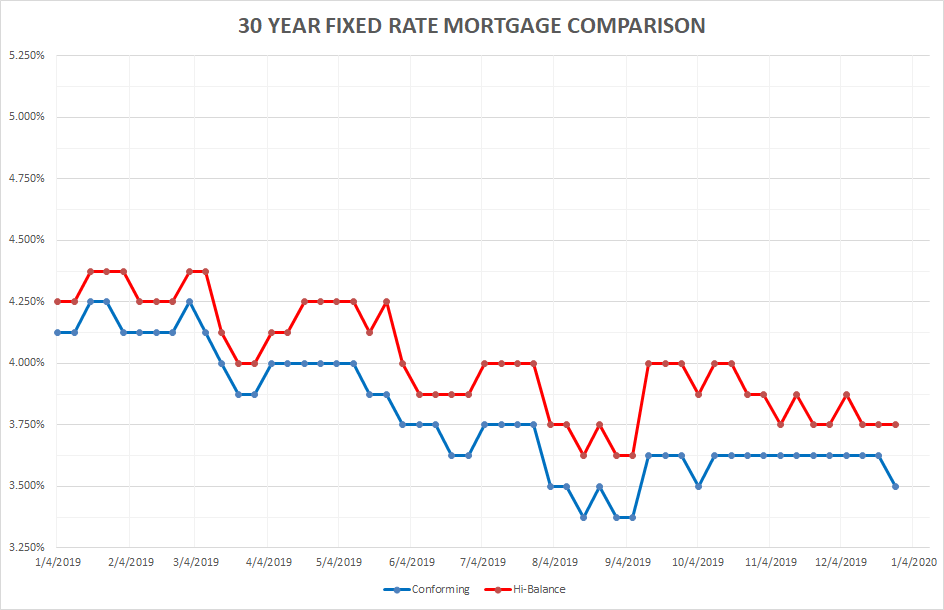
Rates for Friday January 10, 2020: Rates maintain their positions from last Friday. We saw a lot of action in mortgage and equity markets this week due to international events and the hostilities between the United States and Iran. Initially stocks dropped, as did rates, but both have since returned to earlier levels.

FIXED RATE MORTGAGES AT COST OF 1.25 POINTS LOCKED FOR 45 DAYS:

30 year conforming                                            3.50%    Flat

30 year high-balance conforming                   3.75%   Flat

Please note that these are base rates and adjustments may be added for condominiums, refinances, credit scores, loan to value, no impound account and period rate is locked. Rates are based on 20% down with 740 FICO score for purchase mortgages.

I was a bit worried last week posting a lot of movie reviews that readers would not care what I thought about movies. Thank you to those who responded favorably to the suggestions and I hope you too have enjoyed those you have decided to see.

We sent our college sophomore off on a 30 your trip very early Tuesday morning as she travelled from LA to New York to Germany to France and her final destination in Grenoble. She will be there for her semester and returning in late May. Taking full advantage of modern technology, Leslie and I had a brief video chat with her a little while ago to see how she is adjusting to her host family and environs.

I remember my parents telling us to keep a call short if it was “long distance,” which was also the next area code. We had a 15-20 minute video conference with our daughter through Facebook Messenger that did not cost us anything more than our mobile phone monthly rate. The world continues to get smaller and smaller.

Have a great week,

Dennis

Past Weekly Rate & Market Updates can be found on my blog page at my website www.DennisCSmith.com/my-blog
Vacation Update

Question of the week:  No question this week as we return from vacation.

Have a question? Ask me!

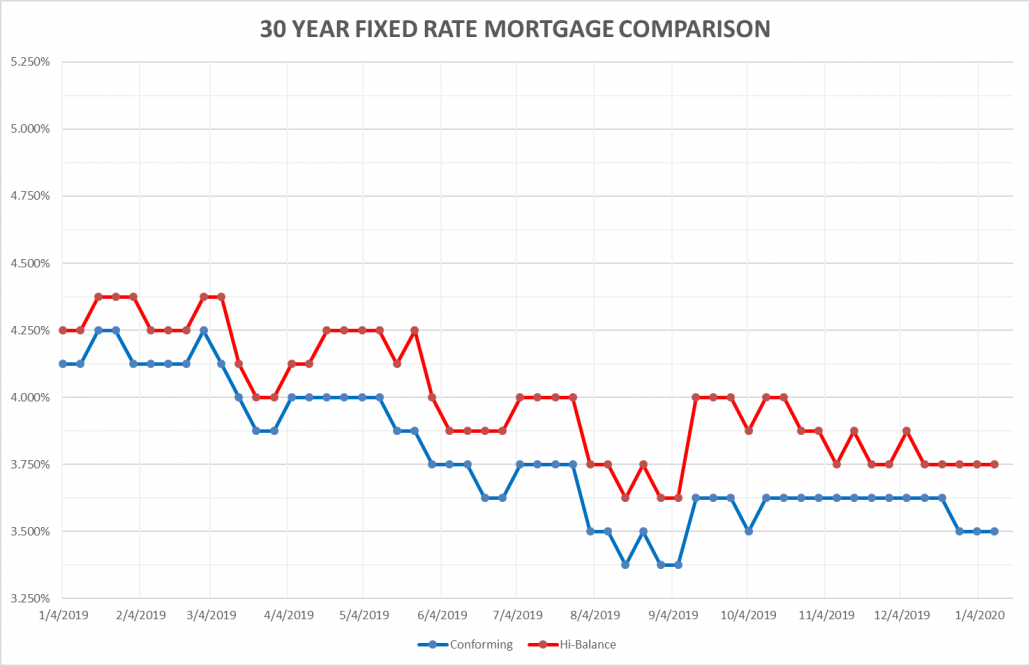
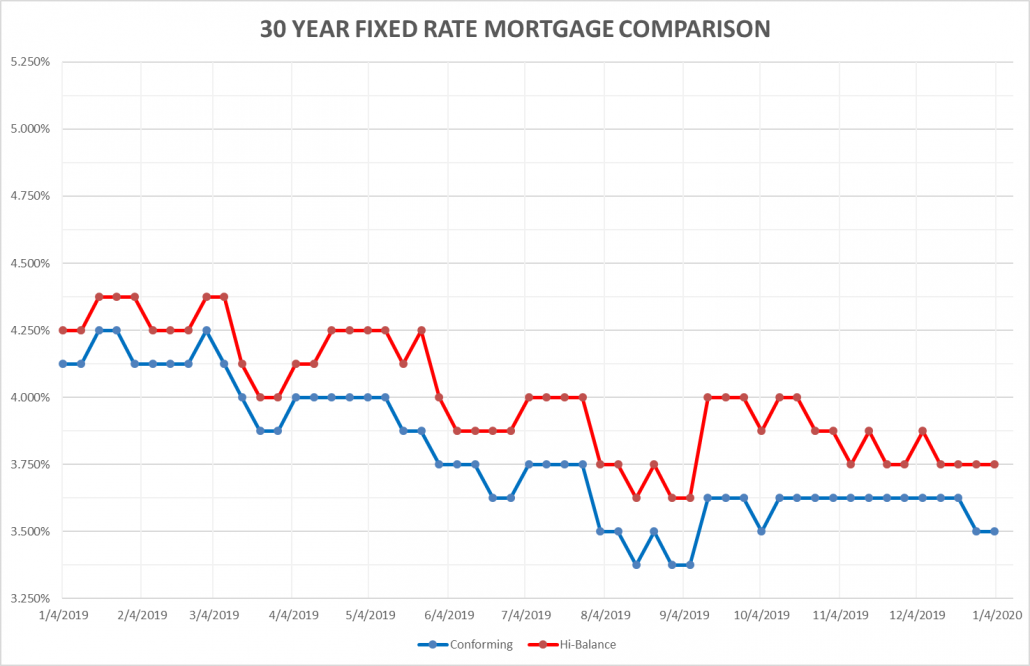
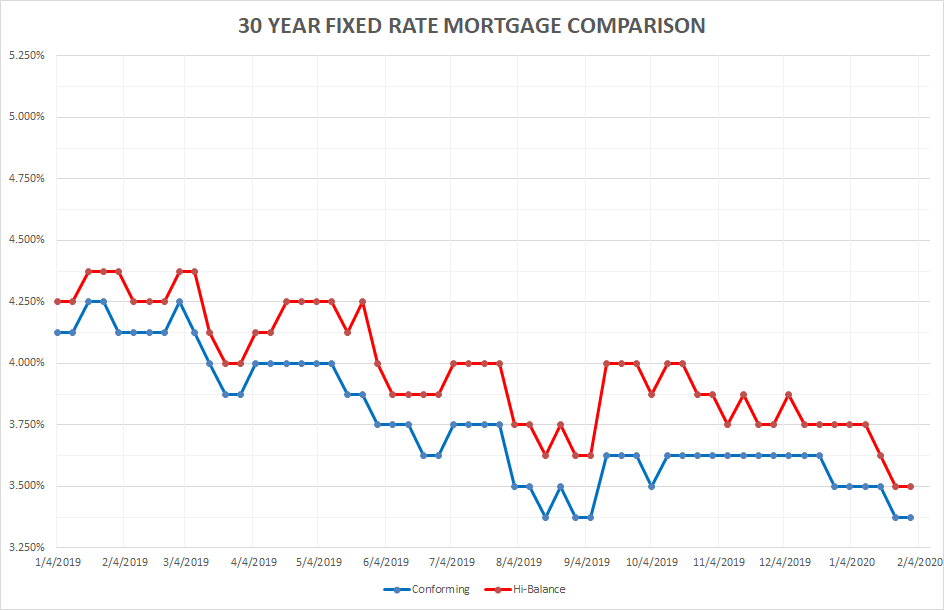
Rates for Friday January 3, 2020: Rates are flat from last Friday as traders laid low through another holiday week. The escalation of tension between the United States and Iran could (should) put pressure on rates to drop as conflict, turmoil and uncertainty usually has investors reacting to protect investments and “flee to safety,” which means fixed rate instruments like mortgages. Note that we start the new year and decade with the lowest rates for the first week of the year since January 2013 when the conforming and high-balance conforming rates were one-quarter percent lower (0.25%) than they are today. Also note the conforming and high-balance rates are 1.125% and 1.00% lower, respectively, than the first Friday of 2019.

FIXED RATE MORTGAGES AT COST OF 1.25 POINTS LOCKED FOR 45 DAYS:

30 year conforming                                            3.50%    Flat

30 year high-balance conforming                    3.75%   Flat

Please note that these are base rates and adjustments may be added for condominiums, refinances, credit scores, loan to value, no impound account and period rate is locked. Rates are based on 20% down with 740 FICO score for purchase mortgages.

As mentioned above, the Smith Family is heading home after a week away. Our tradition is to travel to Scottsdale, or Palm Desert if Dad forgets to make reservations soon enough, right after Christmas for a week. I get in some golf, everyone else gets multiple days to sleep in, we take hikes, play games and catch up on the December Christmas movie releases.

This week we saw:

“It’s A Beautiful Day in the Neighborhood,” excellent movie, Tom Hanks is fantastic as Mr. Rogers and the production was perfect way to tell the story of the man Mr. Rogers was and his impact.

“Uncut Gems,” is a very gritty movie that was very, very good. Our oldest, who does not like movies of this sort summed it up, “I did not like this movie but it was really well made.” Adam Sandler is excellent playing a guy who can’t make a good decision. The entire movie I was anxious and uncomfortable watching Sandler’s character go through a series of events.

“Little Women,” another really good movie. Well cast, the director followed the 1994 adaption of Louisa May Alcott’s classic novel of four sisters and did a very good job. For the guys reading this, “Little Women” is a great date night movie, for the women, it is a great date night or girls-night-out movie.

“Richard Jewell,” shows, once again, how good Clint Eastwood behind the camera. Telling the story of the hero then villain of the bombing in Centennial Park during the Atlanta Olympics in 1996, Eastwood has viewers going through a range of emotions. The entire cast did a great job, especially Paul Walter Hauser in the lead role.

I recommend all of our vacation week movies, and if you go see them hope you enjoy them as much as we did.

(Side note, previously we have seen “Ford vs Ferrari” and “Knives Out,” both excellent movies that I also highly recommend. “FvF” was enjoyed by Leslie and our high school daughter, so it is not just a guy-flick, that said, Dad’s/Granddads a nice night out with son/grandson. “Knives” is extremely well done and the relatively unknown main character does a great job carrying the story from scene to scene amongst an all-star line up of fellow cast members.)

Happy New Year and Happy New Decade to everyone!

Dennis

Past Weekly Rate & Market Updates can be found on my blog page at my website www.DennisCSmith.com/my-blog

The Decade in Review

Question of the week:  A look back at the ‘10’s decade from the lens of mortgages and the economy.

 Answer:  Last week we took at look back at 2019 for mortgages, housing and the economy. This week let’s take a look back to the beginning of the decade and compare it to the end of the decade.

We started the decade with the economy in the early stages of recovering from the Great Recession. While the recession ended in June 2009 (a recession is defined as two or more quarters of economic contraction, or negative Gross Domestic Product growth, a recovery starts when there is positive GDP growth after two or more months of negative GDP growth). Despite the economy starting to grow six months earlier, 2010 saw continued increases in unemployment and decline in housing prices for most of the country. The onset, depth and length of the recession were the result of a collapse in real estate markets across the economy that had been fueled by very easy to obtain mortgages.

One of the first results of the recession was the implementation of new policies for mortgages funded through Fannie Mae, Freddie Mac, using FHA or VA financing and eventually all lenders. As I said at the time, underwriting guidelines went back to the way they were when I started in the industry in 1987—you had to prove your income, verify your funds for down payment and closing costs were your own or source where they came from, and the property you were borrowing or refinancing had to have its value supported by an appraisal. While there has been some relaxing in underwriting guidelines over the past decade, most of the fundamentals remain the same for borrowers looking to obtain the least risky mortgages in regards to rates and terms.

Let’s look back at the data from 2010 and compare to today’s numbers and environment.

As we did last week, we will start with mortgages and interest rates. A big change in the mortgage market from 2010 is the maximum loan limits for Fannie Mae and Freddie Mac. In 2006 the conforming loan limit was raised to $417,000 and it stayed at this limit until 2017 when it was increased to $424,100; in 2020 the conforming loan limit will increase to $510,400. In 2008, to encourage home buying and enable more homeowners to refinance Fannie and Freddie added the “high-balance” loan limit for properties in high cost areas, such as Los Angeles and Orange Counties. This limit initiated at $729,750 for single family dwellings. In 2020 the new high-balance limit will be $765,600.

The decade started with the conforming mortgage rate at 5.125% (using the same parameters I use each Friday for rates in the WR&MU, purchase of a single family residence with 20% down and a borrower FICO score of 740). We end the decade with the conforming rate at 3.50%, and the conforming rate being at or below 4% for three-quarters of the year.

January 2010 saw the median priced home in the State of California selling for $284,600. Statewide the median home price bottomed out in February 2012 at $268,810. As mentioned last week the median home price in California in November 2010 was $589,770, 107% more than the at the beginning of the decade and 120% higher than the bottom in 2012.

More locally, as mentioned last week the median home prices in November 2019 for Los Angeles and Orange Counties were $594,840 and $822,000, like the state median, these prices were up significantly from January 2010. The LA County median price was $316,698 a decade ago, up 88% today from January 2010. Orange County’s median price was $527,477 in 2010 and has increased 56% from the median price to start the decade.

A very large factor in our economy this decade has been the actions of the Federal Reserve. To support the mortgage market, keeps rates low and push economic growth the Fed engaged in a few maneuvers. First and foremost it dropped its discount rate, used by banks to borrow money from each other, to near zero. This caused the Prime Rate, used by many lenders as their benchmark for consumer loans, to drop to 3.25% in December 2008 and remain at that level until December 2005. Today the Prime Rate is 4.75%, down from a post-recession high of 5.5% in August 2019.

Of much greater impact, and significance was the “Quantitative Easing” policies of the Fed. In November 2008 the Fed began purchasing Mortgage Backed Securities (MBS, these investment instruments are composed of bundles of millions of dollars of residential mortgages, mostly from Fannie Mae and Freddie Mac) and U.S. Treasury notes. By purchasing these investments the Fed kept money flowing through the debt markets enabling lenders to continue to make mortgages. The plan was to purchase $600 billion in mortgage debt (MBS) and $100 billion in other debt, mostly U.S. Treasury notes. By March of 2009 the Fed had accumulated $1.75 trillion, well beyond its initial target, and expanded the QE program, purchasing another $750 billion in MBS and $400 billion in Treasuries and other debt. By June 2010 the Fed’s balance sheet had grown from $870 billion in August 2007 to $2.1 trillion.

As the Quantitative Easing ended the  Fed, and others, were criticizing banks for not lending enough, banks countered that there were not enough credit-worthy borrowers. This led the Fed to start what became known as QE2. Starting in November 2010 and continuing to July 2011 the Fed purchased another $600 billion in MBS.

During this time the economy was growing, unemployment slowly began to level off and employers were slowing hiring instead of firing. Not fast enough for the Fed however. In September 2012 another Quantitative Easing process began. QE3 started with the Federal Reserve purchasing $40 billion per month of MBS, in December 2012 the Fed upped the amount to $85 billion per month, reduced the purchases of mortgages to $65 billion per month in July 2013 and stopped the policy in October 2014.

In 2017 the Fed began slowly selling off some of it assets to “normalize” its balance sheet. The selling stopped in august 2019 and the following month the Fed’s balance sheet hit a post-recession low of $3.8 trillion, today the Fed holds $4.2 trillion in mortgage, Treasury and other debt, almost four times the size in 2007.

This is significant moving forward because $4.2 trillion sitting in the Fed’s accounts is $4.2 trillion additional dollars in our economy, and enables the Fed to have even greater control over the economy than it has every had before. Keep in mind the Fed, ostensibly accountable to Congress, really isn’t and acts independently.

Some hard economic data numbers for the past decade for those who are data geeks like myself.

In 2007 the unemployment rate was 5.0% and inflation was a very robust 4.1%. Unemployment rose to 9.3% to start the 2010’s and was at 1.5%. In 2011 the nation experienced its twenty-sixth consecutive month of more jobs leaving the economy than being created.

Despite the recession ending in 2009, the year ended with GDP at 2.5%. By the end of 2010 the GDP was growing at 2.6%, through the 3rd quarter of 2019 GDP was growing at 2.1% on an annualized basis.

We are experiencing economic history as 2019 will be the eleventh straight year of economic growth, the longest period in history. Will 2020 see a recession and break the historic streak? As I mentioned in last week’s WR&MU I do not think a recession is in the cards for 2020 unless some catastrophic or unexpected event occurs.

We have come a long way since 2010, economic and emotionally as workers and consumers have gone from fear to economic optimism and stability. What will the next decade have for us?

Have a question? Ask me!

Rates for Friday December 27 2019: It’s over! After ten straight weeks of no change in the conforming mortgage rate from Friday to Friday we see a change from last week. Mostly because of the mid-week Christmas holiday and light trading the conforming rate has dropped from last week, the high balance rate is also down.

FIXED RATE MORTGAGES AT COST OF 1.25 POINTS LOCKED FOR 45 DAYS:

30 year conforming                                            3.50%     Down 0.125%

30 year high-balance conforming                    3.75%    Down 0.125%

Please note that these are base rates and adjustments may be added for condominiums, refinances, credit scores, loan to value, no impound account and period rate is locked. Rates are based on 20% down with 740 FICO score for purchase mortgages.

Reading through some of my Weekly Rate & Market Updates from 2008, 2009 and 2010 I found myself experiencing some of the feelings I had back then. In the first week of October 2008 the stock market plummeted, it ended the day down 30% from the year before. Leslie, the girls and I were on vacation in Scottsdale and as I watched the numbers come in on the alerts I had set up on my phone my stomach was in knots and my head was light. That evening I told Leslie, “this is really bad. I don’t know what we are going home to, what our future will be for Stratis if this continues.”

We made it through, not without some pain. Stratis never laid off an employee, though we did go to four day work weeks with our staff. Thankfully, we have had, and continue to have, great staff—almost everyone who was with us in 2008 is still with us. Because our business model has always been to concentrate on long-term fixed mortgages and quality over quantity, we have been able to retain our excellent referral bases from past clients and professionals in the real estate and other industries.

It has been quite a decade and we thank everyone who has stuck with us and Stratis Financial through not only the past decade, but the one before that.

I hope everyone had a wonderful Christmas and/or Hanukah with plenty of good times with family and friends. Cheers to 2019, to the 2010’s and for the joy and prosperity 2020 and beyond will bring to each of us.

Have a great week,

Dennis

Past Weekly Rate & Market Updates can be found on my blog page at my website www.DennisCSmith.com/my-blog
What happened this year?

Question of the week:  What happened this year?

 Answer: It has been an interesting year, and a boring one depending on what issues and factors we are observing over 2019.

Since I am in the mortgage business let’s start our 2019 look back with interest rates.

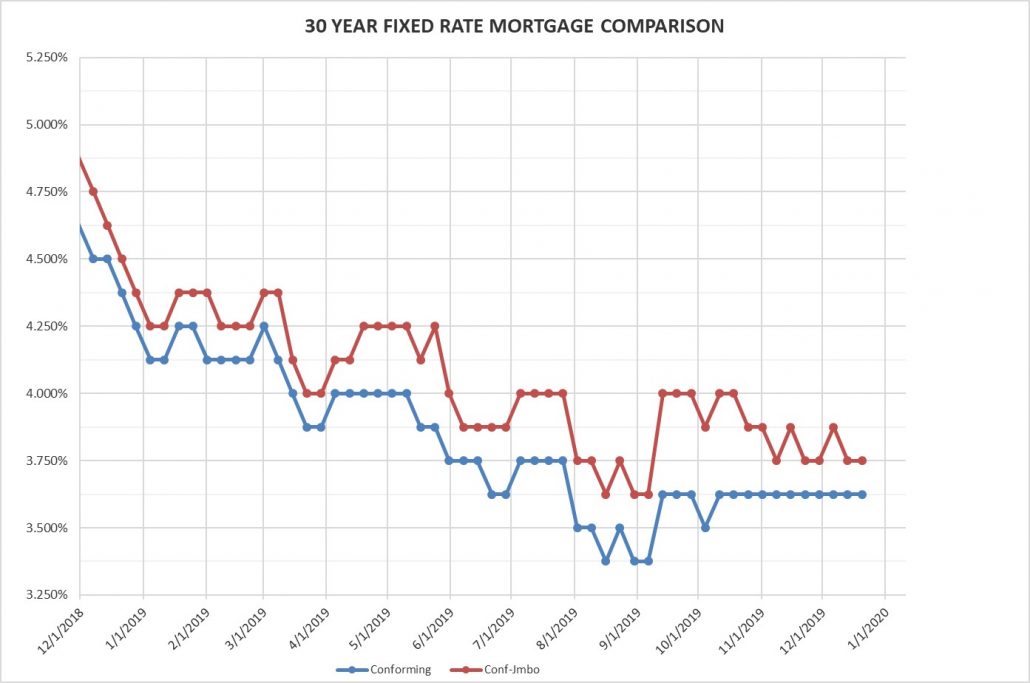
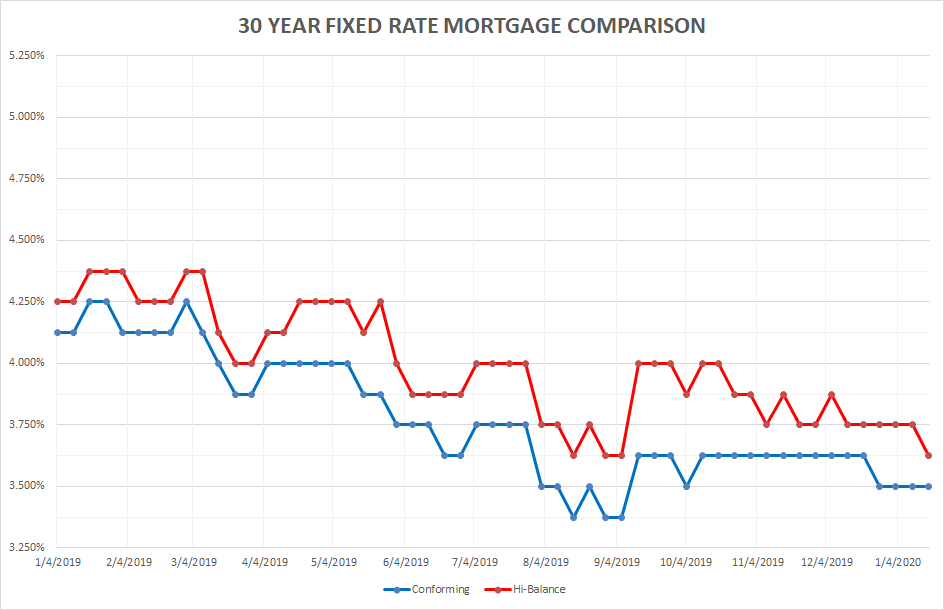
After a run up of one-half of one percent (0.50%) in the conforming 30 year fixed rate from the beginning of September to early October in 2018 rates began to fall as 2018 came to a close. The downward trend caused 2019 to open the year with the conforming rate used for the Friday rate in the WR&MU (30 year fixed conforming with 20% down purchase of a single family residence with a cost 1.25 points and a borrower FICO of 740) at 4.125%.  

Rates bounced around between 4.125-4.25% through February, then in March rates declined to reach 3.875% for a few weeks before spending most of April and into May at 4.00%. In mid-May rates started to drop again until reaching 3.625% briefly to end June before spending July at 3.75%.

July ended with the largest Friday-to-Friday drop in conforming rates, one-quarter of one percent (0.25%) since October 3rd to October 10th 2014. Weekly Rate & Market Update readers will eidetic memory will recall that on the first Friday in August I was sending the WR&MU from Milwaukee, letting readers know that earlier in that week the Federal Reserve announced a reversal of its rate policy. In previous announcements the Fed had stated it would lower its Fed Funds rate by three-quarters of one percent (0.75%) in 2019, after four rate increases in 2018. Following its meeting in the final week of July, Fed Chair Powell announced that the rate drop that day would likely be the final rate change the Fed would make in 2019. Markets reacted by snapping up bonds and mortgages causing the extraordinary move down in mortgage rates that week.

Entering August, following the Fed rate move and announcement on July 31st, the conforming fixed stood at 3.375%, the lowest since November 2016.  The historic lows lasted about three weeks, until the Fed went against Powell’s announcement in July and lowered rates again in mid-September and rates rose to 3.625%, where they have stayed every Friday but one (October 4th when we dipped to 3.5% for a few days) since. This is our tenth week in a row, and thirteenth of the last fourteen, that our conforming fixed rate has remained at 3.625% from Friday to Friday.

Summing up rates in 2019, they have dropped one percent (1.00%) since the start of the year and have been virtually unchanged for the last quarter of the year.

With rates being so positive for borrowers it is no surprise that housing markets in most of California and especially Southern California saw positive gains in values and transactions.

Using data from the California Association of Realtors from sales in November, the most recent month available, sales of single family residences across the state were up 5.6% from November 2018 and the median price went up 6.4% from $554,240 in November 2018 to 589,770 in 2019. Condos statewide also faired very well, up 7.3% in sales from a year ago and an increase in median price from $458,00 to $485,110.

More locally, Los Angeles County, despite seeing a drop in prices and number of units sold from October to November, had an increase of 5.1% in sales and a 7.4% jump in prices from $553,940 last November to $594,840 last month. Neighboring Orange County saw a decline sales from October and an increase in the median sales price, but also saw gains from last November in sales and prices. The median price in Orange County for a home in November 2018 was $795,000, after a 3.4% increase in prices the November 2019 median price was $822,000, the increase in prices was driven by a 6.9% increase in the number of sales.

Investors in the equity markets had a very good year in 2019. Whether an institutional investor managing pension funds or mutual funds, or workers with retirement accounts, or retirees receiving income from their accounts, everyone benefited.

As is frequently mentioned in the WR&MU, there is a strong relationship between equtity (stocks) markets and fixed-rate investment (bonds and mortgages) markets. Historically as the price of one goes up the price of others goes down. This year saw both fixed rate and equity markets see higher prices. (Refresher, when the price of bonds, and similar investments, go up their yields go down. So, when the price of Mortgage Backed Securities rise then interests go down.) As mentioned above, 30 year mortgage rates have dropped one-percent (1.00%) since January, which means the prices investors have paid for a 30 year fixed rate investment has gone up. The result was whether an investor had all their funds in equities or bonds, or a mix, they almost certainly saw a positive return through the year.

Investors were reacting with their consistent investing in all markets to an economy that has had incredibly consistent growth since the Great Recession ended in June 2009. Pushing the economy has been consumer spending, which has grown each month of the year with the exception of a dip in October from September. Consumer spending is 65-70% of our economy, if consumers continue to spend on goods and services our economy will continue to expand.

The expanding economy is directly related to the strongest labor market in decades. The year started with the unemployment rate at 4% in January, and for the rest of the year has declined to November’s rate of 3.5%. With the low unemployment rate has been a steady increase in wages, which outpaced consumer spending almost every month of the year through November. With wages increasing 0.54% in November from October, the annualized rate of increase in paychecks has been about 4% the first eleven months of 2019.

Workers have kept more of their paychecks as well as inflation has been at or below 2% month after month. With paychecks growing faster than spending and inflation the result has been that American families rate of savings has also been increasing.

None of the numbers showing growth in any sector in 2019 have been outstanding. Everything has grown in moderation, and has been for several years. Towards the end of 2018 and early in 2019 the “experts” were predicting that our economy would be in recession by now. Obviously they were wrong, in part because economists are very slow to change and most are still using old models and economic theories to try to predict future events.

Historically very low unemployment, raising wages, increase spending, leads to higher inflation which would lead to higher and higher interest rates. Our economy the past several years has bucked historical data. The constant economic growth has not resulted in high inflation and high rates. In large part because the growth has been so moderate.

As an analogy, think of a track meet. The fast race is the 100 yard dash. The runners go as fast as they can from the start and when they finish, they are completely spent, bent over gasping for breath and it takes a while for them to catch their breath and stumble around gasping. The middle distance runners start at a medium pace and then sprint to the finish line, they can run longer because they don’t push hard until the end. After their race the runners are tired and it takes a while for them to catch their breath. Marathoners run a very long distance at a measured pace, trying to keep their times per mile consistent to ensure they finish the race. When they are finished they are certainly very tired, all their muscles have been used and they are certainly in need of a rest, but do not appear to be gasping for breath as you see with the sprinters. Finally, we have the long distance walkers. Their strides look funny but their pace is quick and measured. When they finish their race they are also tired from their exertion, but their recovery is fairly quick compared to contestants in other events.

When an economy grows at a very fast pace over a short, or medium, period of time is it prone to falling quickly into recession and have that recession last for a long period time. When an economy grows strongly over a longer period of time it will generally shrink into recession slowly and the recession will not be as deep or long as the recession that comes quickly. When an economy grows very moderately over a very long period of time it does not have a lot of shrinking that needs to occur to enter recession, and when it does enter recession it will likely be shallow and short lived before recovery back to growing again.

I think the last statement is true because we have never had an economy grow for so long at such a measured pace benefiting so many sectors of the economy. Theoretically, the less an economy needs to lose to enter recession the less the damage to the economy as it shrinks and is in recession, therefore the less repair needed to pull out of the recession.

Because of the pace and breadth of growth in our economy, I feel 2020 will see more of the same, with moderate growth in GDP, wages, spending and inflation. The greatest risk to our economy entering a recession, in my opinion, is outside influences, such as a major recession in China or Europe.

Home prices in California should continue to grow at a modest pace and rates should continue to be below, or near, 4% for the coming year.

Next week: What happened this decade? A look back at the 2010’s in mortgages, real estate and other areas that impact housing.

Have a question? Ask me!

Rates for Friday December 20, 2019: The positive economic news this week would normally put upward pressure on rates, but investors are perhaps reflecting on the Fed stating no intention to raise rates in not reacting as expected. This time of year is weird with holidays in the middle of the week, senior traders and fund managers taking time away from the office leaving their juniors at the desks with the instructions, “don’t mess up,” which leads to conservative actions—like moving money into cash. As well, many may be selling some holdings to take some capital gains which could lead to drops in market prices over the next five or six trading days in 2019. Rates are flat from last week.

FIXED RATE MORTGAGES AT COST OF 1.25 POINTS LOCKED FOR 45 DAYS:

30 year conforming                                            3.625%     Flat

30 year high-balance conforming                    3.75%      Flat

Please note that these are base rates and adjustments may be added for condominiums, refinances, credit scores, loan to value, no impound account and period rate is locked. Rates are based on 20% down with 740 FICO score for purchase mortgages.

A very exciting few days for the Smith home as our oldest comes home this afternoon from Boston. We haven’t seen her since August and looking forward to a few weeks with her before she’s off to Grenoble, France for her next semester. Her arrival is the best birthday present Leslie will receive for her big day tomorrow—which will be a “Leslie Day” as we do her favorite things, see the new Star Wars movie, having Mexican food for dinner and then going to Color Me Mine to chat and do a crafty project. She loves all three, Star Wars, Mexican food and crafts.

I hope Santa is nice to you all, filing your stockings with joy, love and friendship.

Have a great week,

Dennis

Past Weekly Rate & Market Updates can be found on my blog page at my website www.DennisCSmith.com/my-blog