Why is our mortgage rate impacted by others in forbearance on their mortgage

Question of the week:  Why is our mortgage rate impacted by others who have a forbearance on their mortgage?

Answer:  Last week in the middle, or economic, section of the WR&MU I mentioned new policies enacted by the Federal Housing Finance Authority (FHFA) for collection of loan payments for Fannie Mae mortgages from mortgage servicers. For those who do not want to click back to the update here is a refresher, for those who do click back, this refresher is more in-depth than what I wrote last week.

Fannie Mae and Freddie Mac are called “GSE,” or Government Sponsored Enterprises. They are quasi-government organizations that operate somewhat independently but under government supervision and control. Fannie and Freddie became GSE as a result of the market crash in 2008 when as part of the TARP (Troubled Asset Relief Program) was created to purchase bad, or the term of the times “toxic,” assets from financial institutions.

In many cases instead of purchasing the assets the United States Treasury purchased significant portions of institutions which would be sold back as the funds used to support the institutions were paid back; in the then popular vernacular, when the bail-out was repaid. (A term back in the vernacular today.)

Fannie and Freddie were taken over by a new government agency, the Federal Housing Finance Authority and when that occurred the United States Treasury backed all mortgages funded by Fannie and Freddie who became GSE. Just like the GSE did before, when they were privately owned, the purchased mortgages were bundled into Mortgage Backed Securities (MBS) and sold to investors. The difference being is that the risk on purchasing MBS funded by the GSE was diminished to near zero thanks to the backing of the federal government.

The transaction has worked out well for the American taxpayer as through 2019 the Treasury has made approximately $100 billion on profits of the GSE after the initial purchases have been paid back.

Fannie and Freddie are similar but different, sort of like fraternal twins. They have slightly different underwriting guidelines and processes. Fannie is the more robust twin with about 30% more mortgages funded than brother Freddie. The flow of funds are the same for both of the GSE, investors to GSE to lender to borrower to lender to GSE to investor. Investor buys MBS from GSE, GSE buys loan from lender, lender funds loan for borrower; borrower pays mortgage payment to lender, lender forwards payment to GSE, GSE forward payment to investor.

This, the flow of funds, is what is impacting mortgage rates today. Initially the interruption was investors not excited about purchasing MBS, even though the investment is backed by the Treasury Department. Then the Fed entered the market in two ways. One was dropping its lending rate to member banks which depressed rates for lenders hedging their portfolios causing greater risk. Two was announcing it would purchase several hundred billion dollars of MBS.

This stabilized the lower end of the mortgage market, conventional loans (i.e. Fannie/Freddie) at or below the loan limit of $510,400. We saw rates drift down for both conforming and high-balance rates.

Then Congress passed the CARE Act, President Trump signed into law and the mortgage markets faced another challenge. One of the provisions of the CARE ACT is that any borrower with a federally backed mortgage on a single-family property is eligible for a forbearance for up to 180 days if they request one from their lender. (Note, for the purposes of this update “lender” will mean loan servicer—the company that collects mortgage payments from borrowers. Not all lenders who fund loans retain servicing for the loans and sell them to other companies to collect the payments and pass them along to the GSE.)

Forbearance means a modification of the monthly mortgage payment, either no payment at all, interest only payment, less than interest only; a payment in which the full amount due is deferred in whole or part.

To recap, money flows from the borrower making mortgage payments to lenders who pass those payments, less servicing fees, to the GSE. On the other side the GSE purchase loans from lenders who then have capital to fund mortgages for borrowers.

Prior to last week one of the differences between Fannie and Freddie was that if a loan was in forbearance a lender servicing a Fannie Mae loan had to continue to advance payments for principal and interest until the loan was paid off or foreclosed on. Lenders who had a Freddie Mac loan had to only advance payments for four months. Last week the Federal Housing Finance Authority gave lenders a bit of a break by changing the rules for Fannie to match Freddie, lenders have to advance four months of payments for loans in forbearance.

Big break! Right? Wrong, as the lenders are forwarding four months of payments on mortgages for which they are collecting no payments.

Let’s look at some math. Let’s say the GSE have about $600 billion in outstanding single-family mortgages with an average interest rate of 4%. Let’s say 15% of those homeowners file for a forbearance. That means $300 million per month in interest is not being collected (plus principal on the mortgages) by lenders that is being forwarded to the GSE. Four months of payments is $1.2 billion being taken from lenders in cash.

That is $1.2 billion that cannot be used for other mortgages. That is $1.2 billion that cannot be used for salaries, leases for offices or toilet paper.

This is how forbearance is impacting the market today. Because the lenders have to enable a forbearance on any single-family mortgage that is back by the federal government, lenders do not want to make a loan today that will become a forbearance later in the month, or next month or the month after.

It takes a lender about a year to recoup the cost of originating and funding a mortgage. A year of collecting payments. Add the cost of acquiring the mortgage, then add in four months of no payments during that first year and you can understand the financial loss a lender can take if a new loan goes quickly into forbearance.

Because of this, lenders are looking to mitigate risk while still engaged in their primary business: funding home loans. Risk mitigation is accomplished in several manners, higher rates, lower loan amounts, fewer programs that present higher-risk in normal markets.

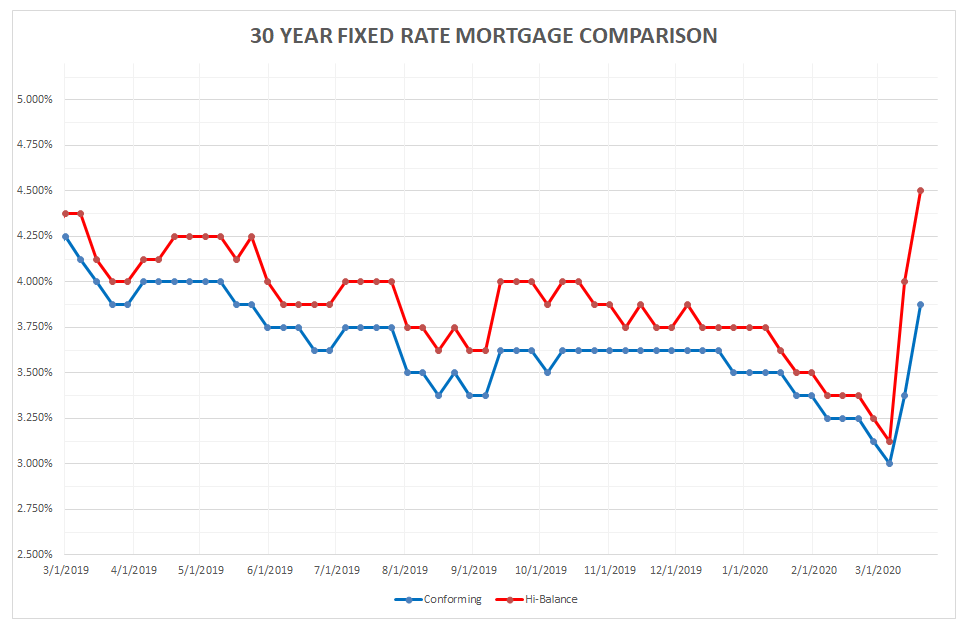
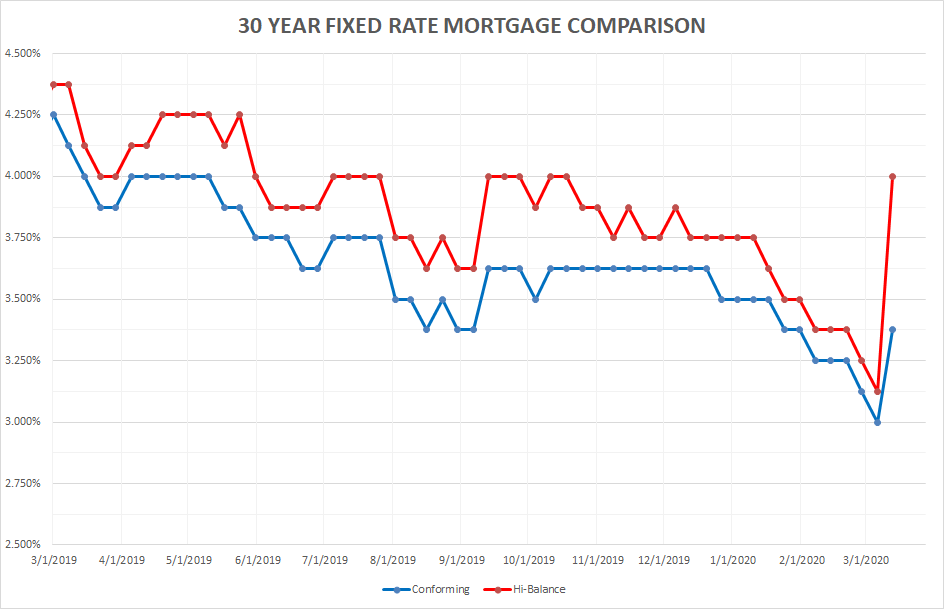
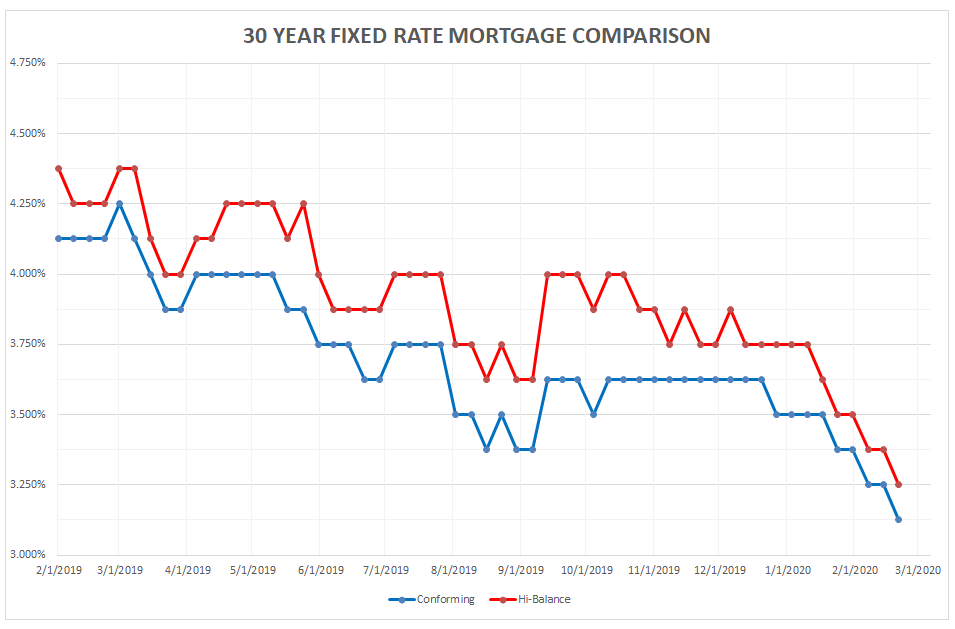
For conforming (GSE) products, what we have seen this week for single-family owner-occupied transactions are rates for purchases and rate and term refinances, for both conforming and high-balance loan amounts, have continued to drift down for purchases and remained fairly stable for rate refinances. These transactions are, at the moment, unaffected by the CARE Act forbearance regulations.

The high-balance market has been somewhat affected lender to lender as they manipulate their rates on a daily, sometimes hourly, basis to manage their pipelines and cash-flow, but across the breadth of the market we are seeing lenders with rates available on refinances similar to what we saw last week. For instance, one lender may have had a rate of 3.625% last Friday and this Friday for the same parameters are asking 4.00%, while another lender who was at 4.00% last week is at 3.625% today.

These are the loans that lenders feel most confident in people continuing to make payments and not ask for forbearances in the near future. Less confidence is given to loans for multi-family (2-4 units) borrowers, which results in slightly higher rates. Even less confidence is given to non-owner occupied (investor) mortgages. And even less to borrowers refinancing and taking cashout as part of the transaction.

Regarding the cashout refinances, several lenders have imposed such a high price premium on the transactions they are essentially telling the market, we are not going to fund any transaction that is not a purchase or rate and term refinance.

What is the solution? As I mentioned last week, either Congress needs to pass legislation enabling the Treasury to open a credit window for lenders to borrow at very low, to zero, rates funds to cover their payments to GSE for mortgages in forbearance because of the CARE Act. As well, the Federal Reserve can step forward and do the same thing, enabling lenders to borrow from the Fed at the same rate charged to member banks to cover their forbearance payment losses.

This would enable lenders to retain liquidity, will greatly stabilize the markets and enable the mortgage industry to provide lower rate mortgages to families to provide payment relief and homebuyers to purchase with lower rates as well.

Have a question? Ask me!

It came as no surprise that the economy shrank 4.8% in the first quarter as a result of the economic shutdown due to Covid-19. The big, huge, question to be answered is what will be the amount of contraction in the second quarter? I have seen some estimates as high as 25%–which would be beyond the Great Depression for a single quarter. There is no amount of federal stimulus money or programs that can provide relief if this were to be the case. The only cure for slowing the economic slide and prevent a major depression is to enable businesses to operate, enable paychecks, enable goods and services to be purchased by the American consumer.

Frequent readers of the WR&MU know that consumer spending is 65-70% of our economy. Preventing consumers from spending has only one result, economic calamity. At some point those able to enact and enforce economic transactions by picking winners and losers as to which businesses can operate and those that cannot need to make the decision as to what amount of medical risk for communities and are nation is acceptable compared to the risk of economic collapse. What will be the long-term toll of each? Being a student of economics going on forty years, I know that the primary basis of physical and mental health is economic stability. For the same amount of time I have been a student of politics (my degree is in Political Studies and Economics), and it has always been apparent that there exists not an insignificant amount of economic ignorance by most elected officials who do not fully grasp how business, small, medium or large, works and the intertwining of all sides of economic transactions. Our stability becomes exponentially more fragile the longer businesses are forced to remain inoperable.

Off my soapbox, for now.

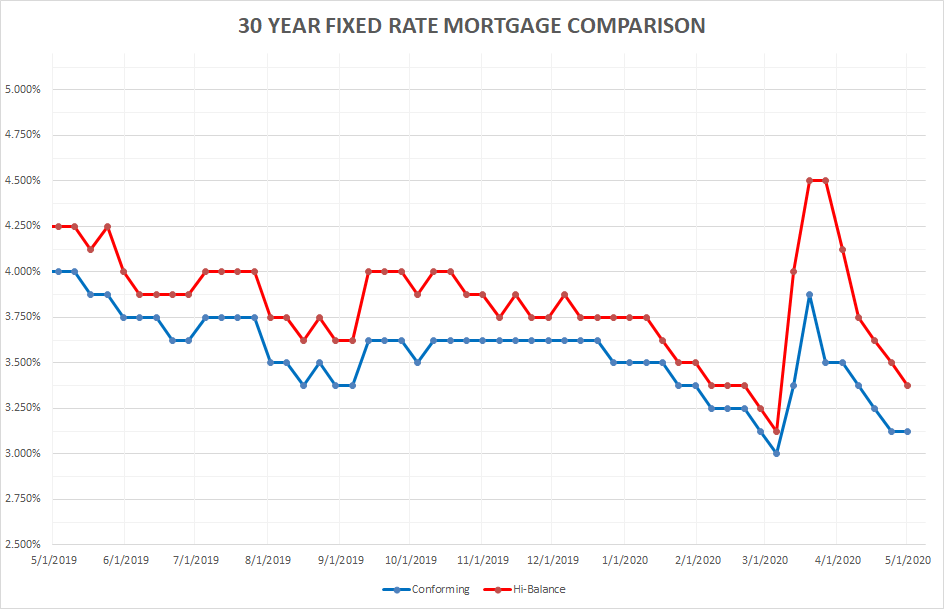
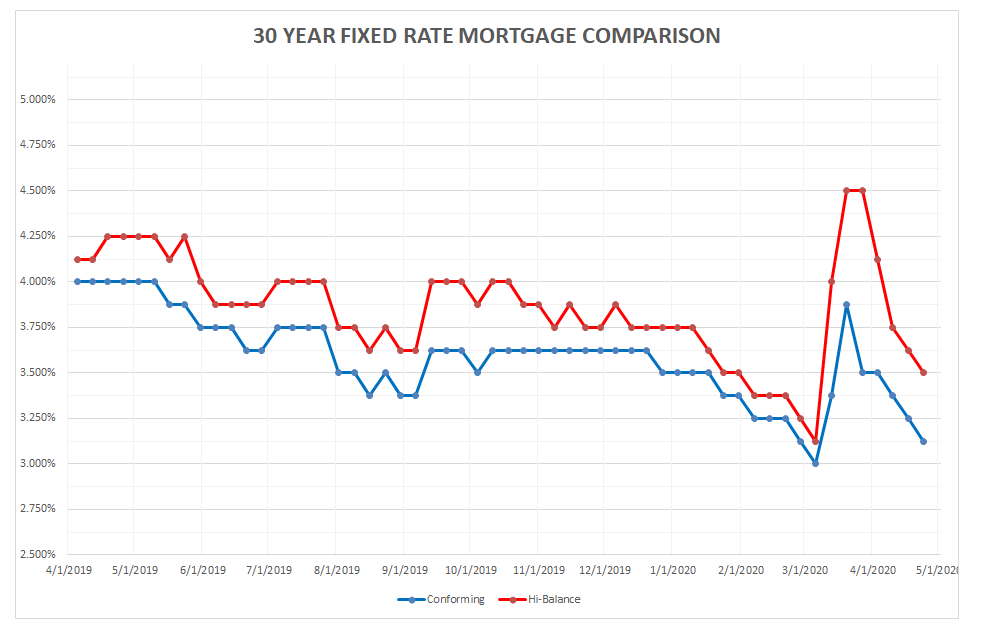
Rates for Friday May 1, 2020:  As mentioned above, rates for purchase transactions remain fairly stable this week. Refinances are case-by-case depending on your situation so call to go through your options.

FIXED RATE MORTGAGES AT COST OF 1.25 POINTS LOCKED FOR 45 DAYS:

30 year conforming                                            3.125%     Flat

30 year high-balance conforming                   3.375%     Down 0.125%

Please note that these are base rates and adjustments may be added for condominiums, refinances, credit scores, loan to value, no impound account and period rate is locked. Rates are based on 20% down with 740 FICO score for purchase mortgages.
I was pleasantly surprised last week in the number of people who commented on my look at the tax implications of the Payroll Protection Program, especially for California businesses. Thank you for all those who provided feedback.

I began home isolation on March 2nd. As some may recall, my daughter had returned from France as her semester abroad was cancelled that Saturday (February 29th) and our company felt it best I stay home for two weeks to ensure she did not pick up C-19 while in France, or her journey through Italy just as they were closing cities. The following week is when the states, counties and cities started isolation orders.

I am now beginning my third month of missing my co-workers, and my wife wishing I was bugging them in their office everyday instead of her in the home office (she has always been a home-based company). I miss seeing my co-workers every day, but am so proud of how our in-office staff have been still providing the great support and service to all the originators in our company to continue processing and funding much needed mortgages enabling families to purchase their new homes or save money on their current mortgage payments.

 I am very fortunate to be in an industry that is still active and providing services to those who need mortgages. Thank you to everyone who has enabled me and Stratis Financial to assist you with your mortgage needs before the C-19 pandemic, but especially during the crisis. We are a small independent company and our much of our staff has been together for almost twenty years. We are grateful for our clients who are enabling everyone at Stratis to work and do our jobs providing excellent service and mortgage products.

With tremendous thanks and gratitude to our clients, business partners who continue to refer their clients and especially our staff who make it all work,

Dennis

Past Weekly Rate & Market Updates can be found on my blog page at my website www.DennisCSmith.com/my-blog

How do unemployment benefits and proceeds from the Payroll Protection Program (PPP) impact mortgage qualifying?

Question of the week:  How do unemployment benefits and proceeds from the Payroll Protection Program (PPP) impact mortgage qualifying?

Answer:  Approximately 26 million Americans are receiving unemployment benefits (UB). Earlier this month when the CARE Act went into effect $350 billion was allocated for businesses under the Payroll Protection Program (PPP), and this week a supplemental bill allocated another $310 billion for the program.

While these programs are doing a lot to help people today, what is the longer-term impact of receiving those funds, and from a mortgage perspective what is the positive or negative if you apply for a mortgage in the future?

For purposes of this conversation I will be using Fannie Mae underwriting guidelines as they are the basis for most other mortgage programs.

As a rule, income used for mortgage qualifying is income that appears on your tax return, i.e. taxable income. There are some exceptions, but income not on your tax return is not going to be used to qualify for your loan.

Unemployment benefits are taxable at both the state and federal level. Does this mean that you can use these benefits for mortgage qualifying? Yes, no, maybe.

Income must be of a “constant and continuing nature” to be used for qualifying. Constant is defined as having been received for two years and continuing means it will be received for at least three more years. Like most guidelines there are some exceptions to this guideline, for instant spousal support has to be shown as being received for six months before it can be used to qualify.

For UB Fannie Mae will use the income of it is “seasonal.” For instance I have had educators who are not paid every summer and claim file for UB. We presented a history of receiving the income and it is allowed for income qualifying.

As for currently receiving UB, Fannie it cannot be used unless it is seasonal, but…. “Unemployment compensation may be used in qualifying a borrower for a high LTV refinance loan whether it is seasonal or non-seasonal.” While this is a Fannie guidelines most lenders will have an “overlay” in which there underwriting guidelines supersede Fannie’s. In prepping for this week’s update I contacted a few of our lenders and they indicated it is very unlikely they would include a current recipient of UB that are non-seasonal as income.

What if you receive UB now, go back to work in a few months and then apply for a mortgage? There is a very likely chance your income will be used to qualify for a mortgage. The gap in employment is easily explained as job loss due to the Covid-19 pandemic, you are back at work and earning again.

Having UB in your income history is not a factor to automatically deny income or a loan. What is the history before the UB income and what is your current income are what is important. 

To recap, while unemployment benefits are taxable income, unless you can prove it is seasonal income current recipients will not be able to use the income to qualify for a mortgage.

Onto the second part of our question, is than an impact for small businesses that receive loans from the Payroll Protection Program?

No. There is no benefit, but there could be a negative.

The purpose of the PPP is to enable businesses to retain their employees and payroll through the C-19 pandemic. Businesses can receive up to two and a half times their monthly payroll (calculated as the average for the prior twelve months with some modifications) for the period from February 15, 2020 to June 30, 2020 in the form of a loan. If the business can show that the funds were allocated properly to retain employees and the business operations (a percentage can go for office space costs, etc) then the loan can be forgiven in total or in part.

Loans that are forgiven are considered taxable income. Under the CARE Act and its follow up there is a provision that the IRS will not tax amounts forgiven under the PPP. Further, the IRS code prohibits taking deductions against forgiven income to prevent double-dipping on tax savings. However, not only did Congress amend the tax code to have PPP forgiveness tax free, but also to enable deductions of expenses covered by the PPP, i.e. payroll and benefits to employees.

PLEASE NOTE Because the IRS will not be taxing the forgiveness as income does not mean the states will exempt the PPP loan forgiveness from their tax codes.

Many/most state have what is called “IRC conformity,” which means the state tax code conforms to the Internal Revenue Code of the federal government.

Now it gets a little murkier. Many states, about twenty, have a “rolling conformity,” which means their state tax codes automatically rolls with the changes in the IRC unless the state passes a law to exempt parts of the IRC and establishes separate tax codes for those exemptions.

Many states, also about twenty, have “static conformity,” which means their state codes conform to very large parts of the IRC as it was written in the past, but not at the moment. These states must update their codes on an annual basis to conform with the IRC, so they are always at least a year behind.

California is a static-conformity state. California has not voted to have its state tax code conform with the IRC since 2015. Why? California did not want its tax code impacted by the Tax Cuts and Jobs Act of 2017. For California businesses to have PPP loan forgiveness not taxes by the State of California Sacramento must pass a bill specifically stating the State will adopt the IRC on PPP forgiveness into the tax code. Depending on how you hold your business (C-Corp, S-Corp, Sole Proprietorship, etc) your tax on PPP loan forgiveness can be up to 12.3%.

From a mortgage qualifying perspective there is no benefit from the PPP in regards to income. If the loan is forgiven it will not be used as income.

There can be however a detriment depending on whether all, part or none of the PPP loan is forgiven and you are required to repay the loan. The detriment is that the loan payments will be on your tax returns and decrease your net income. While the rate on the PPP loans is a very low 1%, the balance must be repaid over a two-year term. If you received a $20,000 PPP loan and none of it was forgiven then you will have $20,000 as a liability on your balance sheet and any amounts paid in a tax year will reduce your income. This reduces the amount of income you have for mortgage qualifying.

It will be interesting as the pandemic isolation orders roll through the economy to see what, if any, mortgage guidelines are adapted regarding income qualifications. My feeling is that there will be very little, or no, changes as income verification has been very consistent up until the early 2000’s when Fannie and Freddie loosened up income requirements and began mass approval of mortgages without verifying income and again after the housing market meltdown and subsequent passage of the Dodd-Frank Act in 2010.

Have a question? Ask me!

Part of the CARE Act required mortgage servicers of Fannie and Freddie mortgages to grant loan deferments, or forbearances, to borrowers impacted by the Covid-19 pandemic. Essentially telling loan servicers they have to enable borrowers to miss payments. What was not in the CARE Act is a mechanism by which the servicers of mortgages do not have to pay Fannie and Freddie the principal and interest on the loans granted deferments due to federal law.

The Federal Housing Finance Authority (FHFA) sort of helped the issue this week by aligning Fannie Mae’s collection of loan payments from mortgage servicers with Freddie Mac’s collection policy. FHFA announced that mortgage servicers need to advance only four months of payments on mortgages payments missed by borrowers in forbearance due to Covid-19 deferrals, after four months the servicers are under no obligation to advance scheduled payments. While this is some help to servicers it does not go far enough to retain liquidity in the mortgage industry, especially for smaller entities.

The Mortgage Bankers Association has called for a federally backed liquidity facility to enable loan servicers access to funds to bridge their collection of mortgage payments and payments that must be sent to Fannie and Freddie. This would ease the cash-flow problems of servicers, enabling them to fund more mortgages to help families able to refinance to lower their payments or purchase their new homes. With Congress on a spending spree it seems reasonable that a major part of our economy would receive some assistance to borrow funds to enable mortgages to continue to be funded. “Reasonable” and legislative bodies are not always thought of in the same sentence without a prefix, “un-.”

Rates for Friday April 24, 2020:   The gap remains between 30-year fixed “vanilla” mortgages and other products. It will likely last until liquidity issues in the secondary markets are settled and investors develop a taste for a bit more risk. In the meantime, rates slip down again this week for purchase transactions. Note, rates below are for purchases, refinance rates differ.

FIXED RATE MORTGAGES AT COST OF 1.25 POINTS LOCKED FOR 45 DAYS:

30 year conforming                                            3.125%     Down 0.125%

30 year high-balance conforming                    3.50%       Down 0.125%

Please note that these are base rates and adjustments may be added for condominiums, refinances, credit scores, loan to value, no impound account and period rate is locked. Rates are based on 20% down with 740 FICO score for purchase mortgages.

Last Friday I received a nice email from Jeanine, long-time reader of the WR&MU and Realtor. She wrote in reply to my closing statement to the effect that from decay comes growth.

She wrote that there is a flower that only grows and blooms out of the ashes of wild fires. “I am hopeful ‘out of the ashes flowers,” she wrote, “ will be a metaphor for our continued concern for each other after we emerge from isolation.”

What a great message, and I and most everyone share this hope with Jeanine.

I did what we all do these days and Googled Jeanine’s “out of ashes flowers” and discovered the flower only grows in California, and only grows after wild fires. It is the Fire Poppy.

Thank you Jeanine for your bringing the Fire Poppy to my attention and your nice note, and thank you to everyone who sends me comment, questions, suggestions and just checks in after receiving the Weekly Rate & Market Update!

Have a great week,

Dennis

Past Weekly Rate & Market Updates can be found on my blog page at my website www.DennisCSmith.com/my-blog

Is it harder to get a mortgage today than a few months ago?

Question of the week:  Is it harder to get a mortgage today than a few months ago?

Answer: It depends on your definition of “harder.”

Fundamentally nothing has changed in mortgage approvals for traditional mortgages since the passage of the Dodd-Frank Act that was passed in 2010. Borrowers must show an ability to repay their mortgage, i.e. show income that supports a monthly payment. Borrowers must have credit history that shows timely payments and obligations that are such that they can support their new monthly housing payment, i.e. have decent credit scores and debt-to-income ratios below 43-50% depending on mortgage product. Borrowers must have sufficient assets for down payment and closing costs and reserves if required for the applied for program.

Income, credit, cash, the three legs to the mortgage approval stool need to be verifiable. That has not changed.

What has changed? Income verification. Especially for self-employed borrowers.

Two months ago, income verification essentially happened twice, when the file was being put together in processing for submitting to underwriting and again before the loan is funded.

In the first step, verification depends on type of income being verified. For the vast majority of applicants who have hourly or salaried jobs we use recent paystubs and W2’s, for self-employed we use tax returns.

In the second step, before we can fund a mortgage, we need to confirm the applicant is still working and being paid. This is mainly for W2 earners, and we call the employer and verify the client is still on the payroll.

That was two months ago. Today, due to the ever-increasing numbers of workers being laid off and furloughed, there is an additional verification. As well, most lenders are requiring third-party verification for self-employed borrowers.

The first verification is the same as before, we verify proof of income using paystubs, W2s, tax returns, etc. during processing. The second verification is before loan documents are drawn, why draw loan documents if a borrower is no longer employed and cannot show income sufficient to repay the mortgage? The third verification is right before the loan is funded, usually the same day.

Why the duplication of verification between drawing loan documents and funding? For refinances in California it might be as long as a week between when loan documents are drawn and when a loan can fund due to mandatory three-day rescission period. Let’s say your refinance loan documents are drawn on Tuesday. Your employment verification was completed the day before on Monday. You sign the loan documents on Tuesday, and we have to wait three days before we can fund your mortgage. Wednesday, Thursday and Friday pass, so we are set to fund your mortgage on Monday. One week has passed since the last employment verification. On Friday the company announced that it was cutting everyone’s hours or income by 20% to avoid layoffs. We call to verify employment, ask if you are still employed and if there have been any changes to your income. The answer is yes, we now need to recalculate your income, determine if you still qualify, and go back to underwriting for an updated approval.

For self-employed individuals verifying that income is still consistent and at the same rate as the income used to qualify you for the mortgage. How is this done? There are a variety of methods. Some lenders are asking for most recent bank statements and daily transactions showing deposits for your business that are consistent with the income on the application. Other methods of self-employed income verification are requiring a letter by your CPA or tax-preparer stating your income is consistent with the application, copies of invoices to clients showing you are actively billing and, in some cases, accompanying letters from the clients stating your are actively engaged in business. Every lender has a slightly different requirement, some more strict than others, for self-employed income verifications right before funding.

All lenders are requiring some form of attestation by borrowers stating that their income has not changed since their mortgage application.

The challenging on our side of the transaction, the origination and funding side, is that seemingly daily we are being presented with new forms for borrowers to complete, and/or with new guidelines that are added by lenders that result in new conditions for the borrower to meet after we have been given loan approval and a clear-to-close (when we can draw loan docs).

This is what is making loans harder to get from application to funding today from two months ago, the additional requirements at the end of the process so lenders are assured borrowers are still generating income and they are not funding mortgages to borrowers who will not, or may not, be able to repay their new mortgages.

What is also harder is the stretching of time frames due not only to the volume in the pipelines throughout the industry, but also due to the number of people working from home which impacts communications and file flow. The “harder” part of this impact is the patience needed as files are moved along from point A to B to C to D.

Last week I listed many of the people involved in the mortgage process. Like many/most of you, many of them are working from home with kids, dogs and spouses in their place of work. If they are working from an office they are concerned about kids home from school with no day-care, or parents in a retirement community that may be prone to C-19 infections, what they need from the store for dinner, etc. Concerns and challenges most of us are facing, the difference is mortgage applicants will never interact with these individuals, they just need them to do their jobs so their mortgages will fund.

As I mentioned above, patience is one of the harder aspects of the loan process these days. Thankfully, one benefit that I have noticed of the stay-at-home policies has been that most people are showing more patience, and compassion for others, and hopefully for themselves as well.

Stratis Financial and the mortgage industry are open for business and ready to help you with your mortgage needs. While some aspects of the process may be a bit more challenging we are meeting those challenges as we have always met challenges, with clear and open communication with our clients and business partners to ensure everyone is working in the same direction—the direction to fund our clients mortgages are quickly and efficiently as possible.

Have a question? Ask me!

Economic data I found interesting this week, not the continuing climb of unemployment claims being filed as those were to be expected, but retail sales in March. The total decline in retail sales was down a historical 8.7% in March, a huge number. What interested me was the inside numbers. Stripping out auto sales and total retail volume dropped 3.1%, a very big drop in sales but not a large as I thought it would be. The two of the biggest segments of retails sales are automobiles and gasoline, which were down 27% and 17/% respectively. Other major categories were clothing stores down 50%, restaurants down 26.5% and department stores down 20%. Lifting retails sales numbers were grocery stores increasing sales by 27%, health and personal stores up 4.3%, internet sales up 3.1% and home centers (Lowe’s, Home Depot) up 1.3%.

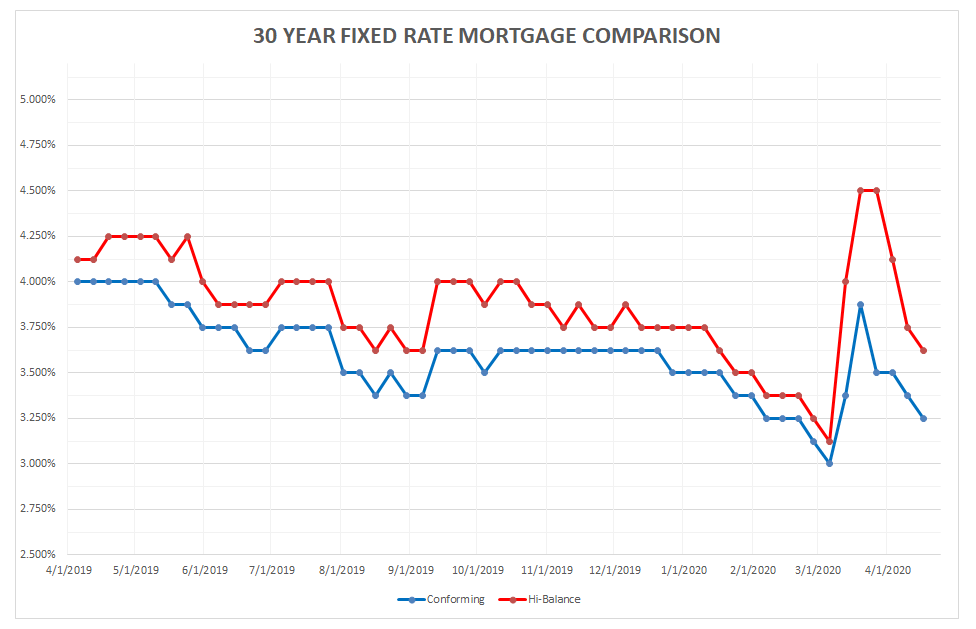
Rates for Friday April 17, 2020:   We continue to see a disconnect between the “vanilla” 30-year fixed mortgage for purchase and rate and term refinances and other products, but the gap is slowly shrinking.

FIXED RATE MORTGAGES AT COST OF 1.25 POINTS LOCKED FOR 45 DAYS:

30 year conforming                                            3.25%     Down 0.125%

30 year high-balance conforming                    3.625%   Down 0.125%

Please note that these are base rates and adjustments may be added for condominiums, refinances, credit scores, loan to value, no impound account and period rate is locked. Rates are based on 20% down with 740 FICO score for purchase mortgages.

Raise your hand if you knew what “Zoom” was two, or even one, month ago. For most of us it was “ZOOM!” inside a graphic in an animation or comic book. Today, Zoom is a verb, not describing going really, really fast, but an action of meeting with an individual or group using video on your phone or computer. One year ago, share of Zoom, the company not the verb, was selling at $62 per share. As I write this the company is trading at about $150 per share.

Perhaps no technology, or software application, has impacted and changed the world in a few weeks as much as Zoom has since early March. It went from a primarily business application for meetings to discuss budgets and proposals to grandmothers’ birthday parties, families gather for Seder during Passover and Happy Hour meet ups with friends and families. Our daughter is on Zoom several mornings a week taking her classes given by her professors in Grenoble, France, another student is logging into the classes from Indonesia.

I am very interested to see how the stay-at-home policies requiring a tremendous segment of the workforce to work from home, combined with Zoom and similar applications, will change the commercial real estate industry. Does your company still need 6,000 square feet of office space in a high rise in Irvine, Long Beach or Century City when productivity remained high during four, five, six, seven…weeks of 80% of your company working remotely? Maybe when the lease renewal comes up moving into 2,000 square feet makes more sense on the bottom line without compromising revenue.

COVID-19’s impact on the world will be long lasting in how we shop, dine, work and especially with how we interact with others near and far. A big benefit is the adaption of new video technology for the members older generations who previously had challenges texting or using applications on their phone or other devices.

From decay comes growth, from adversity comes solutions that have positive impacts on current and future generations.

Have a great week,

Dennis

Past Weekly Rate & Market Updates can be found on my blog page at my website www.DennisCSmith.com/my-blog
Who is involved in a mortgage?

Question of the week:  Who is involved in a mortgage?

Answer: Most people when they are getting a new mortgage only interact with a few people, their loan professional (me), escrow officer and/or assistant, appraiser, and if a purchase transaction their agent and home inspector. But these are just a small part of the team of people who are responsible for your mortgage getting approved and funded.

Here is a list of just some of the people who are involved in the mortgage process who are instrumental in the loan process, I am only detailing those involved in every transaction whether purchase or refinance so not including real estate agents, inspectors and others who are involved and critical for purchase transactions.

Loan professional That is me, and the tens of thousands of others who are the initial contact when you are seeking a mortgage. We provide the information you need on the type and dollar amount of mortgages that fit your situation, take the information needed for you application, are the messenger between processing and underwriting personnel. Essentially, we are the primary point of communication throughout the process. We strategize, manage your file, manage the rate lock and terms to protect you, provide solutions if something happens to potentially jeopardize your transaction.

Loan processor Our company uses processors and assistant processors to collect all the information that will be required for an underwriter to make a decision to approve your application. Processors ensure that we have all the required documentation to verify your income, assets, value of the property, title information to ensure clear title when the transaction is completed, value of the property, and that all this information meets the underwriting guidelines for the mortgage program for which you applied. Processors are the most critical person in the transaction. Their knowledge and ability determine who smoothly underwriting will be and how quick your file goes from approval to closing. A good processor will submit applications to underwriters that are easy for the underwriter to review, presents all the documentation needed for approval. Our processing staff is the best in the business and many companies over the years have told us when underwriters look at the files they have to review each day will put the Stratis file on top as they know it will be fairly easy file to underwrite due to the preparation of our processing staff.

Underwriter The underwriter works for the lender and is the person who determines if a mortgage application will be approved or not. They have guidelines that must follow for each type of loan. It is not unusual for underwriters to issue a loan approval that is subject to conditions to be provided. The conditions can be as simple as an address correction on the appraisal or the most recent paystub or bank statement. Or, conditions can be more complicated to unravel a series of deposits on a bank statement or income from multiple sources through various entities set up for tax purposes. Underwriters are like baseball umpires or basketball referees, the really good ones you often do not recognize how good they are as they issue common sense approvals that quickly lead to closing. The not so good ones we often need to have conversations with to point out why a condition is not required, how they item they want verified is already verified in the file we submitted, or seem to be looking for reasons to say “No” instead of “Yes.” Thankfully, the overwhelming majority of underwriters we work with are the former and not the latter.

Escrow officer Similar to underwriters, it is easier to spot escrow officers who are not at the top of their profession than to recognize the really good ones, for much the same reasons. Escrow officers are similar to processors in that they collect a lot of information from different entities involved in the process. They issue escrow instructions, which state what each party will do, interact with the title company for preliminary title reports and recording of documents, and they are the banker as all funds and payoffs flow through the escrow company. Good escrow officers and companies are ahead of the file in obtaining information they know we will need for loan approvals and fundings.

Not to diminish the others who are involved in a mortgage transaction, but these four are the most critical people involved in getting a loan through from beginning to end. Along the way there are many, many more people involved, I read somewhere a while ago that up to one hundred people are put to work for every real estate transaction, most of them are involved because of the mortgage.

One of the very important people we deal with on a regular basis are the representatives for the many different lenders with whom we have relationships. Lenders have different policies, niches and strengths and our representatives are very helpful as we look to find the best programs for our clients that combine the best rates as well as the guidelines that match our clients’ abilities. While Fannie Mae and Freddie Mac have policies that apply to all loans they purchase, many lenders have “overlays” on programs for how they verify certain types of income, assets or properties that they will not accept. For non-conventional mortgages the guidelines vary from lender to lender and our lender reps help us with what will fit their programs based on our clients’ information. As well, if we are having challenges with an underwriter, a snafu with a rate lock or other issues they are quick to help us resolve the issues. Most of our lender representatives have been our business partners for more than fifteen years, with a few going back to the early 1990’s.

At the end of the process we have the very important people who draw loan document and fund the mortgages. These folks are often under a lot of pressure as we approach a closing date, or a lock expiration date, and a file needs to get through the closing process. They ensure that all conditions are met on the file, communicate with escrow to ensure all the numbers are right for the fees for different services, taxes, insurance, interest on loans being paid off are all correct before drawing the loan docs. Once the docs are back in the office the funder makes sure everything is properly signed, that the funds for closing came from a verified source, that title insurance and property insurance have the right information for those insured and that the funds are ready to be wired.

These days the document and funding departments are also undergoing the additional task of double verifying employment. With the tremendous number of people losing their jobs each week, employment is verified before loan docs are drawn so as not to spend the time drawing the docs for a borrower who cannot be funded. There is a delay, especially on refinances, between when docs are drawn and when a loan can fund, because of this employment is checked again just before the loan funds. Someone employed on Thursday when docs are sent to escrow may not be on Tuesday when the loan is set to fund. 

At the lender we interact with the rate lock desks to negotiate rates and terms, work with us when we need a rate lock extension, or if the market is favorable to see if we can float a rate down.

This is all just to get your loan funded. Once the loan is funded your file is audited by compliance personnel to ensure everything is in the right order and follows regulations. Once this is complete the file is sent to the lender.

Once the file is received by the lender it is processed to set up your payments, what is called servicing. At the same time the file is reviewed by secondary market personnel to be bundled with hundreds of other mortgages to be sold in to Fannie Mae, Freddie Mac or an investor whose program was used for a non-conventional mortgage.

While the mortgage process starts with me, your mortgage closing and subsequent payments and history, is dependent on many people with specific responsibilities to ensure your loan can close.

At this time everyone in the process is working at full capacity to ensure files keep moving from step-to-step. When your loan closes take a moment to appreciate all the people you never met, had contact with or knew about who were integral in your transaction.

If you have any questions please feel free to contact me.

Have a question? Ask me!

As mentioned above, a new step in our process is multiple verifications of income. For salaried and wage earning borrowers this is relatively easy with phone calls and/or emails to supervisors prior to printing loan documents and then funding. For self-employed borrowers the process is more challenging depending on how, when income is received. If you are self-employed be prepared to show deposits into your bank account, letter from tax preparer/CPA or other methods that may show business activity during the COVID-19 pandemic shutting down offices with stay at home regulations.

Rates for Friday April 10, 2020:   A weird day for rates as the mortgage markets stopped trading mid-day yesterday and are not opening until Monday. Many lenders have shoved up their rates to prevent any rate locks until markets open again Monday so they are not caught short should the Mortgage Backed Securities market open considerably lower (higher rates) after the long Easter weekend. Rates below are average from a few lenders “in the market.” As you can see the high-balance conforming market is slowly coming back to a typical gap above the conforming rate. Note these rates are for purchase transactions (see disclaimer below), rates for refinances will vary.

FIXED RATE MORTGAGES AT COST OF 1.25 POINTS LOCKED FOR 45 DAYS:

30 year conforming                                            3.375%     Down 0.125%

30 year high-balance conforming                    3.75%      Down 0.375%

Please note that these are base rates and adjustments may be added for condominiums, refinances, credit scores, loan to value, no impound account and period rate is locked. Rates are based on 20% down with 740 FICO score for purchase mortgages.

We have been having meetings for the Rotary Club of Long Beach the past two weeks using Zoom. Our meetings always begin with an inspiration and flag salute. This week my friend Mark Guillen gave the inspiration and he said something that I want to pass along. Mark mentioned that most of us are often saying, “I wish I had more time…” Well, now many of us have more time. We have the time we are not commuting to work. We have the time not filled with meetings. We have time. We have time to be with our families and everyone not rushing out to practice, rehearsal, a date, dinner with friends. We have the time to have dinner together every night. We have the time to rotate who determines what movie or show to watch. We have the time to play cards or read a book.

When this current environment started and our girls were talking about all the bad things happening, from having semester abroad cancelled, to no prom or high school graduation, to not being able to hang out with friends, I told them there will be good things to come out of this. We may not know what those are for some time, or we may know pretty quickly, but whenever we find out there will be positive situations and changes. The positive in the present, as Mark reminded us, is time. We have time to be together.

I encourage everyone to take time to reach out and call someone you have spoken to in a while, you have time.

Have a great week,

Dennis

Past Weekly Rate & Market Updates can be found on my blog page at my website www.DennisCSmith.com/my-blog

How can a mortgage deferment impact me in the future?

Question of the week:  How can a mortgage deferment impact me in the future?

A quick note, payment deferment and forbearance are synonymous. Each refers to the delay of a payment due, not the same as forgiveness of a payment due. For terms of this commentary we will use deferment.

Answer: This is a question I have been getting a lot lately. Most major mortgage lenders have been announcing that due to the COVID-19 pandemic they are offering their mortgage clients deferments on their mortgage payments. For many families this is very welcome relief due to loss of income, other families may be considering using the opportunity to save some money and start back with their mortgage payments in the future.

Back to our question, what is the impact on a borrower who enters into a deferment program with their mortgage company?

The answer to this question varies depending on the lender and what is being deferred.

First, approving a deferment a lender may request proof that you and your family have been economically impacted by COVID-19, either through loss of income, loss of a family member to the virus, increased medical bills, etc. Some lenders may not require any proof, but from what I have seen most are trying to verify those who are getting deferments are in need of one to avoid going into foreclosure.

Before signing a deferment agreement here are some of the questions you may want answered:

  • What will be the impact on my credit? Will the lender report the deferred payments to the credit bureaus? Will every payment made until the deferred amount is paid current? Some lenders are stating they will not report deferred payments to the credit agencies, this protects your credit scores and also does not show mortgage late payments over a prolonged period of time which can impact your ability for a home loan in the future to either refinance your current mortgage or purchase a new home. If you are in such economic hardship that if you do not obtain a deferment you will have to go into foreclosure then future credit considerations are not as big of a concern; if you are considering a deferment for some cash-flow advantage then this is an important issue for  you to explore. Check with the lender as to their credit reporting policy on deferments.
  • What is the nature of the deferment? There are many variations lenders may offer to their clients, before agreeing to a deferment be very clear on what is being deferred, for how long and what are the terms of repayment.
  • The simplest deferment plan is the lender agrees to add any missed payments to the end of your loan term. For example, if you have a loan that is due in December 2030 and the lender defers your April 2020 payment, your loan will now be due in January 2031. If the lender defers three payments your loan will end in March 2031. For every month deferred your loan is extended a month.
    • Another form of deferment is to add the amount of missed payments onto future payments, spreading out the repayment of the deferment over a period of years. Sometimes this deferment is done when a payment is lowered and not completely postponed for the period of deferment. In this example, let’s assume you have a $2000 monthly payment. The lender may agree to alter, or modify, your payment to $1500 per month for the next twelve months. After that the payment will increase back to the $2000 per month payment for twelve months, and after that the lender will re-amortize your mortgage for the remainder of the loan term to make up for the $6000 not paid due to the modification and your loan term will remain the same.
    • Some lenders allow borrowers to catch up missed payments with lump sums at a future date. In the above example, a borrower may pay the lender $6000 to payoff the deferred amount to reduce future interest charges.
  • Will there be any charges to establish the deferment? Will there be an accrual of late charges for the payments that are deferred? This is important as if the lender is rolling the missed payments instead of adding them to the back of the loan, they may still assess the late fee of 5% of your payment. This goes back to how your loan is being reported to credit agencies if you enter a deferment agreement. Verify if there are any charges for the deferment and any late fees assessed during the deferment period.

From what I have been reading about the various deferment programs from different lenders, 90 days seems to be a popular deferral period. As well, many of the lenders are adding deferred payments to the end of the mortgage terms, not charging late fees and not reporting to credit agencies.

Key words, “most” and “many.” Every lender is different, do  not assume your lender is going to be as borrower friendly as no costs or dings on your credit report. Before making an agreement for deferment make sure you fully understand the long-term consequences and if they are such that your current situation is such that the immediate benefit of a deferral is worth any future consequences.

If you have any questions please feel free to contact me.

Have a question? Ask me!

Unemployment surged in March, more than expected. The economy shed over 700,000 jobs in March and the unemployment rates jumped from 3.5% to 4.4%. By far the largest job losses were in the leisure and hospitality industry, which accounted for 65% of lost jobs. A large impact on the labor statistics for March that were reported by the Department of Labor today was provisions in the stimulus package that went into law last week. Due to the more generous benefits than traditionally paid to unemployed workers through CARE Act, and looking to avoid paying sick-pay to workers, many employers have laid workers off. As well, many workers have reportedly asked to be laid off due to the amount of benefits being received, some then volunteering to assist in relief and recovery efforts in their communities. This not to discount the tremendous amount of workers who find themselves out of a job due to the virus, but understanding that Congress and the President have greatly eased the traditional transition to unemployment that has altered the employer-employee decision process.  

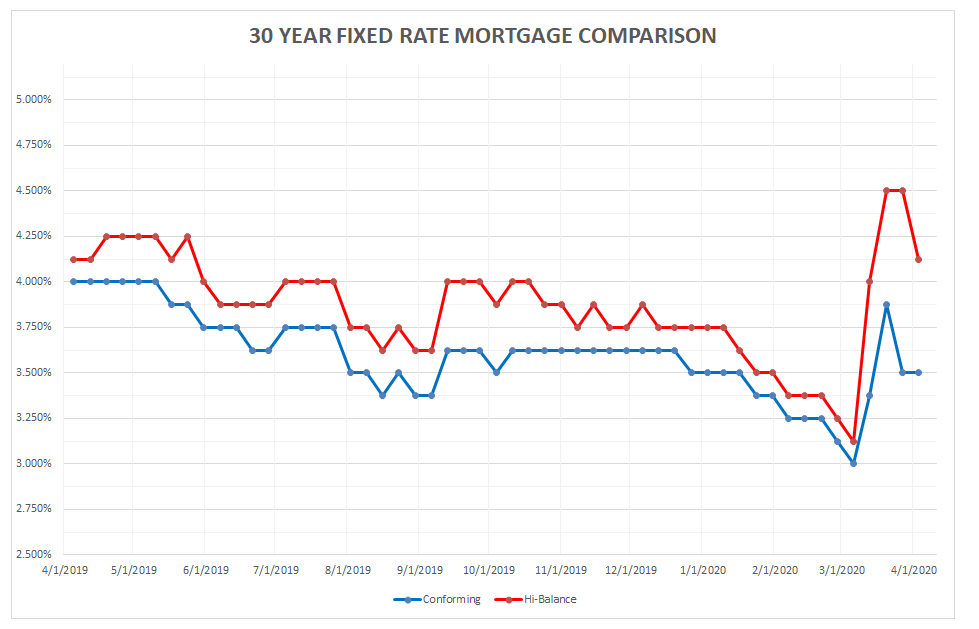
Rates for Friday April 3, 2020:   Rates continue to be volatile, as mentioned above. Rates below are quoted for 45 day locks for purchases only, refinance rates will vary.

FIXED RATE MORTGAGES AT COST OF 1.25 POINTS LOCKED FOR 45 DAYS:

30 year conforming                                            3.50%     Flat

30 year high-balance conforming                   4.125%     Down 0.375%

Please note that these are base rates and adjustments may be added for condominiums, refinances, credit scores, loan to value, no impound account and period rate is locked. Rates are based on 20% down with 740 FICO score for purchase mortgages.

Thank you for those who logged-in for my Lunch and Learn on how money flows through the mortgage industry. I recorded the session and am working on how to edit the file to eliminate the first minute or two of dead time. Once edited I will post on my website or elsewhere and provide a link.

My deepest apologies for subjecting everyone to my ineptness as scheduling and communicating! You did not deserve to receive three emails on the topic and I will do my best to prevent these errors in the future. Let me know if there are any topics you would like me to cover in the future, or re-cover one of our questions of the week with a bit more depth and ability for live Q&A.

Smith household is holding up well during our stay-at-home. Leslie, whose company has always been home based is looking forward to getting her office back—i.e. me going back to an office. The girls are trying to stay active and engaged through on-line classes and chats with friends. I am trying to get in my workouts via on-line sessions. And the dog is thrilled everyone is home and no one is visiting (he is not a fan of strangers in the house).

Stay safe, stay sane and treasure these unique times we have with our families!

Have a great week,

Dennis

Past Weekly Rate & Market Updates can be found on my blog page at my website www.DennisCSmith.com/my-blog

What happened this week? Another in the on-going COVID-19 series on rates and the economy.

Question of the week:  What happened this week?

Answer: A lot….

The headline news was the Senate passed a $2 trillion stimulus package earlier this week, and after I started writing this installment of the Weekly Rate & Market Update the House has passed the legislation and sent to the White House for President Trump’s signature.

The page 3, 4 or 5 news that impacts mortgage rates is the Federal Reserve announcement on Monday that it would purchase unlimited amounts of Mortgage Backed Securities. (Quick note to new readers, Mortgage Backed Securities—MBS—are the financial instruments that your mortgage becomes and are what decide the rates in the mortgage markets. Scroll through past posts of the WR&MU on at my website to read more about MBS and their relationship to rates I am working on updating page for an easy link to archived updates, in the meantime type Mortgage Backed Securities in the search box on the upper right.)

Back to our story, we left off with the Fed announcing it would purchase an unlimited number of MBS. This would seem to be good news for mortgage rates. Observant readers would note the word, “seem.”

Our industry has many great analysts that provide information and insight to those of us slogging it out in the fields on a daily basis. One such expert, who might be the most read and respected and if not the most in the top three to five, is Barry Habib.

Barry’s articles are geared to industry professionals, as such they can get a little bit in the weeds, however even then he is able to simplify the complicated. Yesterday Barry published such an article, “Mortgage Crisis and Fed Unintended Consequences.” It has been by far the most shared article I have seen in my career. I received it no less than five times from others in the industry, another five or more times in communicating with others they have mentioned the piece and it has been shared all over social media.

For the past few weeks I have been writing about rates going up, paradoxically to many. I have written, “there are a number of reasons, but one is…” picking some of the easier to understand issues impacting rates. In his article Habib goes into detail as to how the mortgage market works and how the actions by the Fed are having the impact of increasing rates due to harming lenders’ liquidity, profits and pipelines. The short, and very simplistic summation, is centered around servicing of mortgages and the loss of servicing revenue due to the rate markets and the added costs of acquiring new mortgages. Essentially, when a lender acquires a mortgage it takes about three years for them to recoup the acquisition costs through the fees they earn servicing the loan after they have sold it to Fannie or Freddie. When the rates drop so rapidly from where they were three, five, seven months ago, lenders lose a large segment of their servicing portfolio that has not yet turned profitable.

Further complicating the mortgage industry is the Fed actions harming lenders as they try to hedge their pipelines and losing as the Fed pushing MBS prices higher turns hedges into risks.

In a very, very, simplified nutshell, the Fed in trying to stabilize rates and thinking it is providing liquidity to the mortgage market is harming the market based adjustments for lenders; essentially disrupting the flow of funds in the circular pattern of funding borrowers, selling loans in the secondary market for funds to lend again, collecting servicing fees to offset origination costs, and starting the cycle again.

The current state of the mortgage market is that the non-QM (rather than get complicated these are loans that are not traditional, fully income verified mortgages) and jumbo mortgage products have dried up. For conventional mortgages, almost any mortgage that is not a 30 year fixed rate conforming purchase there is a premium added by lenders, which increases the rates for those products.

We do have some lenders that have concentrated on the purchase market, meaning they are offering significantly lower rates for purchase transactions than they are offering on refinances. As well, many are moving to not accepting rate locks until they have approved a loan submission package.

All this will sort out as the markets find “normal.” In the meantime we can expect choppy waters for non-conforming mortgages in the near future. Hopefully, near is very near and not a bit further near and lenders are able to sustain their pipelines.

In the meantime, we are dealing with historic markets and spreads within and between different products and lenders.

Have a question? Ask me!

In economic news, February data is showing that it was a positive month for economic growth and progress. Key indicators were all positive, durable goods orders, personal income, consumer spending and core inflation numbers all supported continued GDP growth for the 1st quarter. In normal times, personal income growing significantly higher than both expenditures and inflation would be a positive to push rates higher. In normal times.

Most economic news from last month is somewhat irrelevant at this point. Highlighting the point is that jobless claims for the week grew from 282,000 to 3.28 million for the week ending March 21st. It is the most claims ever filed in one week, over four and a half times higher than the prior record set in October 1982. Reading through various reports, it appears many employers were laying off workers ahead of Congress passing legislation on employer obligations for workers out on sick leave due to COVID-19 and other factors that caused employment attorneys advising employers to lay off workers despite wanting to try to keep them on.

Rates for Friday March 27 2020:   Rates continue to be volatile, as mentioned above. Rates below are quoted for 45 day locks for purchases only, refinance rates will vary.

FIXED RATE MORTGAGES AT COST OF 1.25 POINTS LOCKED FOR 45 DAYS:

30 year conforming                                            3.50%      Down 0.375%

30 year high-balance conforming                   4.50%     Flat

Please note that these are base rates and adjustments may be added for condominiums, refinances, credit scores, loan to value, no impound account and period rate is locked. Rates are based on 20% down with 740 FICO score for purchase mortgages.

Community physical health is directly tied to community economic health. Studies for decades have shown that disease and illness impact those in lower economic circumstances than those in higher economic circumstances due to poor eating habits and opportunities, stress and other external conditions caused by lack of prosperity. When is the “when” we must get to so that our nation’s workers and businesses can begin to engage in economic activity to recover from the dramatic drop in commerce, revenue and most importantly, wages?

The very big debate and decisions our nation must face is the “when?” When will the economic well-being of the nation become more vital than the physical health of an undetermined number of the nation? It is a moral question; it is a health question and it is a question that impacts today and the next decade or more. Not assisting in any debate on the “when” question is the extreme emotional element that comes into play whenever discussions involve people’s morals, values and ethics. How that conversation is had will be as important as to the answer and actions.

Back on the home front we have work, classes, yoga, workouts and of course some movie and binge show watching taking up our media devices. As well, I have been able to read more frequently than my normal routine of at least half an hour three times a day. I hope your family is getting along as well as ours during this period of confinement for most of you!

Thank you to those who replied in the positive to my inquiry about interest in “lunch and learn” about loans, economics, etc. I am working up a session on how money moves and will get out an announcement on time and date—likely on Tuesday mid-dayish.

Have a great week,

Dennis

Past Weekly Rate & Market Updates can be found on my blog page at my website www.DennisCSmith.com/my-blog

Why did rates go up after the Fed lowered rates?

Question of the week:  Why did rates go up after the Fed lowered rates?

Answer: Two weeks ago our question of the week was, “What is the impact of the Federal Reserve cutting rates?”  The answer section discussed how the surprise rate cut made by the Fed on March 3rd impacted mortgage rates with investors buying up Treasuries and mortgages pushing rates lower, and why they had this reaction.

 In the commentary I included a link to my WR&MU from October 2018 “How Does the Federal Reserve Impact Mortgage Rates?”.

The simple one-word answer to that question was, “Indirectly.”  That is because, contrary to many people’s belief, the Federal Reserve does not control mortgage rates. The only rate the Federal Reserve directly controls is the Federal Funds rate, the rate banks charge each other to lend over-night. Banks borrow money from each other over night so they can have the reserve amounts they are required to have depending on the amount of their deposits. Dennis’ Bank is required to have $2 billion in reserves, as the day is closing it has only $1.85 billion in reserves. The bank borrows $150 million dollars from Bank of Smith at the Federal Funds rate. The next day the loan is re-paid with interest.

As discussed in prior editions of the WR&MU, when the Fed changes its rate there is typically a ripple effect though the financial industry with other rates changing. The rate that most often moves in conjunction with the Fed Funds rate is the “prime rate.”

The prime rate is the rate banks charge their best commercial clients, usually very large corporations. There is no universal prime rate as every bank can determine this rate for themselves, however historically they all use the same rate. The prime rate as a rule is 3% above the Fed Funds rate.

The prime rate is the base rate used for most commercial and consumer loans, but not mortgages. If the prime rate goes up or down your credit card rate, student loan rate or auto loan rate may change. As well, if you have a Home Equity Line of Credit, that rate changes with prime as almost every bank’s rate for a HELOC is “prime + x.” As the prime rate goes up and down so does you HELOC rate.

Back to our question of the week, why did rates go up after the Fed lowered its Fed Funds rate to zero on Sunday?

There are many, many factors impacting financial markets in the current environment. As discussed many times, of the different areas for investment the two most closely related historically are equities (stocks in corporations) and fixed-rates (bonds and mortgages). The historical relationship is that investors either engage in some risk and purchase equities, or buy assurance and purchase fixed-rate assets with a fixed return.

An investor has one-million dollars. The economy is going well so the investor purchases stock in one or more companies with the expectation that they will have strong growth and profits making their companies more valuable. There is risk that something may happen to impact the economy, or specific companies or sectors where those companies operate, that could cause the companies to lose business, see declining profits and lose value.

An investor has one-million dollars. The economy appears to not being doing as well as it was and there is some question as to whether companies will grow and continue to show as much profit, so the investor purchases a combination of bonds issued by different government agencies and Mortgage Back Securities (MBS) which are provided a fixed return at a certain percentage of the investment. As long as the investor holds the bonds and MBS they know they will receive the same return every year.

The Federal Reserve raises rates when the economy is growing rapidly, or the Fed anticipates it will grow rapidly in the not-to-distant future, in an effort to keep inflation at an acceptable level so the growth does not suddenly get choked off by consumers not being able to afford to purchase as many goods and services.

Conversely, when the Fed feel the economy is slowing, or will slow, it lowers rates to encourage borrowing and spending.

On Sunday the Fed cut its Fed Funds rate to zero. As part of the announcement it also stated it would purchase $700 billion in U.S. bonds and Treasury note, and mortgages. The latter action is known as “Quantitative Easing,” which was done by the Fed several times during and following the Great Recession. The purpose of the QE programs is to put liquidity into the markets to keep cash flowing through the economy. As mentioned above, banks have reserve requirements. If they cannot sell some of their loans they cannot make any more loans. If banks cannot make loans the economy stops. The Fed is telling investors, “we are absorbing $700 billion in fixed rate assets.” The Fed is putting $700 billion into the economy.

There were some other more in the weeds actions announced by the Fed on Sunday which dealt with banks borrowing money and exchanging debt. All the actions had the same intent, keep funds flowing and calm investors with the goal of flattening markets and getting investors to follow the Fed and purchase fixed-rate assets. Which ideally would then cause them to re-enter the equity markets as well.

When the markets opened on Monday investors thumbed their noses at the Fed. Why?

The primary commentary was that the Fed did too much. While the Fed thought a huge move, cutting rates to zero and funneling almost one-trillion dollars into the markets, would have a positive result, investors wondered what was left?

The phrase I read that best described the market reaction was that the Fed fired all its bullets and don’t have any left.

What investors wanted from the Fed was a measured response with the announcement that it was prepared to act in the future if necessary. Last week I commented that I thought the Fed would lower rates by three-quarters to one percent (it lowered by 1%) and begin a QE policy. They did both of these, but investors were looking for a lower rate cut and not as large of a QE  purchase program.

Why? Investors feel that if the impact of the COVID-19 on the economy ripples deeper and longer the Fed does not have any more moves it can make along the way to ease the slide and support the flow of funds in the economy.

The Fed Funds rate after the cuts is 0%-0.25%. The only rate cut left is to go into negative rates whereby banks are paid to borrow money. Huh? “Dear Bank of America, we will pay you 1% to borrow $1 billion from us so you can lend that $1 billion out to your clients at a rate of 1%.”

That is one reason rates have jumped since the Fed announcement. Another reason is lenders are crammed to the gills with mortgages shoved into the pipelines starting in mid-January when rates began to drop. One analyst estimated that the mortgages locked with lender from mid-January to the first week of March was as much or more than the industry has funded in some years. I mentioned in a WR&MU a few weeks ago that lenders were raising and lowering rates throughout the day to control the amount of loans they could take in. With rates significantly higher over the past two weeks loan volume has declined accordingly.

Another reason rates have increased is because there are liquidity issues in the market. Lenders are running up against their limits on warehouse lines; lines of credit used to borrow money to fund loans that are then sold. The secondary market is where mortgages are packaged and sold in bulk as Mortgage Backed Securities. As mentioned above, investors are not fleeing to the safe returns of bonds and mortgages, so the MBS market is sluggish making it challenging for lenders to sell their mortgages.

These are the some of the reasons the Fed made the moves it made, to loosen up the markets and get the funds flowing. However, investors are not satisfied.

On the other side of the coin, equities, investors have been waiting for a very bold move by Congress with a stimulus package. As I write this there are bi-partisan negotiations for such a package that could top $1 trillion. Will that be bold enough? It might be as the Dow has improved very slightly since Wednesday as talks on the package have neared conclusion to lead to a bill for President Trump’s signature.

The big concern is obviously the “R-word,” recession. It was over a decade ago that the Great Recession occurred, one that many Americans were too young to understand, and one that too many remember all to well. That is the question everyone is asking, “will this be like 2008?”

The definition of a recession is two or more consecutive quarters with a shrinking economy.

There are three primary components to a recession that determine its impact: length, depth and breadth. How long will the recession last? How deep will it go, i.e. how negative will be economic activity? How wide will it extend, i.e. how many and what industries will be primarily impacted?

The Great Recession covered a period of eighteen months, December 2007 to June 2009. At its depth the Gross Domestic Product, the measure of our economy, was 4.3% lower than when the recession started. The breadth of the recession was very wide, primarily because the cause was the collapse of the housing markets across the country. Close to 65% of Americans own their own home. Because of this no area of the country was spared a drop in home values, and a loss of personal wealth as a result.

If COVID-19 does initiate a recession the three questions are vital to the economic impact and the recovery. Length, depth and breadth will determine how long, once the recovery begins, it will take for the economy and markets to be back to where they were before any such recession began—lets say March 1st if this quarter is the first quarter of two successive quarters of negative GDP.

The amount of change week-to-week, day-to-day, even hour-to-hour has created tremendous uncertainty, which creates raw emotions and concern. I am amazed at what has transpired over the past two weeks, like I am sure everyone reading this is as well.

Looking forward, I feel that when the quick reactions over the past two weeks or so are over, when a large stimulus package is passed, and nerves calm down, we will see a flattening in the markets. As well, when the rebound happens it could, should in my opinion, be fairly strong. Our economy was very strong going into March. Consumer confidence was high, job markets were high with wages outpacing inflation. Homeowners had growing equity secured by low rate, low risk mortgages that they qualified for using their real income. All these factors support, in my opinion, short, shallow and narrow.

Have a question? Ask me!

Rates for Friday March 20 2020:  As mentioned above, rates jump again this week. I pulled rates about 11:00 this morning, and the conforming rate was at its highest since last May and the high-balance rate was at its highest since December 2018. The last time rates climbed this high from a bottom was in 2018 when it took from January to October for the high-balance rate to climb from 3.875% to 5.125% and the conforming to climb from 3.75% to 4.875%.

FIXED RATE MORTGAGES AT COST OF 1.25 POINTS LOCKED FOR 45 DAYS:

30 year conforming                                            3.875%    Up 0.50%

30 year high-balance conforming                   4.50%       Up 0.50%

Please note that these are base rates and adjustments may be added for condominiums, refinances, credit scores, loan to value, no impound account and period rate is locked. Rates are based on 20% down with 740 FICO score for purchase mortgages.

I have a topic that I have been wanting to share as a few people have asked about it regarding the new credit scoring algorithms. I have been holding off to provide some insight on what is happening that I hope is helpful. My primary intent for the WR&MU is to educate, hopefully through the environment we are in now that is the case.

This morning on our walk with the dog I told Leslie I am thinking about a regular Lunch and Learn about Loans. My idea is to on a regular basis convene a meeting using Zoom to talk about topics I discuss in the WR&MU. Using Zoom would enable an interactive environment and those who participate being able to ask questions. Let me know if this interests you and I will look to put something together.

Part of the idea is from a few Zoom meetings I have had and knowing that we are all social distancing so many of us gregarious types are looking for contact with others outside the home.

Click here with a quick reply if you would be interested.

What are you doing while staying at home with the family? Here is a really neat site that have virtual visits to many attractions around the world, from museums to aquariums to classes for you and the kids. Virtual school activities. The other day I got lost in the Musee D’Orsay site looking at paintings.

For the Smith household, Leslie has decided that she is converting our stay-at-home situation into a Bed and Breakfast. This evening there will be mulled wine and a cheese plate in the living room. Tomorrow I think there will be watercolor painting by the pool before lunch and in the afternoon a walk through the neighborhood with a contest to see who spots the most number of different types of birds.

Reach out to those you haven’t seen or spoken to in a while. Check in with neighbors. Look forward when it is okay to shake hands or even better hug one another.

Have a great week,

Dennis

Past Weekly Rate & Market Updates can be found on my blog page at my website www.DennisCSmith.com/my-blog
What is happening with rates and economy?

Question of the week:  What is happening with rates and economy?

Answer: There is a proverb that is attributed to being a Chinese curse, “may you live in interesting times.” I have always taken the saying to be a positive, I hope my and our lives are interesting.

But as we know, and are currently experiencing, interesting can define many feelings, events and actions. We are certainly in interesting times.

In times of concern and worry some unrelated event to what people are concerned about can become the impetus for actions and events. Last week there were some large daily gyrations in financial markets. From Monday March 3rd to Friday March 6th the Down Jones saw choppy trading daily as investors were concerned about the global impact of the COVID-19 virus. For the week the index was down just over 3%.

Then came the unrelated event last weekend when Saudi Arabia’s state-owned oil company pushed up production. The reason for the large production increase was the breakdown in talks with Russia that were intended to reach an agreement on oil prices. Saudi Arabia’s actions were met by the Russians also increasing production, and a price war began. The immediate result was a drop of over 20% in crude oil prices in the United States. Investors, already concerned over the global economic impact of the COVID-19 virus hit the big red SELL buttons on the morning of Monday March 9th.

Why did a price war between the Saudis and Russians cause U.S. investors to sell? The price of oil per barrel in the United States fell 40% what shale producers need to break even. Such a large drop in oil prices ripples through the economy, and while good for consumers at the pump and heating their homes, investors concerns were more related to economic production and output.

As well, oil and gas sectors make up over 10% of high-yield bond markets, which would be impacted by the price war. Nervous about the COVID-19 impact, investors dumped stocks and bonds, causing prices in both to drop and interest rates to increase.

On Monday the Dow opened about 7% lower than Friday’s close and while gyrating through the day closed with a very small decrease. Tuesday it appeared stability had come to the front as after a mid-day drop the Dow climbed almost 7% in the final hours of trading, and only fractionally lower than Friday’s close. Wednesday saw a slow sell-off. Yesterday, following President Trump’s Wednesday night address to the nation indicating actions that would be taken to try to stabilize markets and stimulate the economy, investors again began selling as soon as the markets opened, dropping the Dow 7%. As I write this the Down is up almost 6% for the day, and down 5.5% from Monday’s open. Like every day this week the trading is choppy with swings up and down, but so far the trend is up for the day with an hour left in trading.

Usually interest rates follow stock prices, when stock prices drop so do rates and vice-versa. Because the impetus for the initial shock trades in the markets on Monday was the oil sector, which is a major influence on fixed rate markets, this week rates have been acting counter to their historical relationship with stocks and as stock prices have dropped rates have increased.

In uncertain times investors put their money in bonds, and mortgages, and the result is lower rates. The uncertainty in direction of the markets each day, the historical disconnect in the stock-bond relationship and the unsatisfaction with the Trump Administration’s announcement on economic action, investors have shown a willingness to sell investments and hold cash.

What’s next? My crystal ball has proven to be cracked, chipped, cloudy and at time myopic over the years. That said here are some things I have been looking at and considering.

When the Fed meets next week, perhaps before but I believe they want to all be in the same room when the announcements are made, it will announce a large cut in its rates—by large I mean 0.75-1.00% (keeping in mind Fed rate changes are infrequent and usually in 0.25% increments). Following the rate cut announcement, I would not be surprised if the Fed announces a Quantitative Easement policy reminiscent of the QE policies enacted after the 2008 real estate market collapse.

The policy will result in the Fed committing to buy billions, tens of billions, of dollars of mortgages and possibly Treasury bills and bonds. This will be to give confidence to investors, stabilize the fixed rate asset markets and provide liquidity so lenders can lend.

The huge unknown for all of us is the impact of the closing of sporting and entertainment events, colleges, and now schools (Long Beach Unified School District is closing classes from Monday until April 20th—one of those weeks was scheduled Spring Break), on the overall economy. Consumer spending is certainly very high right now**, which is very high right now as worried consumers stock up on household items and food. That is very good for the economy, but the untold billions of losses due to cancelled events and the ripple through the economy from the lost wages of workers and sales of tickets, concessions, parking, t-shirts, etc is of great concern.

Economic data from March, and January and December, showed the economy had a continuing strong job market with low unemployment and growth in the number of new hires monthly, and barely any layoffs across most sectors. Consumers were spending a bit more each month than the last, while inflation remained extremely low.

Post-COVID-19 impact is the uncertainty that will keep investors cautious, the actions by the Fed and others will determine how cautious.

In regards to the economy, I have heard many expressing concern that we are going down the same path as 2008, which was also precipitated by a single event. In February 2007, New Century Financial in Irvine could not find a buyer for its sub-prime mortgages. At the time it was the second biggest subprime lender in the country. When it could not sell mortgages to investors it had liquidity problems and stopped lending, eventually filing bankruptcy. Wall Street would not purchase the mortgages due to concerns in the underlying financial strength of the borrowers. This led to closer investigation of other subprime mortgage company offerings, which in turn led to spreading concern of the underlying mortgages that funded the housing bubble.

Back to today, I see the only comparison to 2008 being an event that led to a large drop in equity markets. The biggest difference is the underlying economies. Leading into the Big Recession we had an economy that was fueled by a single sector, housing, that was financed with weak mortgages with borrowers who were deemed “qualified” without verification of income, assets and very often appraisals of real estate. A tremendous percentage of homeowners were highly leveraged and when real estate prices softened many were quickly upside down, which created downward price momentum and we know how that story ended, millions of foreclosures resulting in banks and financial institutions going under.

Our economy since the Great Recession ended in June 2009 has been growing and growing and growing at an unprecedented rate—not in the size of the economic growth but the number of months, quarters and years.

Over the past decade we have seen families purchasing homes with larger down payments, with mortgages they can afford and the ability to lower their monthly payments have interest rates have declined. The housing markets are stable backed by homeowners in homes with a lot of equity and debt they can afford.

Over the past decade we have seen employment growth across all sectors and wages and salaries growing faster than inflation, and most months faster than consumer spending. The result has been a steady growth not only in the economy fueled by personal consumption (65-70% of our economy), but also a steady growth in personal savings rates and retirement accounts. Families are borrowing less on credit cards and saving more of their wages.

When, not if, when the current crisis of the COVID-19 virus is finished, when we get back to “normal” in our activities and actions, we have an economy that has sound fundamentals. This should be reflected in a much quicker recovery in financial markets that in the past when there have been major corrections as investors remember and realize these fundamentals.

In the moment we look around and worry about how we and our families are impacted by major events. In this case the worry is about something unseen that spreads without knowledge or warning until the spread has occurred. The most severe impact appears to be limited to a few demographics, severe enough to justify cancelling large gatherings to protect those most likely to be affected. Hopefully, the actions taken by federal, state and local governments, as well as organizations, to try to limit contact in large congregations of people will quickly “flatten the curve,” as we have been told and this will pass quickly.

As for mortgage rates…they are up significantly from last week as lenders have jumped ahead of the markets to limit their exposure should rates continue to rise—which of course causes rates to rise, which causes lenders to…

As mentioned last week, before this week’s tumultuous markets, lenders were raising rates off and on to control their volume depending on their capacity. The result was intraday jumps and drops in rates from lender to lender and in the market as a whole. I expect this activity to continue as lenders cautiously eye the markets, their pipelines and their competitors to see when they can return to market based rate decisions and more stability in the markets.

It is my contention that in the not too distant future we will see the “V-curves” rebound somewhat sharper than normal; i.e. rates will come down faster than normal and equity markets rise faster than they normally do after a correction. Investors hate “dead money,” or cash, and want their money to work for them.  For this to happen they must invest in stocks, bonds and mortgages.

Have a question? Ask me!

Rates for Friday March 13 2020:  This week the rates at 9:00 a.m. have not been the rates at noon which aren’t the rates at 2:00. As mentioned above, the past few days lenders have been pushing rates to protect themselves. Carefully scouring across many lenders we see some lenders dip down to pick up some rate locks and business and then quickly raise their rates later in the day, and the opposite with others. The increase from last Friday for high-balance conforming is the largest one-week jump I think I have ever seen—going back to 1987—and shows the risk-avoidance lenders have to expose themselves until there is some certainty in the market. The conforming rate increase from last week is largest since March 2012 when it also increased three-eighths of one percent (0.375%).

FIXED RATE MORTGAGES AT COST OF 1.25 POINTS LOCKED FOR 45 DAYS:

30 year conforming                                            3.375%    Up 0.375%

30 year high-balance conforming                      4.00%       Up 0.875%

Please note that these are base rates and adjustments may be added for condominiums, refinances, credit scores, loan to value, no impound account and period rate is locked. Rates are based on 20% down with 740 FICO score for purchase mortgages.

**One or two mornings a month I stop by our local Ralph’s on the way home from my workout class to buy milk. I am there usually around 7:00 a.m. and there are a few other shoppers in the store, also grabbing milk or breakfast items, what appears to be lunch, or items for lunch-time gathering or office celebration. As well, there are a lot of workers stocking shelves with many of the aisles blocked with cartons and pallets.

This morning as I pulled into the parking lot, I wondered why there were so many cars in the parking lot. Entering the store, I saw as many shoppers I would on a Saturday morning. They had carts filled with canned goods, everyone had toilet paper (shelves were empty) and there were a few people with carts filled with cases of bottled water. People doing “regular” shopping of meats, fruits, vegetables and canned goods where as prevalent of the doomsday-shoppers who evidently feel our water supplies are going to be contaminated and an epidemic of dysentery.

Like investors creating self-fulfilling prophecies with their actions to buy or selling thinking markets will go up and down, and thereby causing that to happen, we are seeing consumers behave and react in the same way. I am looking forward to when we have some semblance of reason return to the group mindset and behaviors.

In the meantime, we will have two kids at home due to my older daughter’s university sending all the students home and my younger daughter being home due to LBUSD cancelling classes.

We live in interesting times.

Sorry for the rather lengthy WR&MU this week, a lot I wanted to try to convey in some detail to provide some understanding, I hope.

Have a great week,

Dennis

Past Weekly Rate & Market Updates can be found on my blog page at my website www.DennisCSmith.com/my-blog

What is impact of the Federal Reserve cutting rates?

Question of the week:  What is impact of the Federal Reserve cutting rates?

Answer: In normal times…the Fed will generally signal in advance its general direction and timing on when it will move its discount rate (rate it charges banks to borrow from the Fed). Because of this the markets, stock and fixed-rate (bonds and mortgages) will react accordingly in advance of any rate announcement. When the rate change is announced it often results in interest rates for mortgages to move in the opposite direction—contrary to what one would think would happen.

For instance, in 2017 the Fed kept stating it would be raising rates through 2018. Not only that it would raise rates but when and by how much. Investors reacted accordingly, knowing the rate changes were coming, so when the Fed did raise rates as expected there was little to no change in mortgage rates or other markets. Mortgage rates climbed through 2018 as the Fed kept increasing its rates and economic news was positive. Before the final Fed rate increase in 2018 rates began to drop, partially on economic data and partially because the Fed was announcing only one more rate increase in December and then no plan to change rates in 2019. Investors were reaction was to the unlikeliness that rates would go up again in the near future, and because they would not go up they could go down. Their reaction was a cause for rates to drop into the summer of last year.

That was normal behavior by the Fed and the markets. As a rule, the Fed does not like to surprise markets with unannounced rate cuts as the result could be over-buying and over-selling in either stock or fixed rate markets.

The Fed announcement of a rate cut earlier this week was a surprise. Not only that the rate cut was made without their being a meeting of the Federal Open Market Committee (who makes the rate decisions), but that the rate was not changed in the normal 0.25% (one-quarter of one-percent, or twenty-five cents on one hundred dollars), but was dropped one-half of one percent (0.50%).

The double surprise of the rate cut and the size of the rate cut sent investors scurrying to cover their ass-ets. They sold off on stocks, causing equity markets to drop; and purchased bonds and mortgages causing rates to drop. Some felt there was over-buying and selling and reversed directions, causing stocks and rates to climb. Then they changed direction again…Through the week the daily changes in markets have had wild swings up and down. Exactly the type of behavior the Fed is concerned about if an unannounced rate change is made, and why future rate changes are either announced or strongly hinted at so investors and markets are prepared.

Overall, the impact on mortgage rates has been positive with rates slipping through the week for most products. Note however, that the decline has as much to do with the reason the Fed suddenly lowered rates as the actual action by the Fed.

Concerned about the impact of Covid-19 (aka coronavirus) on the economy, the Fed slashed rates in the same manner it would to stave off a recession. As we saw in the last few weeks, investors were expressing their concern about the economic impact of the virus and its spread by selling off stocks and equities cause large drops in those markets. The Fed was trying to bolster markets with its cuts and try to bring some confidence to markets.

Ordinarily, Fed rate cuts do not have an immediate impact on mortgage rates. This week, by making an unannounced rate cut that is twice the amount the Fed typically moves rates, the Fed’s actions has impacted rates.

For those interested here is Weekly Rate & Market Update from October 2018 “How Does the Federal Reserve Impact Mortgage Rates” that goes into much more detail on the Fed, how it works and impacts rates and markets.

Have a question? Ask me!

Workers continue to gain. The Labor Department released job data for February this morning, and it was all positive. The economy added 273,000 jobs in the month, well ahead of the consensus estimate of 165,000 additions. After slipping up to 3.6% in January, the unemployment rate slipped back down to its 50 year low of 3.5% in the month. Average wages also continue to grow, with 0.3% gain February; wage gains continue to outpace inflation. The news would normally be mortgage rate unfriendly and lead to speculation of the Fed increasing rates due to the continual strength of the job markets, however the global concern over the Covid-19 outbreaks wipes out any positive economic news as it pertains to rates and markets.

Rates for Friday March 6, 2020:  Rates continue to decline as the concern over Covid-19 still have impact on investors. On our side of the industry we are seeing a very interesting phenomenon, one I cannot remember the last time I have seen this. On any given day, for a particular rate we can see a spread between five or six lenders of up to a point and a half (1.5%) in fee. For instance, if you have a $500,000 mortgage, when we look at a rate at 3.00%, the cost for the mortgage that we pay the lender can vary from no cost to as much as a cost, to us, of one and a half percent—which would equate to $7500; again that is the cost we would pay.

Lenders are shifting their costs dramatically from day to day in order to control the number of mortgages being submitted for underwriting and funding as the volumes being generated by the lower rates are stressing every point of the mortgage process. As mentioned above, the labor markets are very tight so hiring to help with load management is extremely hard, and there is the issue if a lender staffs up for the current volume, will the volume still be consistent by the time new workers are trained and fully functional?

Different products have also seen large swings in variances. For instance, while 30 year mortgage rates have dropped, 15 year mortgage rates have been fairly constant with some slight dips.

All that said, we have lenders this week presenting us with rates that are a bit lower than last Friday. For the first-time in a long time I have had to alter the rate chart below as we reached the bottom rate on the Y-axis.

How long with this last? It depends on when investors feel confident in the impact of the Covid-19 virus, which means when governments and those who spread the news of every new case being diagnosed feel the spread is somewhat under control or not as big of a threat. Once that happens we should expect a very large reversal in investors behavior causing equity prices and interest rates to climb—likely very rapidly.

FIXED RATE MORTGAGES AT COST OF 1.25 POINTS LOCKED FOR 45 DAYS:

30 year conforming                                            3.00%    Down 0.125%

30 year high-balance conforming                   3.125%   Down 0.125%

Please note that these are base rates and adjustments may be added for condominiums, refinances, credit scores, loan to value, no impound account and period rate is locked. Rates are based on 20% down with 740 FICO score for purchase mortgages.

Thank you to everyone who reached out to me after last week’s two pieces of commentary on my views regarding the Covid-19 reporting and reactions and elections and the media. I enjoyed hearing from some long-time clients and WR&MU readers and engaging in conversations on those subjects and more.

Don’t forget to push your clocks ahead an hour when you go to bed Saturday night—if you still have any clocks that do not set automatically. I will spare you my thoughts on moving the clocks twice a year, except to say I favor picking one standard and sticking with it. Here is a link to some interesting facts about daylight saving time, eight quick items, that I found interesting.

Have a great week,

Dennis

Past Weekly Rate & Market Updates can be found on my blog page at my website www.DennisCSmith.com/my-blog
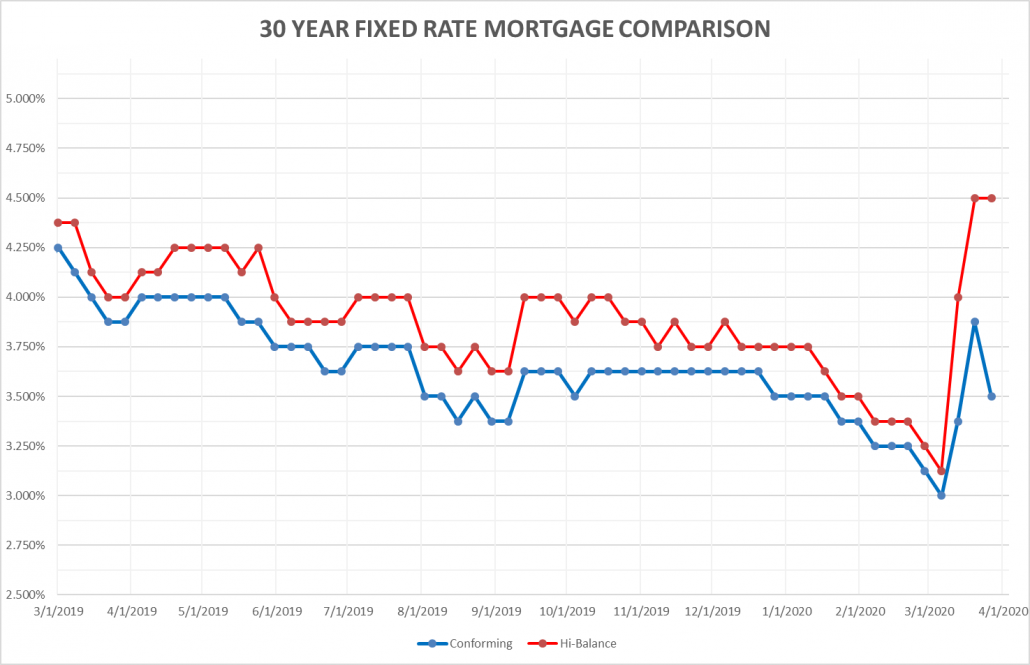
Why do we have to pay our property taxes now?

Question of the week:  Why do we have to pay property taxes now?

Answer: This is a question many homeowners are currently asking. These are homeowners who are in the process of refinancing their current mortgages and will be closing between the middle of February and April. As part of their escrow closing the second-half property tax installment will have to be paid.

Property tax bills are sent to property owners in California in October of every year. Property owners are given the option of paying the entire amount owed, or pay the amount due in two installments. The first installment is due by December 10th and the second installment is due by April 10th.

One condition every lender has for funding mortgages is a title insurance policy that protects the lenders lien position and discloses any liens and claims against the title of the property. When a new loan is initiated a preliminary title report is provided for review that shows, among other items such as the legal description of the property, liens and obligations that are secured by the property. The report will show any current mortgage(s) the property owner is still obligated to pay, and what the annual taxes are and whether they have been paid or not.

Government liens take precedence over any other lien, because of this, lenders want to make sure that when they do fund a loan and record the mortgage, a trust deed in California, against the property that all property taxes are paid current as a delinquency can undermine the lender’s position. Unpaid taxes can result in a government foreclosure on a property, or if the borrower defaults on the mortgage and the lender forecloses and the property is sold at auction the taxes are paid before the lender, which results in the lender possibly not receiving the full amount owed on the delinquent mortgage.

The title company is also insuring an existing mortgage that is being refinanced, or paid off through a sale, is paid in full and no longer a lien on the property. The policy provided insures that all property tax obligations are current and the lender funding the refinance, or purchase, mortgage is in first position with no other non-government lien ahead of it on title.

This time of year, with the second half taxes due relatively soon, title companies will not issue their property unless they have proof the second tax installment has been paid. If you pay your taxes yourself then you will need to account for this amount as part of closing. You can either bring the funds to escrow, which I recommend since you have likely saved the funds to make the payment. The other option is to add the amount due to your new refinance mortgage, which I do not recommend as then you are financing and paying interest on a tax bill.

If your current mortgage has an impound, or escrow, account whereby you include a monthly pro-ration of the property taxes in your monthly mortgage payment, the issue gets a little more complicated. Most lenders pay the second half installment sometime from mid- to late March.

When we are closing refinances from early February to this period the borrower will still have to have the second half taxes paid as part of the closing. The lender will have the funds in the borrower’s impound account, but will not have paid them yet, so the borrower will need to bring the funds to closing, or add to the loan amount. When this happens, when the loan is paid off the lender will refund the amount in the impound account to the borrower after their existing loan is paid off—a process that usually takes up to two to three weeks.

As an example, the Clock’s are refinancing their existing mortgage and have an annual tax bill of $5000 per year. Every month they have included $416.67 in their mortgage payment and the lender paid their taxes when due by December 10th and April 10th.  We are closing their refinance next week, on March 6th. The lender has not yet made the tax payment and has $2913.19 in the borrowers’ impound account.

In order to close the Clock’s need to transfer funds to the escrow for $2500 to cover the second half tax installment. After the loan funds, the old loan is paid off they will receive a check from their existing lender for the $2913.19 that is in their impound account that was not paid for taxes.

When all the dust settles and the accounting is complete, the borrower has not paid any more or less than what is due to the tax collector; the process however has had them pay the amount twice with a refund after closing to ensure they have only paid once.

Note, for a purchase transaction the taxes must also be paid and the amount due is pro-rated between the buyer and seller. The pro-ration is from the date of closing until the end of the tax period. For sales closing between July 1st and December 31st taxes are pro-rated on a daily basis to December 31st; for sales closing January 1st to June 30th the taxes are pro-rated between buyer and seller from the date of closing to June 30th.  If you are selling a home the pro-rated taxes are deducted from your sales proceeds, if you are purchasing a home the pro-rated taxes are added to the funds you will need to bring to escrow to close the transaction.

Not paying property taxes and want to, or know someone who would like to pay property taxes? Contact me to discuss loan and home purchase options and get pre-approved for your new home.

Have a question? Ask me!

Home sales slid in California from December to January, but are up significantly from January 2019. According to the California Association of Realtors the statewide median home price was $575,160, which was down 7.7% from December and total single-family sales we down 0.7% from December. Year over year the statewide sales were up 10.3% and the median price climbed 7.4%. Drilling down to the two primary Southern California Counties, Los Angeles saw a 22.3% drop in closed sales from December to January, but overall sales were up 16.7% for the year. The LA County median home price, while down 3.7% from the prior month was up 9.1% from last January to $617,520. Next door, Orange County median single-family home price was $855,000, a gain of 1.8% from December and 7.3% for the year. Sales volume in the OC dropped 23.7% for the month and the year over year increase in sales was a very strong 22.1% gain.

Some national economic news, the second estimate for 4th quarter 2019 Gross Domestic Product was the same as the first estimate showing the economy grew at a mild 2.1% pace. The news is mortgage rate neutral. With the estimate came was the expectation that the 1st quarter 2020 GDP may not show as much growth, if any, due to possible, some say probable, economic slow down globally due to the coronavirus. This news is somewhat mortgage rate friendly.

On a more micro- level, today the U.S. Bureau of Economic Analysis released personal income and consumer spending for January. Both reports showed positive growth from December, with consumer spending rising a very modest 0.2% for the month and personal incomes increasing a very strong 0.6% for January.  With income outpacing spending it is no surprise that the personal savings rate was 7.9% for the month. A key inflation index, the Personal Consumer Expenditure, rose 0.1% for the month, and is up only 1.7% for the year. With consumer spending still positive, strong gains in income and tepid inflation the news should be mortgage rate unfriendly. However….the impact on the coronavirus news and messaging, as well as how, when, if, the virus will spread through the United States with greater impact than the traditional flu, is not known and many in the media are predicting it will slow down consumer spending in the coming months.

My two cents on the coronavirus. Our daughter is currently travelling through Italy as she is on mid-winter break from her studies this semester in Grenoble, France. As you may be aware, several towns in Northern Italy have been quarantined. She and her friend were scheduled to travel to Venice, they changed their itinerary to avoid the area. Are we concerned? Yes, as parents we are naturally concerned about our daughter travelling thousands of miles away in a foreign country with a virus known to be present. Are we worried? Not that much as we know she has as much of a chance of catching the normal flu as the coronavirus. And that goes for everyone in the country. The flu is under-reported every year, not the actual numbers being provided under the actual cases, but the reporting by the media. According to the Centers for Disease Control (CDC), since 2010 influenza has caused between 9 to 45 million illnesses, 140-810,000 hospitalizations and 12-61,000 deaths annually. Those numbers are just for the United States. Every year we have a flu epidemic that is either extreme or severe with tens of thousands losing their lives as a result. The coronavirus fear is that there is not currently a vaccine and because of its unique make-up specific incidents can be tracked and traced. Meanwhile the traditional flu, which some years is immune from that year’s vaccines, is rampaging across the country as it does every winter. The CDC estimates for the current flu season to date, from October 1st to February 22nd, there have been 32-45 million illnesses, 310-560,000 hospitalizations and 18-46,000 deaths. Am I concerned about the coronavirus? Yes, as much as I am concerned about the traditional flu virus. Am I worried? Not that much. Every year up to 14% of our population gets the flu, and 0.01% die from the illness. I cannot recall any news reports from the past about the flu pandemic impacting 14% of our nation and the major economic slowdown and other impacts it has. Off my soapbox.

Rates for Friday February 28, 2020:  While I am not concerned that the economy will fall apart because of coronavirus, investors are following the news and reacting in a way to not lose money, which creates a domino effect on the markets. The stock markets are down about 14.5% in the past two weeks as investors flee to safety—which means they are buying bonds and mortgages. As a result rates are down from last Friday, until (when, if) investors get a better gauge on the national and international economic impact of the coronavirus there is little to suggest rates will climb in the near future.

FIXED RATE MORTGAGES AT COST OF 1.25 POINTS LOCKED FOR 45 DAYS:

30 year conforming                                            3.125%    Down 0.125%

30 year high-balance conforming                   3.25%      Down 0.125%

Please note that these are base rates and adjustments may be added for condominiums, refinances, credit scores, loan to value, no impound account and period rate is locked. Rates are based on 20% down with 740 FICO score for purchase mortgages.

In an effort to become relevant in the national election scene, California has moved its primary election date from June to March. In most counties in-person voting has already started, with the official election day being this coming Tuesday, March 3rd. I have always contended that local elections have a much greater impact on our lives than statewide and national elections. Local elections determine the public safety ability, the condition of the roads and sidewalks you use on a daily basis, and the types of businesses that are able to open and be successful in your community. Unfortunately, most people only vote in local elections when they are on the ballot with national candidates, i.e. Presidential election years.

One of the greatest, I venture to say the greatest, negative impact resulting from the decline in print media is the loss of local newspapers who used to report on local municipalities and elections. Many local reporters and editors would investigate candidates, elected officials, leaders at city halls and events that impacted their cities and communities, providing valuable information. Now many municipalities operate in media vacuums, which can lead to unscrupulous actions benefiting the few at the cost to the many.

It is my hope that more people pay attention to what is happening down the street at City Hall and less to across the country in the big white buildings in Washington. Examine those representing you locally and research those who are running to represent you who will decide how many members will be in your police force, how well funded is the fire department, will there be enough money to maintain and replace streets and sidewalks as needed.

Pay attention and vote accordingly.

I’m feeling pretty soap-boxy this Friday, thank you for indulging me!

Have a great week,

Dennis

Past Weekly Rate & Market Updates can be found on my blog page at my website www.DennisCSmith.com/my-blog