Happy Holiday Week, where we spend some time each day trying to remember if it is Tuesday or Thursday, and then miss putting out the trash cans for pick up.
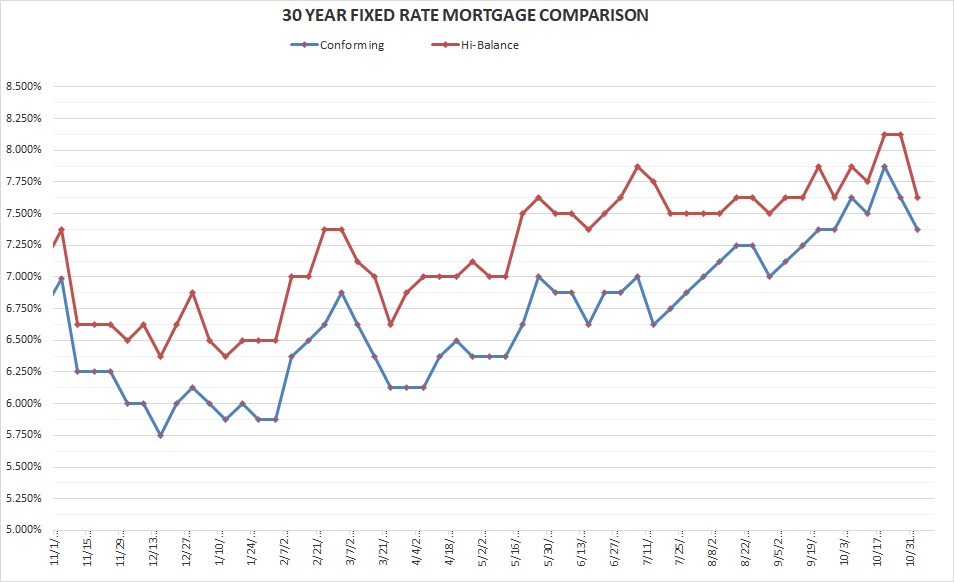
As we end the year here is a quick look back at the year in rates.
The biggest influencer on mortgage rates the past two years has been inflation. In January 2023 the rate of inflation was 6.4%, by November it had dropped substantially to 3.1%.
As it does from time to time, the Federal Reserve has dominated all conversations about markets. With the surge in inflation starting in 2021, the Fed waited to raise it’s benchmark Federal Funds rate until 2022 to try to control the increase in prices, and eventually drop the inflation rate to near 2.0%.
In January the Fed Funds rate was 4.33%. The Fed continued its policy of quantitative tightening and increased its in increments to 5.33% in August where it has remained.
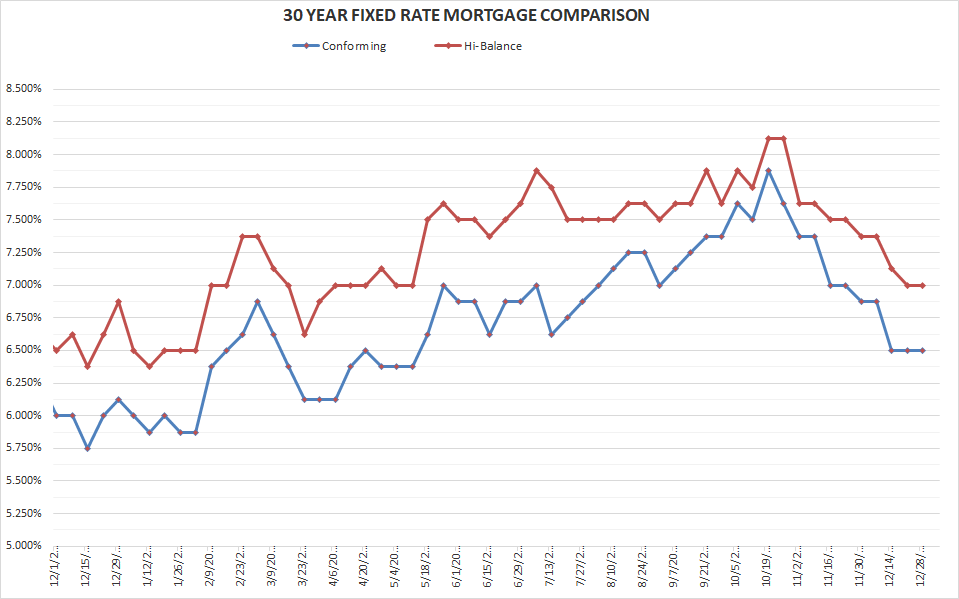
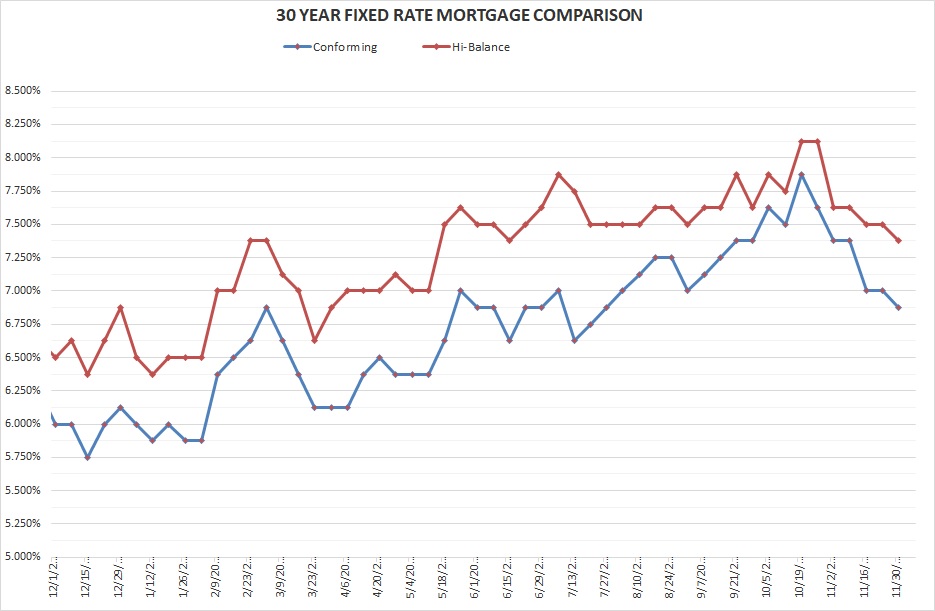
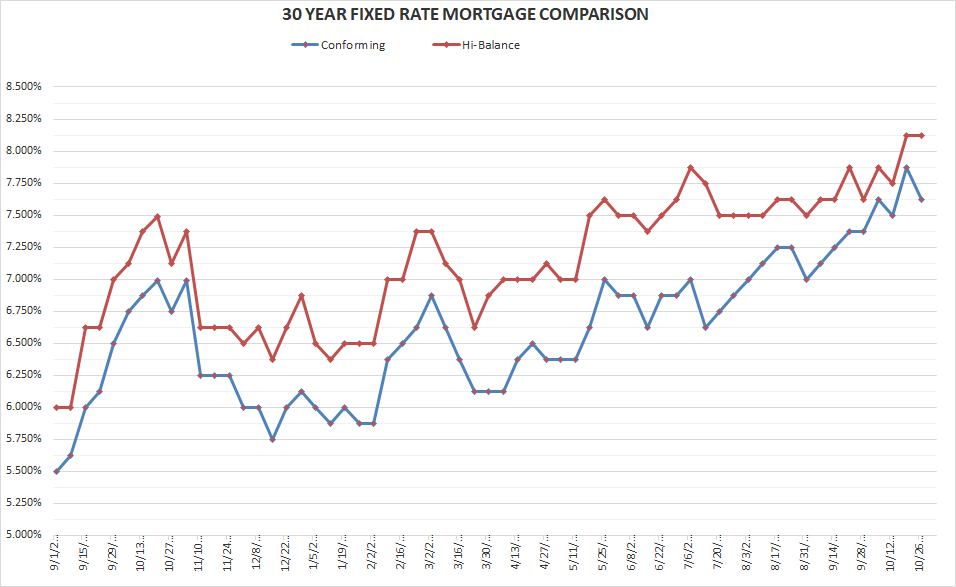
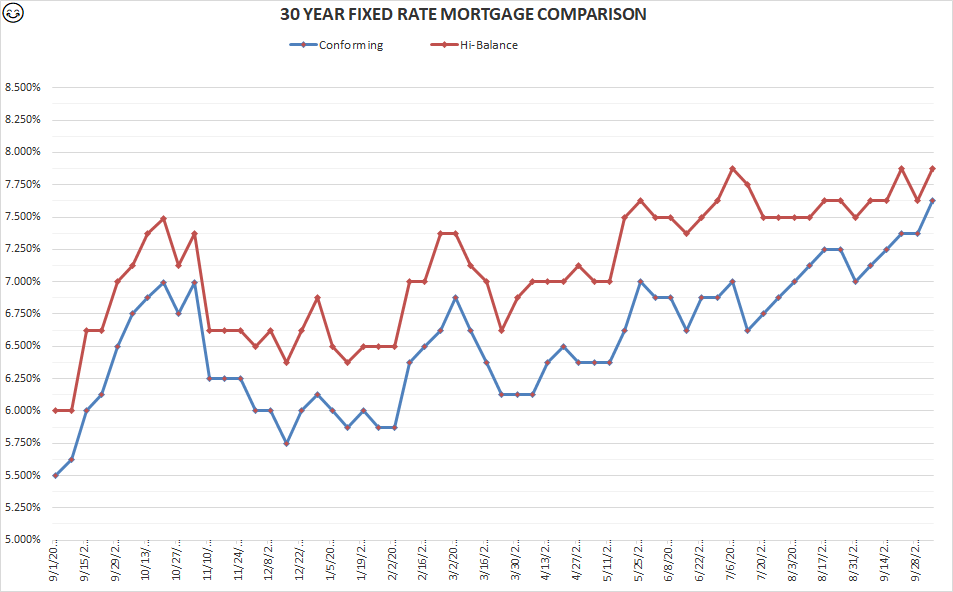
The impact on mortgage rates from the first week of 2023 to this Friday, the last of 2023, was an increase in the 30-year fixed rate from 6.00% to 6.50%.
From a snapshot perspective the 6.50% rate is a big bump from the 6.00% to start the year, however for those in the industry it feels like a great rate as it is considerably lower then the peak rate of 7.875% for the week ending October 20, 2023.
As we enter 2024 the expectation is for rates to continue to decline as the Fed is signaling it will cut its benchmark rate in the coming year, perhaps as many as three times.
Expectations are not always met, if inflation continues to be stubborn and not drop, if employment markets tighten, if economic expansion surges, the Fed may not lower rates, or may find it necessary to hike rates again.
My feeling is that mortgage rates will find 6.00% again in 2024, and spend the latter half of the year as low as 5.75% and move between that mark and 6.00% or slightly higher.
To schedule an initial meeting by phone or Zoom, click here for my calendar, please feel free to forward to a friend or family member!
Rates for Friday December 29, 2023: We end the year
FIXED RATE MORTGAGES AT COST OF 1.25 POINTS LOCKED FOR 45 DAYS FOR PURCHASE TRANSACTIONS:
30-year conforming 6.50% Flat
30-year high-balance conforming 7.00% Flat
Please note that these are base rates and adjustments may be added for condominiums, refinances, credit scores, loan to value, no impound account and period rate is locked. Rates are based on 20% down with 740 FICO score for purchase mortgages.
Hoping everyone had a great Christmas and that you are able to enjoy some quiet time this week—if that is what you desire. We have enjoyed having both daughters home for the week, the oldest heads back to Boston and work tomorrow.
Wishing everyone a happy and prosperous 2024, if I can assist with either in the new year let me know!
https://www.denniscsmith.com/wp-content/uploads/2022/12/calendar2.jpg293409Dennis C Smithhttps://www.denniscsmith.com/wp-content/uploads/2024/06/dennis-c-smith2.pngDennis C Smith2023-12-29 09:08:162023-12-29 09:08:17Look at 2023 in rates
Question of the week: Is Christmas-New Year holiday period a good time to buy a home?
Answer: Yes!
The old-saw in the real estate business is that December and January are slow months—for many agents this is a self-fulfilling prophecy as they slow down the work, or take the time off because, “it’s slow.”
There are plenty of agents that are on call and working during the “slow” period because the have sellers who want to sell; or buyers who want to buy.
If a seller has their home active on the market during the holiday season, are willing to have potential buyers visit the home to preview it to see if they want to buy it, despite partially decorated, a tree with presents, in-laws staying in the office-guest room, they are motivated and want to sell.
Sellers of a vacant home, unaffected by the call at 1:30 to their agent from another agent, “I have buyers who want to see the home this afternoon, is that okay?” If the response is affirmative when their listing calls with the question, the sellers are motivated and want to sell.
The market maybe, is, a little thinner during the holidays as home sellers put a pause on showings until the new year, but the homes that are actively listed with no hold on showings have motivated sellers looking for buyers.
What better present to put under the tree, or celebrate the new year, than a set of keys that represent your new home that will close escrow before you exchange Valentine’s Day cards!
To schedule an initial meeting by phone or Zoom, click here for my calendar, please feel free to forward to a friend or family member!
Rates were choppy this week despite economic news that should push rates lower. Primarily the PCE index, which the Federal Reserve used to determine its moves on rates, showed consumer prices dropped in November by 0.1%, the first monthly decline in prices since 2020. Personal income increased in the month, while consumer spending was flat—which means fewer units purchased as prices dropped.
Also positive for mortgage rates, was the revision for 3rd quarter GDP, which showed economic growth for the quarter was 4.9%, down from the prior evaluation of 5.2% growth.
Rates for Friday December 22, 2023: With inflation heading down, possibly entering deflation, and the economy growing not as fast previously expected markets should have responded with a drop in rates. However, rates are flat from last week, not unusual for this time of year as investors make end of year trades based not only on market conditions and expectations, but also on year end numbers for income, capital gains, and overall returns for their 2023 financials.
FIXED RATE MORTGAGES AT COST OF 1.25 POINTS LOCKED FOR 45 DAYS FOR PURCHASE TRANSACTIONS:
30-year conforming 6.50% Flat
30-year high-balance conforming 7.00% Down 0.125%
Please note that these are base rates and adjustments may be added for condominiums, refinances, credit scores, loan to value, no impound account and period rate is locked. Rates are based on 20% down with 740 FICO score for purchase mortgages.
For those with stocking hanging on the mantel I hope Santa rewards you for your kindness and good deeds through the year. For readers who do no celebrate Christmas, a virtual Santa giving gratitude for your kindness and good deeds.
https://www.denniscsmith.com/wp-content/uploads/2023/12/House-with-bow-scaled.jpg25602560Dennis C Smithhttps://www.denniscsmith.com/wp-content/uploads/2024/06/dennis-c-smith2.pngDennis C Smith2023-12-22 14:47:062023-12-22 14:47:32Is Christmas-New Year holiday period a good time to buy a home?
Question of the week: Is the drop in rates a blip or a trend?
Answer: I think it is more of the latter than the former; but that does not mean that there will not be some spikes with higher rates during the trend.
Before we look at what has happened this week that has resulted fastest drop in the conforming rate since the outset of the pandemic, a light pat on the back.
The QoW for August 25th was, “When will rates go down?” After my typically verbose explanation of what was happening, I wrote that rates should be between 6.75% to 7.00% at the end of the year. With two weeks to go I was close, but currently on the high-side as you can see below that our 30-year fixed rate conforming rate is 6.50% this Friday.
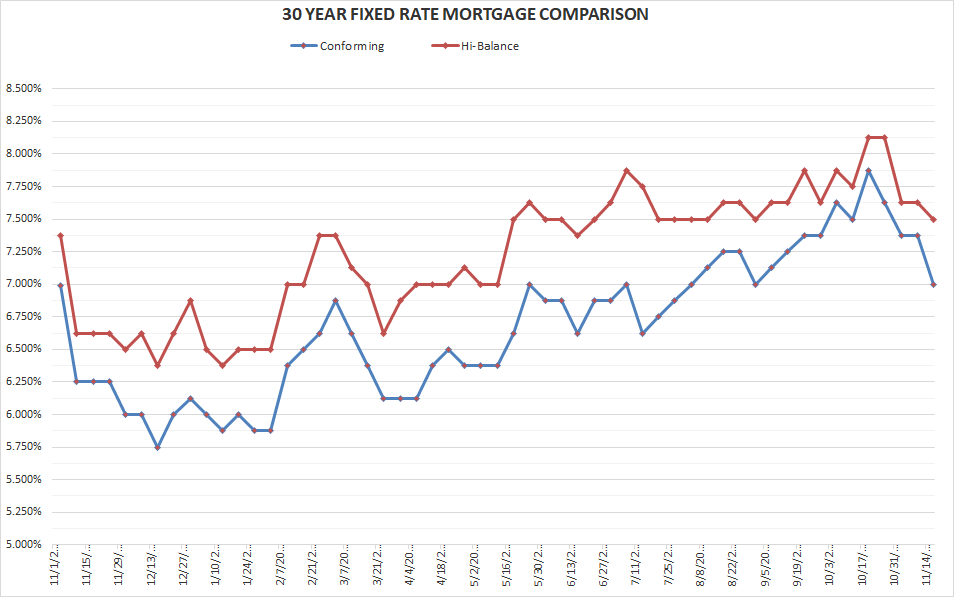
For the second time in the past five weeks the conforming rate dropped 0.375% (three-eighths of one-percent) from Friday to Friday. As well, the rate drop from 7.875% on October 20th to 6.50% today is the fastest rate drop quoting the same rate parameters (conforming loan amount, 20% down, 740 credit score, cost 1.25 points) in my records going back to 2005.
How did we get here so fast?
Rates have been dropping since their peak on October 20th, when they had jumped 0.375% from the Friday before.
As related in each Friday’s WR&MU, cooling inflation, cooling job markets, cooling consumer spending, and comments from the Federal Reserve, all created momentum for rates to slowly, and steadily, drop.
Investors are mostly data driven. They collect economic and market data, use that to form an idea of where the market(s) may be going and buy or sell based on that data and their interpretation of what the price of what they are buying or selling will be in the future.
Historically, the rules are that good economic data pushes stock prices and interest rates up, poor economic data pushes prices and rates down. Key word, historically.
This past week the consumer price index for November was released that showed all prices in the CPI increased a very modest 0.1% in November—good news for rates as it showed inflation cooling and supported the Fed holding steady on rates, possibly putting a rate decrease on the table in the future.
Digging further into the data we saw that the “core” rate, food and gas prices are stripped from the index, showed that prices jumped 0.3% for the month. The core rate is the focus of the Federal Reserve when making decisions on interest rates, because of this the sharp increase was not good news for lower rates.
On a year-to-year basis inflation ticked down to 3.1% from 3.2% in October, however core rate remained at 4%, a level that CPI has had difficulty dropping below. This sticking point at 4% is concerning as the Fed’s target rate for inflation is 2%; if the rate stays this high how long will the Fed hold off on another rate increase?
On Tuesday the sentiment was not interest rate friendly, but investors made no major moves waiting for Wednesday to learn what the action, if any, the Federal Reserve Open Market Committee (FOMC—the body that decides on the Fed’s rate moves) will take on interest rates; and more importantly what comments come out of their meeting regarding future action, or inaction.
The initial news was that the Fed was standing pat, no increase interest rates. In September the speculation, fed by the Fed, was possibly two more rate increases in 2023; here we are at the last meeting of the FOMC and there were no increases from September on. Also in the release was that the Fed was penciling in three rate cuts in 2024, up from the two cuts previously considered. That pushed stock and bond prices higher (lower rates).
Then Fed Chairman Jerome Powell had his press conference. While stating that the Fed still holds the line to increase rates if economic data shows the economy is not responding to higher rates in the markets, he said that the Fed feels that it is likely we are at or near the top rates for their current cycle of quantitative tightening.
Very importantly, and what really pushed markets and the plummet in rates, was his confirmation of possible rate cuts, “the question of when it will be appropriate to begin dialing back the policy restraint was a discussion for us at our meeting today.” Translation for “dialing back the policy restraint” means “cutting rates.”
These 30-45 minutes on Wednesday caused investors to completely ignore the strong economic data from the day before. So strong was the sentiment that the Fed will be dropping rates in the near term that it over-rode the economic news from Thursday as well.
After staying away from retail purchases in October, when sales dropped 0.1%, consumers were back in force in November. Overall sales were up 0.3% from October, held down by lower sales for gasoline and cars*. Taking cars and gas out of the data and sales shot up 0.6% from the prior month. A big part of the jump came at bars and restaurants, sales up 1.6% in November and up 11% since last year—almost three times the rate of inflation. *Retail sales are actual dollars spent not units sold so inflation impacts the data.
This news following Tuesday’s inflation data, should have pushed rates higher that last Friday—were it not for the Federal Reserve non-action and comments on future rates.
Looking forward, the downward trend in rates should continue into next year, perhaps through the 1st quarter. The markets have already priced in a Fed rate cut in March, making rates a bit stickier in coming down.
The danger ahead is if inflation climbs and the Fed sees the need to intervene with another, more, rate increase(s). Inflation is sticky, the economy is strong, consumers are spending money showing they are not worried about the economy or their future paychecks. The Fed is willing to let these factors play out to see if they can achieve a “soft landing” as inflation cools—have inflation drop without the economy going into recession and unemployment spiking.
In the meantime, how low will rates need to go before current homeowners loosen up the markets by deciding it is time for them to sell their current homes and buy up, or down. Is 6.5% low enough?
The four-year run, kicked off by the pandemic, of “interesting” years will continue in the rate and real estate markets in 2024.
To schedule an initial meeting by phone or Zoom, click here for my calendar, please feel free to forward to a friend or family member!
Rates for Friday December 15, 2023: As mentioned above, conforming rates are down 0.375% from last Friday, the high-balance rate is a bit stickier, down 0.25%
FIXED RATE MORTGAGES AT COST OF 1.25 POINTS LOCKED FOR 45 DAYS FOR PURCHASE TRANSACTIONS:
30-year conforming 6.50% Down 0.375%
30-year high-balance conforming 7.125% Down 0.125%
Please note that these are base rates and adjustments may be added for condominiums, refinances, credit scores, loan to value, no impound account and period rate is locked. Rates are based on 20% down with 740 FICO score for purchase mortgages.
Our holiday season kicks off tomorrow when our youngest comes home for four weeks before returning to New York to start her senior year. Her working sister comes home next Saturday for a week, putting the family together. The best presents parents can receive.
https://www.denniscsmith.com/wp-content/uploads/2023/12/businessman-holding-the-down-arrow-on-wooden-blocks-with-the-word-rate-and-house-low-interest-in_t20_7mAaky-scaled.jpg14942560Dennis C Smithhttps://www.denniscsmith.com/wp-content/uploads/2024/06/dennis-c-smith2.pngDennis C Smith2023-12-15 12:21:132023-12-15 12:21:14Is rate drop a blip or a trend?
Question of the week: Can my parents benefit from helping us buy our new home?
Answer: Yes.
This came up in a conversation this morning with second-generation real estate agent Paige this morning in discussions regarding a couple of her clients who were in need of more funds to purchase the homes.
Both couples have parents that are retired and have funds available to assist but are reticent for various reasons that are common to many parents who would like to assist their children in purchasing a home but feel uncomfortable separating funds from their savings or retirement.
The biggest reason is not willing to deplete cash from their accounts that they need, or may need, for their own living expenses and retirement.
Some parents have funds available, but they are in retirement account(s), typically an IRA, and are not willing to pay income tax on funds to assist with closing costs for the home purchase.
“Fairness” is an issue that also comes up with parents helping a child with a home purchase. Fairness to other children and providing assistance for one child and how it may affect any division of assets with other children.
Historically, most parents provide a gift to their children purchasing a home. Some prepare the necessary tax forms to account for the funds gifted as an early distribution from their estate, to be reconciled when the parents pass away and their trust is to be distributed to their beneficiaries within the tax exemption limits of estates ($13.61 million in 2024, note the limit put in place in the 2017 Tax Cut and Jobs Act expires in 2025 unless extended by Congress).
This straight cash transfer is the what some, many, parents are reluctant to do, not only because it is purely beneficent to their child and presents no benefit to them, but also restricts cash they have available for their own needs.
The solution I presented to Paige to bring to her clients is the parents making a loan to their children as part of the transaction. Not just a handshake loan, as this can create some issues later, but a legal obligation with a note spelling out repayment terms and a trust deed recorded against the property.
This benefits the parents as they can collect monthly payments* from their children, and have in the note a specific time it must be paid off. For instance, a loan of $100,000 with a rate of 5% to be paid with minimum interest only payments every month with the entire balance to be paid within 5-years. The parents collect 5% per year on the loan, perhaps outperforming some of their investments over the time, and know that they will receive the principal amount back in a few years. If they pass away before the 5-year period, the obligation is owned by the estate and is settled through trust/estate being finalized. *see below regarding “after closing.”
If the parent’s funds for assisting their child are in a retirement account, they can make loan from their IRA, with the IRA being the beneficiary of the note, collecting the monthly payments and having the final payment of the outstanding balance to the IRA**. Just like other investments in the IRA account, the income received from the monthly payments are tax free. If the parents are of the age they must take required minimum distributions (RMD), the payments back to the IRA can be used to pay RMDs, whether in full or partially; i.e. the note taking funds out of the account may/should not jeopardize not being able to make the required annual RMD.
**Before entering this transaction using an IRA consult with your tax preparer to ensure you take the proper steps to ensure you are in compliance with state and federal tax regulations and do not have an income tax, and/or penalty depending on your age.
For the children purchasing the new home, here is the impact on them, during the transaction and after.
During the transaction, the loan and its payments must be included in calculations for qualifying debt-to-income ratios and loan-to-value used to determine interest rate.
Regarding the latter, there must be some down payment for the transaction, i.e. the parents cannot make a loan for 20% of the purchase price and the kids obtain a loan for the other 80%.
Example: Purchase price $800,000, kids have available 5% for down payment and enough for closing costs. Parents agree to loan them $120,000 at 5% for 5-years with interest only payments. They apply for a loan of $640,000.
Assume a 7.375% interest rate on the primary mortgage, the payment is $4420 per month, add the $500 for the interest payments to the parents and the total obligations for the mortgages is $4920 per month.
If the kids purchased the home with just the 5% down, obtaining a loan for $760,000, the rate would be about 6.75% (see prior WR&MU regarding lower rates for some loan-to-values with mortgage insurance) and there would be mortgage insurance required on the mortgage.
The mortgage payment would be $4930 per month, add mortgage insurance of $285 per month and the total payment for the mortgage is $5215 per month; higher than the other transaction by the cost of the mortgage insurance.
For the transaction, the loan from the parents results in a lower payment, which makes qualifying a bit easier, and the parents are receiving a steady income from their loan.
It is very important for the funds provided by the parents to be in the terms of a loan, if it does not impact qualifying, due to what will occur in the future when the children pay off the loan.
Above we discussed the most common assistance parents give their children is a straight gift, for some families the gift is a “gift;” the kids expect to pay their parents back in the future.
Let’s look at two cases using the above scenario. Parents gifted $120,000 to Cain for his home purchase with an expectation from both parties that at some point Cain would repay the money; a few years later the parents loaned $120,000 to Abel under the terms in our scenario above.
Four years after purchasing the home with his 6.875% mortgage, Cain wants to refinance as rates have dropped and his equity has increased enough that refinancing his primary mortgage and obtaining funds from the transaction to repay his parents “gift,” his loan-to-value is 80%.
Because he is taking cash out of his property to repay his parents, Cain’s refinance is a “cash-out” refinance, which will have a rate of 5.625%.
Abel also wants to refinance at the same time, he too has 80% loan-to-value if he refinances his primary mortgage balance and includes the loan balance he owes his parents.
Because the $120,000 from his parents was a loan, and the loan was used to purchase the property, and that Abel can show he made on-time payments every month for the mortgage, his refinance is considered “rate and term,” which will have a rate of 5.00%.
In the end, having a “gift” from parents become a loan, the children save money every month on their total payment, as it is lower than purchasing with mortgage insurance provided the payment to mom and dad is interest only, and when it comes time to refinance and repay mom and dad their refinance rate is considerably lower than if they were to pull cash out of their home.
Mom and dad benefit because they receive some monthly income, their money is somewhat secured as it is lien against the property, which benefits their estate and other beneficiaries should they pass away before the loan is repaid. If funds come from a retirement account, the income is tax free as long as payments are made directly to the IRA.
Before finalizing and committing to parental support for your new home purchase I strongly advise your parents consult with their tax preparer.
To schedule an initial meeting by phone or Zoom, click here for my calendar, please feel free to forward to a friend or family member!
Downward momentum stalls for rates as the job market is a bit hotter than desired. The Labor Department published data for November showing the economy added 199,000 jobs for the month—a high number but tempered somewhat by about 50,000 striking workers in Hollywood and the auto industry returned to work. What is not tempered is that wage growth is still strong at 4%, well above the 3% growth rate the Fed has said it needs to see to take future increases off the table. Markets reacted by reversing gains earlier in the week.
Rates for Friday December 8, 2023: Rates hold steady from last Friday after dipping earlier in the week. Markets still not sure if Fed will hold that line on rate increases, and beginning to speculate how many, if any, rate decreases the Fed may make in 2024.
FIXED RATE MORTGAGES AT COST OF 1.25 POINTS LOCKED FOR 45 DAYS FOR PURCHASE TRANSACTIONS:
30-year conforming 6.875% Flat
30-year high-balance conforming 7.375% Flat
Please note that these are base rates and adjustments may be added for condominiums, refinances, credit scores, loan to value, no impound account and period rate is locked. Rates are based on 20% down with 740 FICO score for purchase mortgages.
The turmoil in our country for those of Jewish faith and ancestry since the barbaric attacks by Hamas two months to the day of the first night of Hanukkah have many, rightfully, concerned for the well-being of their family, friends, and other Jews worldwide.
The origins of Hanukkah, simplistically Mattathius leading a revolt against Antiochus who, as part of outlawing Judaism, ordered and altar to Zeus erected in the Temple of Jerusalem and Jews to make a sacrifice to Zeus. The rebellion was successful and after three years, in 164 BCE, the Temple of Jerusalem was liberated and rededicated and the festival of Hanukkah began to celebrate.
For the past 2100 plus years there have been several periods when kings, dictators, people, have tried to rid the world of Judaism and Jews. We are witnessing yet another attempt by Hamas and its supporters who proclaim here, and abroad, their stated goal, many of those supporters in our own country.
It is my hope that next year, or a year in the very near future, when Jews around the world light their candles to celebrate the Festival of Lights that the world is once and for all rid of those who are committed to preventing Hanukkah, and its celebrants, from performing their annual rituals of lighting their menorahs from happening.
Happy Hanukkah, for those celebrating I hope you do so in joy and peace, this year and every year.
https://www.denniscsmith.com/wp-content/uploads/2022/07/house-money-buy.png675896Dennis C Smithhttps://www.denniscsmith.com/wp-content/uploads/2024/06/dennis-c-smith2.pngDennis C Smith2023-12-08 14:20:572023-12-08 14:20:59Can my parents benefit from helping us buy our new home?
Question of the week: If buyer has to pay agent commission, will mortgage regulations change?
Answer: Good question, my thought is that there will be no change, my reasoning further down.
This week’s question is a follow up to the WR&MU from before Thanksgiving asking if recent court cases regarding real estate commissions. In re-reading the update I realize I should not have tackled a somewhat complicated issue a few days after knee replacement surgery and the resulting narcotic pain killers I was still taking—it is a bit disjointed, more so than my normal WR&MU’s.
For those who missed the not well written WR&MU, it centered on decision by a jury in federal courts against the National Association of Realtors and a few of the biggest brokerages in the United States. The suit was in regards to the practice that home sellers pay the real estate commissions to the buyers’ agents—standard practice across the country and part of the membership requirements for all agents who are member of NAR.
The decision in the case likely will lead to a change in the practice, and thereby require buyers to pay their agents directly.
If this is the case, if the agreed upon commission is 3% for each agent upon closing, for a $750,000 home, the buyer would need to pay $22,5000 to their agent, for $172,000 for down payment and commission.
Under the current arrangement, where that $22,500 comes out of the sellers proceeds from the sale, the commission to the buyer’s agent is included in sales price, and therefore part of the financing, the buyer pays the $150,000 down payment and seller pays the commission.
Our question above concerns if federal regulations require each party in a real estate sale pay their own agents, will mortgage regulations change to allow buyers to add the commission to their real estate agent to the loan amount and finance the fee.
Example as to how this might look. In the above example, buyer is purchasing the home for $750,000, putting 20% down ($150,000), and funding a mortgage for $600,000, and there is a $22,000 commission. The question is, will guidelines change to allow the commission to be financed?
If underwriting requirements for Fannie Mae, Freddie Mac, FHA, etc were to allowing financing of commissions what would it look like? Add the commission to the loan amount, and still price the loan as if the commission was not part of the loan?
Example, the above loan would be priced as an 80% loan to value mortgage. If a 3% of the sales price broker commission is added to the loan, the amount financed would be $622,000, or 83% of the sales price.
Under today’s regulations, the 83% LTV would have a slightly better rate than the 80% loan, but would require mortgage insurance.
The change that would need to be made to make the guidelines under new regulations requiring buyers to pay their own agents, without adding to the loan-to-value of the transaction, means that the total loan will still be $622,000, but the guidelines would price the loan at 80% loan to value and not require mortgage insurance.
The reason this likely will not happen is the secondary market. Most mortgages are sold by Fannie, Freddie, FHA, to investors purchasing Mortgage Backed Securities (MBS). The price of the MBS are what determine interest rates for borrowers. The price investors are will to pay of MBS is determined in part by the risk that a loan will not pay off and go through foreclosure. Mortgage insurance protects lenders, therefore investors, from losses due to foreclosure.
If lending guidelines were to change to allow commissions being financed as part of closing to not be factored into loan-to-value guidelines, investors will balk, or require different pricing on those mortgages—which would mean if buyers want to finance commissions and not have the amount added to the loan-to-value, instead of paying mortgage insurance they will pay a much higher rate due to the higher risk.
The reason a mortgage at 85% loan to value has a lower rate than a loan at 80% loan to value is because investors are protected against foreclosure losses due to mortgage insurance. The estimated loss in a foreclosure is about 25% of the loan amount, which is what mortgage insurance covers.
If/when the market changes and buyers have to pay their agents’ commissions, I do not see a change in lending guidelines to accommodate the new regulations. I do see a significant change in the real estate compensation models and the industry creating separate structures for listing (represent seller) and selling (represent buyer) agencies.
To schedule an initial meeting by phone or Zoom, click here for my calendar, please feel free to forward to a friend or family member!
Momentum continues for lower rates. Economic data is showing inflation is slowing, as are consumer spending and income. While the economy grew at a very fast 5.2% in the third quarter, estimates for the 4th quarter of the year is grow between 1-2%. The data supports a “soft landing” for the economy as inflation slows, possibly avoiding a recession in 2024.
Rates for Friday December 1, 2023: Back to summer, that is where we look to find rates as low as they are this Friday, down 1% from their high in late October.
FIXED RATE MORTGAGES AT COST OF 1.25 POINTS LOCKED FOR 45 DAYS FOR PURCHASE TRANSACTIONS:
30-year conforming 6.75% Down 0.25%
30-year high-balance conforming 7.25% Down 0.25%
Please note that these are base rates and adjustments may be added for condominiums, refinances, credit scores, loan to value, no impound account and period rate is locked. Rates are based on 20% down with 740 FICO score for purchase mortgages.
A different Thanksgiving for Leslie and I this year. Last week was the first time in close to 20 years that we did not host family and friends, and that I did not do most of the cooking. It is my favorite holiday, the sentiment of gratitude, gathering those close to us, and for me cooking the meal.
With me being somewhat immobile, we ordered a meal from a restaurant around the corner (Wood and Salt for those in the area) who provided a twelve-pound turkey, stuffing, potatoes, and green beans. Everything was delicious and since it was just the two of us we had plenty of leftovers to enjoy.
Unusually quiet and restful, but looking forward to next year and back to our traditional holiday.
https://www.denniscsmith.com/wp-content/uploads/2023/12/commissions.jpg6581000Dennis C Smithhttps://www.denniscsmith.com/wp-content/uploads/2024/06/dennis-c-smith2.pngDennis C Smith2023-12-01 13:12:212023-12-01 13:12:22If buyer has to pay agent commission, will mortgage regulations change?
Question of the week: Will court ruling on real estate agent commissions impact home prices?
Answer: This is a question being asked across the country, and a main topic of discussions in real estate offices nationwide.
A big Halloween scare shook the real estate industry when the jury in a federal court case awarded plaintiffs in a class-action suit be paid close to $1.8 billion in damages by the National Association of Realtors (NAR) and several of the biggest national real estate brokerages. Under federal antitrust law, the amount could be tripled to over $5.3 billion.
There are some additional law suits in the judicial pipeline that are similar to the above Gibson, et al v. NAR, et al, this is the first to come to a verdict.
The Cliff Notes version of the lawsuit is that home sellers sued because they felt they were being over charged on commissions as half the commission being paid to the listing agents (representing sellers) were paid to the agents representing the buyers (selling agents). Because this arrangement, commission splitting by the agents paid for by the sellers, is standard in NAR contracts, the plaintiffs argued this violates federal antitrust laws.
Most real estate listing contracts have a 5-6% of sales price as the commission paid by the seller for the agent to represent them in their sale process and list the property on the Multiple Listing Service (MLS), as agreeing that a non-negotiable, by the seller, commission, typically half the total commission, will be paid to a selling agent.
The lawsuits contend that because the sellers have to pay commissions to the agents representing buyers, they are paying for more to sell their homes than if the buyers were to pay their agents directly. One other factor, is that since they buyers are not able to negotiate the commissions the agents representing them are getting paid, the contention is they are paying more than they might if they negotiated the commission directly.
So, what does this mean to the real estate market moving forward?
To generalize there are three segments of the market that are impacted the most: buyers, sellers, and agents.
Real estate buyers in the United States are somewhat unique when it comes to real estate agent compensation. Internationally, the United States is pretty much the only market where buyers’ agents are paid by sellers through an agreement with the listing agents. Elsewhere, buyers, contract with an agent prior to working together. Some of the agreements call for a flat fee to be paid for a period of time during which the agent will be diligent in finding a home, negotiating a price, and handling the details required for the sale. Other agreements call for a commission to be paid as a percentage of sales price.
Because the seller is paying the buyer’s agent, both agents’ commissions are part of the sales price. If a seller agrees to a 6% commission with half being paid to each agent, a sales price of $1,000,000 generates a total commission of $60,000. In closing the buyer will fund $1,000,000 into escrow in some combination of cash and loan(s). At closing the seller will net $1,000,000 minus costs, including the commission before paying any mortgages or other liens on the property.
Due this arrangement, the buyer is technically paying the commission for their agent as it increases their sales price by that amount—assuming the market price would not be the same if only the listing agent’s commission was being paid by the seller.
In the example above, a normal transaction is the buyer would purchase the home with 20% down, $200,000, and 80% loan, $800,000.
If the market changes and selling agents are no longer paid through escrow from the seller’s proceeds, buyers will need to pay their agents directly. How does the buyer restructure their contract? If the commission remains 3% to the selling agent, does the buyer continue with 20% down and pay the $30,000 in cash at closing? Or does the buyer only have $200,000 for the transaction, plus other closing costs, put down $170,000 and obtain a loan for $770,000, which because it is higher than 80% loan to value will require mortgage insurance.
Because of either the additional cash to close required, or the higher loan amount, the buyer may no longer be qualified for the home.
If the seller reduces the sales price by 3% because they are no longer paying the selling agent commission, the price of $970,000 still, at 3%, would have a $29,100 commission—still presenting an issue for the buyer as to paying cash, restructuring the loan, or not qualifying.
For sellers, the supposition is that they will net more from the sale of their homes if commissions for selling agents are no longer taken from their proceeds. But this is assuming the market does not make an adjustment to market values due to buyers having to pay agents directly and not finance as part of their purchase price.
In the above example if the sales price is reduced 3% due to the seller not paying the selling agent, the net proceeds of sales price minus commission (3% to listing agent), would be $970,000 less $29,100, $940,900.
In the “traditional” sale with a $1,000,000 sales price and $60,000 commissions being paid, the seller’s net proceeds would be $940,000.
If the market adjusts downward in pricing because of the change in commission structure, the seller may net a bit more in proceeds, depending on the market adjustment. If prices do not adjust due to the commission structure changes, the seller will net considerably more.
What about realtors? How will they be impacted if the federal judgement results in wholesale changes and buyers having to pay their agents directly.
The real estate industry will go through tremendous change. First, commissions paid per transaction will go down. While the listing agent commissions may still remain in the current 2.5% – 3% range for listing agents, buyers not being able to finance selling agent commissions will very likely reduce the amount able to be paid to selling agents.
With buyers negotiating commissions directly with the agents to represent them, and factoring that cost into their ability to qualify for the homes they wish to buy, market forces will result in lower commissions for agents representing buyers.
Currently there are about 1.2 million members of NAR, and approximately two million more licensed agents that are not members. The vast majority of real estate transactions are done by a minority of licensed agents, estimated to be 20-30% of licenses. Consider that in 2021, a very active year with record sales, the average number of sales per real estate license was 12. If there are 3 million licensed agents, that means 1.5 million did less than 12 and 1.5 million did more than 12.
Real estate is one of the few industries where part-time workers can earn significant income; consider a part-time agent who sells two homes for a total value of $1.5 million with 3% commissions will earn $45,000. If those commissions decline by 25%, 30%, 50%…? how many part-time agents will remain active?
Should commissions drop, so will the number of active, full and part-time agents. This reduction of competition, increase in specialization, should result in increased volume for agents to can make up for some, a lot, of the lost income due to reduced commissions.
Buyer behavior will be interesting to see. Due to Zillow and other real estate websites, for the past several years many of the buyers we have worked with are very knowledgeable about what is on the market, prices in certain areas, and often know the home they want to purchase before they engage a realtor. With more sophisticated buyers, will they contract with the traditional realtor to represent them, try to represent themselves, or use other services.
I foresee agencies that specialize in representing for flat fees become part of the real estate market should the commission structure drastically change with large impact on the commissions paid to selling agents.
To schedule an initial meeting by phone or Zoom, click here for my calendar, please feel free to forward to a friend or family member!
Speaking of change in prices, a very small change in prices had a huge impact on mortgage rates this week. Prior to the release of the Consumer Price Index data on Tuesday, the consensus among economists was that the data would show the CPI increased 0.1% in October. They just missed in their estimate as CPI showed no change for the month, the first time in 15-months CPI was flat month to month. The zero growth was primarily due to gas prices dropping 5.3% in the month. Stripping out food and gas for the “core” rate, inflation was 0.2% for the month. The year-over-year rate fell to 3.2% , the lowest increase in two years; the core rate, which is the Fed’s barometer for adjusting rates, was 4%–a level that has not been able to be breached due to fluctuating food and energy costs. Bond and mortgage markets loved the news, sending prices soaring and rates dropping.
Rates for Friday November 17, 2023: Conforming rates have their biggest Friday to Friday drop since July 14th and hit lowest level since September 1st due to the CPI data.
FIXED RATE MORTGAGES AT COST OF 1.25 POINTS LOCKED FOR 45 DAYS FOR PURCHASE TRANSACTIONS:
30-year conforming 7.00% Down 0.375%
30-year high-balance conforming 7.50% Down 0.125%
Please note that these are base rates and adjustments may be added for condominiums, refinances, credit scores, loan to value, no impound account and period rate is locked. Rates are based on 20% down with 740 FICO score for purchase mortgages.
Good thing I like routines. Several time a day, pedal machine, leg bent 90 degrees, leg flat 0 degrees, deep vein apparatus, leg lift, leg bend, leg flat, leg squeeze, and icing throughout…surgery rehab is a full-time job. But worth it as working my goal of incrementally better each day. A motto that is not only good for rehab but also for life!
We have much to be grateful for this year, as every year. I hope you and your family are able to spend a happy, and grateful, Thanksgiving together.
https://www.denniscsmith.com/wp-content/uploads/2023/11/Court.jpg7201280Dennis C Smithhttps://www.denniscsmith.com/wp-content/uploads/2024/06/dennis-c-smith2.pngDennis C Smith2023-11-17 13:39:192023-11-17 13:39:20Will court case on real estate commissions impact home prices?
Question of the week: Are we losing money on our home?
Answer: Maybe, but probably not.
With this very open question there are plenty of answers, but the main answer to the question is the question when did you buy your home?
Ignoring specific locations and looking at regional locations, let’s looks at home prices over the last several years.
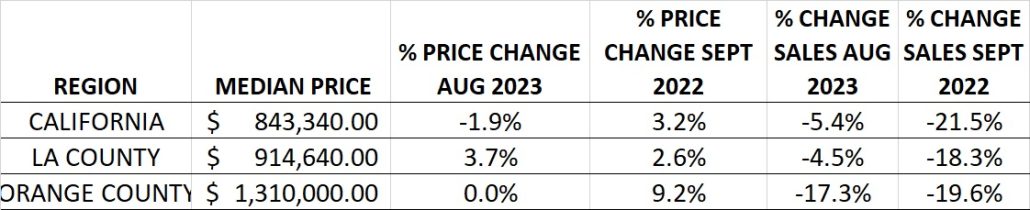
Starting with data from the California Association of Realtors for residential sales in September 2023, when the conforming rate was 7.375% for a 30-year fixed mortgage.
As you can see median home prices are down statewide from last month, but not in Southern California as LA County prices rose and Orange County prices were flat from August. Statewide, and locally, prices are up from September of 2022. With the number of sales down, and prices being up, we see the impact of lack of supply with plenty of demand.
To our question of the week, if you purchased a home in Los Angeles or Orange County in September of 2022 you likely did not lose any value in your home.
Very few people purchased homes in 2022, but several people did in September 2021, when the conforming rate was 2.75%, before interest rates began to climb in 2022. For historical context, below is also price data for September 2019, when the conforming rate was 3.625%, before pandemic exploded housing markets with lack of supply and historically low rate.
As you can see from the chart, median prices are up from September 2021, moderately statewide (4%) and in LA County (3%), and significantly in Orange County (19%).
For those who purchased their home prior to the pandemic, your home value is up considerably. Using the September 2019 median prices, statewide prices have increased 39%, in Los Angeles County the median price is positive by 38%, and the Orange County median price has increased a whopping (technical term) 58%.
Rephrasing the question of the week, do you think you have lost money in your home?
To schedule an initial meeting by phone or Zoom, click here for my calendar, please feel free to forward to a friend or family member!
Fundamental to prices are supply and demand. As has been discussed in the WR&MU, while higher rates have certainly dampened demand, buyers are still in the market—but they have very little inventory to look at and eventually purchase. Overall lack of inventory is primarily due families staying in their homes, not moving up as their families grow, or moving to smaller homes as their families have contracted.
Stats back up the lack of move up buyers. Reading Cathy Francis’, a veteran agent in the Central Coast, newsletter this week, she put forth a statistic that perfectly shows the supply issue in the housing markets. For many years, decades?, the average amount of time for homeownership before moving was 6.5 years. Currently the average time has almost doubled, with families staying in their home 12.3 years. That results in a lot of homes not being on the market.
Rates for Friday November 10, 2023: Not a lot of news moving rates this week, so no surprise that the conforming rate has not moved from last Friday.
FIXED RATE MORTGAGES AT COST OF 1.25 POINTS LOCKED FOR 45 DAYS FOR PURCHASE TRANSACTIONS:
30-year conforming 7.375% Flat
30-year high-balance conforming 7.625% Flat
Please note that these are base rates and adjustments may be added for condominiums, refinances, credit scores, loan to value, no impound account and period rate is locked. Rates are based on 20% down with 740 FICO score for purchase mortgages.
Part of me is five days old, and appears to be getting along with the other parts that are over 60. Monday, I became semi-bionic with a new knee, putting me in day five of the rehab process. My objective is to be incrementally better each day until I am fully rehabbed. And then can go through the process again with the right knee!
I am very much looking forward to the day sometime in early to mid-2024 that I can walk a golf course with the only pain being in my head for the lousy shot I just hit.
https://www.denniscsmith.com/wp-content/uploads/2023/02/house-on-cash.jpg4001000Dennis C Smithhttps://www.denniscsmith.com/wp-content/uploads/2024/06/dennis-c-smith2.pngDennis C Smith2023-11-10 13:26:072023-11-10 13:26:08Are we losing money on our home?
Question of the week: Should we enroll in auto-pay?
Answer: Yes.
Too often we see credit reports for clients who have excellent credit, except….one credit account that has a late payment or two, thus turning excellent credit into fair credit and resulting in a higher interest rate on their mortgage.
The lates could have been easily avoided if they had set up auto-pay on the accounts.
The most common scenarios where we see the “rogue” derogatory reporting are HELOCs (Home Equity Lines of Credit) and credit cards with small balances.
Here are some scenarios that are not uncommon.
First scenario: You get a HELOC with a bank or credit union with which you have never had an account. You open an account with a minimum balance of $2500 to lower the rate on the HELOC by 1%, and you must maintain at least that amount to avoid monthly bank charges.
Your minimum payment is interest only, and because you are using the loan to do various home maintenance and remodeling projects, the amount owed varies from month to month.
Every month you transfer money from your personal checking account to the bank or credit union to make the payment.
One month you forget that you had transferred money from the HELOC to your bank account, therefore raising the balance and the minimum payment. You send the same payment from the month before, which is not enough.
You get your next statement and notice two things, a late charge for the last payment, and that the minimum payment was more than you sent. You now have a 30-day late on an account that lenders see as a mortgage late, a very egregious late reporting for mortgage underwriting.
Second scenario: You have several credit cards, but primarily use two; one for most of your transactions that builds miles for an airline you use frequently for the family, the other builds points for a hotel chain your family uses frequently when you travel and you only use it at those hotels as they triple the points when used at their properties.
Your primary card was compromised and you are waiting for the replacement card to arrive. You are shopping with your son before he heads back to college, he needs a good pair of boots. You use your hotel-points credit card for the $250 purchase.
You have paperless statements, and since you have not travelled in a while you don’t go on-line to check your hotel-points card account. You miss the payment and you end up with a late charge and a reporting on your credit report of a 30-day late.
In both of these scenarios setting up auto-pay would have prevented the late reporting of the two late payments.
For the HELOC, set up an automatic transfer every month to send a deposit from your checking account to the HELOC for the interest on 2-3 times the balance. If your current rate is 8.5% and your balance is $30,000 the minimum payments of interest only is $212.50, send $500 to $600 to your account at bank with the HELOC. Next set up auto-pay for the HELOC that will take the minimum payment each month from the account.
Your balance at the HELOC bank account will grow from the minimum required $2500 as you deposit more than the interest only payment being taken to pay the HELOC’s interest. Every quarter, or month if you prefer, review the account and you can decide to pay down some principle on the HELOC or leave the funds in excess of the $2500 account minimum as you know the balance on the HELOC will go up in the near future.
Even if your balance were to fall below the $2500 minimum after the bank takes out the minimum interest only HELOC, resulting in monthly bank charges for a month or two, those charges will cost you less in the long run than having a 30-day late on your credit report.
For all your credit cards setup and auto-pay for the credit card company to pull out the minimum monthly payment from your bank account. This way when you have a one-time charge on a card you do not use very often the minimum payment will be made until you remember you made that charge. On the card you use most frequently you can always pay as you always have, but if travelling or something else comes up they payment will be made.
Using auto-pay is wise for all your accounts, mortgages, auto loans, student loans, etc. Set them up for the minimum required payments, and if you want to make a higher payment you can do so.
For mortgages, I prefer to set up an auto-send from my account to be taken on the 5th of the month. This is because our household income varies every month since we are both self-employed. By having the payment taken on the 5th I have a few days to see what has come in for the month prior and if we need to make a transfer from savings or not to cover the mortgage payment.
With mail theft seemingly increasing by the month, the stories about mishandled checks at payment processing centers, I strongly recommend that if you are writing checks every month to pay your bills, “because that is the way I have always done it,” set up auto-pay through your bank, and/or creditors.
To schedule an initial meeting by phone or Zoom, click here for my calendar, please feel free to forward to a friend or family member!
Bang, Zoom, to the Moon (Alice—a reference for some of our mature in age readers), describes fixed rate investment markets this week (meaning markets for bonds, mortgages) as prices soared and interest rates plummeted. Why? The Fed did not make any move on rates, letting market rates cool the economy and inflation was on reason. The other was today’s jobs report from the Labor Department.
After heating up the economy and contributing to inflation, the heat is way down in labor markets as seen by September’s payroll and unemployment figures. The unemployment rate rose to 3.9% in September, continuing a steady climb since April’s 3.4% low. Employers hired 150,000 more workers in September, down from 297,000 new hires in August. Analysts are showing that most of the added jobs were “back-fill” in services still trying to get back to pre-pandemic numbers, i.e. retail, hospitality, healthcare. Hiring slower, unemployment rising, so no surprise that wage growth is weaker, up .2% from August and 4.1% from last September. Taking an annualized figure for the last three months and wages are growing at 3.2%. All of this news is positive for mortgage rates.
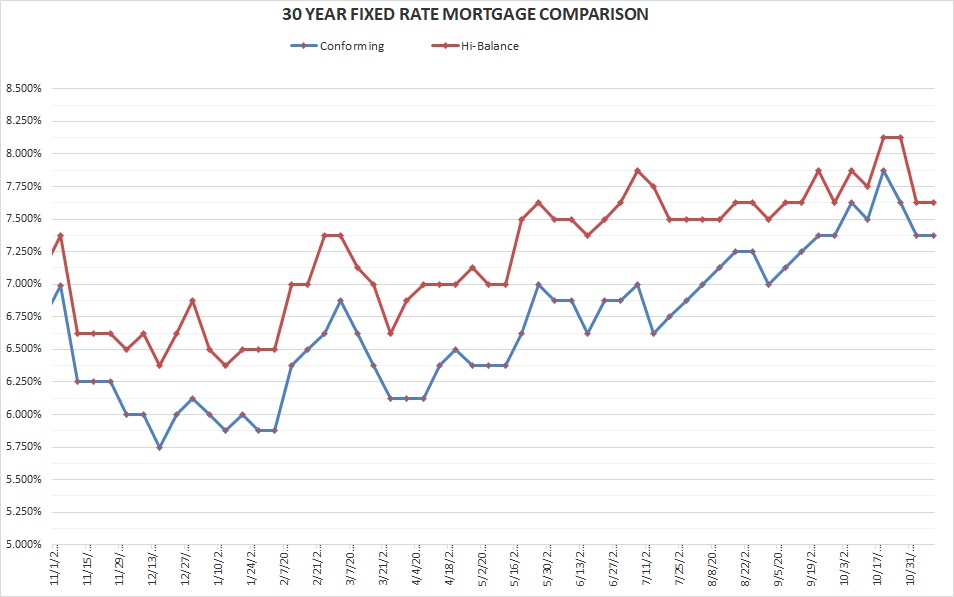
Rates for Friday November 3, 2023: Mortgage rates have their biggest Friday-to-Friday drop since July this week. The trend is downward for rates, will it continue? For how long? How far will they go
FIXED RATE MORTGAGES AT COST OF 1.25 POINTS LOCKED FOR 45 DAYS FOR PURCHASE TRANSACTIONS:
30-year conforming 7.375% Down 0.25%
30-year high-balance conforming 7.625% Down 0.50%
Please note that these are base rates and adjustments may be added for condominiums, refinances, credit scores, loan to value, no impound account and period rate is locked. Rates are based on 20% down with 740 FICO score for purchase mortgages.
Time for the bi-annual debate: should we move the clocks back and forth each year or just pick a time and stick with it?
If we stick with one time there are plenty who argue for each time to be the one, the daylight savings time (34 weeks every year) and those who want standard time (18 weeks). With the government deciding when to move the clocks, it is evident which way they lean.
Don’t forget to “fall back” Saturday night before you go to bed.
https://www.denniscsmith.com/wp-content/uploads/2022/10/12.png800800Dennis C Smithhttps://www.denniscsmith.com/wp-content/uploads/2024/06/dennis-c-smith2.pngDennis C Smith2023-11-03 09:55:382023-11-03 09:55:39Should we enroll in auto-pay?
Question of the week: Should we get an adjustable rate?
Answer: Maybe
For decades we’ve steered clients away from adjustable rate mortgages (ARM) because of the uncertainty in the future compared to a fixed rate mortgage. However, with the primary uncertainty in the market being when rates will go down, now is a very good time to consider an ARM for your home purchase, and possibly refinance.
First the benefit, then the risk.
Today a $800,000 purchase with 20% down and a 760 FICO score, the rate on a 30-year fixed rate mortgage is 7.625%, with a payment of $4530 per month.
The rate for the same transaction with a 5/6 ARM (description below) is 7.25% with a payment of $4365 per month.
Simple math shows us a payment differential of $165 per month, or almost $2000 per year.
For high-balance loans (soon to be loan over $750,000) the 5/6 ARM rate is 7.25%, the fixed rate is 8.00%, on a loan of $800,000 the difference in monthly payment is $413 per month, or almost $5000 per year.
A 5/6 ARM has a fixed rate the first five years of the loan and then adjusts ever six months. The most the rate can change, up or down at the first adjustment is 2%, thereafter the cap and floor each adjustment is 1%. The maximum the rate can increase is 5% above the start rate. For above examples with 7.25%, the most the rate can increase is to 12.25%.
When the loan enters the adjustable period, the new interest rate is calculated by taking the 30 day Average Secured Overnight Financing Rate (SOFR) and adding a margin of 3%.
Today the SOFR is 5.32%. If you have a 5/6 ARM currently and has adjusted to the fully adjustable rate (i.e. without consideration of the 1% or 2% cap limit) the rate would be 5.32% + 3.00% = 8.32%.
That is the primary risk for an ARM, if rates increase so when you enter the adjustable period you may see your rate increase.
On the other hand, if rates drop you will see your rate go down.
Most borrowers funding 30-fixed rate, or 15-year fixed rate, mortgages are rate watching so they can refinance when rates drop. With a 7.25% ARM, you will be watching rates to refinance as well.
A homeowner that has funded a 7.75% rate on an $800,000 loan is paying approximately $5730 per month. If/when rates go to 7.25%, they are highly likely to refinance as they will drop their payment to $5400 or less (depending on how much principal they have paid on the mortgage) saving at least $330 per month.
The homeowner that has a 7.25% mortgage saves the cost of refinancing (about $4-5,000 for fixed costs before considering the points vs. rate cost—no points means a higher rate than paying points).
If/when rates drop to 6.50% both homeowners are likely to refinance. Assuming both borrowers have lowered their loan balances to $775,000 by this time, they lower their payments to about $4900, saving almost $400 per month.
Both homeowners have the same payment, however the one who purchased with the 5/6 ARM saved considerably more money due to the lower monthly payments until the rate lowered to 6.50% when both homeowners refinanced, plus the costs of the additional refinance the fixed rate homeowner funded.
Why wouldn’t someone obtain an adjustable rate mortgage?
Qualifying. For the majority of ARM programs, the qualifying rate is the greater of the note rate (start rate) + 2%, or the fully adjusted rate today.
Looking above at the calculation of the fully indexed rate, today is it 8.32%. The start rate on the 5/6 ARM is 7.25%, add the 2% for qualifying and you need to qualify for a rate of 9.25%.
Real numbers, a $800,000 home with 20% down and a mortgage of $640,000. Assuming approximately $1100 per month for taxes and insurance, let’s look at the different income needed to qualify for this mortgage using a fixed rate and a 5/6 ARM.
At 7.625% for the 30-year fixed the PITI is approximately $5630 per month. Assuming this is 35% of your income, you will need monthly income of $16,000 per month ($192,000 per year) to qualify.
At a qualifying rate of 9.25% the payment for PITI on the 5/6 ARM is approximately $6365 per month. Using the 35% of your income to qualify,, you will need monthly income of $18,100 per month ($217,200 per year).
An ARM may be the right loan for you, call me to run the numbers on your qualifying ability using an ARM to see if it is.
To schedule an initial meeting by phone or Zoom, click here for my calendar, please feel free to forward to a friend or family member!
When? Our economy’s GDP grew a very robust 4.9% in the 3rd quarter, driven by consumer and government spending. The growth in Q3 was greater than Q1 and 2 combined and the biggest expansion in the economy, absent the pandemic burst, since 2014. The surge in growth, not only in the 3rd quarter, but this year, has heads being scratched. The Feds systematic increase in rates to slow the economy, to slow, even contract job growth, and to slow inflation, had many, including myself, predicting a slow-down, even recession, in 2023. When will economic growth slow, much less contract? When will the next recession occur? When will inflation drop below 3% much less hit the Fed target of 2%? When will the sustained high interest rate environment have the historical result of all these occurrences?
Another hike on the table? Following the GDP data were numbers on consumer spending, incomes and prices. Consumer spending, as seen in the GDP data, is 65-70% of the economy. In September spending rose a very robust 0.7%, after adjusted for inflation spending rose 0.4%. Incomes, adjusted for inflation, increased 0.3% for the month, dropping for the third month in a row. With growth in spending outpacing growth in wages, it is no surprise the personal savings rate dropped to 3.4%, a trend that has continued since the end of the pandemic. While several Fed officials have said a hike at their next meeting was unlikely, the latest price data may have some fence sitters at the Fed voting to hike rates. The PCE index, the preferred inflation index for the Fed, showed prices increased by 0.4% for the second month in a row, driven by oil prices. Year over year, the index is up 3.4%, well above the Fed’s 2% target.
Rates for Friday October 27, 2023: Despite the economic news, rates rode rallies in the bond markets early in the week to today, over coming a strong drop yesterday, to show a strong drop in the 30-year fixed from last week.
FIXED RATE MORTGAGES AT COST OF 1.25 POINTS LOCKED FOR 45 DAYS FOR PURCHASE TRANSACTIONS:
30-year conforming 7.625% Up 0.25%
30-year high-balance conforming 8.125% Flat
Please note that these are base rates and adjustments may be added for condominiums, refinances, credit scores, loan to value, no impound account and period rate is locked. Rates are based on 20% down with 740 FICO score for purchase mortgages.
There’s always next year. That is the most benign statement coming from most of my fellow Phillies phans, who were unable to knock out the Arizona Diamondbacks to make the World Series for the second year in a row. For those on social media, there are endless videos of the team’s phans that are more typical of the city’s love-hate relationship pitch-to-pitch, snap-to-snap, free-throw-to-free-throw, for all the teams. Caution, most are not to be played with sound up in the office or in front of children.
Almost all of the commentaries though end with a common sentiment, “Go Birds,” hopeful our Eagles will repeat a trip to the Super Bowl with a different outcome.
About fifteen weeks until pitchers and catchers report to spring training, the start of the always next year…
https://www.denniscsmith.com/wp-content/uploads/2022/08/up-or-down.jpg418347Dennis C Smithhttps://www.denniscsmith.com/wp-content/uploads/2024/06/dennis-c-smith2.pngDennis C Smith2023-10-27 12:01:062023-10-27 12:01:07Should we get an adjustable rate mortgage?
Question of the week: Should we write a backup offer?
Answer: Yes, especially in this market.
With inventory scarce, multiple offers on properties, and most importantly, a market that has seen an above normal escrow fallout rate.
The last phrase is a primary reason you should write a backup offer on a home you would like to purchase, but your offer was not accepted in favor of another one.
What is a backup offer? It is pretty self-explanatory, after a seller has entered escrow with another buyer, you present an offer to the seller indicating the price and terms you will purchase the home if the current buyer they are in escrow with cancels the sale.
There are many reasons why a buyer may cancel a sales contract, among them:
Buyer does not qualify for their mortgage, either because rates have increase, insurance premium is too high, lender did not do a proper job pre-qualifying the client, or a multitude of other reasons
Are not able to get an insurance policy, or the premium is too high for them
The physical inspection presented issues with the structure and property they were unwilling to take on if they close the purchase
Appraisal value is less than sales value and negotiation to amend sales price with seller fails
Funds for the purchase are no longer available
Buyer’s purchase contingent on sale of their home fell out of escrow, buyer no longer has funds nor qualifies for purchase
Buyer changed their mind for whatever reason and used one of the contingencies in the contract to cancel
The advantage of the backup offer to a seller is that if their current escrow does fallout, they do not have to go back to the market, but can pivot and move forward with the backup buyer.
Writing a backup offer does not cost you any additional money, though some sellers will request a deposit that is refunded if your backup offer is not activated and you become the buyer of the home. This enables you to look at other homes, and if you find one you like negotiate to purchase the home. If you have an accepted offer on another home, you cancel the backup offer.
This is important to note, if you have a backup offer accepted it does not preclude you from purchasing another home.
To schedule an initial meeting by phone or Zoom, click here for my calendar, please feel free to forward to a friend or family member!
Rates roller-coastered while we were on our vacation in Italy, and currently climbing again. A lot has happened in the last three weeks:
The jobs report for September showed a gain of 336,000 jobs, almost double expectations, not good for rates
Retail sales in September were up 0.8%, significantly higher than expectations. The news was rate unfriendly as it shows consumers are shrugging off inflation and still buying goods and services
The Fed sent some mixed signals, on the one hand implying that more strong economic news will put the Fed back into rate-increasing mode; on the other hand, saying the bond markets (10-year Treasury at/near 5%) are putting a damper on inflation and will pause on any rate hikes
By far the biggest impact on markets is the Israeli-Hamas war. Wars create a “flight to safety” for investors, fleeing stocks for the safety of fixed returns found in bonds. That the war is in the Middle East, and could impact oil and gas production and distribution, and therefore push energy costs higher, can damage the world economy with even higher prices.
Rates for Friday October 20, 2023: Rates spike this week from last, pushing them to their highest levels of the century—not since 2000 have we seen rates this high. The markets are like a turbulent sea, rising and falling as winds and tides shift. Normally this would create downward pressure on rates, but with consumers, who are approximately 65-70% of our economy, still buying goods and services, and employers hiring more workers, both expanding economic growth, investors are more pushing rates higher.
FIXED RATE MORTGAGES AT COST OF 1.25 POINTS LOCKED FOR 45 DAYS FOR PURCHASE TRANSACTIONS:
30-year conforming 7.875% Up 0.375%
30-year high-balance conforming 8.125% Up 0.375%
Please note that these are base rates and adjustments may be added for condominiums, refinances, credit scores, loan to value, no impound account and period rate is locked. Rates are based on 20% down with 740 FICO score for purchase mortgages.
After taking the most time we have ever taken from home and work, Leslie and I have returned, adjusted to jet-lag, and missing our time in Italy.
We had a wonderful time on our trip, sharing it with our good friends Shannon and Greg. Our trip was five nights in Rome, four nights in Florence (staying at Airbnb’s in both cities), two nights in Santa Margherita Ligure, and for Leslie and I two nights in Milan with our travel buddies headed to Switzerland before returning home.
Besides the amazing historical treasures we saw, the standout surprise for me was how inexpensive it was to eat. We ate at some very good, make that excellent, restaurants and our bills were considerably less than similar meals would be in Southern California—at times half or more less.
I come back inspired for new experiments in the kitchen to try to re-create some of the fabulous dishes and flavors we enjoyed.
If you are planning a trip to Italy and want some tips and ideas please do not hesitate to contact me.
https://www.denniscsmith.com/wp-content/uploads/2022/11/two-people-shaking-hands-scaled.jpg17072560Dennis C Smithhttps://www.denniscsmith.com/wp-content/uploads/2024/06/dennis-c-smith2.pngDennis C Smith2023-10-20 13:09:392023-10-20 13:09:40Should we write a backup offer?