When will we know it is time to buy?

Question of the week:  When will we know it is time to buy?

Answer: Not an uncommon question for those of us in the real estate industry; agents, lenders, escrow officers, appraisers, almost anyone directly, or tangentially, active in real estate gets this question not infrequently.

The question is the real estate version of “when should I get back in the market” after a correction in stock markets; or conversely, “when should I sell XXX stock that has risen significantly.”

The question is basically, “can you tell me how to time the market perfectly to buy/sell?”

The question arises from fear. Younger generation(s) have given us FOMO, for my generation not in the know: Fear Of Missing Out. FOMO arose on social media for users to post that they may miss an event, opportunity that will be fantastic—maybe it turns out to be okay, but they spent the time and money because they didn’t want to miss out in case it was great.

Inherently, we delay decisions, important decisions, because of FOMO.

At the beginning of February we showed the increase in cost and payment purchasing a home in January 2024 versus purchasing in January 2023. As shown in the 2/2/24 WR&MU, the cost to purchase a home due to higher prices and rates went up 10.71% in payment due to 6.42% price increase and 6.12% increase in rate.

Those who succumbed to FOMO January 2023 made the right decision, those who did not succumb as they were waiting for rates and/or prices to drop in 2024, appear to have lost out.

“Appear,” as many are still wondering when prices and/or rates will drop to make homes less expensive.

There will be a “when” on interest rates. All indications are rates will drop this year. What is unknown is how far, and when.

If you purchase a home today and rates drop later in the year, next year, at some point in the future, you should be able to refinance to lower your payment, making your home “cheaper.”

If prices rise and rates decline, you are not saving. Running different scenarios using $800,000 purchase price today at today’s rate with 20% down, the payment is approximately $3940 per month, and the down payment is $160,000.

If rates drop to 6% (down 00.5% in payment) and the price increases to $825,000 (up 3.1%), the monthly payment increases slightly, $20, but your down payment increases $5000—along with your taxes and insurance.

Going further, if the home’s value increases 6.3% to $850,000, and rates drop to 5.75%, the payment is $30 more per month than our base scenario ($800,000 price, 6.25% rate), and your down payment is $10,000 higher, and taxes and insurance will be higher.

Finally, what really matters is how long will you own the home? If this scenario was reversed, and you purchase a home for $850,000 and values take a rare, for Southern California, 6.3% drop to $800,000 in a year to 18-months, but you will own the home for several more years, historically the value will increase above your original purchase price within 24-months of that decline.

Also unknown, is what will happen to prices as rates drop? As I have been writing for more than a year, economics fundamentals, i.e. supply and demand, should dictate that prices remain stable, or more likely, in my opinion, continue to increase.

Looking at the above scenarios, as rates go down more families will enter the market to purchase homes, increasing demand. As well, more families that have been waiting to move up, or down if older, but do not want to trade their mortgage rate in the 3% range for a new rate above 6%, will put their homes on the market to buy their next home, increasing supply—but also demand.

Overall, demand should be higher than supply for quite some time absent a major economic downturn that impacts the middle class causing them to need to sell their homes. That event, absent some major external event, is not on the horizon.

Answering our question of the week, the right time to buy a home is when you can afford to buy the home you like. Trying to time the market to get “a deal,” is impossible as the bottom of any market is not known until several months, in some cases year or more, have passed.

To schedule an initial meeting by phone or Zoom, click here for my calendar, please feel free to forward to a friend or family member!

Have a question? Ask me!

Lower rates? Consistent readers of the WR&MU know that the Fed watches not only inflation data but also labor market data as it decides what to do with its benchmark interest rate. Today the Labor Department released the jobs data for February, which was a mixed bag. The top line number, 275,000 jobs added in the month, was not rate friendly. However, digging into the data some rate friendly numbers are discovered. First, while almost 80,000 more jobs were added than expected in February, total job gains for December and January were reduced by 160,000 jobs, greatly reducing the impact new hires last month. Second, wage growth for the month was only 0.1%, below inflation for the month. Finally, unemployment increased from 3.7% to 3.9%; for unemployment the Labor Department uses household surveys where fewer respondents said they were employed and more said they were looking for work. This survey method is not as accurate as actual payroll numbers, but is a gauge of where the labor market is going. All these factors mitigate the impact on rates the large leap in payrolls would normally have on markets, and interest rates. In other words, the overall report does not give a lot of indication the Fed will push off its first lowering of its benchmark to later in the year.

Rates for Friday March 8, 2024: Bonds and Mortgage Backed Securities (which determine mortgage rates) have been strong all week (higher prices mean lower rates), as a result we see a big drop in rates from last Friday.

FIXED RATE MORTGAGES AT COST OF 1.25 POINTS LOCKED FOR 45 DAYS FOR PURCHASE TRANSACTIONS:

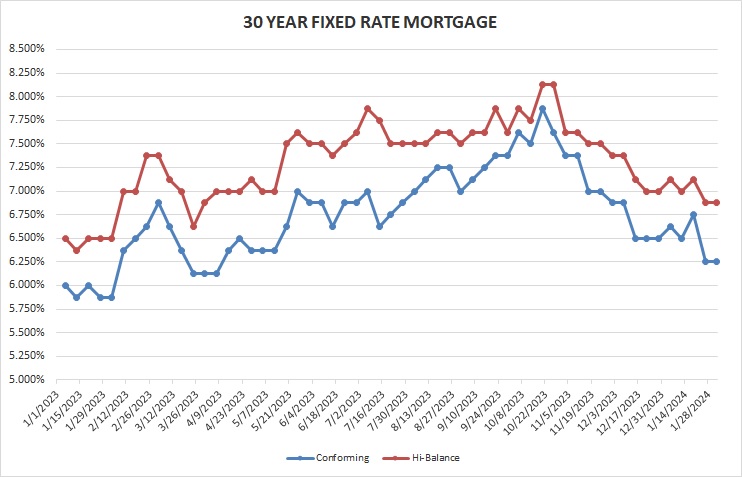
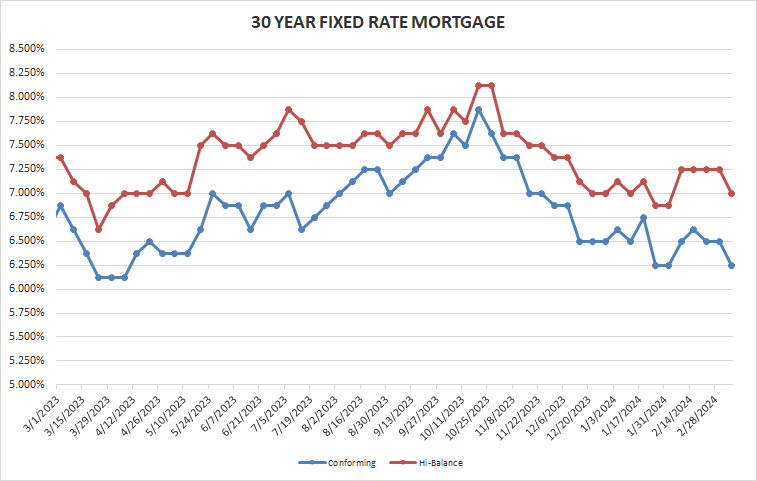
30-year conforming                             6.25%          Down 0.25%

30-year high-balance conforming        7.00%          Down 0.25%

Please note that these are base rates and adjustments may be added for condominiums, refinances, credit scores, loan to value, no impound account and period rate is locked. Rates are based on 20% down with 740 FICO score for purchase mortgages.
In or out on the Oscars?

Leslie and our youngest daughter are very much in, I am pretty much out. I love movies and going to the movies; however, I am not a big fan of award shows. This started to occur earlier in the century when they became more and more political on the presentations and acceptances, and my interest continued to decline when they expanded the nominees—in large part due to the explosion of movies by streaming companies’ production companies.

Of the several nominees for best picture, I have seen four, Barbie, The Holdovers, Maestro and Oppenheimer. Of these four I enjoyed all of them, however the standout was The Holdovers—the biopics of Bernstein and Oppenheimer were excellent, however the story, casting, acting in The Holdovers has my vote.

Our tradition is hot dogs for dinner on Sunday (OSCAR Mayer), and my watching a movie or show in the kitchen, while my wife, and any guests, watch the big show in our family room.

If you are an Oscars fan, I hope you have a great show and enjoy it. If not, I hope you enjoy whatever your option is!

Have a great week,

Dennis

Past Weekly Rate & Market Updates can be found on my blog page at my website www.DennisCSmith.com/my-blog

How will AI impact the mortgage industry?

Question of the week:  How will AI impact mortgage industry?

Answer: It already has.

In the mid-1990’s Fannie Mae and Freddie Mac rolled out “Automated Underwriting Systems” (AUS). It enabled lenders to upload loan applications and credit reports through AUS where the program analyzes the data and returns with a credit decision.

The decisions are returned very quickly, less than a minute.

Using Fannie Mae as our example, when the decision is returned it will have one of three decisions:

  • Approve/Eligible
  • Approve/Ineligible
  • Declined

With each of the decisions the results will indicate what will be needed for final loan approval, why the file is ineligible, or why it was declined.

If eligible, the decision will list conditions that have to be met/proven for final approval. Proof of income and assets listed on the application, and an appraisal confirming the value are the three main factors listed. With the Approve/Eligible, we send the file to underwriting with the Fannie list of conditions proving income, assets, property value, and any factors that also need to met per overall underwriting requirements, i.e. sourcing large deposits, gift letters if applicable, explain gap in employment.

If the Approve/Eligible is our AUS result, it may not be unexpected. Most lenders require an AUS result for their jumbo mortgage products. The “ineligible” for these applications is usually because the applied for mortgage amount exceeds the maximum loan limits for the area.

At times the ineligible results in operator error when inputting the file (occasionally guilty) which when corrected returns the Approve/Eligible result.

When “declined” is the result, this is usually an input or calculation error. My experience is that I most frequently receive decline results when applicants have multiple properties and calculating rents, expenses, mortgages, matching them to the correct properties.

It is very rare that we have a “declined” as a final result as we will not submit files into AUS unless we know the file meets underwriting guidelines, we have the evidence to back up our application, and the file is approvable and able to close when underwriting.

It is for another WR&MU, but the Fannie/Freddie AUS were a primary factor in the mortgage and real estate collapse that began in 2007 due to very loose conditions regarding income and asset verification.

Looking forward, there is not much more that AI can do in the mortgage process in our industry. One area being explored is scanning a file into a program and having it analyze the data on paystubs, W2s, tax forms, bank statements, to confirm income and assets.

Where AI will have a very difficult time replacing humans is setting up mortgages application packages for applicants who are not “cookie-cutter” for lack of a better analogy; borrowers who are W2 employees with long term employment, have very good credit, their funds for closing are in their accounts with no big deposits or unusual transfers.

Where files have wrinkles, such as self-employment, using asset depletion for qualifying, inter-family transfers such as estate or divorce, multiple properties owned, whoever writes code for AI underwriting will have a very challenging time to understand nuances, sleuth through documents and histories to put together a file that meets the underwriting guidelines and result in an approved file and funding.

Where I see a lot of AI being increasingly used, and it is somewhat annoying, is marketing. My inbox is exponentially getting filled with messages that are marketing services and companies, not all of them in the mortgage or real estate industries, that obviously are written by AI, and have time frames for re-sending “you must have missed my email” messages with a day or two. My list of emails that automatically go to my Junk folder seems to double weekly—not counting those in our system spam folder than never reach my inbox.

As I see it, the mortgage industry, which has been using AI for around thirty years, does not have a lot of room for expansion in regards to mortgage origination and approval processes. But, I am likely wrong with this assessment and will be proven so in the coming years/decade.

To schedule an initial meeting by phone or Zoom, click here for my calendar, please feel free to forward to a friend or family member!

Have a question? Ask me!

Slowing. That is the description of consumer spending and inflation. January saw consumers spend 0.2% more in January than December, which did not result in more goods and services, as the inflation index used by the Federal Reserve to determine interest rate decisions increased 0.3% for the month, 0.4% if fuel and food taken from the data. Income jumped up 1.0% in January, but the increase was mostly due to dividend payments being received from December and more importantly the cost-of-living increase to social security recipients. Overall, the data this week was somewhat mortgage rate neutral as the data was as expected.

Rates for Friday March 1, 2024: With the PCE inflation index coming in as expected, investors are anticipating a rate decrease by the Fed as more likely than not. While rates are flat from last week there appears to be some downward pressure on rates.

FIXED RATE MORTGAGES AT COST OF 1.25 POINTS LOCKED FOR 45 DAYS FOR PURCHASE TRANSACTIONS:

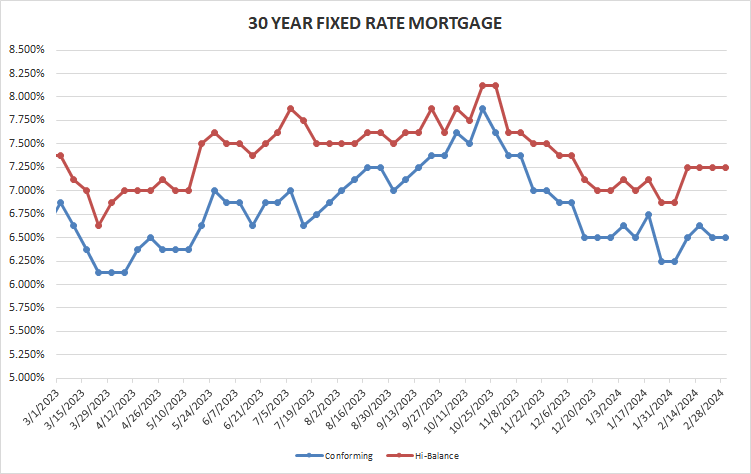
30-year conforming                             6.50%          Flat

30-year high-balance conforming        7.25%          Flat

Please note that these are base rates and adjustments may be added for condominiums, refinances, credit scores, loan to value, no impound account and period rate is locked. Rates are based on 20% down with 740 FICO score for purchase mortgages.

March 1st…this morning on our walk with the dog I told Leslie that in elementary schools in Oklahoma and Pennsylvania, March 1st meant that our classrooms would be decorated with lambs and lions. Of course, with seasons in those areas that have weather that is different in each season, the onset of Spring had more impact than it does here in Southern California year after year. The “in like a lion out like a lamb” was hopeful for kids and adults alike as we looked forward to mowing lawns and playing ball in the streets, instead of shoveling driveways, or stuck inside due to freezing rain or sleet.

California’s in like a lamb out like a… lamb? Ewe? Ram? March weather doesn’t seem to have the same impact.

Thankfully!

Have a great week,

Dennis

Past Weekly Rate & Market Updates can be found on my blog page at my website www.DennisCSmith.com/my-blog

How do we buy a home?

Question of the week:  How do we buy a home?

Answer: Have a plan and follow the plan.

The plan that I suggest:

Know your ability. The overwhelming majority of homebuyers I have worked with in the thirty-five plus years come to me to get pre-qualified after they have already started looking for their new home.

For some this is not an issue, they are pretty well qualified for the price of the homes they have been looking at.

For others there is not an issue, except they waited longer than they needed to as they did not think they were financially ready to purchase the home they wanted and could have been home owners sooner, possibly for a lower price or same price but a bigger home.

For others there is an issue as they are not quite ready to purchase the home they would like to purchase.

When you first start thinking about purchasing a home meet with a mortgage professional (I know one) to go through your current financial situation and ability to purchase a home. You may discover you are ready to buy today, you may discover that you need to wait a while to accumulate more funds for the purchase, payoff debt, improve credit score, wait for increase in income that is expected.

If you need to do some work, the sooner you are aware of the goal you need to attain to be ready to buy a home.

You cannot start the pre-qualification process too early.

Know what you want to buy. Regardless of the home price, know what you would like in a home. A simple process that I have suggested to home seekers over the years is to write it down.

My suggestion, for a couple purchasing a home, is for each to go to a separate room, be completely selfish, and write down the three things you must have, or really, really want in your new home. This is not a laundry list; these are three things that are by far the most important. For instance, must be in a certain school district, must have multiple full bathrooms, must have separate laundry/utility room.

Then write down no more than three things that if there is a deal breaker and you will not buy the home. For instance, on a busy street, has a flat roof, at the bottom of a hill.

When finished compare lists. If one person has something on their “must have” list that is on the other’s “cannot have” list, it is better to know before you start looking that wandering into a home that one person wants to buy and the other does not. Discuss the item, be as flexible as you can and come to an agreement. You do not want to purchase and live in a home that one party starts their home ownership with resentment.

Get a professional. Yes, Zillow has all the homes listed so you can visually tour them, know the asking price, see if it is something you would like to buy. However, Zillow cannot work with you and your “must have” “can’t have” lists, know the neighborhoods, schools, etc and give you insight that can be valuable.

Find an agent that you feel comfortable with, that you know will work for you to find the home that fits your price range and needs. And most importantly, will communicate with you honestly.

Be realistic. The last sentence above is important. Also important is you must listen and understand that honesty. You want a four bedroom, three bath, formal dining room with a pool based on your “must have” list. Having already been pre-qualified for your purchase price range, your agent knows it is not available in the neighborhood, area, region where you want to buy.

What and how does your agent relate this information to you? Do they say, “no problem something will come up?”

Or, “this is a problem as the home you want cannot be purchased within price range and area you want to live. Do you want to consider a different area? We can take a look at the homes, location and distance you may have to travel for work? Or we can look at the homes available in your price range and see if they will work for your family?”

If the first response is what you get, expect to either wait a long time to find a unicorn home go on the market—likely with many bidders, or more likely after too long of a wait decide you must move on and change location or home amenities. At which point prices may have risen further.

If the second response, do both. Look at homes that are smaller, have less amenities in the area you want. As well, look at homes similar to what you want in different areas, see what commutes may be, the schools, the neighborhoods and surrounding stores, shops, etc, and the “feel” of the area.

Living in Long Beach, we know first hand that for many, many years, and still for some, Long Beach had a bad reputation for many people in the region for its past. This included many agents from other areas who would not show homes in Long Beach due to their predisposition; unfortunately, many of their clients over the years could have gotten more for less.

The same is true today for many other areas in Southern California, and across the state.

Be realistic as to what you budget can afford. Maybe you need to move areas, get a smaller home, or buy a condo to get started then working to be able to buy “the one” in the future.

How do you buy a home? Be prepared, use a professional, be realistic.

To schedule an initial meeting by phone or Zoom, click here for my calendar, please feel free to forward to a friend or family member!

Have a question? Ask me!

Rates for Friday February 23, 2024: Very little economic news this week that impacts rates. We saw a spike mid-week due to U.S. Treasury auction on long term bonds, but rebounded strongly today resulting in 30-year conforming dipping after last week’s increase.

FIXED RATE MORTGAGES AT COST OF 1.25 POINTS LOCKED FOR 45 DAYS FOR PURCHASE TRANSACTIONS:

30-year conforming                             6.50%          Down 0.125%

30-year high-balance conforming        7.25%          Flat

Please note that these are base rates and adjustments may be added for condominiums, refinances, credit scores, loan to value, no impound account and period rate is locked. Rates are based on 20% down with 740 FICO score for purchase mortgages.

I very rarely get political in the personal section of the WR&MU. Today after getting multiple mailers in the mailbox, having endured several ads while watching Jeapordy! and M*A*S*H re-runs, I have to break my rule.

These are our choices? For a multiple of reasons that have aggregated over many years, decades, we are bereft of candidates who are not pandering to one end of the spectrum or the other and ignoring the vast majority who are a bit of one “side” on some issues, and some of the other “side” on other issues. Politics has always been nasty, brutal and divisive—go see “Hamilton” or read some pre-Civil War history. But has it always had such a plethora of electeds and candidates who just seem to be not nice or good people?

Every year we hear complaints of low voter turnout, it’s not the opportunity to vote that is keeping people from casting their ballots, it is what is on the ballots.

End of rant, thank you for indulging me.

Have a great week,

Dennis

Past Weekly Rate & Market Updates can be found on my blog page at my website www.DennisCSmith.com/my-blog
Can commercial market drag economy into recession?

Question of the week:  Can commercial market drag economy into recession?

Answer: Maybe.

Those of you who are old enough may recall that the Great Recession that began in late 2007 was precipitated by a collapsing housing market. Dropping housing prices led to many homeowners owing more on mortgages than their homes were worth. Some tried short-sales, others just left their homes. As more and more properties hit the market, either through short-sales, or as bank owned properties following foreclosures or abandonment, prices continued to drop.

The dropping value of bank collateral put banks underwater as well and led to many banks failing—their assets being purchased at discounts by other, much bigger banks, often at the insistence of the Federal Reserve.

The negative repercussions began to ripple, then flood, through other sectors of the economy and unemployment soared, especially for the major foundation for homeownership, middle income earners.

Technically lasting from December 2007 to June 2009, the impact of the Great Recession to the housing market lasted well into 2010, in some regions into 2011.

Our question of the week asks if the commercial market today can do what the residential market did in 2007 and pull the economy into the recession.

There is a fairly good chance that it may.

Some data on commercial real estate (note “commercial” encompasses a very large range of property, essentially anything that is not 1-4 residential units):

  • 19.6% of office space vacant in 4th quarter 2023, highest since 1979
  • $541 billion in commercial loans were due in 2023, many of these loans, and loans due in 2022, received one- or two- year extensions which run out this year and next
  • $2.2 trillion in commercial loans mature between now and the end of 2027
  • Rent regulated residential buildings (again not 1-4 units) values dropped 34% since 2019
  • 25% of central business district buildings (think high rises in major cities) loans are with foreign banks, 17% with regional and local banks
  • Regional and local banks hold 54% of medical office building and 45% of suburban office building debt

What does all this mean in regards to our economy?

Last week in the economic roundup section of the WR&MU the trouble New York Community Bank is in was mentioned. Delving further into that trouble, as a microcosm for the commercial banking issues that may come to bear, provides us with a very similar set of circumstances that led to the residential real estate market collapsing the U.S. and global economies.

NYCB is the biggest lender to owners of rent stabilized apartments, i.e. rent controlled by government fiat, with approximately $18 billion outstanding, or 20% of its loans. Above it is mentioned that rent regulated buildings have lost 34% of their value; not mentioned above is the increasing number of buildings/complexes in New York City, and other urban areas, selling for 50% or below of their prior purchase prices.

If 20% of your portfolio’s collateral has lost 34% of its value, that means the overall collateral for the bank has lost 6.8%, absent decline in values of other assets, i.e. office buildings.

Expand NYCB to other banks, say two other banks that hold a lot of loans to residential buildings that are rent regulated, JPMorgan Chase and Wells Fargo. The regional bank’s issues are also issues that two of the biggest banks in the world are also having, again absent the declining values of commercial office space and other commercial loans. Expanding overseas, whose banks hold 25% of business district loans, U.S. banks are not the only ones at risk in the commercial space.

Higher vacancies, weaker cash flows, declining values, loans coming due, rates on new loans up to 3%, or more, from existing debt that is having troubled being serviced by leases, add up to a very concerning sector of the economy. A sector, that is highly leveraged, though not as much as the residential real estate sector leading to the Great Recession.

Using NYCB as the example of the commercial banking sector is appropriate. Why? Because the first domino to fall that led to the Great Recession fell in February 2007 when Irvine based New Century Mortgage could not sell a portfolio of mortgages on Wall Street as they were determined to be too risky, too leveraged, for the rates of return. This led to the collapse of New Century, which led to scrutiny of other “hard money” lenders, who in turn could not sell their portfolios, leading to their collapse.

At the time I wrote that the hard money mortgage market only made up about 10% of the residential mortgage market. Ten percent was enough to pull down several lenders and banks, and property values.

Loans coming due on properties with declining values and cash-flows, into higher interest rate market is a good formula to weaken any banking system.

To schedule an initial meeting by phone or Zoom, click here for my calendar, please feel free to forward to a friend or family member!

Have a question? Ask me!

Our market this week could have the Ohio Players providing the theme song (with Wolfman Jack as bonus). Okay, so the rate roller coast was not something to love…Rates jumped up on Tuesday, started rebounding on Wednesday and Thursday, then jumped again on Friday. Since prices of mortgages are inverse to rates, your roller coaster had big drop, then slowly climbed before having a big drop to conclude your ride.

Inflation spiking in January more than anticipated caused the drop in prices and spike in mortgage rates on Tuesday. Up 0.3% for the month, the Consumer Price Index was higher than Wall Street’s consensus of a 0.2% increase. Year over year inflation slipped to 3.1% from 3.4% in December. The 3% level of inflation has been tough to crack, inflation has not been below 3% since March 2021. Putting pressure on rates was the 0.4% increase in the “core rate” of inflation (stripping food and energy from the data), with the annual rate remaining at 3.9%.

Several factors contributed rates rebounding mid-week. Among them annual changes to how the government calculated price in CPI, many companies using the beginning of the year to increase prices—which CPI should adjust for the formula for doing so often needs tweaking, and the primary factor for the CPI increase was housing related as rents and home prices increased. Taking these into consideration, the market felt the inflation impact on consumers for their everyday spending was not as significant as the total increase in prices including in CPI.

Pushing bond and mortgage prices higher, and rates lower, on Thursday was a sharp drop in retail sales in January. A slow down was expected following the large increase in sales in December, however the actual drop of 0.8% in sales was considerably higher than the consensus decline of 0.3%. The decline in sales was the largest in ten months. Auto sales had some impact of the sharp decline, however removing autos from the data, sales still dropped a significant. 0.6% for the month. Weather, blowing out spending budgets for the December holidays, “dry January” may all have contributed to the lack of ringing cash registers. If the primary reason for the slow down was consumers reducing their spending outside essential needs, the economy should see a slow down and rates falling. “If” and “should” being key words.

Ordinarily the Producer Price Index has some influence on investors’ decisions. Today’s PPI data had significant influence as it increased 0.3% in January, consensus was a 0.1% increase, the largest one month jump in five months. The core wholesale prices jumped 0.6%, the largest increase in a year. Wholesale prices can be a very good predictor of what is to come for consumers as retailers must gauge how much, of if, to raise their prices to offset the costs they pay for goods and services.

Rates for Friday February 16, 2024: The rate roller coaster ended up going up another incline as the conforming rate is up for the second week in a row after hitting a nine month low at the end of January.

FIXED RATE MORTGAGES AT COST OF 1.25 POINTS LOCKED FOR 45 DAYS FOR PURCHASE TRANSACTIONS:

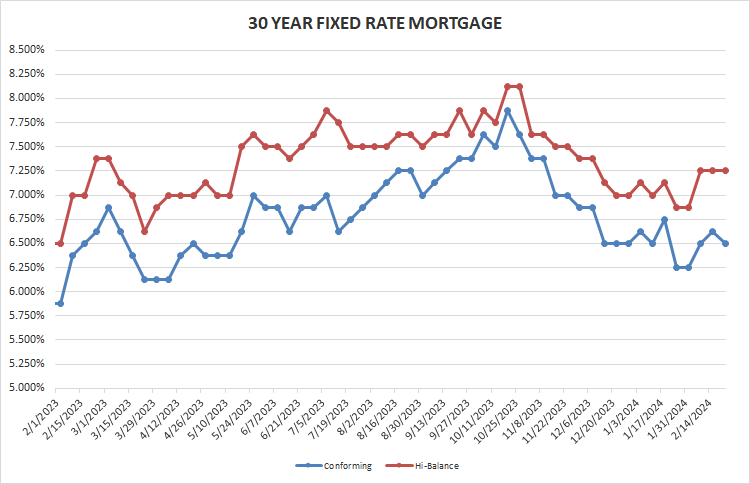
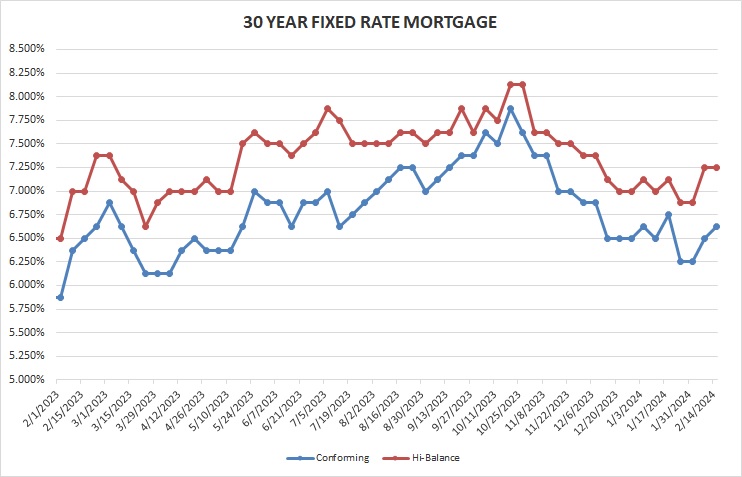
30-year conforming                             6.625%        Up 0.125%

30-year high-balance conforming        7.25%          Flat

Please note that these are base rates and adjustments may be added for condominiums, refinances, credit scores, loan to value, no impound account and period rate is locked. Rates are based on 20% down with 740 FICO score for purchase mortgages.

Woo-hoo! Great finish to the Super Bowl as I won the final score in the squares pool!

The analogy I have been using for the game was that for the first half it was a pitchers’ duel with defenses dominating the game. In the second half the Niners brought in their bullpen that gave up some runs in the 3rd quarter. In the fourth both bullpens faltered, then in the bottom of the 10th the Niners brought in the wrong relief pitcher and gave up a grand slam to lose the game. (For those not following my analogy, with my Eagles out of the playoffs my heart and mind turn to baseball and my Phillies).

There has been so much chatter about turnover on a punt, blocked extra point, coach decision on the coin flip, that great performances seem to be over looked. My top performers are both teams defenses who held down two of the best offenses in the game to only thirteen points total in the first half, Brock Purdy who played a great game for the Niners, and of course Patrick Mahomes who just wins games.

Mahomes is starting to be compared to Tom Brady, who has seven Super Bowl rings. I’m comparing the two to Tiger Woods (Mahomes) and Jack Nicklaus (Brady). Nicklaus won 18 majors in golf, Woods has 15. Tiger is still chasing Jack as he is active and playing the four majors, but the chances are very slim he will catch them. I feel the same with happen with Mahomes’ chase of Brady.

Have a great week,

Dennis

Past Weekly Rate & Market Updates can be found on my blog page at my website www.DennisCSmith.com/my-blog

What are some areas we should review to start the year?

Question of the week:  What are some areas we should review to start the year?

Answer: If the question of the week looks familiar, it is as it is we ask near the beginning of every year; because it is that important. Over the next few weeks, or months depending on your particular situation, you will be gathering statements, forms, and information to prepare your tax returns. While you have all this information in the same place it is a good time to also review various areas of your economic life to see what may need updating, or changing.

Here are some of the areas I suggest you review:

  • Retirement Did you alter your retirement withholdings in 2023?  Do you need to increase or decrease your deductions for your 401(k)?  The maximum contribution for 2024 is $23,000, up $500 from 2023. If you are over 50 the “catch up” contribution limits $7500 for a total contribution (pre-tax) of $30,500.  The combined total for employee and employer contributions is $69,000.

Are you self-employed or work for an employer who does not have a retirement plan so you contribute to some type of IRA? Review your 2023 income and contributions and determine based on estimated income in 2024 whether you need to adjust your monthly or quarterly contributions to your IRA. If you do not make regular contributions to your IRA, I strongly recommend it so you can take advantage of “dollar cost averaging.”

  • Insurance Is your hazard insurance policy current and accurately reflecting the replacement value of your home?  Is your life insurance coverage adequate? Are you home, auto, life insurances with the same company allowing you to take advantage of bundled discounts?

As you are aware, many insurance companies have changed their homeowners’ insurance coverages, not issuing new policies, or dropping existing clients. Check in with your agent regarding your coverage and any expected changes that may occur from their side.

If you have significant equity in your property, consult with your property and casualty agent to see if you should consider earthquake insurance. Because the deductibles are extremely high for earthquake insurance, it is not recommended to get earthquake insurance if you do not have enough equity to protect when calculating premiums and deductible.

  • Estate Planning Do you have an estate plan?  Is it current and reflective of your current assets and wishes?  Do you own property but do not think you need any family planning because you are single?  Everyone with assets should have an estate plan, especially if they own real estate in California (or any other state with inheritance taxes). If you have an estate plan and family trust when was the last time you had it reviewed? Have your children become adults since the trust was last reviewed and amended? What about your wishes for you when you pass on to the next dimension, are they the same as they were when you initiated your trust?
  • Debt Have you increased your debt in the past twelve months?  Do you have a plan to pay it down and off?  Can you restructure your debt to lower the overall interest rates being charged or the monthly cash flow required to manage the debt and keep payments current? Was your 2023 resolution to pay down/off debt but were unable to do so? Call me and we can discuss potential plans to help you achieve this goal in 2024.
  • Mortgage Do you need a review of your current mortgage and options?  Call me!

These are not fun or sexy issues for most people to be tackling, but like changing the batteries in your smoke detectors you need to regularly review and update these critical areas of your home economics.  If you have any questions or looking for qualified professionals to assist you, please do not hesitate to contact me.

To schedule an initial meeting by phone or Zoom, click here for my calendar, please feel free to forward to a friend or family member!

Have a question? Ask me!

 The impact of the Signature Bank failure last year lingers. New York Community Bank acquired $40 billion in assets from Signature when it collapsed last March. Over the past week shares of NYCB shares dropped 60% over concerns of its liquidity. Wednesday markets reacted to concerns of the bank perhaps following Signature Banks course from concerns to failure, and interest rates spiked.

After spike mid-week, investors calmed down and bond prices stabilized, awaiting next week’s Consumer Price Index data. With members of the Federal Reserve making comments since their last meeting that there has been progress on inflation, labor markets strong, might (might) lower rates in 2024, investors read in the comments that the Fed may take action not to lower rates as expected, but increase its benchmark rate if CPI comes in too high.

Rates for Friday February 9, 2024: Markets are very wary and in a point of transition—either better with low inflation data, or worse if the trend of inflation going lower reversing to higher prices for consumers. Rates up from last Friday as markets await Tuesday’s inflation data.

FIXED RATE MORTGAGES AT COST OF 1.25 POINTS LOCKED FOR 45 DAYS FOR PURCHASE TRANSACTIONS:

30-year conforming                             6.50%          Up 0.25%

30-year high-balance conforming        7.25%          Up 0.375%

Please note that these are base rates and adjustments may be added for condominiums, refinances, credit scores, loan to value, no impound account and period rate is locked. Rates are based on 20% down with 740 FICO score for purchase mortgages.

Super Sunday is upon us, with different story lines than many Super Bowls past. It is not unusual to have a lot of chatter and stories about halftime concert performers before the game, and in some cases after (see Super Bowl XXXVIII [38 for Roman numeral challenged] with Janet Jackson’s “wardrobe malfunction” with Justin Timberlake twenty years ago). This year we have had chatter all year about a musical performer, but not about her concert performances, but her attendance at Kansas City Chief games to root on her boyfriend Travis Kelce.

Taylor Swift’s entry into NFL news, updates, game coverage, has turn many of her fans into Chief fans, and has caused many NFL fans to scorn Ms. Swift, Mr. Kelce and the Chiefs.

Me, I think anyone who brings more fans to a sport should be celebrated. Thousands of young women who would see Sundays as a time when they would not see much of dad and their brothers, are now watching games and guessing the Chiefs’ defense is going to do a zero-blitz on the other team’s 3-and-19, or admiring how Mahomes ran a perfect RPO rollout to find Kelce in the seam of the cove-1 zone.

With my Eagles out of the contest I have no real dog in the fight. That said, with the rivalry that has arisen between the Forty-Niners and Eagles, I find it easy to root for the Chiefs in what should be a great game.

I feel the Chiefs defense is better than the Niners defense, which will be needed as the Niners have more weapons on offense. I see a final of 27-20 Kansas City, which means you should probably place your wagers on San Francisco.

Have fun at your watch parties, enjoy the game, and the commercials, and good luck in you squares pools.  

Have a great week,

Dennis

Past Weekly Rate & Market Updates can be found on my blog page at my website www.DennisCSmith.com/my-blog
How much more does it cost to buy a home this year?

Question of the Week: How much more is it to buy a home this year?

Answer: From the end of December in 2022 to end of December 2023 it will cost you 6.42% more to buy the median home in California if you are paying cash, and depending on various factors, 10.71% if using a mortgage.

Let’s crunch data supplied by the California Association of Realtors in their monthly Housing Market Update.

Median prices increased in all but five of California’s twenty-eight counties. With apologies to Lake and Calaveras Counties, the most prominent county with a year-to-year price drop is San Francisco, where the median price dropped 7.3%, over $110,000. Also notable is the 10.6% drop for Santa Cruz prices.

Statewide the media price finished the year with the median price dropping 0.3% from November, to $819,740; which was up 6.4% from December 2022’s median price of $770,490.

More local to most of the readers of the WR&MU, Los Angeles County’s median price of $853,340 was off 5% from November, but up 6.7% from last December’s $799,670 median. Orange County has the statistical anomaly of zero percent change in November’s $1.3 million median price in December; the December 2023 median is 14.9% higher than the prior year’s median $1,131,760, an almost $170,000 gain in twelve months.

Total sales are improving in various areas of the state. In Southern California, sales in LA County were up 3% from November, but down 5% from the start of the year. Orange County saw sales decline 8.1% for the month, contributing to the flat median price from month-to-month, and were off 7.6% for the year.

While sales measured on an annual basis declined for the thirtieth straight month after peaking during the pandemic in June 2021, the rate of decline is slowing. Does this portend a reversal in sales volume? Perhaps, but after so many months of declining sales it will not take too many to move into positive sales territory.

Where have the gains in prices been in the state? Higher price ranges, $1 million and higher, increased their share of the total market to 29% of all sales, while the lower end of the market, prices up to $499,999, saw market share fall to 28%. The middle market of $500,000 to $999,999 remained stable with 43% of market share. This growth in the upper price range and reduction in the lower price range is seen in the increase in the median price.

As for total sales volume in the state, the Southern California (LA, Orange, San Bernardino, Riverside and San Diego Counties) has unsold inventory of only 2.6 months, with average days on the market of 26 days. The tight SoCal market is seen in the sales-to-list price at 99.7% (meaning if home listed for $1 million the sale price would be $997,000).

Almost one out of every two homes sold in the state, 46%, were in the Southern California market.

Can you answer the question already? Okay, okay.

Rounding the median prices to the nearest $500, using the rates posted in the WR&MU for the last Friday in December 2022 and 2023 here is a look at the difference in down payment, monthly payment and income needed to qualify (note, using 35% DTI, depending on many factors the amount needed to qualify may be higher or lower—this is for comparative purposes only).

As you can see, while the median price was up 6.42%, the 30-year fixed rate increased 6.12%, increasing the payment and income needed to qualify by 10.71%. The Consumer Price Index in December was 3.4% on an annualized basis, less than a third of the increase in cost to purchase a home in California—let’s call it the housing inflation index—and the cost to purchase with a mortgage is more than twice the increase in average wages and salaries.

To schedule an initial meeting by phone or Zoom, click here for my calendar, please feel free to forward to a friend or family member!

Have a question? Ask me!

Not so fast…Federal Reserve Chairman Jerome Powell held a press conference on Wednesday after a Fed meeting and stunned the markets who were expecting the Chair to say something along the lines of “all signs point to lowering rates in March…”

Instead, Powell threw cold water on the low-rate fire.

Rather than paraphrase Mr. Powell, here is part of his statement, “Based on the meeting today, I would tell you that I don’t think it is likely that the committee will reach a level of confidence by the time of the March meeting to identify March as the time to do that…(lower rates).”

After several months of anticipation for the Fed to lower rates at the March meeting of its Federal Open Market Committee Meeting, the now likely pause in that action had markets reacting negatively.

Maxwell Smart…missed it by that much. Leading into today’s January job report from the Labor Department the consensus on Wall Street and amongst economists was that job growth would be 185,000 new jobs. The report this morning showed that there were 353,000 jobs added to the economy in January, missing the estimate by more than I can remember the estimate being missed. The number of new hires was the largest in over a year, adding to the strong labor market data was the revision of the December job report upward from 216,000 new jobs to 333,000.

One more factor showing the job market is incredibly strong was the wage report showing workers are getting paid 4.3% more in January 2024 than in January 2023, far outpacing inflation.

Not good news for interest rates from the Labor Department. The Fed looks very closely at the labor market when determining what to do with their benchmark interest rate; today’s data suggests they might be closer to increasing the rate than lowering it.

Rates for Friday February 2, 2024: As expected, bond markets reacted significantly today following the jobs report, with prices dropping and yields (rates) rising. However, yesterday the markets were very positive pushing rates lower. The result of the down then up in rates is that we are currently flat from last Friday.

FIXED RATE MORTGAGES AT COST OF 1.25 POINTS LOCKED FOR 45 DAYS FOR PURCHASE TRANSACTIONS:

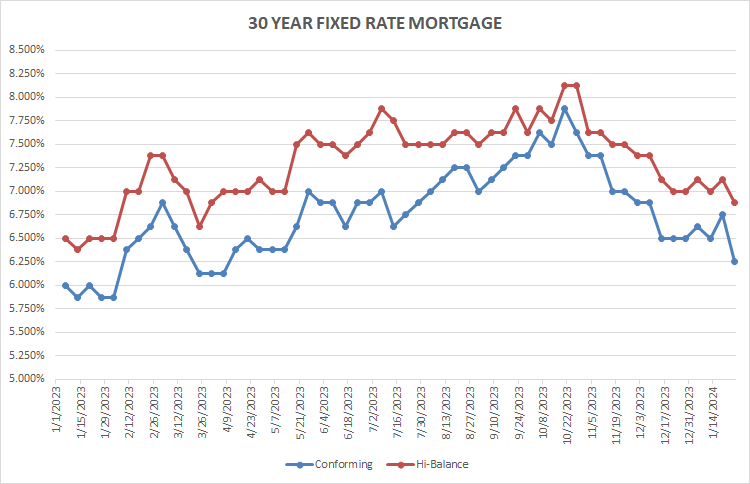
30-year conforming                             6.25%          Flat

30-year high-balance conforming        6.875%        Flat

Please note that these are base rates and adjustments may be added for condominiums, refinances, credit scores, loan to value, no impound account and period rate is locked. Rates are based on 20% down with 740 FICO score for purchase mortgages.

Growing up in areas of the country that experienced the fullness of each season, Groundhog Day meant something. Some February 2nds we would come in from shoveling the driveway so Dad could get out to the train station to see if we would be doing the same in April, or if we would be mowing the yard. Despite our current weather of “atmospheric rivers,” what Punxsutawney Phil does on the second day of the second month each day is pretty irrelevant to whether our weather is expected to be more winter or more spring for the next six weeks…we can almost guarantee that we will be able to entertain outside in the middle of March.

Have a great week,

Dennis

Past Weekly Rate & Market Updates can be found on my blog page at my website www.DennisCSmith.com/my-blog

Our roof is leaking; can we sue the seller?

Question of the Week: Our roof is leaking; can we sue the seller?

Answer: Probably not.

This question came up as when I got up on Monday morning and was headed to kitchen for my morning routine of coffee and reading, I heard a “plop…plop…plop” coming from the family room. “Uh-oh” I thought, because I knew we have a leak in the roof, which is flat (a whole other WR&MU perhaps) that has had some issues in the past. I got out the towel and bowl and we put in the call to our roofer.

Long-time readers of the WR&MU know that almost every winter our question of the week involves why home buyers should go out and look at potential homes when it is raining, or shortly thereafter.

For those who don’t want to click, the reason is so you can see any issues that rain, and water, may be causing for the property. Including a leaking roof. Because in Southern California we can go months and months and months between days of rain, think February to December in some years, home buyers do not have many opportunities to see what rain and water accumulation does to the house and property.

Because of this, if you purchase a home in late summer, it rains in January and you have a roof leak, you might look for some financial relief to help pay for the cost to repair the roof and any damage.

Some may think, “the seller should be liable because they did not tell us about the leak.”

California law requires that almost every seller of a home must provide the buyer with a Transfer Disclosure Statement (form here). Page two of the disclosure requires the seller to disclose “aware of any significant defects/malfunctions” in any of several structural components, include roof(s).

“Aware” is the key word.

If you have a leak in your roof in a reasonable period of time after you purchase your home, is it also reasonable that the seller was “aware” the roof had a defect that would result in a leak?

Were there water stains in the ceiling when you first looked at the home? Did you inquire about the water stains and were told the roof had leaked and then repaired? Is the leak in the same location?

Perhaps that opens up to having seller participate in repairing the roof and any leaks, more likely if the seller did not actually have the roof repaired. If there was repair, did you get a copy of any guarantee from the roofer on the repair for future leaks? Is the guarantee transferable to a new owner?

Given the amount of time between rains in our region, proving a seller was aware of a defective roof that results in a leak(s) is very hard to prove.

I gave the question of the week to my friend and long-time real estate agent Mollie. In her reply she indicated if the seller had no issues and discloses as such, “you get what you paid for.”

So goes on, “there is nothing to say the roof, or any other system, is expected to be new and infallible.”

The important time for mechanical or system issue discovery is after you enter a contract with the seller and exercising your option to have a professional do a thorough inspection of the home. If the roof, or other system like plumbing or electrical, is called out by inspector as old, near end of life, etc, then hire a professional roofer, plumber or electrician to inspect the system and provide feedback on expected lifetime and cost of correction if necessary.

Many buyers obtain a home warranty policy as part of the closing, these policies cover partial/complete costs of repair or replacement for many systems in the home, including appliances, depending on the policy. Some of these policies also cover roof leaks. If you have a home warranty policy, check to see if your leak is covered.

Taking covering costs a step further, I asked another friend, Vali, who is an agent with a major insurance company and has written thousands of policies in her career, if roof leaks are covered under standard homeowner’s policies.

Her response was maybe. She states that a leaking roof on its own is a maintenance issue, and maintenance is not covered in homeowner’s policies. However, if there were “heavy rains and wind driven rain damage to the roof during a storm” that causes a leak, the policy would cover replacing the damaged part of the roof and any interior damage that resulted.

Regarding water damage, she also noted that damage caused by a sudden flow of water from within the home, say a burst pipe, is likely covered for repair of damage. Note, a damage to a slow flow of water would not be covered as, again, homeowner’s policies do not cover maintenance.

If you are unsure if damage to your home by some event is covered by your insurance or not call your agent to discuss the incident and possible coverages, costs and your deductible.

California is known as a litigious state, a roof leak is likely not a reason to fulfill the stereotype.

To schedule an initial meeting by phone or Zoom, click here for my calendar, please feel free to forward to a friend or family member!

Have a question? Ask me!

Rate should be climbing. Historically robust economic growth, strong consumer spending, higher wages, put strong upward pressure on interest rates. We are in a weird time in history as the economy grew at the fastest rate over two quarters since 2014, consumers are spending more and more money each money, and wages are outpacing inflation, and rates are steady*.

The data. Gross Domestic Production grew 3.3% in the 4th quarter of 2023, following 3rd quarter growth of 4.9%. Consumer spending rose 0.7% in December and wages were up 0.3%. The PCE inflation index preferred by the Federal Reserve was up 0.2% in December and up 2.9% from 2022, the lowest year-over-year increase in three years.

The data, historically, would have the Fed looking to push off any rate decreases in 2024 to see if the economy will slow, consumers will slow spending and wages stagnate. However, with the strong economic data, inflation is slowing—the antithesis of economic modeling.

*The asterisk We are adding some new lenders to our portfolio and as a result have available a few sources with better programs. As such, in today’s rate quote we see a dramatic drop in the 30-year fixed rate with the new opportunities. The drop is an anomaly to the overall rate market but indicative of the turmoil in the industry and its lenders.

Rates for Friday January 26, 2024: As stated above, we see a drop in rates from last Friday.

FIXED RATE MORTGAGES AT COST OF 1.25 POINTS LOCKED FOR 45 DAYS FOR PURCHASE TRANSACTIONS:

30-year conforming                             6.25%          Down 0.50%

30-year high-balance conforming        6.875%        Down 0.25%

Please note that these are base rates and adjustments may be added for condominiums, refinances, credit scores, loan to value, no impound account and period rate is locked. Rates are based on 20% down with 740 FICO score for purchase mortgages.

I always enjoy the rain, but as mentioned above, less so this past week with our roof leak. I have never like flat roofs, but we love our home and about one-third of our home has a flat roof due to addition made in the early ‘70’s. The cost of our love is every few years we have a small leak in some part of the roof that needs patching. A permanent fix involve what Leslie and I call “lottery money;” essentially adding a second story to the area of the home with the flat roof.

Having lottery money requires purchasing tickets, which I rarely do as I listen to my older brother who has always said the lotter is a tax for people bad at math.  

Have a great week,

Dennis

Past Weekly Rate & Market Updates can be found on my blog page at my website www.DennisCSmith.com/my-blog
Should we transfer property to our children this year?

Question of the Week: Should we transfer property to our children this year?

Answer: Perhaps. If not this year then possibly next.

In January 2018 the Tax Cuts and Jobs Act took effect. The Act had a tremendous on the tax codes for individuals, businesses, corporations, and estates.

One of the largest changes was the increase in the value of an estate that can be transferred tax-free as inheritance from $5.49 million in 2017 to $11.18 million in 2018. For 2024 the amount is $13.61 million.

The 2018 tax act had a sunset clause of December 31, 2025 for most of the provisions, including the increase in the value of estates that could be transferred as inheritance.

Unless Washington extends the current tax rates, the inheritance threshold will return to pre-2018 levels, $5.59 million.

I am not a tax preparer, CPA or estate attorney. Please consult with your tax and estate professionals before engaging in any transfers or sale of property that may have tax consequences.

Gifting an early inheritance to beneficiary(s) is a way to transfer assets while you are still living, and avoid paying taxes. A gift of assets in 2024 or 2025 will count against the $13.61 million threshold before inheritance taxes are payable. Should the taxable threshold drop in 2025, or the future, the threshold in the year you made the transfer takes precedent.

Because of the uncertainty with the tax code limits in 2026 for a myriad of taxable events, many families are consulting with their tax professionals and attorneys to determine if they should make early transfer of assets part of their 2024 financial objectives.

With the tremendous increase in property values that has resulted in many holding onto several properties to avoid capital gains taxes, many waiting to have the properties transfer to their children to avoid the capital gains pass the assets through via their estates.

In Southern California, it does not take too many properties to reach the $5.59 million possible inheritance threshold that may return in 2026 and beyond.

Consider a primary residence valued at $1.5 million, the first home you purchased in 1994 for $300,000 that is now worth $1.2 million, a duplex you purchased during the 1999 downturn for $550,000 now worth $1.8 million, the vacation home in the mountains you inherited from your parents in 2000, then valued at $250,000 that is worth $900,000, and the condo in the desert you purchased in 2009 when prices plummeted for $150,000 that is now worth $500,000.

These properties are generating income for you, and have expenses, and are also valued at over $5.59 million—with the values rising.

Presuming values in the region continue to climb through 2025, the total values may approach $6.2 million by the end of next year. If you still have these properties on January 1, 2025 and the inheritance threshold reverts to 2017 levels, your estate has taxable value.

If you were to transfer one or two, properties to your children, the value of the properties can be exempt from inheritance taxes.

It is important to note however, that the tax basis for any properties transferred early will likely have the same tax basis as they currently have; i.e. for the property purchased in 1994 will be $300,000. Whereas when the properties are transferred at death have a step-up in basis to the value at time of death.

One strategy to minimize, but not eliminate, taxes, would be to sell property in 2024, pay the capital gains taxes on the property* and then transfer the net proceeds to your children as an early inheritance.

*Consider the federal capital gains taxes currently in place are as low as they are ever likely to be, 15% if your joint income is $94,051-$583,750.

Federal estate tax rates are considerably higher than capital gains taxes, as high as 40% on amounts over $1 million.

To put some possible numbers together:

You sell your first home you purchased in 1994 for $300,000 at a price of $1.2 million, after eligible deductions your capital gains on the property are $750,000. Federal capital gains taxes are 15%, $112,500, California capital gains taxes are calculated as income, another $74,000, for a total of $186,000 in taxes. Your next proceeds are $563,500 you can distribute to your children tax free.

Consider you pass away in 2026 and the inheritance threshold is $5.59 million and your properties are worth $6.3 million. Federal taxes on the $710,000 over the $5.59 million inheritance threshold is $233,500.

By selling the property in 2024 or 2025, then transferring the net proceeds to your children in 2024, you can likely save close to $50,000 in taxes, provide your children with a liquid asset, and reduce the potential inheritance tax on your estate they will have to pay in the future.

That is one strategy, another to explore is transferring property to children as early inheritance and have them sell the property and have them pay capitol gains, which may be lower if gains are split between two or more children.

Once again, I am not a tax or estate law professional. These are examples for possible strategies to discuss with your advisors for 2024 planning.

To schedule an initial meeting by phone or Zoom, click here for my calendar, please feel free to forward to a friend or family member!

Have a question? Ask me!

Consumer spending is approximately 65-70% of our economy, and retail spending is approximately one-third of consumer spending. Because of this, retail sales data is a critical economic data point impacting mortgage rates. In December retails sales rose 0.6% from November, which had a strong increase of 0.3% from October. For the year, retail sales were up 5.6% from 2022; double the rate of inflation. The news is mortgage rate unfriendly as the ringing cash registers reflect a strong and growing economy, no slack on pressure on prices, a need for a strong labor market in the retail sector which can spread to other sectors. All of these factors support the Fed pushing out any rate cuts to their benchmark interest rate. The consensus has been a cut in March, however if next week’s GDP data show a strong 4th quarter to finish 2023, the initial rate cut may not be until the summer.

Rates for Friday January 19, 2024: After seeing the 30-year conforming fixed rate at 6.50% for four of the last five weeks, this Friday the rate jumps to its highest since early December.

FIXED RATE MORTGAGES AT COST OF 1.25 POINTS LOCKED FOR 45 DAYS FOR PURCHASE TRANSACTIONS:

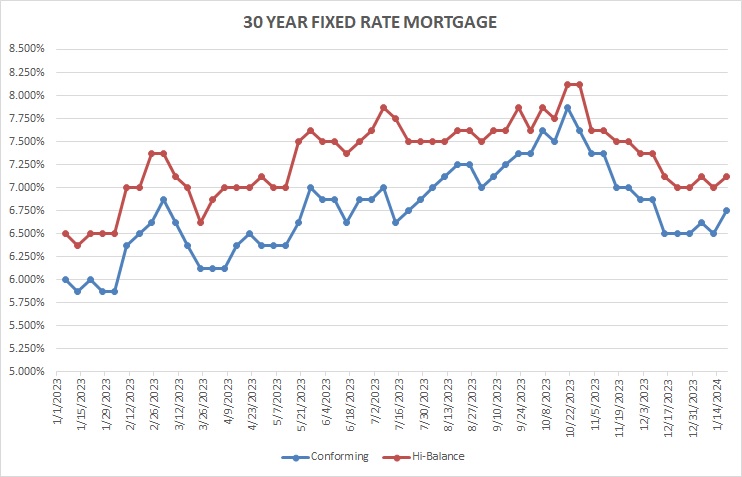
30-year conforming                             6.75%          Up 0.25%

30-year high-balance conforming        7.125%        Up 0.125%

Please note that these are base rates and adjustments may be added for condominiums, refinances, credit scores, loan to value, no impound account and period rate is locked. Rates are based on 20% down with 740 FICO score for purchase mortgages.

It is Empty-Nest Day in the Smith household as our youngest heads back to New York to start her senior year after four weeks R&R at home. Always a bit tough for the SoCal kids who leave the sunny moderate temperature December-January weather for snow and freezing temps, and no more In-N-Out until they return.

We have a bit of a cushion in the empty-nesting as tomorrow we head to San Diego for the day to see our oldest who is there for a conference and flying back to Boston tomorrow evening.

Then it is back to Leslie, the dog, and I watching Jeopardy! and shows we want to watch.

Have a great week,

Dennis

Past Weekly Rate & Market Updates can be found on my blog page at my website www.DennisCSmith.com/my-blog

How can we buy a home in 2024?

Question of the Week: How can we buy a home in 2024?

Answer: With planning and assistance from professionals, and perhaps family.

While there are families buying homes for over one-million dollars with cash, they are the far, far outliers for the home buying market. Chances are if you are reading the WR&MU, or someone you know because you were kind enough to forward it, need a mortgage to purchase your new home.

Income, funds for closing, credit payments and score are the factors that go into mortgage underwriting and approval. The income and credit payments are used in the debt-to-income (DTI) calculation, the primary factor in the amount of mortgage for which you will be able to qualify.

Debt-to-income Add up your monthly credit obligations, add in the new PITI (total housing payment that includes mortgage payment principle and interest, property taxes, homeowners insurance, and other fees such as homeowners association if applicable), and divide by your gross income. This calculation results in a percentage rate:

Income = $10,000 per month

PITI of proposed mortgage = $3500 per month

Car payment = 600 per month

Credit card minimum payments = $250 per month

Total debt payments divided by income: $4350 / $10,000 = 43.5%

This DTI will be eligible for most conforming mortgage programs. If you wish to purchase a home that needs a larger mortgage, your options are to increase your income, and/or reduce your monthly debt payments.

Income Perhaps the most difficult factor to control. Most people cannot quickly increase the amount of money they make—and if they can, depending on how they create that increase it may not be eligible for loan qualifying. Because of this, if you are not able to qualify for the size of the mortgage you need for the price range you require you may need to obtain a co-signer.

Qualifiable income has many facets depending on whether you are a W-2 employee or self-employed, are paid bonuses or overtime, have commission income, all have different guidelines to qualify what income will be used to determine the size of your mortgage amount.

Regarding increasing your income, guidelines look backwards as to your history of amount you are paid and how you are paid. If you add a side-gig, guidelines will want to see that you have a history of working more than one job, and will want to see at least one year of the income to show consistency in earnings.

Credit payments While it can still be challenging, it is often easier to reduce credit obligations to improve qualifying than to increase income.

During initial quick pre-qualification calls and meetings to get an idea of what our starting point is, many clients when asked about what their monthly debt payments are tell us how much they are paying per month on credit cards.

For mortgage qualifying the industry uses the minimum required payment, for most credit cards that amount is 2% of the outstanding balance. It is great that you are paying more per month on your credit obligations to pay them off sooner, but while your $1500 per month payments are very helpful, for our standpoint the $250 per month minimum increases the amount of mortgage you qualify for dramatically.

When it comes to auto loans, or other installment debt, if the balances on the obligation are 10-months or less, for most mortgage programs, the payment will not be included in the DTI calculation. For instance, in our above DTI calculation with the $600 per month car payment, if the balance of the loan is $5980, the $600 payment is not included—this frees up $600 that can be used to increase your purchasing power.

As for credit card debt, if we are able to show on a credit report that balances are lower, or paid off, then new payment, or no payment, can increase purchasing power.

Funds for closing One of the hardest struggles most people have is losing weight and keeping the lost weight lost. Equally challenging for many, most, is saving money and keeping money saved. Both require pretty much the same methods: plan, execution of plan, discipline to stick with execution of plan.

Funds for closing include down payment, closing costs, and funds for those who may need to lower debt obligations as described above.

Down payments can range from no down payment if you are a veteran with available benefits to as much as you can handle. Most first-time buyers are looking at down payments starting at 3% and increasing from there.

Closing costs are roughly estimated at 3% of the purchase price, perhaps more or less but that is the rough starting point before digging into details of price, loan amount, closing costs requirements (for instance if an impound account is required so your taxes and insurance are collected by the lender).

With home prices where they are, families who started a long-term savings plan several years ago to use for buying a home have been chasing the market and needing to save more and more.

Important note: many families we have worked with over the years have been waiting to buy until they have a 20% down payment, in the mean time they have missed out on buying and subsequent home value appreciation because they did not buy with 3%, 5% 10% down when they would have qualified.

It is never too soon to start planning, and saving, for your home purchase. Ideally, you consult with us to go through different ideas and options for your plan. If you have a financial advisor consult with him/her for savings plan and options with investments.

One avenue for funds for home purchases that is very often over-looked, or avoided due to poor information, is the use of retirement accounts as sources for funds.

The IRS allows first time homebuyers, defined as someone who has not owned a home for 3-years or longer, can withdraw up to $10,000 from a retirement account without penalty (there are some conditions, please check with your tax preparer). For a married couple that is $20,000 tax free for closing costs.

Most employer sponsored retirement accounts (i.e. 401(k)) allow employees to borrow from the 401(k) for the purchase of a home. Typically, plans will let you borrow up to 50% of your account balance to a maximum loan amount, also typical is $50,000 or less.

If you borrow from your 401(k), you likely will have an option of period to repay and the payments are made through your normal paycheck. You pay yourself back, not a 3rd party, and as with all loans there is an interest rate—you pay yourself interest. Note if you leave the company before the loan is paid off, you will have to payback the outstanding balance or the amount is deducted from your 401(k) and the amount is counted as income and subject to taxes and any penalties for early withdraw.

Consider, husband and wife, both long-term with their companies, each has $80,000 in their 401(k) accounts. Each obtain a loan for 50% of their balances, then take $10,000 each with no penalties. They have $100,000 for down payment and closing.

Yes, you have depleted your retirement accounts, however you will be paying the funds back, with the exception of the $10,000 each taken with no loan, and your funds will be invested in a home that will appreciate over time, which will at some point become part of your future retirement.

Finally, a very common source of funds are parents or other family members providing a gift, or in some instances loaning funds as a second mortgage on the home with a generously low interest rate and repayment terms that do not negatively impact qualifying.

Credit score For most borrowers credit history does not lead to inability to qualify, but instead impact the interest rate they will receive. Mortgage rates are determined by several factors, one of which is credit score, or FICO score. Pricing is determined in tiers; higher scores have lower prices and lower tiers have higher prices. Depending on your history and current accounts, you may be able to increase your credit score. For some clients this can happen somewhat quickly by adjusting account balances, for others it can take more time to cure some past issues.

Too often we have met with clients who made decisions thinking they were improving their qualifying and speeding up their home buying process that need more time do to actions that took that slowed their home buying process; usually from scouring the internet, watching YouTube and TikTok videos and getting poor information. If you are considering purchasing a home this year, next year, or at any time in the future, meet with a mortgage professional to learn about the process, what your options are given your specific situation, and put together a plan to homeownership.

To schedule an initial meeting by phone or Zoom, click here for my calendar, please feel free to forward to a friend or family member!

Have a question? Ask me!

Maybe not bad news? The Bureau of Labor Statistics released the Consumer Price Index for December yesterday, and the numbers went backwards. Prices rose 0.3% in December, the highest in three months. Year-over-year, prices rose 3.4% after increasing 3.1% annually in November. Making what would not be good news into good news is that the “core” rate of inflation (energy and food prices stripped out of data) decreased year-over-year to 3.9%, the first time the number has gone below 4% since mid-2021. What could have been negative for rates with the monthly increase in the broad data, became somewhat neutral as the data will have no impact on any Fed decision on rates.

Rates for Friday January 12, 2024: Rates dip from last Friday, starting 2024 with some nice downward momentum!

FIXED RATE MORTGAGES AT COST OF 1.25 POINTS LOCKED FOR 45 DAYS FOR PURCHASE TRANSACTIONS:

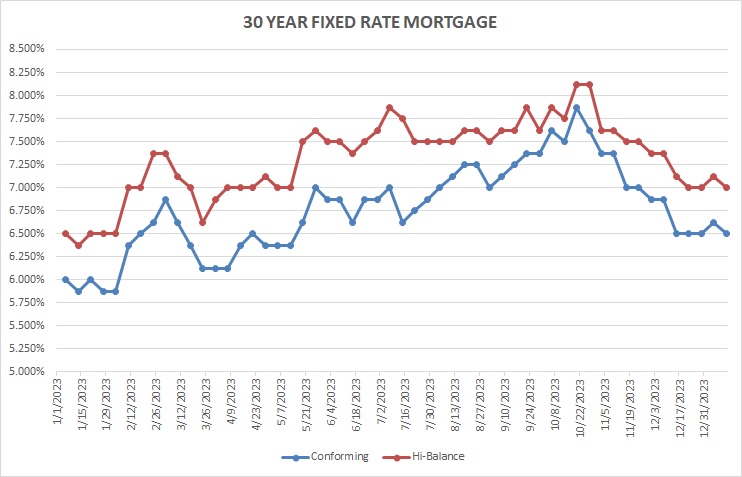
30-year conforming                             6.50%          Down 0.125%

30-year high-balance conforming        7.00%          Down 0.125%

Please note that these are base rates and adjustments may be added for condominiums, refinances, credit scores, loan to value, no impound account and period rate is locked. Rates are based on 20% down with 740 FICO score for purchase mortgages.

Our first “normal” week of the year. Schools are open, everyone working normal work week, the “Resolutionistas” are filling gyms and the vegetable section of grocery stores…

Heading into my knee surgery I put into my head a mantra to prevent over doing it during rehab, which I have been apt to do in the past for other procedures and ailments. I kept telling myself my objective (resolution?) was for my knee to get incrementally better every day.

As I thought about it, and continue to through the rehab process, I learned that this is the mantra I should have had for life starting many years ago.

So, for 2024 and beyond, that is my daily objective, get incrementally better every day.

Have a great week,

Dennis

Past Weekly Rate & Market Updates can be found on my blog page at my website www.DennisCSmith.com/my-blog

Looking into 2024 and rate impacters

Happy 2024!

Every new year is approached with hope and promise for the coming year. Such are the sentiments many in the real estate industry have for 2024. Any optimism in regards to real estate markets is based on mortgage rates continuing their move downward that began in October.

Yes, rates should drop in 2024, but how far? What forces will impact rate movement?

The same forces that always impact mortgage rates, the economy and global geo-politics.

Primarily, the economy. The expectation is the economy will slow down, pulling rates down with it. The Fed has announced it expects to drop its benchmark rate up to three times, anticipating the slowdown.

If consumers do not slow their purchasing of goods and services, supporting higher inflation and tight labor markets, rates will resist downward movement.

International events also impact rates, especially armed conflicts. Ukraine’s war with Russia is approaching two years, Israel’s military action in Gaza to eradicate Hamas will be on-going through the year; with a likely spread to armed conflict with Hezbollah, Iran’s surrogate terror group based in Lebanon. Houthi rebels based in Yemen, also supported by Iran, have already disrupted cargo and tanker ships in the Red Sea with their missile and drone attacks, interrupting shipments of oil and cargo headed to the Suez Canal. Iran’s involvement in these conflicts is increasing tensions between the Shia centric nation and other nations in the Middle East governed by Sunni centric leaders.

China is increasing its aggressiveness towards Taiwan in its historic desire to fold the island-state into the People’s Republic. North Korea has increased its testing of ballistic missiles, and recently its leader, Kim Jong Un has stated his military would annihilate South Korea and the United States if provoked.

These conflicts, if exacerbated, would dramatically disrupt the global economy and put strong downward pressure on interest rates.

Finally, the race to the White begins in ten days when Iowa will hold caucuses across the state to select nominees for both partes, followed by New Hampshire’s primary eight days later on January 23rd. Election years are somewhat notorious for having a lot of movement, up and down, in markets, as consumers and investors try to read the tea-leaves as to what the results of the presidential election in November will be.

Two occurrences in 2024 that should have no impact on markets are that we have a leap year, and the summer Olympics.

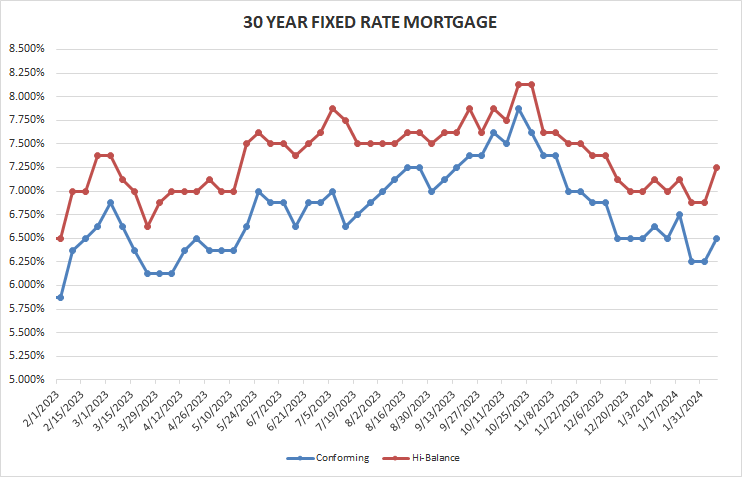
Since the fall of 2022, mortgage rates have mostly been over 6.00%, with a significant number of months over 6.5%. What will become the “normal” rate that will shake loose the real estate market inventory? What will be the cause of the market to drop to that rate?

To schedule an initial meeting by phone or Zoom, click here for my calendar, please feel free to forward to a friend or family member!

Have a question? Ask me!

Opening data for year not positive for rate cuts. This morning we got the monthly job data from the Labor Department. The numbers show that 216,000 jobs were added to the economy in December, the most in 3-months. Higher employment is not unusual in December as many retailers and hospitality employers increase hiring for the season; however, the strong hiring was not due to seasonal workers. The number one hiring sector for the month was government (begging the question from this limited government advocate, why are local, state and federal governments adding this many jobs in December?). The total hiring numbered was a bit tempered by strong reductions in the total number of hirings in October and November. A strong job market in a neutral environment would portend higher rates, in this case the numbers put delaying Fed rate decreases further into 2024 as likely.

Also making the case, was the wage data from the Labor Department. Hourly wages increased 0.4% in December and year over year the increase was 4.1%. These numbers surpass inflation, putting more “real” dollars in workers bank accounts, which can lead to more spending. If the wage increases, in addition to adding to cost of business to employers which can lead to higher prices, increase demand for goods and services, inflation could become stickier on its path downward, or reverse course. Another point of concern for the Fed when calculating when, or if, to lower its benchmark rate.

Rates for Friday January 5, 2024: Our new year starts with a bump in rates from last year (last week), and 0.625% (five-eighths of one percent) higher than the first Friday of 2023.

FIXED RATE MORTGAGES AT COST OF 1.25 POINTS LOCKED FOR 45 DAYS FOR PURCHASE TRANSACTIONS:

30-year conforming                             6.625%        Up 0.125%

30-year high-balance conforming        7.125%        Up 0.125%

Please note that these are base rates and adjustments may be added for condominiums, refinances, credit scores, loan to value, no impound account and period rate is locked. Rates are based on 20% down with 740 FICO score for purchase mortgages.

This is coming to you from Palm Desert, where Leslie and I have spent the week relaxing and relaxing. We have discovered a few new restaurants, to us as some have been here a while, and re-visited a few favorites, and caught up on our reading and streaming movie and show lists.

I hope you too have been able to start the year relaxed and getting ready for a year that will be interesting in many ways.

Have a great week,

Dennis

Past Weekly Rate & Market Updates can be found on my blog page at my website www.DennisCSmith.com/my-blog