What’s Next

Question of the week: What’s next?

Answer: I have been thinking of how to write this WR&MU for quite a while, but there is not a lot of thought that needed to go into it so I’ll get to the point.

Astute observers will note that the header on the Weekly Rate & Market Update has changed after almost two decades looking the same. There is a reason.

Stratis Financial is closing just a few months shy of its 25th anniversary. No longer young guys who opened a mortgage company, now older guys who all have different goals and objectives, from retirement, to starting anew, to continuing with a different mortgage company, the time has come for the six partners of Stratis to take different paths.

My path is similar to the one I have been following for the past several years, continue assisting those who need mortgage advice and products, while providing financial advice and asset management to my growing list of clients as a SEC registered Investment Advisor, through Copiam Asset Management.

Over the past few years, with the slow down in the mortgage market, I have been able to concentrate more time and effort in my advisory business. As I have investigated options for myself in the mortgage business with the closing of Stratis I have found a company that will allow me to devote time and energy to my advisory and mortgage clients. In the near future I will have the details in the Weekly Rate & Market Update.

I am excited for the next chapter of my mortgage career. I feel with the company I will be working with there will be more product opportunities for clients. The process is such that I will be able to spend more time working directly with clients to prepare them for homeownership, discuss mortgage options, and as always how both of these fit into their total financial abilities today and in the future.

Changes such as this have various challenges, of foremost concern to me is communication, therefore for mortgage inquiries, referrals (yes please!), and business please change my email address from [email protected] to:

[email protected]

If I properly made changes to my profile, then your reply to today’s WR&MU message will go to my new email address.

I’m hopeful as well that this has not been caught in your spam filters!

As always, I have made a short story long, so here is the long story short:

Stratis is closing, Dennis is still in business and will continue to provide excellent service, knowledge, and analysis for you, your clients, friends and family.

Thank you for supporting me and our Stratis family for these many, many years.

To schedule an initial meeting by phone or Zoom, click here for my calendar, please feel free to forward to a friend or family member!

Have a question? Ask me!

Celebrating slowing was the mood this week as the Consumer Price Index for April showed inflation slowed in the month, increasing 0.3% from March with year-to-year prices increasing 3.4%, down from 3.5% growth from March to March. Core data (CPI minus food and energy) came in at 3.6%, down from 3.8% growth in March. While the 3.4% is well above the Federal Reserves 2.00% for inflation, the slower growth in prices was well received by markets as it puts a possible rate cut by the Federal Reserve back in discussions.

More rate positive data was the retail sales number for April, positive because the data was neutral. Sales in April were up only 0.2% from March, pushed positive mainly because of the 3.1% increase in gasoline prices for the month.

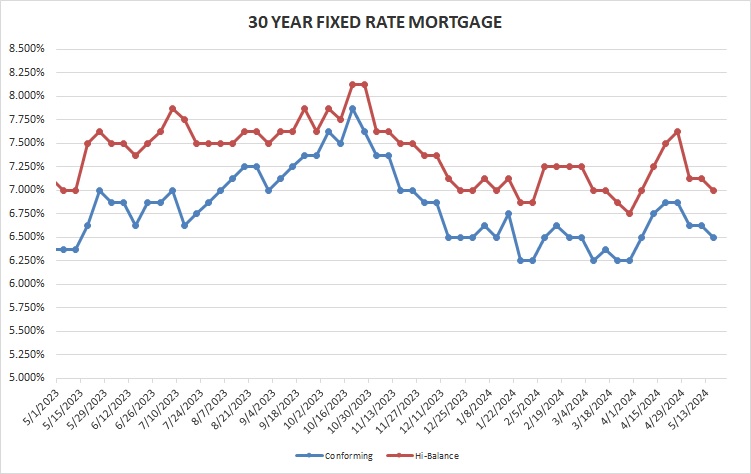
Rates for Friday May 17, 2024: Rates reacted as expected for the week with data putting possible Fed rate cuts on the table, dropping from last Friday.

FIXED RATE MORTGAGES AT COST OF 1.25 POINTS LOCKED FOR 45 DAYS FOR PURCHASE TRANSACTIONS:

30-year conforming                              6.50%          Down 0.125%

30-year high-balance conforming        7.00%          Down 0.125%

Please note that these are base rates and adjustments may be added for condominiums, refinances, credit scores, loan to value, no impound account and period rate is locked. Rates are based on 20% down with 740 FICO score for purchase mortgages.
A daily newspaper has been delivered to my home for almost all my life. When I was young, I read the sports page, especially this time of year when I would pour through the box scores for all major league teams. When we moved overseas, we got the International Herald Tribune every day and I began to read, or scan, articles and features from front page to the back (where sports were). In college, I subscribed to the LA Times and all my friends knew the best time to catch me to talk about something was sometime near the dining hall opening at 7:00 each morning where they would find me with the paper and coffee.

As long as I have lived in Long Beach (full-time as a non-student since 1984) and except for a brief period, I have received the (Long Beach) Press-Telegram every day, and the LA Times on Sundays.

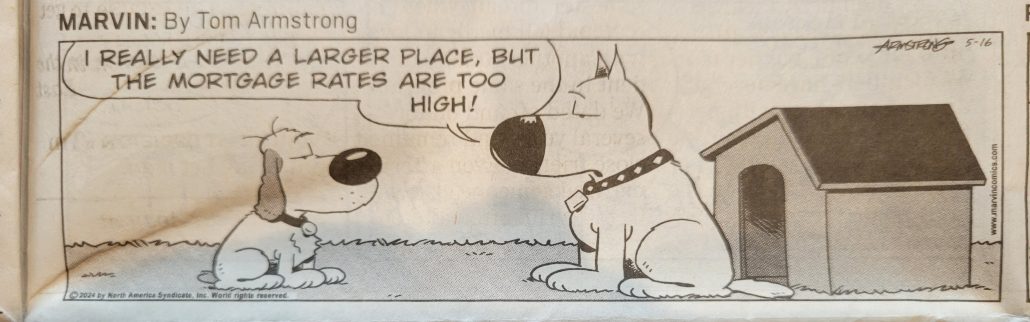
Throughout my life-time as a daily paper reader, I have always read the comics, or funny pages as we called them growing up, every day. Several reading the WR&MU today have been recipients of an email or text early in the morning with a cartoon I found funny and that they would relate to. Today, over 450 people will receive a comic from yesterday that made me chuckle as it relates directly to our real estate market for the past few years.

Enjoy the panel from Marvin by Tom Armstrong.
Have a great week,

Dennis

Past Weekly Rate & Market Updates can be found on my blog page at my website www.DennisCSmith.com/my-blog

Should we buy the home we rent?

Question of the week: Should we buy the home we rent?

Answer: With the scarcity of homes on the market, many want-to-be homeowners who are renting my find their new home in their current home.

A follow up to this question is from the landlord’s side, “should I sell my rental property to my tenant?” With the changing landscape for investment property owners in California, political pressure for rent controls, erosion of landlord/property rights as seen during and post-pandemic, combined with many older landlords seeing that their children likely do not want to inherit investment properties, selling rental homes and realizing the cash from the sale makes more sense than exchanging the property for another rental. (In 2021 WR&MU asked and answered “Should we exchange our investment property or sell it and pay the taxes?”)

Another factor that comes into play are landlords who are currently renting their former primary residence and may be able to take advantage of the primary residence capital gains tax and avoid the long term investment capital gains tax.

A few years ago, I had a client who contacted me the other day about wanting to sell a home she rents out because the tenant has given notice. She is nearing the end of the time frame of living in a home two out of prior five years to avoid capital gains and the time is perfect. I asked if she contacted the tenant about purchasing the home, however the tenant is giving notice because they had already entered a contract—otherwise did not think of asking to buy the home or they would have.

This was a missed opportunity for both parties. When they decided they wanted to own their own home the tenant should have informed the landlord, who gladly would have worked with them to see if the right price and terms could be found, saving each party a lot of time and expenses.

What are the opportunities for the landlord and tenant in having the tenant purchase their rental home from their landlord?

From the landlord side, there are several advantages to selling to your tenant.

For most landlords selling their rental property the status of the tenant is a primary factor in how the process will proceed. If it is a single-family residence then the buyer will almost always be looking to owner occupy the property, so the property needs to be vacant.

Typically, the dwelling should be vacant during the marketing period to maximize the ability to show the property to the most buyers and encourage offers. If you have a long-term lease with the tenant you will need to wait until the lease is nearing termination and provide notice that the lease will not be renewed and the tenant must vacate. If the lease is month-to-month you will need to give the tenant a 30 day notice to vacate. Depending on your tenant at this point it can get sticky if your tenant decides to not vacate on time. In California, the tenant has significant rights to delay vacating the property and can prolong any eviction process for a very long time. Several times over the years I have witnessed landlords paying tenants to vacate properties to get the process over and property vacant for sale or closing.

If you tenant is cooperative and does vacate the property you will continue to have costs, mortgage, taxes, insurance, maintenance, until you close escrow with a buyer, without receiving any rent. Depending on many factors you could have a vacant, non-revenue producing property for two, three, four or more months. 

Speaking of maintenance, when selling to the tenant there may be some repair work requested by the tenant-buyer following a home inspection, however there will not be the costs of preparing the home for showing. No landscaping for curb appeal, refreshing flooring, painting, or other touch-ups most sellers go through before marketing their home to try to maximize value.

When selling to your tenant you have a bit more control of the escrow period, which can be especially important if your intention is to purchase a new rental property, rolling over your proceeds in what is known as a 1031 Exchange to postpone capital gains taxes. When participating in a 1031 Exchange there are time frames to identify your “up-leg” and close on that transaction, if you miss them then your gains from the sale of the property are subject to capital gains. If your sale is an open market sale with two or three other transactions that you have little to no control over it is more difficult to extend the closing date of the sale of your rental property if you need more time to find and close on your up-leg.

Your costs of sale can be significantly lower selling to your tenant than going on the open market. You can have more control over timing of the transaction. If you are considering selling your rental property it is advisable you contact the tenant to see if they are willing and able to purchase the home.

From the tenant’s perspective purchasing the home you have been renting also has several advantages to going to the open market.

One big plus is you do not have to pack, move and unpack. You will not have the added expenses that occur when you move, new shower curtains, dustbins, pieces of furniture, lamps, fixtures, etc. Of course, now that the home is yours you may want to make some changes, however we have found most tenants who purchase their rental home make fewer changes and spend less than those who move into a new home.

Familiarity is another major benefit. If you like your neighbors and neighborhood, you become a homeowner and still go to the same store for groceries, walk to your local coffee shop to meet friends, go to the same schools for your kids and the same dog park with Phideau.

Utilities, seemingly a small thing, but no getting set up with gas, electrical, cable. Dealing with timing to meet vendors or pay deposits.

Not every home is perfect, even if you purchase a newly constructed home there can be, and usually are, some issues. Purchasing the home you have lived in for a while you already know the quirks and issues, some of which your landlord may be willing to fix as part of the transaction.

A major plus, it does not always happens but usually does, is the tenant-discount. Because the landlord does not have to have the property vacant, require your cooperation to show the property if on the market while you are still living there, nor spend the funds to get it “market-ready,” we typically see some discount to market for the tenant-buyer. Some landlords have refused to offer any discount and see their tenants leave the property instead of purchasing the home and the landlord later regrets trying to maximize price instead of maximizing combination of total costs and efficiency of the sale.

One more bonus of buying the home you rent…you don’t have to move! No packing and unpacking everything you own!

If you are in a residential rental relationship, as landlord or tenant, and are considering severing that relationship by selling or buying please contact me and I can assist you with options and other professionals who can assist you.

To schedule an initial meeting by phone or Zoom, click here for my calendar, please feel free to forward to a friend or family member!

Have a question? Ask me!

Rates for Friday May 10, 2024: A nice, perfectly boring week in the markets with no major news, or comments, resulting in significant buying or selling. As a result rates are flat from last Friday,

FIXED RATE MORTGAGES AT COST OF 1.25 POINTS LOCKED FOR 45 DAYS FOR PURCHASE TRANSACTIONS:

30-year conforming                              6.625%        Flat

30-year high-balance conforming        7.125%        Flat

Please note that these are base rates and adjustments may be added for condominiums, refinances, credit scores, loan to value, no impound account and period rate is locked. Rates are based on 20% down with 740 FICO score for purchase mortgages.

Happy Mother’s Day to the moms! My life has been blessed with two incredible mothers, my mom who passed away when I was in high school, and my wife Leslie who forged a wonderful bond with each of out daughters very early in their lives. Now adults, they are very close and communicate frequently about everything. Our daughters are very different personalities and women, and in each can be seen wonderful traits the inherited, or learned, from their mom.

I hope you are honored, spoiled, and pampered on your special day!

Have a great week,

Dennis

Past Weekly Rate & Market Updates can be found on my blog page at my website www.DennisCSmith.com/my-blog

How do we time the market?

Question of the week: How do we time the market?

Answer: With luck.

It is impossible to perfectly time any market as to when to buy at the very bottom or sell at the very top. One reason is that the peak or bottom are usually not know until well after they have occurred as prices do not move in straight lines when grafted; they move in directions with reversals before continuing in a direction.

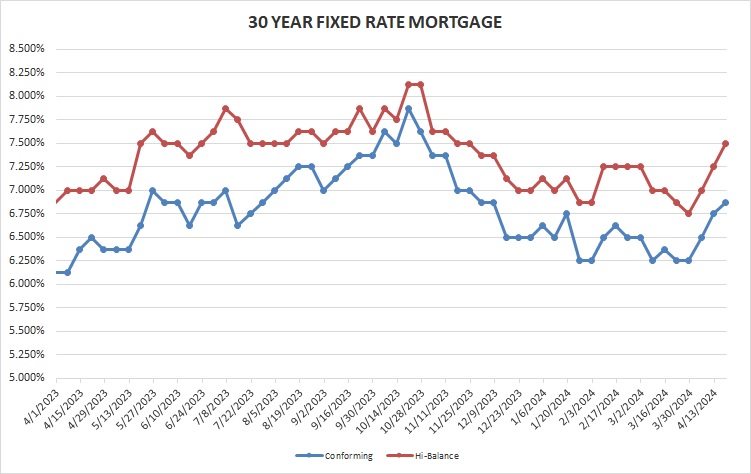
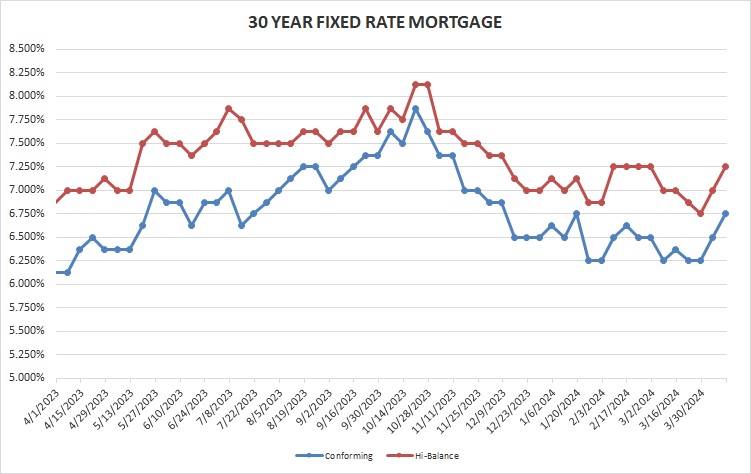
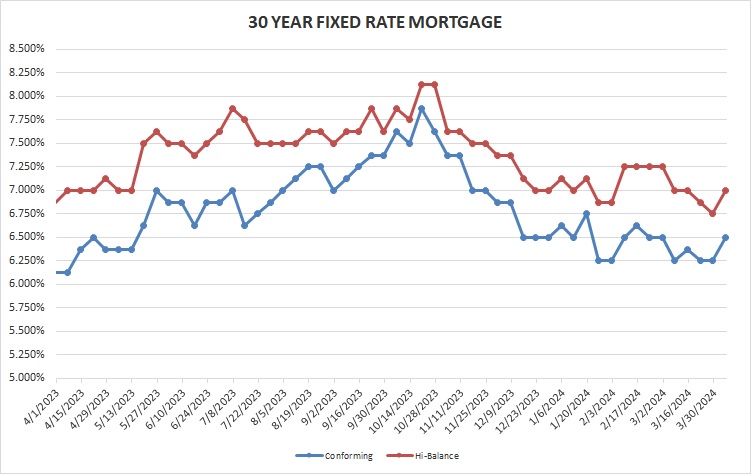
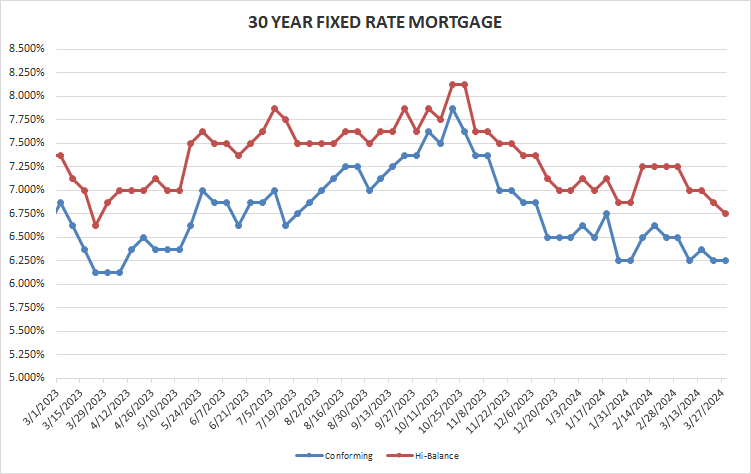
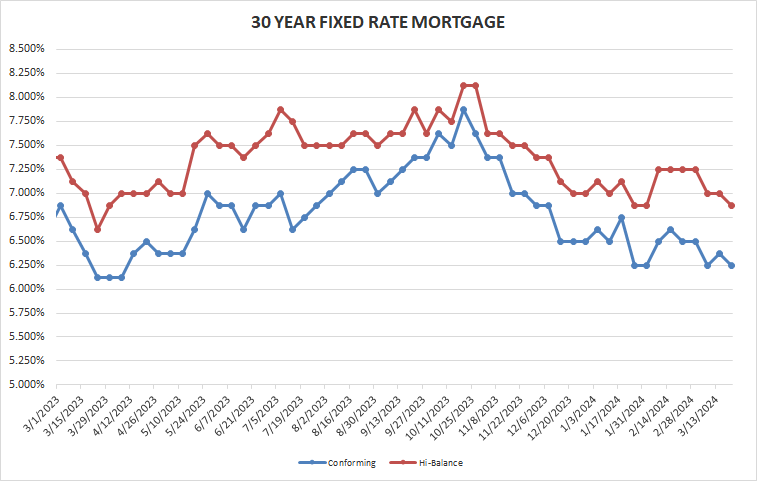
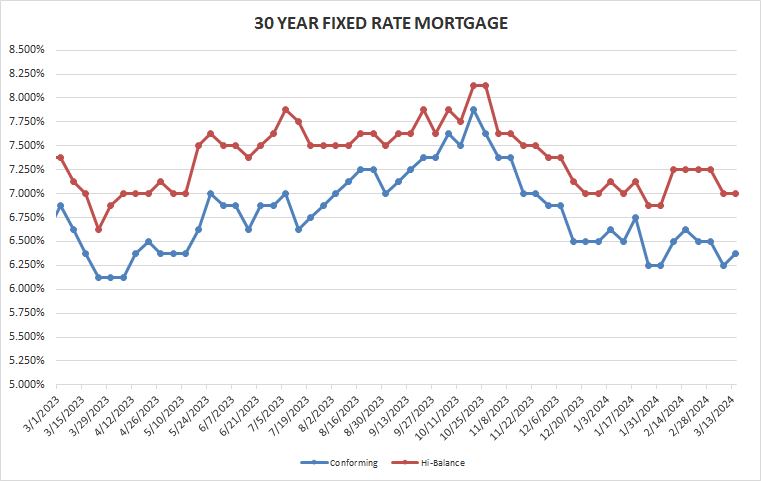
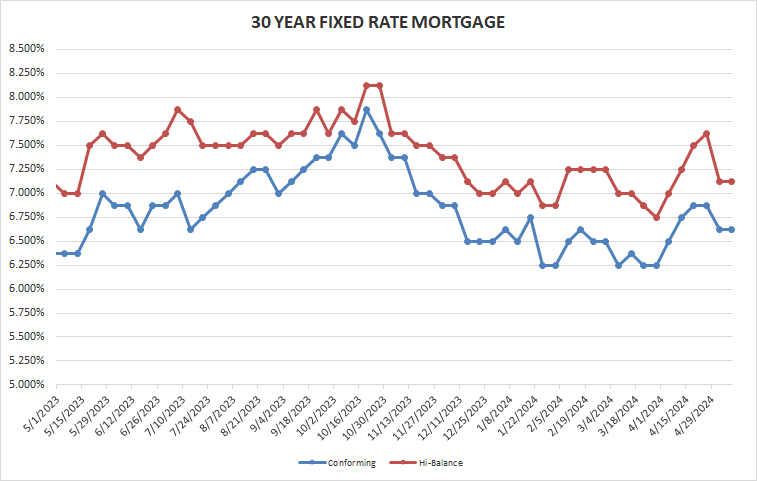
The mortgage rate chart provided in every WR&MU reflects this aspect of markets. As you can see, from May of last year until October of last year rates were gradually moving up. After October rates moved in a downward direction until February and March, when they started moving up again.

Was October the peak, or will the current trend of the last five to six weeks continue upward to reach or exceed October’s rates? Was late March the bottom, or is the dip in rates this week after climbing a run to “the bottom?” If the latter is true, how far down will they go before they go up again?

While many in the market for a new home are very interested in interest rates, home prices are likely more of a concern.

What if I buy and then prices drop? I feel I should wait about six months to see what prices are doing.

The underlying concern in this question is, “I don’t want to buy and then see my home value drop as the market drops.”

Which translates to, if I had waited, I could have gotten my home for a cheaper price.

Technically, and realistically, probably not as your current home would have been bought by someone else. That said, yes, if you waited and if prices had dropped you may have been able to purchase a somewhat comparable home in your neighborhood at a lower price.

No one wants to feel like they over-paid, or under-sold, something. This is especially true for a large ticket like your home. However, as discussed in the March 3rd WR&MU, if you wait and have mistimed the home price and/or mortgage rate  markets, your cost of waiting can far exceed your cost of buying too soon.

We are seeing an uptick in families interested in purchasing homes, and this issue, timing, is a primary concern, which is why I am covering the topic again so soon after doing so in March.

Instead of making your decision as to when to purchase your new home through a filter of fear of missing out, make your decision through of filter of what homes and opportunities are available to us now.

Personally, I was told I over paid for our first home in 1994. Some agents told me I probably paid about 5% over market (about $10,000); however, the opportunity to purchase with little down payment and assuming a loan far outweighed the concern about perhaps over paying. When we sold that home in 1998 and purchased our current home, again a few agents felt we over paid for the home, again, by about 5%, about $15-17,000.

In 2024 with current home values, does it matter that we possibly paid a combined $25-27,000 too much for our homes? Absolutely not, as the equity we have built by taking advantage of opportunities far, far exceeds what we may have overpaid for homes twenty-six and thirty years ago.

If you see it, you like, and you can afford it, buy it. It’s a home, not a company’s stock or other investment.

To schedule an initial meeting by phone or Zoom, click here for my calendar, please feel free to forward to a friend or family member!

Have a question? Ask me!

As mentioned above, rates dropped this week from last, the reason was jobs data for April released today by the Labor Department. The consensus was the report would show the economy adding 240,000 jobs for the month, the realty was 175,000 new jobs. Historically, 175,000 new jobs in a month is somewhat normal; however since the economy has averaged 246,000 new jobs for the first four months of the year, April was a surprise. The primary sector responsible for the lower-than-expected gain was leisure and hospitality gaining only 5,000 jobs. For the past two years this sector has averaged 53,000 new jobs per month. The low hiring in April was surprising as the sector is still employing fewer workers than before the pandemic against factors such as a growing population and significantly increased travel and dining out.

Investors reacted very positively to the data, pushing prices higher for stocks and bonds, thereby pushing rates lower (higher prices mean lower rates). The Federal Reserve has put a significant amount of importance on the labor market in determining what to do with its benchmark interest rate, a greatly reduced number of new hires is supportive of the Fed lowering its rate. Whereas last week the feeling was that the Fed may not lower interest rates this year, today’s data has some thinking perhaps a summer rate decrease is on the table.

Rates for Friday May 3, 2024: The conforming rate has its biggest week to week drop since the end of January on the jobs data. One report does not a trend make, but investors are acting as if it does.

FIXED RATE MORTGAGES AT COST OF 1.25 POINTS LOCKED FOR 45 DAYS FOR PURCHASE TRANSACTIONS:

30-year conforming                              6.625%        Down 0.25%

30-year high-balance conforming        7.125%        Up 0.50%

Please note that these are base rates and adjustments may be added for condominiums, refinances, credit scores, loan to value, no impound account and period rate is locked. Rates are based on 20% down with 740 FICO score for purchase mortgages.

Training, diet, treatment, technology have all been responsible for advancement in athletic achievement. The result has been a constant improvement in speed, strength, and agility for athletes to produce better results from their predecessors.

This is true across almost every sport. Except one.

The Kentucky Derby will have its 150th Run for the Roses. The record for the race is 1:59.4. The record was set in the 99th running of the Derby by Secretariat.

In the last fifty races the closest another horse has come to Secretariat’s record was in 2001 when Monarchos finished in 1:59.97. Monarchos was only the second horse to ever break the two-minute mark.

Secretariat had a historic, and miraculous, year in 1973. Not only did he win the Triple Crown that year, the first time in twenty-five years, but he not only set the race record for the Kentucky Derby, but he also set the records for the other two legs of the Crown in the Preakness Stakes and the Belmont Stakes. His race records in those two races also stand today.

When he captured the Triple Crown with the race at Belmont, he won the race by a staggering thirty-one lengths.

As race horses are specifically bred for speed, it is truly amazing that Secretariat still holds the most significant records in horse racing after half a century of improvements to athletic achievement.

The 2010 “Secretariat” is a wonderful movie, if you have not seen it, I highly recommend it. Writing this has me thinking I will probably watch it again sometime soon.

Have a great week,

Dennis

Past Weekly Rate & Market Updates can be found on my blog page at my website www.DennisCSmith.com/my-blog

How do we choose a real estate agent?

Question of the week: How do we choose a real estate agent?

Answer: Let’s start our answer with another question.

What skills will be most beneficial to you in your real estate transaction?

Knowledge of the market, in general and to the area where you are looking to buy or sell.

Knowledge of the legal requirements of residential real estate sales; forms, disclosures, fiduciary requirements, seller disclosure requirements, contract completion and clauses.

Good working relationships with affiliated services you will be using, such as lenders, escrow companies, title companies, inspectors, home services, depending on if you are buying or selling, contractors from plumbers to landscaping.

Wrapped into all of these is communication. The real estate industry is essentially a communication business that works best when everyone involved in a transaction, buyer, seller, agents, lender, escrow, title, appraiser, inspectors, all communicate openly, honestly, expeditiously, and respectfully.

Finally, putting you and your wants and needs above their own. This comes back to honest communication. Ane agent who says “you can’t get what you want in this market/area/your abilities” is much preferred to an agent who says, “no problem…”  Too often clients working with no-problem agents take longer to buy or sell their home than clients working with agents who address the issues that may limit or prohibit you from getting what you want and show you the compromises needed to get what you need.

Where to find such a person? Primarily through your network of friends, family, neighbors, co-workers, professionals such as attorneys, accountants, financial advisors.

Some entering the home buying or selling market find agents through open houses, or calling about a home they see for sale. If meeting an agent “cold,” ask for two or three references from recent transactions.

Before signing a contract with an agent, meet with them and interview them. What do they enjoy about the business, what is their view of a “good transaction,” how do they communicate, what do they see as your biggest hurdle(s) to the desired sale or purchase.

During an interview you will determine if there is “chemistry,” which is very important as buying and selling your home is typically a very emotional and stressful situation. It is your primary asset, you may be committing most or all of our savings, there are deadlines, details such as having to move, setting up utilities, transferring mailing addresses, possibly relocating children to new schools, issues that may come up that while solvable add stress. As such, you will want to be working with someone you trust, you respect, you know will be open with you, and that you like. You don’t have to be best friends, but you do need to get along and not dread making or getting a call.

 Two keys to a successful real estate transaction are a good agent and a good lender, make sure you have both in hand before starting your process.

To schedule an initial meeting by phone or Zoom, click here for my calendar, please feel free to forward  to a friend or family member!

Have a question? Ask me!

Ooops! Last week I predicted this week’s release of 1st quarter GDP would exceed the consensus expectation of 2.2%. I missed, but so too did the consensus. The “miss” was well below my prediction (close to 2.5%), and below the 2.2% consensus on Wall Street, the data showing 1.6% growth in the quarter. The 1st quarter growth in the economy was extremely slower than the prior quarter that grew at 3.4%. A slowing economy is positive for lower rates, but…

Prices not shrinking. The Federal Reserves preferred inflation index the Personal Consumption Expenditure (PCE) rose 0.3% for the second month in a row, and the year-over-year index rose 2.7% in March, up from YOY increase of 2.5% in February. Inside the PCE report was data showing consumer spending was up a robust 0.8% in March, with wages outpacing inflation, increasing 0.5%. Instead of inflation approaching the Fed’s target of 2.0% it is moving further away.

The back-to-back GDP and PCE reports are concerning for economists and investors as a slowing economy in a period of high inflation results in stagflation. Stagflation is a very challenging economic phase to get out of as there are limited remedies that can be put into place by a central bank. The best way out is an increase in investment by businesses to grow the economy, draining money from salaries and retail like purchases. Essentially growing the backbone of the economy while seeing limited demand and spending from consumers to tame inflation. A delicate tap dance that can take a prolonged period of time to conclude.

Rates for Friday April 26, 2024: Early week dip in rates as a result of the poor GDP growth were reversed with the PCE inflation data. As a result rates are flat from last Friday.

FIXED RATE MORTGAGES AT COST OF 1.25 POINTS LOCKED FOR 45 DAYS FOR PURCHASE TRANSACTIONS:

30-year conforming                              6.875%        Flat

30-year high-balance conforming        7.625%        Up 0.125%

Please note that these are base rates and adjustments may be added for condominiums, refinances, credit scores, loan to value, no impound account and period rate is locked. Rates are based on 20% down with 740 FICO score for purchase mortgages.

The worst part of my lame-knee status keeping me pretty much home bound for the next month is that my beloved Phillies are on a Southern California road trip to San Diego today through Sunday, then coming to Anaheim for three games against the Angels. Were it not for the new engineering in the right knee I would see at least two games of each series.

Sacrifices one doesn’t realize they have to make as a result of medical procedures.

Have a great week,

Dennis

Past Weekly Rate & Market Updates can be found on my blog page at my website www.DennisCSmith.com/my-blog

When should I throw away our financial and tax documents?

Question of the week: When should I throw away financial and tax documents?

Answer: NEVER!

Never throw away any document that has any financial or personal identification information such as your social security number, ALWAYS SHRED THEM.

Okay, perhaps that was a bit over the top, but before I get to how long you should retain records, I want to strongly emphasize never tossing any bank statements, tax documents, paystubs, etc into your trash. Always shred these documents to prevent identity or financial theft. One of the primary sources of identity theft is your garbage bin outside your home, many thieves posing as recycle bin divers are more interested in what financial documents they can find in your trash can other than the soda cans and wine bottles.

Buy a home shredder, Amazon and other stores have many low cost, small shredders that you can use to shred any documents and protect your identity and assets. If you do not have one, buy one, a $50 or $60 investment that may save you thousands.

Now onto the intent of the question, how long should you retain financial and tax records?

Over the years I have been asked this question by many clients and the standard answer from most tax professionals is for federal tax documents retain your records for three years and for state taxes retain your documentation for four years. Conventional wisdom to retain the records for seven years. The IRS can audit you for the prior three years, however in auditing one year they can discover something that causes them to look for the prior year, and then the year prior. From the IRS website, “Generally, the IRS can include returns filed within the last three years in an audit. Additional years can be added if a substantial error is identified. Generally, if a substantial error is identified, the IRS will not go back more than the last six years.”

There is a very important qualifier to retaining your records: records relating to the purchase of your home and mortgage documents should be kept permanently. Even if you are in your home for fifty years, when the time comes for the property to be sold or transferred as part of your estate there may be, probably will be, the need[DCS1]  to establish the cost basis and other factors that weigh into any potential capital gains calculations.

Other factors that could trigger capital gains calculations and needing documents establishing value are death of spouse or co-owner of home, divorce, major remodel.

So, there you have it, on the short side three years for federal tax documents and four years for state documents, but to be safe save records for seven years for most records like bank statements and income records, but save records on your home purchase until you no longer own the home.

To schedule an initial meeting by phone or Zoom, click here for my calendar, please feel free to forward to a friend or family member!

Have a question? Ask me!

The economy remains hot and does not appear to be cooling for a while. Consumer spending is 65-70% of our economy, retail spending, purchases of goods[DCS2] , is an estimated one-third of consumer spending. In March retail sales increased a robust 0.7% from February, as well sales in February were increased from the original report. Auto sales were slow in March, taking that sector out of retail sales and the monthly increase was 1.1%. Driving the data was a 2.7% increase in internet sales.

A strong indicator of consumer sentiment regarding their future economic situation is discretionary spending, eating out is a very big factor in this sector. In March spending in restaurants increase 0.4% and is up 6.5% from last year.

Looking at the data for the past few months, next week’s GDP report is expected to show growth of 2.0% in the first quarter, my expectation is higher, closer to 2.5% than 2.0%. Also coming out next week is the Fed’s primary inflation indicator, the Personal Consumption Expenditures Price Index (PCE). There is a good chance that PCE will not be moving to the Fed’s liking, i.e. down, putting Fed rate cuts in 2024 as less likely.

Rates for Friday April 19, 2024: Historically armed conflict creates a “flight to safety” for investors, moving investments from stocks to bonds, thereby pushing rates lower. Our economic data has suppressed this flight to safety as the Iran-Israel conflict escalates. Rates are higher, again, this Friday, to their highest since early December 2023.

FIXED RATE MORTGAGES AT COST OF 1.25 POINTS LOCKED FOR 45 DAYS FOR PURCHASE TRANSACTIONS:

30-year conforming                              6.875%        Up 0.125%

30-year high-balance conforming        7.50%          Up 0.25%

Please note that these are base rates and adjustments may be added for condominiums, refinances, credit scores, loan to value, no impound account and period rate is locked. Rates are based on 20% down with 740 FICO score for purchase mortgages.

The WR&MU is coming to you from a laptop. Yes, my ThinkPad laptop, but also my laptop as I work from the family room recliner with an ice wrap around my right knee which was jealous of my left knee’s replacement in November and followed suit on Monday.

The process begins again to rehab a knee, with the big goal to be playing golf by winter, hopefully sooner!

Have a great week,

Dennis

Past Weekly Rate & Market Updates can be found on my blog page at my website www.DennisCSmith.com/my-blog



Are rates going down?

Question of the week:  Are going down?

Answer: Yes, but…

When?

Not tomorrow.

Consistent readers of the WR&MU know that the Federal Reserve raised its bench mark interest rate (the federal funds rate) starting in March 2022 as inflation was starting to climb rapidly. The stated objective was to increase rates, slow the economy, likely push up unemployment, until inflation was down to 2%–the historic “acceptable” inflation rate that the Fed feels supports moderate economic growth and stable job growth.

Last year the Fed said it was predicting it would likely begin to lower the Fed funds rate in 2024, possibly as many as six times.

For the Fed to lower rates, it needs to feel that inflation is under control and tracking lower, labor markets are at worst neutral with wages in line with inflation, and the economy growing very slowly, or contracting.

Economic data thus far in 2024 has not been supportive of lower rates, to the contrary some feel the Fed may need to start increasing rates again.

Wednesday the Bureau of Labor Statistics released the Consumer Price Index for March—a key indicator of inflation. The report showed that prices grew 0.4% in March from February; it is the third month in a row that CPI has grown at a high rate. Prices were up 3.5% from March of 2023, the year-over-year price increase in February was 3.2%.

The “core” inflation rate is considered to be a bit more dependable overall gauge of prices as it strips out energy and food prices which are volatile from month-to-month, and is given more weight by the Fed when gauging inflation. The core rate also increased 0.4% for the month, however the annual rate soared to 3.8%.

The report, on top of last week’s jobs report showing a very strong labor market, puts a significant amount of doubt into markets as to whether the Fed will cut rates in the near future. As well, the data has many feeling the not only with the Fed not cut rates this year, but may increase them to cool off the economy and lower inflation.

As you might expect, mortgage rates have spiked for the second week in a row.

Back to our question of the week, are rates going down? Yes, at some point they will. As to when, not any time soon absent an external event.

Defining “rates going down,” for me this is a consistent period of time with rates going lower in measured tempo, such as we saw from February to early March, and continuing for more than four to five weeks before leveling off and then starting to drop again.

I do not see this happening before mid- to late summer, at the soonest.

To the contrary, I foresee rates increasing before they start to drop again.

For those who are rating for rates to get below 6% before buying my crystal ball says you may not be buying your new home until 2025.

To schedule an initial meeting by phone or Zoom, click here for my calendar, please feel free to forward to a friend or family member!

Have a question? Ask me!

Inflation numbers translated to personal finances and how it looks…

For the past three years we have seen data that inflation was increasing 1%, 0.5%, etc per month; 5%, 7.8%, 3.5% per year. What does this mean to consumers? As the 3.8% increase in prices this March from 2023 is on top of the 5.1% increase in 2023 from 2022 and so on.

For a better understanding, since 2021 prices have increased about 17%. The $100 pair of shoes in March 2021 cost $117 in March 2024. You may think $17 isn’t that much. That is on one item, spread it across everything you buy.

On the other side of your finances is the income to pay for the $117 pair of shoes. To keep up with inflation, if you earned $10,000 in March 2021, your pay needs to be $11,700 per month in March 2024—an increase of 17%. If you pay keeping up with inflation?

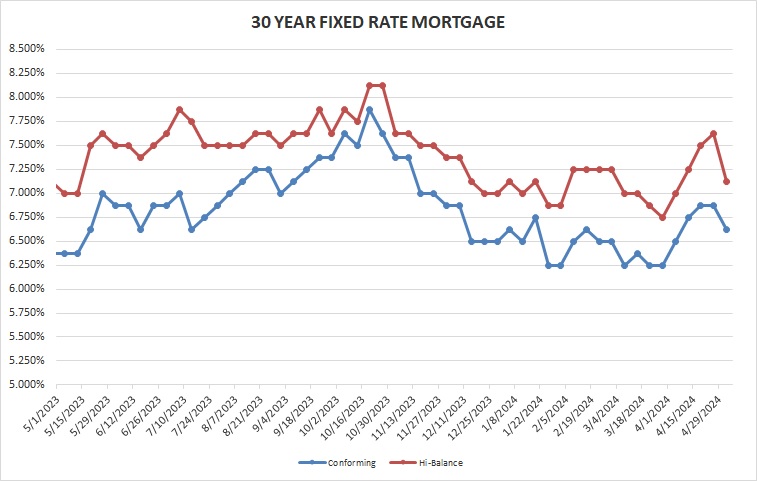
Rates for Friday April 12, 2024: The result of the commentary above is that rates increased 0.25% (one-quarter of one percent) for the second week in a row. Rates are at their highest rate since mid-January.

FIXED RATE MORTGAGES AT COST OF 1.25 POINTS LOCKED FOR 45 DAYS FOR PURCHASE TRANSACTIONS:

30-year conforming                              6.70%          Up 0.25%

30-year high-balance conforming        7.25%          Up 0.25%

Please note that these are base rates and adjustments may be added for condominiums, refinances, credit scores, loan to value, no impound account and period rate is locked. Rates are based on 20% down with 740 FICO score for purchase mortgages.

Like millions of golf fans across the country, likely around the world, technology has enabled me to have The Masters golf tournament in the corner of one of my screens while I work.

I will admit to some evil thinking when I watch professional golfers. When they completely mess up a hole, perhaps dunking a few balls in the water on a par 3 and taking an eight, I have a  mini celebration as it means for that particular player and hole, I play golf like a professional!

Have a great week,

Dennis

Past Weekly Rate & Market Updates can be found on my blog page at my website www.DennisCSmith.com/my-blog
Will change in real estate agent commissions impact mortgage industry?

Question of the week:  Will change in real estate agent commissions impact mortgage industry?

Answer: Yes.

Before we get into the answer, some background. In November we wrote about the lawsuit that shook the real estate industry as a federal jury ruled against the National Association of Realtors and several real estate companies in an anti-trust suit that the industry over-charged sellers with listing agreements that included commissions being paid to selling agents (i.e. buyers’ agents). The ruling has shook up the industry as real estate companies come up with solutions as to how to retain an open market with buyers’ agents wanting to show other agent and company listings, get paid for representing buyers, and formulas that will satisfy both sides of the home buying transaction.

When taking a listing do agents ask sellers if they want to include compensation to the agent representing the buyer in the sales price? Do agents sign contracts with buyers to represent them at a flat fee based on how much work they will do; i.e. showing homes, writing contracts, referring other professionals such as inspectors and lenders? Or contract for percentage of sales prices?

The impact of these changes will be felt in a few different areas by those of us on the front line of the mortgage industry—loan originators who are with clients from pre-qualification through closing.

At the beginning of a transaction, the pre-qualification and pre-approval processes, the unknown of whether an agent will be paid to represent a buyer, and if so how and how much, impacts the results for the client of sales price and loan amount.

In December we covered the challenge of cash. If a buyer has to pay their agent themselves, the seller will not pay the buyer’s agent from sale proceeds, how do we account for paying the buyer’s agent by the buyer? Likely by reducing the amount of down payment, thereby increasing the loan amount, changing the debt-to-income ratios due to a higher payment, possibly adding mortgage insurance.

Likely two scenarios will be prepared, one if a seller will pay the selling agent (representing buyer, the agent who sells the home) through sales price, either increasing the price to accommodate the commission or accepting the agreement based on list price; and if the seller will not be paying commissions. Of course, the buyer may wish to have a higher loan amount and pay the commission themselves to have a lower sales price.

Buyers who have little cash to work with for their purchase, typical buyers using FHA with 3.5% down payment requirement, will be harder pressed to pay an agent as they simply do not have the cash to manipulate a down payment reduction to include an agent commission they will be paying.

More scenarios, more unknowns until a buyer finds a home, writes an offer, and the offer is accepted, leads to more up-front work for the mortgage originator to ensure that when that offer is written, either with the buyer paying their agent or it being included in the sales price, if accepted will close with a mortgage we said could be closed.

Depending on how the buyer decides to approach the use of an agent to represent them, could increase the responsibility of the mortgage professional through the transaction.

There is no rule, or law, the buyers have to have an agent to represent them in the purchase of their home. It is recommended, but not required. With the ability to search for homes on websites, many buyers are already finding homes they want to see and possibly purchase and then letting their agent know. Or they can set an appointment with the listing agent to see the home, and then write their own offer, negotiate for the price and terms and sign an agreement with the listing agent that they are not being represented by the agent and hold them harmless for any issues that come up.

Or they may pay an agent to write the offer and negotiate for them for a flat fee and then end the contractual relationship.

If we are working with a buyer that does not have an agent representing them the buyer, will come to us to with all the issues they would have worked with an agent to resolve. Who to use for a home inspection? What to do with the results of the home inspection? How can we get the seller to repair, or pay for repairs, that may be needed? Can you explain the escrow instructions? What is this title report we received? Should we close when the final walk-through shows damage to floor covering that was hidden by furniture?

There are a myriad of questions and issues that can, and do, come up that are typically handled by agents that will not be asked of the buyer’s lender. If we are acting ipso facto as the buyer’s agent, can we charge more for the extra responsibility? No.

Mortgage origination compensation laws were enacted following the mortgage and real estate market melt-down that limited the amount of compensation that could be charged. As well, there can be no change in compensation after initial disclosure of what the mortgage originator will be paid for the transaction.

As well, mortgage originators cannot be paid in advance for their services. No contract with an upfront retainer to be credited if and when a transaction closes, one strategy some agents may use for buyers. No compensation for pre-transaction consulting and strategy can be paid to a mortgage company or lender.

Depending on how the buyer’s agent compensation payment is applied to each transaction, the mortgage originator will be impacted from start to finish in some way.

To schedule an initial meeting by phone or Zoom, click here for my calendar, please feel free to forward to a friend or family member!

Have a question? Ask me!

Kaboom! Not referencing the earthquake that hit this morning that rattled buildings and nerves throughout New York City and beyond, but the “blowout” as the Wall Street Journal labelled today’s job report for March from the Labor Department. The consensus from WSJ reporters and sources was the economy adding around 200,000 jobs for the month; they were off by 50% as the data showed 303,000 additional workers getting paid for the month. It was the biggest increase in jobs for a month since last May. The data was not nice, not nice at all, for mortgage rates as the Fed watches the labor market as closely as inflation when determining what to do with its benchmark interest rate.

A bit nice for rates, was salary growth was 0.3% for the month and 4.1% from last March. The annual pay increase was the lowest year-over-year since June of 2021.

If, when, how much, are the questions regarding the Fed’s stated intent to lower its benchmark rate in 2024. Today’s data likely pushes the first rate cut, if there is one, later into the year.

Rates for Friday April 5, 2024: After holding the course after last week’s economic data showing a strong economy, investors could not hold back on today’s news and rates climb back to where they were five weeks ago.

FIXED RATE MORTGAGES AT COST OF 1.25 POINTS LOCKED FOR 45 DAYS FOR PURCHASE TRANSACTIONS:

30-year conforming                              6.50%          Up 0.25%

30-year high-balance conforming        7.00%          Up 0.25%

Please note that these are base rates and adjustments may be added for condominiums, refinances, credit scores, loan to value, no impound account and period rate is locked. Rates are based on 20% down with 740 FICO score for purchase mortgages.

Anyone else become a women’s college basketball fan, or start to somewhat follow, this year in large part, full part?, due to Caitlin Clark at Iowa? She is trying to win her first national championship and certainly has much of the nation rooting for her and the Hawkeyes.

Under reported is that there are two chances for a college to have both their men’s and women’s basketball teams win the championship. This has only happened twice, in 2004 and 2014, when the University of Connecticut men’s and women’s teams both cut down the nets.

UConn has a chance to accomplish this again, the men’s team is the big favorite to win the men’s championship, the women’s team is not favored to win but there’s always a chance. Joining UConn with the opportunity to pull off the double championship is North Carolina State.  The Wolfpack men won one of the most memorable championships in 1983, their only title, and the women’s team has never been to a NCAA final game much less won a title.

Have a great week,

Dennis

Past Weekly Rate & Market Updates can be found on my blog page at my website www.DennisCSmith.com/my-blog

What are your credentials?

Question of the week:  What are your credentials?

Answer: This question was asked earlier in the week from an agent that is fairly new in the industry, licensed just before the pandemic, who was referred to me by a very veteran agent (25+ years) suggesting the newish agent refer his buyers to me.

It is a good question that many people never ask someone who will be handling very important transactions, especially those involving their most important purchase, or sale—their home.

A mortgage is the solution to a problem, which is needing money to purchase a home. Tangible credentials, such as licensing, alone do not provide that solution; intangible credentials do provide the solution. This is especially true for when the family in the market to get a mortgage has wrinkles in their financial credentials.

My credentials for the mortgage industry started to be built in my four years at Pitzer College, part of the Claremont Colleges, where I earned a degree in Economic and Political Studies in 1984. My course work developed analytical thinking and problem-solving skills.

After working at Farmers and Merchants Bank for a few years after graduation, and then a stint in personal finance company where I did collections, I entered the mortgage industry in 1987.

For the industry I have a California Department of Real Estate Broker’s license and registered with the National Mortgage Licensing System.

My start was challenging, it was hard to get business as the new guy in the industry—not many real estate agents were willing to refer me, thereby entrusting their commissions to me, no loan no pay. As result I worked seven days a week soliciting loans and working the few loans I could get, and held several part-time jobs from door man at Square Cow Fun Bar (the bar turned night club within several Black Angus restaurants), to pizza delivery, to house/dog sitting among others.

For a brief period I worked with partners, one ran a real estate company and the other opened a mortgage company. I sold and listed real estate and handled mortgages for clients of other agents. It took me just a few years to realize that I was much better suited to crunching numbers and helping clients determine the best price and mortgage option for purchasing a new home than I was at driving clients around looking at homes and deciding which one to buy and how much to offer.

In the early ‘90’s I left the real estate side of the business and devoted all my energy to the mortgage industry. It was about this time I started providing market updates to professionals in the real estate industry—it was also when I met Leslie McCormick who was working at the Long Beach Association of Realtors, in 1994 she made the big switch to change her name to Leslie Smith.

In 1999 my partners and I opened Stratis Financial, with offices in Huntington Beach and Torrance. When we were meeting about whether to open a new company, and then how it would look, our primary conversations were the type of business we wanted to do, the way we wanted to work with clients, referral sources, and most importantly our employees and loan originators.

In about 2002 I started this missive, the Weekly Rate and Market Update, to inform readers about the mortgage and real estate industries, provide economic information that impacts both markets, and to educate on readers about important matters. While I never stopped studying and learning about economics and markets after college, the WR&MU has allowed me to pull important data that impacts my industry from the news and distill it into information that can help homebuyers and owners, and professionals, make decisions.

For a long period of time, I felt I was missing an opportunity to further assist my clients. For a few decades, with over a thousand meetings and calls with clients to discuss their personal financial information, their plans for the future that should factor into their home buying decisions, options for their home purchase, as well as credit counseling and big picture what ifs, I learned that too many families were ill prepared for “what next.”

In 2014 I became a registered SEC Investment Advisor, passing my Series 7 and 66 exams, as well as exam for California Department of Insurance for life insurance.

I took this step to assist my clients with both sides of their balance sheets, their liabilities, i.e. mortgages, and their assets, mainly planning for their retirement.

While professional licensing and registration is very important as it shows required knowledge to transaction business and interact with consumers, more important are the thousands of meetings, conversations and transactions over the years, in addition to being an avid consumer of economic and political data and information, that have resulted in acquired knowledge, experience, and exposure to different problems to find solutions to provide options to families that result in homeownership.

What’s a mortgage other than a solution to a problem—you need money to purchase a home. My years of experience have seen many different solutions to that problem, resulting in helping families obtain homeownership since 1987.

To schedule an initial meeting by phone or Zoom, click here for my calendar, please feel free to forward to a friend or family member!

Have a question? Ask me!

Robust, strong, solid, some of the adjectives describing the American economy, supported by this week’s economic data. From the total economy (4th quarter 2023 GDP revised upward to 3.4% growth), to the labor market (fewer jobless claims last week), to inflation (PCE in February grew at .3% and up to 2.5% from last year), everything shows a growing economy.

The Federal Reserve entered into a tightening policy two years ago this month with the objective to lower inflation to 2%. Before the first rate hike of its benchmark Fed funds rate in March 2022, the prime rate (not controlled by the Fed, but follows the rate changes the Fed makes) was at 3.25%. Today the prime rate is 8.5%, where it has been since last July, during the eight month period the PCE (Personal Consumer Expenditures, the Fed’s preferred inflation index), has dropped from 4.2% to 2.5% and GDP has dropped from 5.2% to 3.4%.

Data does not support the Fed lowering rates if it want to achieve its objective. The economy is growing at a slower rate, and inflation is inching (millimetering?) down, but doing so with high rates. What happens to inflation if the Fed drops rates during a robust, strong, solid economic cycle?

Rates for Friday March 29, 2024: Despite economic data that does not support a Fed rate cut, investors were on the sidelines all week and the conforming mortgage rate is the same as last Friday.

FIXED RATE MORTGAGES AT COST OF 1.25 POINTS LOCKED FOR 45 DAYS FOR PURCHASE TRANSACTIONS:

30-year conforming                              6.25%          Flat

30-year high-balance conforming        6.75%          Down 0.125%

Please note that these are base rates and adjustments may be added for condominiums, refinances, credit scores, loan to value, no impound account and period rate is locked. Rates are based on 20% down with 740 FICO score for purchase mortgages.

A busy week for sports fans as the NCAA tournament providing its annual entertainment and major league baseball is officially underway. Spring is here! Except no one has told the Controller of Weather for Southern California!

Have a wonderful Easter weekend everyone.

Have a great week,

Dennis

Past Weekly Rate & Market Updates can be found on my blog page at my website www.DennisCSmith.com/my-blog
What is happening in the housing market?

Question of the week:  What is happening in the housing market?

Answer: This week’s question is a continuation/follow-up of three prior questions of the week:

How much more does it cost to buy a home this year?

How do we buy a home?

When will we know when it is time to buy a home?

The first and last questions in this list dealt with home values and interest rates, which determine the cost side of the affordability equation; the other side of the equation is buyer’s qualifying price and mortgage amount.

This week we will present some housing data for February supplied by the California Association of Realtors.

Overall, February was a very good month for home sellers in California.

Statewide the median home price increased 2.2% from January and 9.7% from February 2022. The median price in February across the state was $806,490 compared to $789,480 in January and 735,300 in 2023. Those employed in real estate industries were happy as well with total sales increasing 12.8% for the month and up 1.3% for the year.

Locally, Los Angeles County home sellers as a group were a little less happy than those who sold in January and a lot happier than those who sold a year previously. The $817,100 median sales price was down 1.9% from January’s median of $833,000, but up 12.4% from last February. Sales were up significantly month over month, plus 8.4%, and year over year, up 6.3%.

In Orange County the median price reached $1.35 million last month, up from $1.32 million (2.3% higher) and $1.159 million (up 16.5%) from last February. Sales in the county surged 23.6% from January and 12.4% year over year.

With rates lower this February from January, and about the same as last February, even with the lower rate, because of the median price rise in Orange County buyers obtaining mortgages had higher costs and payments, a lot more given the price increases.

Last month’s Los Angeles County home buyers faired better on costs and payments than those who bought the previous month; but like the OC, those who waited a year to buy paid a lot more due to the increase in values.

Does the decline in prices in February mean we are heading to a decline in home values? No. One month doesn’t a cycle make. With inventory still at a somewhat low 3-month supply and the median days on the market low at 23 days, there is still an imbalance in the market favoring sellers.

To schedule an initial meeting by phone or Zoom, click here for my calendar, please feel free to forward to a friend or family member!

Have a question? Ask me!

Breath in and hold your breath…you may now breath out. That was what I heard about 5 times this morning during a CT scan for my next knee replacement. It is also what markets did this week ahead of the news from the Federal Reserve’s Open Market Committee (FOMC) meeting. The exhale was a big sigh of relief as the news was positive, double positive, for lower rates.

While not lowering its benchmark rate at the meeting, Fed Chair Jerome Powell did announce the Fed still expects to lower the rate three times this year. As well, the second positive from the meeting, was that the Fed would slow down its “unwinding” of its balance sheet; in layman’s terms, slow down the selling of Treasury and mortgage debt that it accumulated during its quantitative easing period during and after the pandemic (which increased liquidity causing rates to be very, very low). By not flooding the market with the rate baring instruments it owns, the Fed is reducing market supply, with increases prices on Treasury and mortgage bonds and securities, which lowers rates. If the Fed continued aggressively selling these holdings the effect is to put upward pressure on rates.

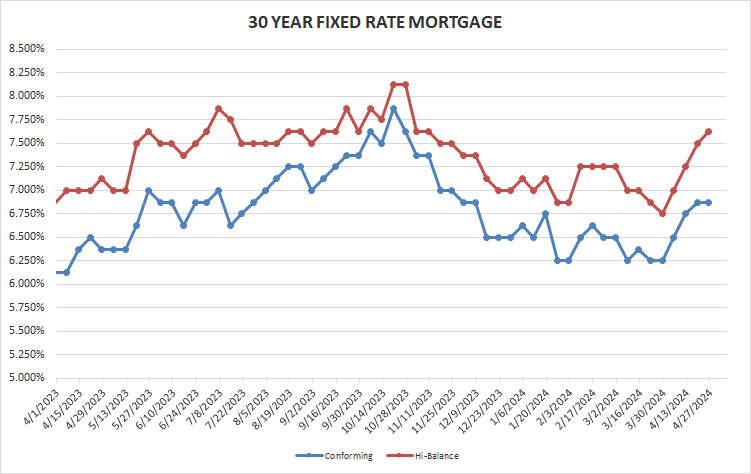
Rates for Friday March 22, 2024: Positive news from the Fed pushed rates lower from last Friday. As a result, rates are at the lowest they have been this year, and approaching rates last seen in March of last year.

FIXED RATE MORTGAGES AT COST OF 1.25 POINTS LOCKED FOR 45 DAYS FOR PURCHASE TRANSACTIONS:

30-year conforming                              6.25%          Down 0.125%

30-year high-balance conforming        6.875%        Down 0.125%

Please note that these are base rates and adjustments may be added for condominiums, refinances, credit scores, loan to value, no impound account and period rate is locked. Rates are based on 20% down with 740 FICO score for purchase mortgages.

Cinderellas and powerhouses collide. It is that time of year when we find out that Golden Grizzlies can topple Wildcats and Bears maul Raiders.

Some friends and I started our first pool for the NCAA Men’s Basketball Tournament in 1982 when we were in college (for those who remember, the title game that year between the Hoyas and Tar Heels began with Patrick Ewing being called for goal tending on several shots by the Heels to start the game. It ended with Michael Jordan hitting winning shot with 17 seconds left, then Georgetown’s Freddie Brown mistakenly sending a pass to North Carolina’s James Worthy.).

I organized the pool, and 46 years later am still the organizer and of the seven players in our pool, three of us were in that first pool in 1982; five of us have been in it since 1985. We have gone from mailing picks that had to be postmarked the day before the tourney started, to fax machines, to emailing brackets, to texting pictures of our pics.

Our story is not that unique, as the NCCA tournament keeps friends in touch through the years, some gathering in person to watch the first rounds, others via email and zoom, to brag about some picks and get razzed for others.

While the tournament is known for many great upsets (see Oakland Golden Grizzlies beating the Kentucky Wildcats) and last minute shots to win games; what it is really about for most is that chance to get together once a year.

As soon as I get this sent, I’ll call my friend Laird who I met as a teammate on the lacrosse team, two years ahead me in school, and living in Dallas. I haven’t seen him since 1985, but we talk every year on this day. It always goes, “Hey LJ” “Hey DC”…..

Have a great week,

Dennis

Past Weekly Rate & Market Updates can be found on my blog page at my website www.DennisCSmith.com/my-blog

Should we get an adjustable rate mortgage?

Question of the week:  Should we get an adjustable rate mortgage?

Answer: Astute readers of the WR&MU will be thinking, “didn’t we just have this question not too long ago?” and they will be right.

In October 2023 we asked the same question, and the answer was “maybe.”

The answer this week is, “probably not.”

In October the rates on a mortgage that is fixed for the first 5-years of the mortgage were lower than the rates no a 30-year fixed rate mortgage.

Today, the opposite is true as rates are in what is know as an “inverted yield curve;” which means rates are higher on shorter term investments (therefore mortgages) than longer term mortgages.

Ordinarily, with 30-year mortgage rates expected to drop creating a target rich refinance market for the mortgage industry, and a payment saving boon for homeowners, adjustable-rate mortgages (ARMs) are a very viable option. As discussed last October, if there is a very high probability the 30-year mortgage rate will be lower in the future than the current ARM rate, getting the lower rate today to lower it further in the future makes sense.

However, this is not the case when the ARM rates in some cases exceed the 30-year rate by up to one-percent, or more.

To schedule an initial meeting by phone or Zoom, click here for my calendar, please feel free to forward to a friend or family member!

Have a question? Ask me!

Hey guys, how does the summer look for you? This seems to be the question the Fed will be asking at its next meeting when debating lowering its benchmark interest rate after economic data from February released this week.

September revisited. Both the Consumer Price Index and retail sales showed their biggest month-to-month increases since September. Gasoline prices rose in February impacting both indexes. That said the 0.4% increase in the CPI was matched with the “core” CPI (gas and food stripped out of data), also increasing 0.4%. Year over year CPI increased from 3.1% to 3.2%, while core CPI dipped from 3.9% to 3.8%. Whichever part of the index one looks at, they are a long ways from the Fed’s 2% target, and more importantly not declining with any rapidity.

Consumers are keeping cash registers ringing, as retail sales were up .6% from January, whose retail sales were adjusted up from initial reports. Sales were boosted by the strong labor market and tax refunds working their way into household accounts.

Rates for Friday March 15, 2024: Several of the policy makers at the Fed want solid evidence that inflation is slowing towards the 2% target before lowering rates. Economic data the past few months show there is scant, to no, evidence slowing is imminent. Feeling rates are as sticky has inflation, markets pushed rates a bit higher this week, and the upward pressure is increasing.

FIXED RATE MORTGAGES AT COST OF 1.25 POINTS LOCKED FOR 45 DAYS FOR PURCHASE TRANSACTIONS:

30-year conforming                              6.375%        Up 0.125%

30-year high-balance conforming        7.00%          Flat

Please note that these are base rates and adjustments may be added for condominiums, refinances, credit scores, loan to value, no impound account and period rate is locked. Rates are based on 20% down with 740 FICO score for purchase mortgages.

Sunday brunch and lunch out on the town should be popular this weekend with St. Patrick’s Day. The weather locally should be nice for those who want to enjoy a nice meal the crawl, I mean stroll, around areas with more than a few establishments.

Corn the beef, boil the cabbage, chill the Guinness, and raise a pint in cheers to friends and family here and gone.

Have a great week,

Dennis

Past Weekly Rate & Market Updates can be found on my blog page at my website www.DennisCSmith.com/my-blog