
What are loan limits?
Question of the week: What are loan limits?
Answer: Every mortgage program has limits as to how much of a loan the program is eligible to fund. The limits are dependent on several factors, depending on what type of mortgage is being approved. For example is it what is termed a “conventional” loan, is it a “government” loan, is it “non-conforming” or “jumbo?” Another factor is geographic location of the subject property, some programs will have higher loan limits in Long Beach, California than Long Beach, Mississippi. One more factor is what is the loan-to-value, i.e. what percentage of the value of the property is covered by the loan.
Conventional mortgages “Conventional,” or “conforming” loans refer to mortgages that are funded using guidelines established by Fannie Mae or Freddie Mac. These loans are funding by lenders who then sell the loans to Fannie or Freddie, who then package the loans into bundles and sell them as investments called Mortgage Backed Securities (MBS).
The conforming loan limits are set by Federal Housing Finance Agency (FHFA) based on the percentage increase, or decrease, in the average housing price. Mortgages that meet either Fannie or Freddie underwriting guidelines and fall within the established loan limits are eligible to be purchased by either entity depending which guidelines were used for approving and funding the mortgages.
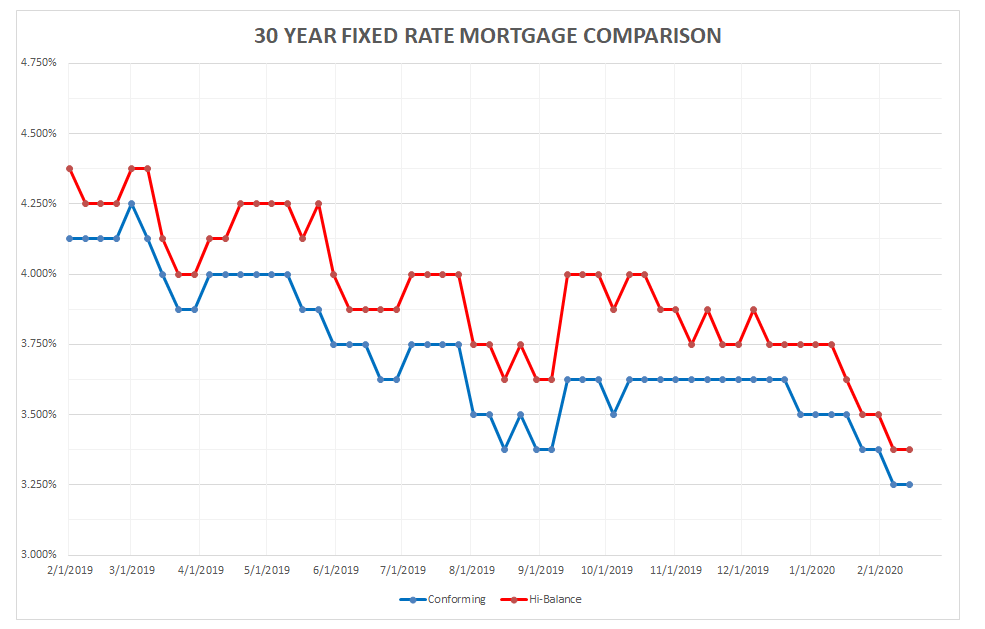
Following the housing and mortgage markets melt-down starting in 2008 a “high-balance” loan limit was established for high cost areas across the United States. This enabled home buyers and owners in areas such as Los Angeles or Boston, where the median home price is higher than the conforming loan limit, to have easier access to low rate mortgages supported by Fannie and Freddie’s funding guidelines.
The high-balance loans have higher rates and pricing than standard conforming loans, as well as stricter underwriting guidelines.
For 2020 the conforming loan limit nationwide is $510,400. The high balance loan limits vary by county with the maximum being $765,600, which is the maximum limit for Los Angeles, Orange and several counties in Northern California. Here is a map that shows loan limits by county across the country.
Note that these are the limits for single family residences, there are different loan limits for two-, three-, and four- unit properties.
When I started in the mortgage industry in 1987 the maximum conforming loan amount was $153,100.
Government Loans that are insured by either the Veteran’s Administration (VA) or Federal Housing Authority (FHA) have separate underwriting guidelines. It should be noted that while conforming loans are sold to either Fannie or Freddie, government loans are insured by government entities.
VA loans are unique in that there is no limit on loan amounts based on location or imposed by the VA. The primary limit is the amount of the entitlement the veteran has from the VA, his/her ability to qualify, and what, if any, down payment or equity is in the property.
FHA has loan limits by county, the maximum loan in Tulare County is lower ($331,760) than the loan limit in Orange County ($765,600).
You probably noticed that the maximum loan limit in Orange County for FHA mortgages is the same as it is for conforming mortgages. Like the conforming high-balance mortgages, the FHA Jumbo mortgage is for those loans over $510,400 and have higher rates and prices with slightly different underwriting guidelines.
Non-conforming Generally labelled as “jumbo” mortgages, those loans that are funded outside of conventional or government channels have many different programs, and therefore limits and underwriting guidelines.
The most common non-conforming mortgages are traditional jumbo loans, which means they are used for applicants using underwriting standards that are close to those used by Fannie or Freddie; i.e. decent credit, verified income and funds to close, and properties that are “traditional.”
Non-conforming mortgage programs are funded by lenders and then sold to specific investors who establish the guidelines for underwriting and funding the mortgages. There are hundreds of different such investors who purchase mortgages from lenders, from major brokerage houses, to equity firms, to insurance companies, to regional banks. They establish mortgage products that run the gamut from traditional 30 year fixed mortgages to what are termed “hard money,” or “alternative” mortgages for those with credit or other challenges.
Most jumbo programs will fund mortgages under their guidelines down to the conforming loan limit plus one dollar. For example, if you are purchasing or refinancing a home with a loan amount of $525,000, because it is higher than the conforming $510,000 limit, you have the option of using either a high-balance conforming mortgage or a jumbo mortgage. Why would a borrower choose a jumbo loan instead of high-balance conforming? Some days the rates are lower on the jumbo option, or there may be something in the qualifying guidelines with a jumbo program that is more lenient and enables the borrower to qualify.
Most non-conforming loan limits are based on loan to value limits. For instance, a lender may go to 90% LTV to $1,000,000; 80% to $1.5 million, 75% to $2 million and 70% LTV to $2.5 million. Another lender may not lend above 80% LTV but at that limit lend to $2 million.
Loan limits come into play when we are working with clients as the loan amount, loan to value, and very importantly their ability to qualify, are factors as we determine loan product options and what rates and costs are associated with those options.
Want to know your loan limit? Give me a call!
Have a question? Ask me!
Rates for Friday February 21, 2020: Rates are a little softer from last Friday, while the conforming rate is flat for the week the price is a bit lower, with either some closing credits or lower origination fee. The coronavirus still looms over markets as the length and breadth of its impact on commerce and populations is still not known.
FIXED RATE MORTGAGES AT COST OF 1.25 POINTS LOCKED FOR 45 DAYS:
30 year conforming 3.25% Flat
30 year high-balance conforming 3.375% Flat
Please note that these are base rates and adjustments may be added for condominiums, refinances, credit scores, loan to value, no impound account and period rate is locked. Rates are based on 20% down with 740 FICO score for purchase mortgages.
We became childless this week. Our youngest had her eighteenth birthday and is now a legal adult. So, while we have adult children, we no longer have children that are childs!
Looking through the pictures of she and her sister through the years I get, as most parents likely do, a sense of how long ago it was she had her Dottie stuffed elephant and princess gown on, and also how it seems like just a year or so ago the picture was taken.
The passage of time is our blessing and curse. Blessed to be experiencing new adventures, relationships and, hopefully, more wisdom. Cursed as the experiences increase the time left to create more is lessening. We do not know how long we have for our new experiences, enjoy them and those you share them with every moment of every day!
Have a great week,
Dennis
Past Weekly Rate & Market Updates can be found on my blog page at my website www.DennisCSmith.com/my-blog