
When can we, should we, refinance
Question of the week: When can we, should we, refinance?
Answer: A very popular question recently and it was part of a lunch discussion I had yesterday with two friends.
As for “when” you can refinance, there is no time limit. I say that with some trepidation as many lenders are faced with stiff penalties from the lender being paid off if the payoff is too soon after the close of the loan. Unless you have a pre-payment clause in your contract that has a fee if you payoff before a certain date you can refinance when you are able.
It should be noted that if you are paying off and closing a Home Equity Line of Credit (HELOC—see below for more details on refinancing HELOCs) with your refinance you may face an “early closure fee,” the amount and time limit for such a fee varies from lender to lender.
As to the “should” you refinance, it depends…does it “make sense” for you?
There are two types of refinances, rate and term or cash-out.
A rate and term refinance is one where you are not pulling any money out of the property and are refinancing to reduce your monthly payment, change the terms of the loan from an adjustable to a fixed rate or possibly from a 30 year to a 15 year or vice-versa, or possibly reduce the monthly payment and eliminate mortgage insurance—in some cases lower the monthly payment on mortgage insurance if it cannot be eliminated.
The most common refinance is a rate and term refinance from one 30-year fixed rate mortgage to a new 30-year fixed rate mortgage. For these types of transactions, the “make sense” filter we use is what is your tangible benefit? Will your monthly payment decrease by 5% or more? What will be the total cost of the refinance divided by the monthly savings, is it less than 3 years?
Many reading the last sentence are thinking, aren’t there ‘no cost’ refinances?
Everything has costs, including “no cost refinances,” the question is how are the costs paid in a no cost refi? In the March 29, 2019 Weekly Rate & Market Update we answered the question, “Do we have to pay closing costs?” I do not want to recap the entire answer, but briefly closing costs for a refinance can be paid by adding to the loan amount, your bringing funds to escrow to pay them, or by your taking a higher interest rate and the lender will pay them, or a portion some or all of these options.
What if you want to convert your 30 year mortgage to a 15 year mortgage? This is a refinance some homeowners like to consider prior to retirement so they will have their home paid off when they retire, or shortly thereafter. The decision is usually not as easy to make as it is when refinancing from one mortgage to another that has the same term because a 15 year mortgage will have a much higher monthly payment than a 30 year mortgage. Is it worth the costs to refinance to a mortgage with a higher payment, or does it make more sense just to make larger payments on your existing mortgage—or to put extra money into savings and investments and use those funds to pay down or assist on payments when you do retire?
For a rate and term refinance the answer to “should we refinance” is very easily answered with math and the assistance of my trust HP12C calculator to determine your new payments and comparing them to your current payments.
Cash-out refinances involve a different set of circumstances and therefore the decision is usually a bit more challenging.
Why would someone take cash-out of their property? There are many reasons, payoff debt, gift children money to purchase their own home or for college, buy-out a partner in the property or a business, use for remodeling, or perhaps for down payment on a second home or income property.
One form of cash-out refinance is paying off a HELOC*. The guidelines for conventional mortgages (Fannie Mae/Freddie Mac) are that unless the HELOC, or other 2nd lien, was used to purchase the property a refinance that includes paying off a HELOC is considered “cash-out.” For many jumbo programs, if you have not accessed the line of credit in the past 12 months they will consider the refinance a rate and term transaction. Note that many jumbo lenders will loan down to the conforming loan limit plus one-dollar (total $484,351) so homeowners with a high-balance loan amount can benefit from the more generous jumbo guidelines if paying off a HELOC that has not been accessed for a year or more.
Does it make sense to refinance to consolidate your HELOC into a one mortgage with your current primary mortgage? It depends on the math, your comfort with likely having your payment increase, how risk averse you are to potential/probable higher rates on the HELOC in the future and your ability, willingness and actions in paying down the HELOC.
A typical transaction on a refinance to payoff a HELOC can look like this. A couple have a home worth $650,000 and have a primary mortgage of $350,000 at 3.75% that was $400,000 when they bought the home and has a payment of about $1800 per month. They have a HELOC with a $100,000 balance that was used to remodel their kitchen, the rate is currently Prime (5.25%) plus 1.5% for a rate of 6.75%. The payment on the HELOC is interest only, about $560 per month. Every month they intend to make payments to pay down the balance but never really do. Should they refinance?
If they get a 4.25% rate (a sample rate, not today’s rate which may be higher or lower depending on many factors) for a $450,000 mortgage ($400,000 primary + $100,000 HELOC), the payment would be about $2215 per month. Currently the couple is paying $2360 per month with no reduction in the HELOC balance—this makes sense.
But what if the math was different, they are paying $2500 per month now and a refinance would be $3000 total per month, does that “make sense?” Now we discuss with the client how comfortable they are with the adjustable aspect of the HELOC, when and how they intend to pay off the balance. Eventually the HELOC will no longer be interest only and be amortized over a ten or fifteen year period (much higher payments) or a balloon payment will be due and it will need to be paid with cash or a refinance. Now the decision is not so easy.
Like most Questions of the Week, there is no standard answer of “should we refinance?” The math often provides the clearest answer, but some situations are more complicated than others.
Making the decision easier for many homeowners is the very low interest rates currently available.
If you have been asking yourself, or others, the question as to whether to refinance or not, call me and I’ll do you math and go through your options.
Have a question? Ask me!
Not so fast…That is the message from the first revision to the Gross Domestic Product (GDP—essentially the measure of the U.S. economy) revised economic growth in the 2nd quarter down from 2.1% to 2.0%. The more detailed report than the initial GDP estimate was interesting in that it showed very robust consumer spending in the quarter and GDP growth has dampened by fewer exports and less business investment. Between the lower investments and higher consumer spending U.S. businesses saw profits grow pre-tax by 5.3% in the quarter—the largest increase in five years. Overall the revision has no impact on mortgage rates.
Buy big. That was the sentiment for the American consumer in July as consumer spending increased 0.6% in July from June, such grow can be described as “robust.” Leading the way in spending was a strong increase in new car and truck sales—and RVs! To make their purchases consumers dipped into savings (the savings rate falling from a high of 8% to 7.7%) as personal income rose only 0.1% for the month—giving employers a breather in the steady wage increases seen over the past year or so due to the tight labor markets. Inflation for the month saw prices increase 0.2% with prices up 1.4% from last July; well below the Fed’s 2.0% target giving some support to those in the Fed who want to lower rates in September. The news is mixed for mortgage rates; the consumer spending is negative for rates as spending is 65-70% of GDP, the inflation news is positive for rates as it fuels speculation the Fed will lower rates and investors will act accordingly.
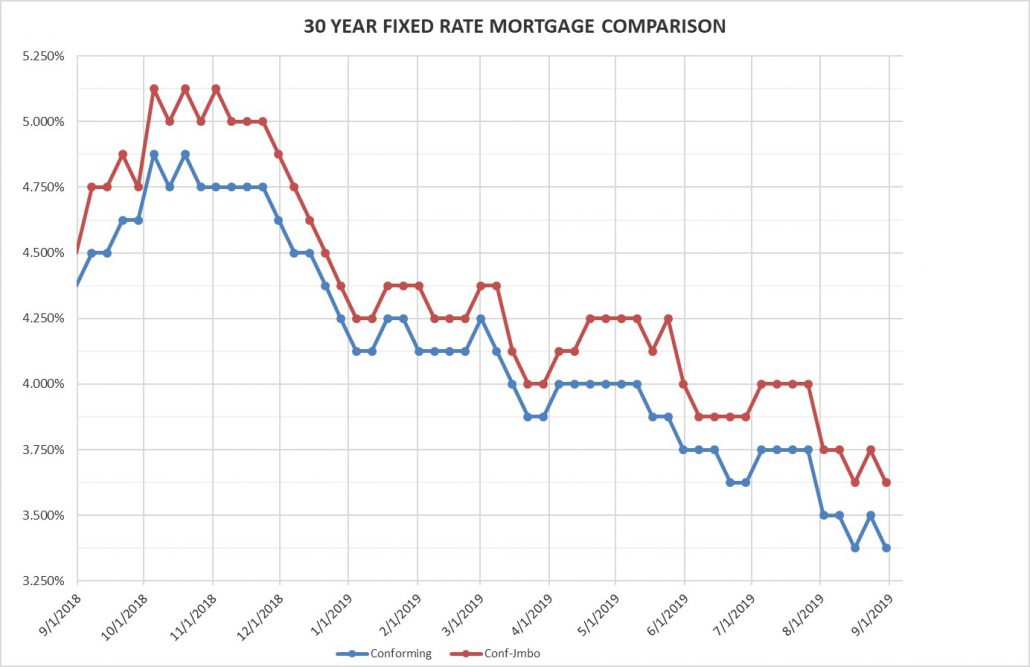
Rates for Friday August 23, 2019: Early in the week rates paired the pop in rate last week and we touch our multi-year low once again this Friday.
FIXED RATE MORTGAGES AT COST OF 1.25 POINTS LOCKED FOR 45 DAYS:
30 year conforming 3.375% Down 0.125%
30 year high-balance conforming 3.625% Down 0.125%
Please note that these are base rates and adjustments may be added for condominiums, refinances, credit scores, loan to value, no impound account and period rate is locked. Rates are based on 20% down with 740 FICO score for purchase mortgages.
Twenty-five years ago on Labor Day weekend I was playing golf with some friends and relatives on Saturday, then a nice family dinner. Monday, I woke up late, which is unusual, and heavy headed but very happy. In between, on Sunday, I spent the morning and midday trying to relax because I had a 4:00 appointment with Leslie in the backyard with about 25-30 others. Somewhere close to 4:00 Leslie’s dad escorted her across the lawn where he dropped off next to me and in front of the minister.
Our anniversary is this coming Wednesday, but Labor Day weekend is always memorable for me for one of the shortest sentences I have ever uttered, and by far the wisest, “I do.”
Have a great week,
Dennis
Past Weekly Rate & Market Updates can be found on my blog page at my website www.DennisCSmith.com/my-blog