What do you mean my interest rate is lower than my interest rate?

Question of the week: What do you mean my interest rate is lower than my interest rate?

Answer: Disclaimer, I am not a tax professional, this week’s WR&MU is for informational purposes using example that may not (probably not) reflect actual values and dollar amounts. Please consult your tax preparation professional to determine the impact on your finances when owning or purchasing a home.

Now that we have that out of the way…

What if I told you that the 6.75% interest rate this keeping you from purchasing a new home is effectively 4.93%? Would you remove the interest rate barrier from your home buying decision?

For over three decades, when working with home buyers I give an example of how their “effective” mortgage payment is less than their actual mortgage payment. Which in essence is paying your mortgage at a lower rate.

You and your spouse earn $175,000 dollars per year and before any other deductions your federal income tax is $28,328, or 16.2% of your income.

The calculation using the 2025 federal income tax table is as follows. Income taxed in tiers of 10%, 12% and 22%; for $175,000:

$2385 on first $23,850 earned

$8772 on amount from $2380 to $96,950

$17,171 on amount from $96,050 to your total income of $175,000

You purchase a new home for $1,000,000 with 20% down and a loan amount of $800,000. You obtain a 30-year fixed rate loan with a rate of 6.75% and have a monthly payment of $5189.

How?

The federal tax code allows deduction from income for interest paid up to $750,000 in loan amount for mortgages on primary residences. Note this deduction is dollar for dollar from your income.

The interest on $750,000 at 6.75% is $50,625, thus lowering your taxable income to $124,375. Running $125,375 through the income tax tiers your federal income tax is $17,191, or 9.8% of your income.

This is a savings of $11,370 in federal taxes, or $928 per month.

If you apply that tax savings to your monthly mortgage payment, you essentially lower your payment to $4261 per month, which in an effective interest rate on a $800,000 mortgage of 4.93%.

Your federal income tax deduction has lowered your effective interest rate from 6.75% to 4.93%.

That is just the deduction for mortgage interest, if you have a $1,000,000 your property taxes are $12,500 or more. The federal tax code lets you deduct up to $10,000 for SALT (State and Local Taxes). This $10,000 deduction lowers your income to $115,375, saving another $2200 per year ($183 per month).

If you and your spouse each contribute 10% of your income to your employer sponsored retirement plan, the is another $17,500 deducted to your income, lowering your taxable income before any other deductions to $97,975; just $925 above the 2nd income tier limit of $96,950—the $925 will be taxes at 22%.

I will not calculate tax savings and new effective mortgage rate using the SALT and retirement account savings as you are very likely taking that anyway. What adding those deductions do so is that with just those three deductions, mortgage interest, SALT and retirement contributions, you likely lowered your top tax tier from 22% to 12%.

*If you live in California, the maximum residential interest that can be deducted is interest on $1,000,000. For above example the deduction for California is $54,000. Running the numbers, lowering taxable income to $121,000 your tax is $3311 less per year than it would be on $175,000, a savings of $275 per month. With your federal tax savings, your monthly payment is lowered to $3986, a savings of $1203 per month, your effective interest rate is 4.36% on your mortgage.

I have always approached home ownership as a math problem that breaks down to what is the monthly payment and how much cash is needed to close the transaction.

The biggest variable is the interest on the mortgage, which is also the figure that has the most emotion around it as many people draw a line in the sand, “I won’t buy until rates drop below X%.” But if they do the math the will be paying less than X%, significantly so.

What is your stance is you will not buy a home until rates are under 5%? In the scenario above, effectively the rate is where you are ready to buy a home.

What are you waiting for?

To schedule an initial meeting by phone or Zoom, click here for my calendar, please feel free to forward to a friend or family member!

Have a question? Ask me!

Normally, a monthly surge in retail sales would push interest rates higher on concerns economy is getting hot and inflation pressures will increase. These are not normal times, which is why Wednesday’s data on retails sales in March was largely unimpactful. Sales jumped 1.4% from February, following February’s large 1.2% increase. Most of the surge in sales were consumers consuming in front of impacts on prices ahead of tariffs hitting the market. The biggest factor in the jump in sales were seen in auto dealerships, as seen by only a 0.5% increase in retail sales if auto sales are stripped by the data.

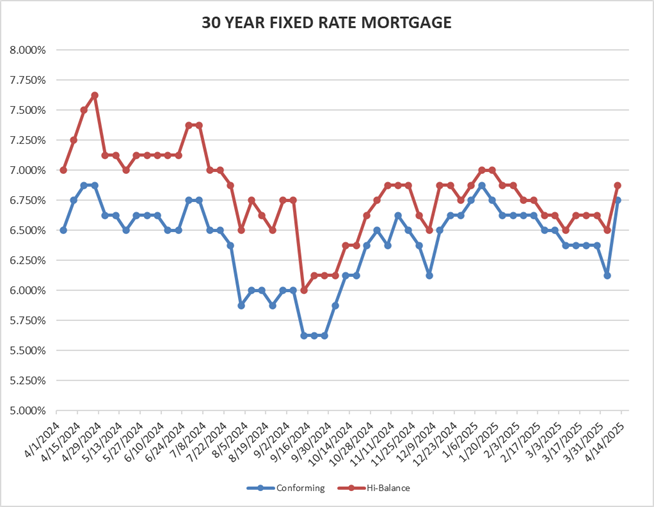
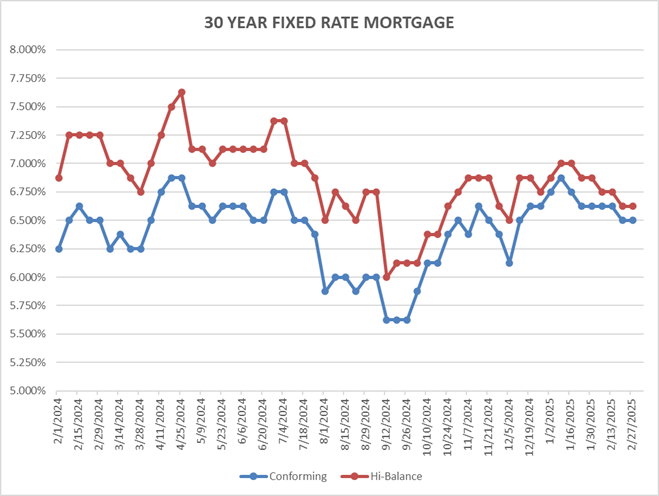
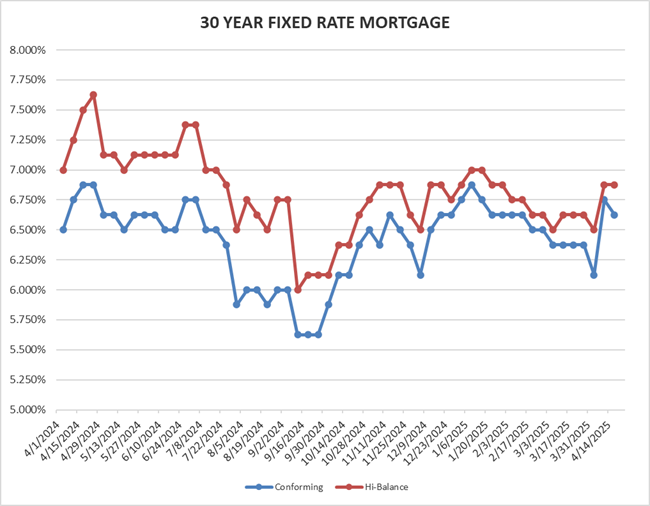
Rates for Friday April 18 2025: Money flowed into fixed rate assets, including mortgages for most of the week, resulting in a dip in rates following last week’s spike.

FIXED RATE MORTGAGES AT COST OF 1.25 POINTS LOCKED FOR 45 DAYS FOR PURCHASE TRANSACTIONS:

30-year conforming                             6.255%        Down  0.125%

30-year high-balance conforming        6.875%        Flat

Please note that these are base rates and adjustments may be added for condominiums, refinances, credit scores, loan to value, no impound account and period rate is locked. Rates are based on 20% down with 740 FICO score for purchase mortgages.
Tuesday was an important historical date in America, and not just because of the April 15th tax filing deadline. On April 15th the following happened.

In 1865 Robert E. Lee surrendered his Army of Northern Virginia to General Ulysses S. Grant at Appomattox, essentially ending the civil war.

In 1912 the most luxurious, and one of the largest, ocean liners sank on its maiden voyage on its way from Southhampton, England to New York City. Eighty-five years later the movie “Titanic” was released, telling a somewhat fictionalized tale of the famous ship.

In 1947 at Ebbets Field in Brooklyn the first baseman trotted out to his position at the top of the first inning, becoming the first Black man to play in the modern major leagues. At the end of the season, Jackie Robinson won the inaugural Rookie of the Year award and would go on to have a Hall of Fame career.

One more historical note, on this date 250 years ago an event happened that gave Henry Wadsworth Longfellow the subject of one of his most famous poems, perhaps the most famous.

For those who are history buffs, or those who really like the month of April, I highly recommend “April 1865: The Month That Saved America” by Jay Winik. In it Winik chronicles all the events that occurred in that month that could have radically changed our nation’s history.

Finally, a personal note in the personal note section to my very good friend Alex; pursuant to our conversation last night and use of AI, I did use it to verify some of my calculations above—confirming that AI can do math.

To others not Alex, in our discussion I mentioned that the most ardent WR&MU readers know that AI is not used to compose any of the writing, as evidenced by the spelling, grammatical and usage mistakes that some of you are very kind to point out from time to time.

Happy Easter, find all your eggs.

Can you explain a reverse mortgage and its benefits?

Question of the week: Can you explain a reverse mortgage and its benefits?

Answer: For several years I have been saying that reverse mortgages (RM for the remainder of the WR&MU) are the most misunderstood financial tool available to consumers. Because the lack of knowledge of RMs, how they work and the benefits, many eligible homeowners do not consider using a RM as part of their financial planning and stability.

Before we get into whether you should get a RM, let’s go through some basics of the product.

  • First and foremost, and most importantly, the lender cannot take your home as long as you are living in the property.*  More on this below.
  • You can use a RM to purchase or refinance your primary residence, note this does not include second, or vacation, homes; though proceeds from a RM may be used to purchase a vacation home.
  • Eligible properties are 1-4 units, as long as you occupy one unit, condominiums, and certain manufactured homes depending on requirements from lender.
  • The most common RMs are HECM (Home Equity Conversion Mortgage), which are government insured by the Federal Housing Administration, yes, the same entity responsible for FHA mortgages used by millions to purchase or refinance their homes. To be eligible for a HECM you must be 62 years old or older.
  • Other RMs in the market have a minimum age of 55, these products are not insured by FHA and have different guidelines and features.
  • For HECM products there is an equity line feature, as well the amount of the available funds on the equity line increases over time. This feature is flexible depending on what funding options you select at closing. Some borrowers obtain a RM and have an amount of funds available they may draw on in the future, with no proceeds being disbursed at closing. For example, they obtain a $450,000 HECM with no funds paid to them at closing. Over the life of the loan the they can draw on the equity line, either in lump sums or regular payments.
  • For the life of the loan, you do not need to make payments on the mortgage, but you must make payments for taxes, insurance, homeowners association fees, etc. While you are not required to make payments on the RM, you may do so.
  • Some RMs have higher closing costs and more features, other RMs have lower closing costs and fewer features. Some RMs have adjustable rates, other RMs have fixed rates. It is important that you understand the options available and compare features, rates and costs.
  • All potential borrowers must go through counselling about RMs, the benefits, the costs, the risks, the options. This counselling is done by a third party who is not affiliated with the loan originator or any lender. A final and complete application for a RM cannot start until seven days after the counseling is completed. This allows time for the borrower to do more research and make a decision.
  • Loan amounts are determined by value of the property, age of the youngest borrower, and the current interest rate and fees on the RM.
  • The loan is due when the home is no longer the primary residence for any borrowers; i.e. when relocate to a senior facility, purchase or rent another home as primary residence, borrowers have died. If a husband and wife have a reverse mortgage and one of them dies, the loan is still in place until the surviving spouse no longer occupies the property.
  • When the last spouse vacates the property, the loan becomes due. At this point communication between whoever is legally able to make decisions and enter agreements for the property and the RM lender to allow time for the title of the property to be transferred.
  • Homes with RMs can inherited. Depending on the value of the property and the balance on the RM, heirs can retain the property provided the RM is paid off, either with a refinance. This must be done within one year of the passing of the borrower on the RM. (Side note, over the years we have assisted may clients with refinances to pay out other beneficiaries to retain a home with a RM and the parents have passed away.)
  • If the balance of the loan exceeds the market value of the home the home can either be sold with an agreement from the lender to accept a lower payoff to enable the sale, or the property may be deeded to the lender.

*This is the most misunderstood aspect of RMs. A lender cannot kick a borrower out of the home. A lender cannot prevent an heir from obtaining the property as long as the RM is paid in full. Depending on the value of the property and the balance on the RM, the heirs may choose to deed the property to the lender.

Here are some issues that come up when discussing RMs options with clients.

  • A lender can foreclose on a home with a RM. Keep in mind a foreclosure occurs after the lender files a notice of default, meaning the borrower has violated one or more closes of the Note; if the default is cured there is no foreclosure. Here are the factors that can lead to default.
    • Homeowner does not pay property taxes or other required expenses such as insurance or homeowners association fees.
    • Property is no longer primary residence.
    • Borrower dies, as mentioned above, while this will trigger a notice of default calling the loan due, there are time frames heirs have to retain the home by paying off the balance due.
    • Borrower does not use the home as primary residence for more than twelve consecutive months, i.e., relocates to a senior care facility.
  • If your loan balance is higher than the value of the home the lender cannot make you pay the loan balance down. If the lender does foreclose and the loan balance is higher than the proceeds from the foreclosure the lender cannot come after you for any balance due.
    • Scenario: Senior purchased a home twenty years ago in a retirement community in Beaumont. The balance on the RM is $350,000. The property is worth $340,000. The homeowner wants to relocate to a senior facility. Contacts the lender and deeds the property to the lender. The lender sells the property and after expenses nets approximately $300,000. The lender cannot file any claims or suits against the borrower for the $50,000 difference between the loan balance and the proceeds following the sale.
  • If you do turn the property back to the bank it will have negative impact on your credit. In scenario above, if the senior is no longer going to purchasing property, automobiles or otherwise access new credit the impact of a negative rating on the credit report is negligible.
  • The rates on RMs are higher than rates on traditional mortgages. This is due to the lender not receiving any interest payments until the loan is paid off, plus the risk that they may have a property that is worth less than the amount they loaned plus accumulated interest.
  • A very common reason eligible borrowers do not obtain RMs is because they are concerned with losing equity in their home due to the increasing balance of the RM for accruing interest. Interestingly, this is often more a concern for the potential borrower’s children worried about inheritance than the borrower. Yes, the loan balance is increasing, but in most markets, especially in coastal Southern California, home values are increasing as well. With the calculations involved to determine the amount of the loan at funding, and any potential equity line, the math is whether or not the RM balance is increasing faster than the value of the property, and at what rate.

Many people have a difficult time understanding how a reverse mortgage works because they have imprinted in their consciousness that when you get a loan you make monthly payments until it is paid off. Perhaps the easiest explanation is it is an interest only mortgage, but you don’t pay the interest until the loan is paid off.

You and your spouse are both 68 years old are down-sizing, you sell your home for $1,100,000 and pay off your $350,000 mortgage. After costs of sale, you have about $675,000. The home in Palm Desert you are buying costs $850,000. Your income is social security payments for you and your spouse and accessing funds from your IRAs.

Option 1, you purchase the property with $450,000 down using a traditional 30-year fixed mortgage of $400,000 with an interest rate of 6.5% for a monthly payment of $2525 per month. As well you have association dues of $300 per month, your monthly housing expense is about $2825 monthly before real estate taxes (which you can transfer from your current property). With your housing costs and other expenses, plus enjoying your retirement you need to pull about $3000 per month out of your IRAs, which is taxed as ordinary income.

Option 2, you purchase the property with a reverse mortgage. Based on your ages you are eligible for about $300,000 mortgage and put $550,000 down. Your monthly payment for the mortgage is zero, your housing costs is your $400 per month for HOA fees and estimated insurance. You to pay housing and other expenses, plus enjoying your retirement you pull about $400 per month from your IRAs.

In this scenario, there is a difference of over $31,000 per year that is not accessed as taxable income from retirement accounts. Estimating federal and state taxes to be about 30%, that is an additional $9400 per year, or $780 per month, you will pay in taxes due to having the traditional mortgage.

As well, while your mortgage balance is decreasing with the traditional mortgage, so are your IRA balances from the additional withdraws to pay the higher housing expense, and taxes. Further, by removing the additional funds you are also removing the funds from growth in the markets, dividend and interest reinvestment.

You are widowed and have lived in your home for over 30-years, you have no mortgage. Your property value is $750,000. You are experiencing difficulties and rather than move to a senior assisted living facility want to have in-home care where someone cooks and cleans for you, as well a nursing professional come to check on you on a regular basis. Estimated cost for this care is $6000 per month. Based on your age and the value of your home you can obtain a HECM line of credit for about $460,000.

Accessing $6000 per month to pay for the care you obtain $72,000 per year, tax free, to cover the costs. After five years you owe about $500,000 on the mortgage (remember the line of credit increased annually).

During this time your home value has increased an average of 3% per year to about $1,200,000. You are 83 and it is time for you to move into an assisted living facility. The RM enabled you to age in your home for five more years, after which you sell your home, and net approximately $600,000 to pay for your assisted living and medical needs until no longer needed.

As you can see, in these scenarios, while the RM balances do grow and reduce equity, they are enabling the preservation of liquid assets, enabling stay-at-home aging, with little to no risk to the homeowner.

I used “you” for my examples, however some of those receiving the WR&MU are not in the viable age range for reverse mortgages; substitute “your parents” for “you” to see how your family may benefit from this useful financial tool. Especially with rising rates and inflation putting more pressure on older homeowners looking to downsize or maintain quality of life and lifestyle.

If you, a family member, or friend are interested in learning more about reverse mortgages please contact me.

To schedule an initial meeting by phone or Zoom, click here for my calendar, please feel free to forward to a friend or family member!

Have a question? Ask me!

Some good news this week. Inflation data came in much lower than expectations. March CPI showed prices dropped 0.1% from February, the lowest inflation figures since May 2020 and well below Wall Street’s estimate of 0.1% increase in prices. Year over prices increased 2.4% against expectations of 2.6% growth.  Core price (energy and food stripped out) grew at 0.1% for the month and 2.8% year over year. The two components removed for the core data went in opposite directions in March. Gass prices dropped 6% in the month, while food prices increased 0.4%, with eggs increasing 6% for the month and 60% since last March*. Hotels, airlines and other discretionary spending industries saw prices drop as consumers unsure of their economic future pulled back on spending.

In ordinary times the data would push interest rates lower as lower inflation increases the chances the Federal Reserve will lower rates. But we are in interesting times not ordinary and investors have been very skittish as they watch for news from the White House on tariffs on, tariffs off, tariffs up, tariffs down (somewhere in there is a Broadway song). Key to the mortgage market has been the activity in the Treasury markets, which has seen prices drop (rates up) this week, not good for mortgage rates.

Rates for Friday April 11 2025: The pull back in Treasury markets was exacerbated in the mortgage backed securities market, pushing 30-year rates to their highest since January, with the largest Friday to Friday rate increase since February 2023.

FIXED RATE MORTGAGES AT COST OF 1.25 POINTS LOCKED FOR 45 DAYS FOR PURCHASE TRANSACTIONS:

30-year conforming                             6.75%          Up  0.625%

30-year high-balance conforming        6.875%        Down 0.375%

Please note that these are base rates and adjustments may be added for condominiums, refinances, credit scores, loan to value, no impound account and period rate is locked. Rates are based on 20% down with 740 FICO score for purchase mortgages.

*Coming out of Ralph’s and heading to my car I was accosted in the parking lot by a guy who said, “stick ‘em up.”

I raised my right and with my left I reached from my front pocket and said, “Here’s my wallet.”

“No body carries cash; I don’t want your wallet! Give me your eggs!”

While Spring may have arrived in March, this week is the official start for many, especially golfers. The Masters is underway, starting the one a major a month schedule for pro golfers finishing with the British Open in August.

Should we refinance?

Question of the week: Should we refinance?

Answer: Maybe not yet.

Turbulence is an understatement to describe our markets this week, and the turbulent conditions will not be more stable for a little while yet.

Investors are not fans of turbulence as it makes the future murky as to what investments will be beneficial and which will result in losses. When this is the case “smart” money moves into more stable investments with expected guarantees, like United State Treasury bonds and bills; and to a certain extent mortgages.

As more investors move into the safety of fixed rate investments, the prices on those investments climb, and the price of investments they are selling, i.e. stocks, drop. For fixed rate investments, where return is based on the interest rate of the investment, as the price increases the rate of return decreases.

For example, if you purchase a $1000 bond with a 4% return for $1000 you will earn $40 for the year. If the $1000 bond becomes a sought after investment, a holder of the $1000 bond may want to sell it to you for $1100. If you purchase at this price your return will be 3.64% ($40 interest divided by $1100 cost). The seller of the bond will have made 10% on their initial investment, plus 4% from the date of purchase to sale (profit $100 divided by initial investment of $1000).

On the other hand, if investors feel better returns are in stocks, they will sell their fixed rate investments to get cash to purchase stocks. If a lot of investors are selling bonds, supply exceeds supply and prices will go down.

The holder of the $1000 bond wants to sell to get cash to invest elsewhere and sells it for $900. The buyer of the bond is receiving a 4.44% return on investment ($40 divided by purchase price of $900). The seller will take a 10% loss on his investment, minus however much they were paid in interest between buying and selling.

This week we are seeing stock market prices drop and fixed-rate asset prices climb. Interest rates are falling.

Whenever refinancing the primary math is how much is it costing and how much is it saving. This is true if you are doing a rate and term refinance to lower your rate and payment, or if you are doing a cash-out refinance to payoff other debt.

Refinancing is not free, there are certain hard costs involved, escrow, title insurance, appraisal, underwriting, credit report, etc. Depending on loan size in Southern California these costs can total $4000-5000.

Another cost are loan points, the cost for the interest rate. As described above the higher the cost the lower the rate, the lower the cost the higher the rate.

You can add the fixed costs and points to your loan amount, getting a smaller rate. Or you can choose a higher rate and have the costs paid by the lender as part of the transaction. Or you can do a little of both, add the fixed costs to your loan and have a slightly higher rate to cover the cost of the loan.

You want a rate and term refinance to lower your payment. You add $4500 to your loan to cover costs and decide upon a not point loan. With the costs your loan amount is $800,000, which is 70% of the value of your property, and you have good credit with a score o 760. You can lock in a rate of 6.375%.

Your payment will be $5122 (rounded).

You purchased your property for $1,015,000 with 20% down in March 2023 with a rate of 6.875% and a payment of $5334 per month.

If you refinance, you added $4500 to your loan and are saving $212 per month; which is a 21 month “pay-back” ($4500 cost divided by $212 savings.

You are likely going to be in your home for more than two years, so the cost will be “repaid” by the savings. However, what if rates drop further and in two months you can refinance for 6.00%, lowering your payment to $4796 per month, a $538 per month savings. If you have not refinanced yet your pay-back period for the costs drops to eight months. If you have refinanced already, the payback becomes and additional fourteen months plus however many months from your prior refinance (your savings on second refinance is $326 per month below payment after first refinance).

There is a lot of uncertainty as to where rates will go, certainly down in the short term, but how far? If you jump in too soon, will you then jump in again later adding more costs to lower your payments, and then again if they drop further, adding even more costs?

Homeowners are about to be inundated with calls, texts, emails, mailbox-mail, soliciting them for refinancing—remember the period of the Covid rate drops? Many with offers* that are enticing (*rates and terms subject to change after reviewing application—so no, you probably can’t get 4.5% with no points).

The challenge for homeowners who have purchased after rates spike in 2022 is to refinance for lower saving now to start saving, with possibility lower rates could be available in a short period of time for more savings?

If you need help with your math and to discuss timing contact me.      

To schedule an initial meeting by phone or Zoom, click here for my calendar, please feel free to forward to a friend or family member!

Have a question? Ask me!

Employers disrupted expectations in March. There were 228,000 jobs added to the economy last month, a lot more than the 140,000 Wall Street expected, and more than the adjusted 119,000 added in February (adjusted down for the 151,000 reported last month). While hiring increased, the unemployment rate also increased to 4.25 from 4.1% in February as more job seekers entered the market. Average hourly wages increased 3.8% from last March, down from the 4.0% increase in February.

Rates for Friday April 4 2025: Typically higher employment numbers push rates higher as they can foretell a stronger economy; however, Wednesday’s tariff announcements through all other economic data into the somewhat superfluous category for a little while. Investors leaving equities and buying bonds and mortgages, resulting in the lowest Friday rate since early December.

FIXED RATE MORTGAGES AT COST OF 1.25 POINTS LOCKED FOR 45 DAYS FOR PURCHASE TRANSACTIONS:

30-year conforming                             6.125%        Down 0.25%

30-year high-balance conforming        6.50%          Down 0.125%

Please note that these are base rates and adjustments may be added for condominiums, refinances, credit scores, loan to value, no impound account and period rate is locked. Rates are based on 20% down with 740 FICO score for purchase mortgages.

Not sure if addict is the correct word, perhaps strong enthusiast might be more appropriate as millions have the same enthusiasm, perhaps tens of millions.

I referring to our nightly viewing, or future viewing is unable to watch on the nights that Jeopardy! is aired.

While it is fun to answer in the form of a question, an added benefit for me is using the show as a source for my reading list. Biographies of presidents (I’ve been working through pre-Civil War office holders), or classics (currently reading Elmer Gantry by Sinclair Lewis), plus many other books and authors that appear on the 30-square board for the show.

Jeopardy! A source of entertainment in more ways than initially intended!

Should we have seller pay costs?

Question of the week: Should we have seller pay costs?

Answer: Yes.

While the answer seems obvious, of course you should have a seller pay costs for you—if they are willing.

But what if the question was, “should we pay more and have the seller pay costs?” The answer will almost always still be “yes.”

In the WR&MU last Friday we answered, “Are prices dropping?” In the discussion were statistics from the California Association of Realtors for home sales in February. Amongst the data were that homes sold at 99.4% of their list price, that 31% of homes on the market reduced their list price, and that the median size of the price reduction was 4.5% of the original list price.

This data shows list prices are softer and that the market overall is shifting from sellers to buyers.

Let’s do some math comparing a lower price or the same price with seller paying costs.

Because I like even numbers, let’s assume a home has been on the market for 60-days is listed for $1,050,000. The timing may be right for the listing agent to approach the seller to lower the price closer to $1,000,000—or perhaps $999,990 because for the psychology of sales indicates it will attract more attention for the extra 1% price reduction because it is not One Million Dollars.

In negotiations the sales price offered by the seller is $1,000,000.

Should you purchase the home for $1,000,000 or more?

You accept the offer and structure your financing with 20% down and a $800,000 loan at 6.5%.  Let’s assume loan costs, escrow, title, etc of close to $20,000, is $220,000 for down and closing costs. Your monthly payment on the mortgage would be $5057 per month.

But what if you offered a sales price of $1,035,000? As part of the offer, the seller pays the $20,000 in closing costs, plus agrees to pay for a temporary rate buy down for your loan; a 2/1 buydown.

What is a temporary buydown? It is loan strategy used primarily in higher rate markets to soften the monthly payment for borrowers. In a 2/1 buydown mortgage’s rate is 2% lower for the first year, 1% lower for the second year, then for the rest of the loan at the note rate.

The cost of the buy-down is the total savings in payments for the two years the rate is bought down.

$828,000 mortgage with a 6.5% rate payment is $5235 per month. If you have a 2/1 buydown:

Year  Rate            Payment     Savings/mo           Annual Savings

    1    4.50%          $4,190         $1045                     $12,540

    2    5.50%          $4700          $535                      $6,420

 3-30  6.50%          $5235          $0                          $0

Total savings on monthly payments $18,960 thanks to the buydown, this amount is also the cost of to temporarily buydown your interest rate.

Your costs to close are $38,960, the original closing cost plus the buydown.

The seller agrees to pay this amount for you, net proceeds to the seller is about the same as if they sold the property for $996,040.

Your down payment is higher, by $7000, but you save almost $19,000 in monthly payments and the new mortgage for only $178 more per month after two years. The math, cash savings $38,900, divided by $178 per month after two years is almost twenty years before the higher monthly payment equals the savings at closing.

An added bonus, if you sell or refinance the property before the loan rate and payment adjusts to 6.5%, the amount remaining from the buydown is credited to your loan balance for payoff.

Consider in 18-months you can refinance your home for 5.5%, you can do so, get a credit to paydown your balance of approximately $3200, and lock in your lower rate and payment for the future.

If the seller is negotiating on price, negotiate on price and terms for seller to credit costs at closing. The credit can pay closing costs, pre-pay HOA fees, or with the change in real estate agent compensation the seller can pay your agent’s fee.

While a higher sales price will come with a higher down payment and monthly payment, the savings is costs compared to the higher down payment and monthly mortgage difference almost always works out in your favor in the long run.

If you focus on cash to close as opposed to sales price you can generally find common ground with a seller that does them no to little harm while providing a tremendous financial benefit to you.    

To schedule an initial meeting by phone or Zoom, click here for my calendar, please feel free to forward to a friend or family member!

Have a question? Ask me!

The second, and final, revision of GDP for the 4th quarter of 2024 showed economic growth of 2.4%, higher than the prior revision of 2.3% growth. Last year ended with a nice amount of growth, though slowing from the prior quarter (3.1%), consistent with inflation slowing as well.

Enough to weather the storm? Personal income increased 0.8% in line with Wall Street estimates, thanks in part to social security benefits being paid out to public sector retirees who had non-Social Security Administration pensions. With personal spending increasing 0.4% in February, incomes far outpaced spending—increasing savings that can be used to buffer possible increases in inflation due to tariff increases.

As expected, the preferred inflation gauge for the Federal Reserve, the Personal Consumption Expenditures (PCE), rose 0.3% in February. The core index (energy and food stripped from data) rose a tick over expectations, up 0.4%. Year over year inflation remains, stubbornly, above the Fed’s 2.0% target, rising 2.5% in February, in line with January’s increase; the year-to-year core rate increased last month to 2.8% from 2.7%. While meeting expectations, inflation is still higher than expectations from five to six months ago and remains a concern for the Fed, and investors.

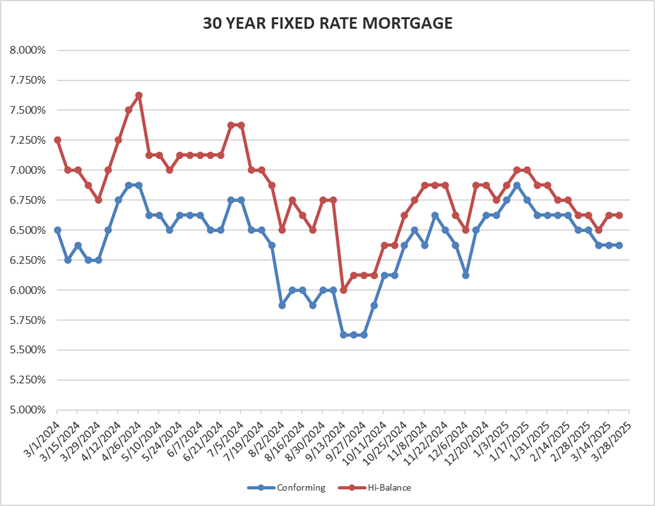
Rates for Friday March 28 2025: We love consistency and stability, and the 30-year fixed rate is giving us that Friday to Friday, despite some early week volatility. The conforming rate has stayed the same for four straight weeks, since it dropped the first week of the month.

FIXED RATE MORTGAGES AT COST OF 1.25 POINTS LOCKED FOR 45 DAYS FOR PURCHASE TRANSACTIONS:

30-year conforming                             6.375%        Flat

30-year high-balance conforming        6.625%        Flat

Please note that these are base rates and adjustments may be added for condominiums, refinances, credit scores, loan to value, no impound account and period rate is locked. Rates are based on 20% down with 740 FICO score for purchase mortgages.

It’s here, it’s here!

Major league baseball is officially underway for all teams (I will refrain from a prolonged rant against the first regular season games being played overseas a week before every other team starts).

Optimism is in the air for most clubs, “this could be our year!” Which is valid as no team has repeated as World Series champions since the Yankees won three in a row from 1998 to 2000.

Eternal hope is all Seattle Mariner fans have had as their team has never made the World Series. Joining the Mariners in having never won the championship trophy, but having played in the World Series, are the Milwaukee Brewers San Diego Padres, Tampa Bay Rays and Colorado Rockies.

This phan is rooting for the Philadelphia Phillies for the 56th straight year!

Ring the Bell!

Are prices dropping?

Question of the week: Are prices dropping?

Answer: Yes and no, depending on where the property is located and what price range it is in.

The California Association of Realtors sales report for February sales shows some interesting data.

The big picture raw data shows statewide the median sales price was $829,060 in February, down 1.2% from January, but up 2.8% for the year; condos bucked the statewide trend showing a 4% increase in median price. Sales were very strong across the state, up 11.6% from January and 2.6% from last year.

Locally, the median price in Los Angeles County dropped 3.9% from January to $852,150, though still 4.3% higher for the past twelve months. Sales were 4.8% higher month over month, but 2.4% lower than a year ago. Factoring into the County’s sales and price data could be the Palisades and Eton fires in January, moving forward the data analysts will like parse the data to see what impact the loss of thousands of homes has on the resale market.

Down south, Orange County showed continued growth in prices as the median price was up 2.5% for the month and 8.6% from last February to $1,465,500, an all-time high. Sales were flat from last February but up 9.5% from January.

The difference in prices and sales between the two counties hi-lights a statewide trend. Sales of homes priced below $1 million fell for all price categories, the lower the price the higher the drop in sales. Sales for homes priced from one to two million dollars are up 2%, for homes priced over two million sales are up a whopping 18%.

The number of total sales statewide are at their highest level since October 2022. This is due in very large part to active listings being at a four-month high, and the most active listings in February since 2020.

The Southern California region had 4.1 months of unsold inventory on the market in February with the average time on the market of 30-days, both trending higher. For those homes selling, the sales price averages 99.4% of the listing price; homes have not sold over 100% of list price since the first half of 2022.

Statewide, 31.8% of listings have a reduced price, with the median revision being a 4.5% drop (or $45,000 reduction on a $1,000,000 initial list price).

Taking a home initially listed for one-million, the decline in list price, plus the sales percentage below price, approximately one-third of listed inventory at that price will sell for $949,270.

For buyers in the market, depending on the market price and location, the data shows there is room for negotiation on price, or likely more beneficial on terms. Next week we will cover why it may be better to pay list price and get concessions from the seller other than price.

To schedule an initial meeting by phone or Zoom, click here for my calendar, please feel free to forward to a friend or family member!

Have a question? Ask me!

Cash registers weren’t running out of receipt paper in February. Retail sales increased 0.2% from January, whose sales were adjusted to -1.2%, missing the consensus of 0.6% growth in sales from sluggish January. With CPI running at 0.2% for February, while total sales went up, units sold were flat month to month. Pulling sales higher were internet sales, up a very strong 2.4% (likely due to cold weather keeping people from going to brick-and-mortar stores), and pharmacy sales up 1.7% (for that nighttime sniffling, sneezing, coughing, aching, stuffy head, fever, so you can rest medicine).

A concern in the report for the economy was the 1.5% drop in restaurant sales, the largest in 13-months. Restaurant sales are a strong gauge of consumer sentiment and household finances as dining out is discretionary spending that drops when people are getting tight on their budgets. Since retail sales are one-third of consumer spending, which is 65-70% of GDP, a drop in discretionary spending can lead to a drop in other spending, which can lead to a drop in GDP.

Not good…but…investors digging deep into the retail sales data found some kernels of goodness. One data set in the report is the “control group.” This data strips out auto sales, gasoline, building materials and restaurant sales and feeds into the calculations for GDP. In February sales for the control group were up 1%, suggesting that the sluggishness in retail sales may not be a drag on first quarter GDP. We will find out next month.

Rates for Friday March 21 2025: Overall a benign week for bond and mortgage markets, a bit of drifting during the week but we finish the week flat from last Friday.

FIXED RATE MORTGAGES AT COST OF 1.25 POINTS LOCKED FOR 45 DAYS FOR PURCHASE TRANSACTIONS:

30-year conforming                             6.375%        Flat

30-year high-balance conforming        6.625%        Flat

Please note that these are base rates and adjustments may be added for condominiums, refinances, credit scores, loan to value, no impound account and period rate is locked. Rates are based on 20% down with 740 FICO score for purchase mortgages.

Long time readers know that I rarely get political in the WR&MU, not that I don’t have my opinions but this is not the place to express them. That said, I will weigh in on a debate that was raging on Monday and Tuesday talk shows.

I had no problem with the NCAA Men’s Basketball Tournament selection committee putting the University of North Carolina Tarheels into the tournament and leaving the West Virginia Mountaineers out of the tournament. There, I said it.

I didn’t say what talk shows were having this raging debate!

Should we build an ADU?

Question of the week: Should we build an ADU?

Answer: Maybe.

Accessory Dwelling Units add value to a property, how much depends on multiple factors so it may take a while for your increase in property value to catch-up to your costs of building an ADU.

Over the past several years Sacramento has been fairly aggressive in removing local zoning regulations and ordinances that restrict the building of Accessory Dwelling Units, and reducing the costs to build them, as a way to ease the housing shortage in the state.

Towards the end of last year, the Legislature passed, and the Governor signed, into law clarification of prior laws and some new regulations preventing local housing and building agencies from have more restrictive building regulations than those from the state.

To over simplify the matter, if you can fit a unit on your property, you can build it.

In addition to prior regulations that:

  • Raised height regulations (depending on how close to public transit or current structures on property 16- to 18-feet)
  • Speed up the process (all agencies reviewing ADU plans must respond within 60 days of plan submission)
  • Reduce setbacks (if ADU less than 800 square feet there is no front setback requirement to prevent building the ADU)
  • Removes restrictions on permitting existing unpermitted units (if had unpermitted unit in a garage to be permitted it no longer is required to meet current building standards unless there is health and safety concern)
  • Reduce costs (for example, fire sprinklers are no longer required for main dwellings as part of ADU permitting process)

Laws that went into effect on January 1st go further in easing the building of ADUs:

  • Further reduces costs for converting illegal units (checklist of “substandard conditions” that must be repaired or upgraded to receive permit, prohibits agencies charging penalties, impact fees, or connections fees as long as new utilities connections are not required)
  • Increases the maximum number of ADUs (to eight as long as the number of ADUs do not exceed the number of existing units on multi-family lot and meet setback and height requirements)
  • Eliminates off-street parking in some cases (ADUs on multi-family properties can build ADU units on existing uncovered parking areas and be required to have replacement off-street parking)
  • Takes power away from the California Coastal Commission (CCC must provide clear guidance on amending local costal program to streamline approval process for ADUs)

Additional benefits for property owners with ADUs as enacted by the state:

  • Forbids owner-occupancy requirements for ADUs (gated community and other neighborhoods with CC&Rs, HOAs, etc cannot prohibit property owner from renting the ADU)
  • Local agencies must have pre-approved ADU plan scheme(s) (architect can submit plans for ADU to be pre-approved so can be used for future ADU construction without going through plan review and approval process)

Perhaps the most advantageous law in regards to property values is requiring local agencies to allow ADUs to be sold separately from the lot’s primary dwelling if certain conditions are met.

Rental unit, guest quarters, she-shed or man-cave, office space, work shop or craft space, are all possible applications for an ADU. Consider a two-story unit within the 16-foot height limit with living quarters below and office space above with separate entrance, as just one possibility.

Another option is constructing an ADU for full-time in home care  using conventional financing, then refinancing with a reverse mortgage to eliminate housing payments that can go towards paying for the in-home care for aging adults.

The are countless options for how ADUs can be used.

Should you build one?

Maybe?

To discuss financing and other options for constructing an ADU on your property give me a call!

To schedule an initial meeting by phone or Zoom, click here for my calendar, please feel free to forward to a friend or family member!

Have a question? Ask me!

It was okay. That describes the overall reaction to the Commerce Department’s Consumer Price Index data for February. Prices were up 0.2% for the month, year-over-year they increased 2.8%, a smaller hike compared to January’s 3.0%. Core prices (energy and food removed from the data) were also up 0.2% monthly, year over year the core rate in February, 3.1%, was also lower than January’s 3.3% reading. Inflation was a bit lower than expected for the month, but not enough to excite markets. The okay news puts the consensus in the markets that the Federal Reserve will not lower its benchmark interest rate at its meeting next week.

The future may not as okay, as seen by the University of Michigan’s monthly consumer sentiment survey, which hit a twenty-nine-month low in February. Concerns and uncertainty due to President Trump’s tariffs raising prices for consumers, many who are already slowing their spending, has them less positive about their economic future. Retailers from the Dollar Store to department stores to grocery stores are consistent in stating they are seeing lower income consumers spending less, including on necessities; as well upper income consumers are lowering their spending and tending to lower tier items for what they are buying. Combine the surveys and sentiments from those who provide consumer goods and services and rough winds appear to be forming for the economy.

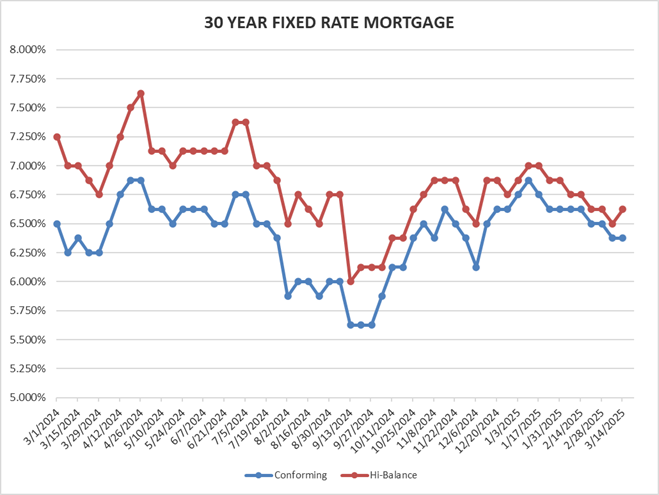
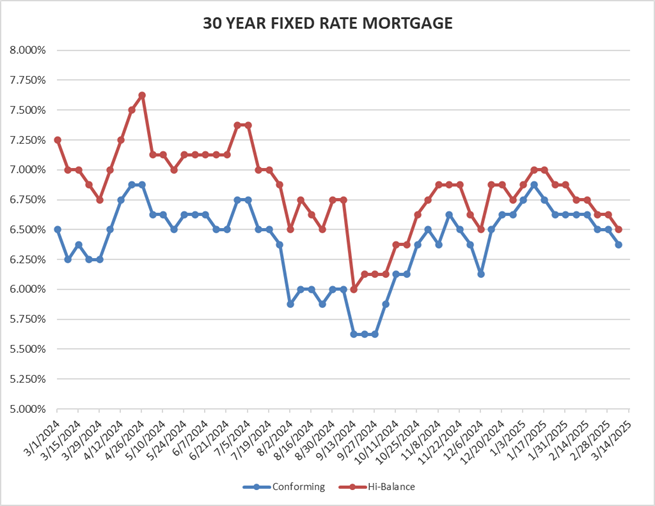
Rates for Friday March 14, 2025: Rates continue to benefit from investors reducing stock holdings and purchasing fixed rate investments, such as mortgages as investors are more worried about inflation from the tariffs impact on the overall economy slowing than rates rising to combat inflation . The conforming rate is flat from last Friday.

FIXED RATE MORTGAGES AT COST OF 1.25 POINTS LOCKED FOR 45 DAYS FOR PURCHASE TRANSACTIONS:

30-year conforming                             6.375%        Flat

30-year high-balance conforming        6.625%        Up 0.125%

Please note that these are base rates and adjustments may be added for condominiums, refinances, credit scores, loan to value, no impound account and period rate is locked. Rates are based on 20% down with 740 FICO score for purchase mortgages.

Great weather for ducks and geese this past week, not so great for those walking dogs in the morning who miss time their strolls in the morning after looking at the radar for when the rain will hit.

I’m sure we do not have the only dog who will not go outside to take care of business when it is raining but will run to his closet where his leash and other walk accessories are kept so he can go for a walk in the rain.

Stay dry and drive safe.

Should we use an FHA loan to buy our house?

Question of the week: Should we use an FHA loan to purchase our home?

Answer: Maybe.

Every Friday we provide a snapshot as to what mortgage rates are doing on a week to week, month to month basis. The parameters use conforming mortgage products for a purchase transaction with 20% down, a 740 FICO at a cost of 1.25 points (1.25% of the purchase price) locked in for 45 days.

For many years the WR&MU included FHA mortgages, but they were removed when the rate differential between FHA and conforming mortgages was very small and the amount of FHA mortgages being applied for and funded in our local market declined significantly.

FHA has a not great reputation in the real estate industry, some of it valid, much of it not. For years FHA was considered a first-time buyer, hard on their luck, only low-down payment, mortgage product, that had more challenging underwriting than conforming mortgages. The latter statement is not true, in some, many, instances, FHA can be more forgiving than conforming underwriting.

For real estate agents there was an added factor that FHA was harsher on property conditions than conventional mortgages, which could lead to delays or challenges in closings. This is true, in general appraisers do a more thorough inspection for FHA appraisals than for conforming loans as they call out property defects, especially what FHA considers health and safety issues. If the following are present, they issues will have to be cleared up before closing; issues such as peeling, chipping, scaling paint, broken or cracked windows, missing switch or electrical plug plates, non-working heating systems, are some of the examples.

A very big historical disadvantage that FHA has had over conventional mortgages is mortgage insurance. For conforming loan amounts that are 80.01% or more loan-to-value (i.e. less than 20% down, or combined down payment and second mortgage at closing less than 20% of the purchase price), the mortgage insurance cost is considerably less than the mortgage insurances required for FHA.

Yes, insurances, plural. Conventional loan mortgage insurance is a percentage of the loan amount paid on a monthly basis until the loan is paid off, or the borrower can provide evidence the loan amount is 78% or less of the home’s value, provided some other factors also met (timely payments), or at the mid-point of the mortgage’s term, i.e. if 30-year loan on the start of the 15th year.

For FHA there are two mortgage insurance premiums, an upfront premium added to the loan amount at closing and a monthly premium. Unlike mortgage insurance for conforming mortgages, FHA monthly mortgage insurance is paid as long as the loan if open.

The upfront mortgage insurance premium is 1.75% of the loan amount, the monthly premium is determined by your loan amount and down payment.

Purchasing a one-million dollar home with 5% down, and a $950,000 mortgage, using a 740 FICO score, the monthly mortgage insurance for a conventional loan is approximately $348 per month. For an FHA loan the monthly premium is approximately $554 per month, as well the upfront mortgage insurance premium of $16,625 will be added to your loan and amortized at the loan’s interest rate for 30-years.

In total the mortgage insurance for FHA adds almost $650 per month to you mortgage payment $348 per month for a conventional loan’s mortgage insurance.

So why would you consider an FHA loan?

Because the interest rate is plus or minus one-percent (1.00%) lower than a conventional mortgage with the same parameters.

                              Loan        Rate          PI           MI                Total

Conforming       $950,000     6.50%     $6005      $348           $6,353

FHA                   $966,625     5.50%    $5488      $554           $6,042    

As you can see, because of the one-percent lower rate on the total loan amount, the total monthly mortgage payment for the FHA loan is over $300 per month lower than the payment for the conventional loan.

If the mortgage insurance on the conforming loan is lifted after the required two-year waiting period to be eligible, the payment absent the mortgage insurance will only be $37 less per month than the FHA mortgage. During that two-year period the FHA borrower will have paid almost $7500 less in total payments on their loan. Put another way, that translates into about $50,000 more in purchasing power.

If you are using a low-down payment for your home purchase, you may want to consider using FHA financing.

To schedule an initial meeting by phone or Zoom, click here for my calendar, please feel free to forward to a friend or family member!

Have a question? Ask me!

Holding steady-ish, for now. Today’s job data for February from the Labor Department showed 151,000 jobs added in the month, halfway between January’s 125,000 new jobs and the Wall Street expectations of 170,000. In part due to more severe winter weather for the month, the unemployment rate inched up to 4.1% from the January’s 4.0%. Wages slumped to a 0.3% increase in February from the 0.5% increase in January; year over year however the 4.0% increase in pay is outpacing inflation.

Not yet impacting the labor markets, are the layoffs of federal workers, most of which have occurred after the Labor Department collected its data. Looking forward forecasts are for a choppy, and slowing number of jobs due to cuts to the federal workforce and spending which will impact other sectors of the economy. As well, with President Trump’s on-again-off-again-delayed-again changes in tariff rates for different nations,there is great uncertainty as to the impact foreign trade will have on our nation’s labor force.

Rates for Friday March 7, 2025: A roller coaster in the mortgage backed securities markets this week, starting high (lower rates), dropping (higher rates) then climbing back today. The result is rates at their lowest in three months.

FIXED RATE MORTGAGES AT COST OF 1.25 POINTS LOCKED FOR 45 DAYS FOR PURCHASE TRANSACTIONS:

30-year conforming                             6.375%        Down 0.125%

30-year high-balance conforming        6.50%          Down 0.125%

Please note that these are base rates and adjustments may be added for condominiums, refinances, credit scores, loan to value, no impound account and period rate is locked. Rates are based on 20% down with 740 FICO score for purchase mortgages.

Time to wake up in the dark again. Just as I was enjoying waking up at dawn I will need to adjust back to a dark house as I make my way to the kitchen for my first cup of coffee and the morning papers. Count me as one of those who wish we would pick a time and stick with it year-round.

Don’t forget to set the clocks back before you go to bed Saturday night or you’ll be late for church, soccer tournament, mimosa’s with your besties….

Economy: breezy or stormy?

Question of the week: Economy: breezy or stormy?

Answer: Back from relaxing week in Maui with very soft and pleasant breezes, where a cold front is 81 degrees and a heat wave is 87 degrees, I spent some time relaxing by diving into so economic and mortgage data as we enter the end of the first quarter of 2025.

Some of the news portends soft breezes ahead, some portend potential storms brewing.

Consumer spending drives the economy (65-70% of the economy). The top 10% of income earners (making $250,000 and up) have been responsible for 49.7% of spending, that is approximately one-third of GDP. From September 2023 to September 2024 spending increased 12%, during this same period middle- and lower-class spending dropped.

The bottom 80% of income earners saw a 25% increase in spending from four years ago, the top 10% increased spending by 58%. Inflation during the period was 21%, the increase in spending by the bottom 80% was only 4% above inflation over a four-year period.

Our economic growth has been unhealthily dependent on the very top income earners spending a lot of money.

Housing is another primary driver of our economy. It is not news that housing sales have been very (very) slow the last several years. High interest rates and rising prices has driven many home buyers to FHA mortgages with their low-down payments and some easier to qualify guidelines than conventional mortgages.

Over the past few years, the risk on FHA mortgages has increased somewhat substantially.

In 2007 35% of new FHA mortgages had a debt-to-income (DTI) ratio over 43%. Debt-to-income is your total credit debt, including new housing payment, inclusive principal, interest, home insurance, property taxes, and if applicable mortgage insurance and homeowners association fees, divided by your gross income. If you monthly housing and credit payments are $4300 and your monthly income ins $10,000, your DTI is 43%.

In 2020 the number of new FHA loans with a DTI over 43% was 54%, in 2024 the number grew to 64%. Take out income taxes, social security, health insurance premiums from paychecks, for many FHA borrowers their DTI of net income exceeds 80%, leaving not much for other life essentials like food, clothing, transportation, and almost none for savings.

It is estimated that 79% of first-time buyers using FHA financing have one month or less of financial reserves in the bank. Lack of reserves puts homeowners in a precarious position should a set-back occur.

Of the FHA mortgages funded last year 7.05% were 90 days or more past due on their mortgage payment within the first twelve months of closing. This is higher than the prior peak in 2008, when we saw the mortgage and real estate markets crash and drive the economy and into the Great Recession.

The collapse leading into the Great Recession was greatly caused by homes going into foreclosure driving home values down, leading to more foreclosures as loan balances exceeded home values, or short-sales with lenders agreeing to take large losses through short sales rather than massive losses through the foreclosure process.

Covid relief by the last administration to borrower and mortgage servicers has rescued many delinquent loans. Last year there were 52,531 FHA loans in serious delinquency in their first year, yet only nine went into foreclosure. Many of the homes were saved by owners having enough equity to sell and payoff their mortgage and closing costs, others were propped up with funds from the government.

These funds pay servicers to work with borrowers missing payments to add those payments to the back end of the loan, to be repaid with interest, and/or cut payments by 25% for up to three years. In the past year 556,841 “incentive payments” were made to services to prevent foreclosures, almost the same amount of new loans funded.

Data above from Wall Street Journal

With new administration steam-rolling through federal agencies looking to cut costs and spending, will the federal payments to mortgage servicers to prop up delinquent borrowers continue? If not what is the impact on housing?

The lop-sided spending skewed to upper income earners, and the increasing risk taken by lenders for lower income borrowers and resulting challenges in their making payments, belies some of the strength in economic growth. As well, should employment markets weaken, the first to be cut are usually lower paying jobs, many of whom are already having challenges meeting all their household costs, which could be a tipping point for housing and the economy as a whole.

These are clouds gathering for a potential storm.

On the breezy side, economic data released this week shows continuity from the end of 2024 into 2025. The first revision of GDP for the last quarter of 2024 was no revision; the economy grew at a healthy 2.3% in 2024. Spending increased a healthy 4.2% for the year; the GDP report did show inflation at 2.7%, up from initial estimate of 2.5%.

Looking forward, the Atlanta Federal Reserve revised its estimate of GDP growth in the first quarter down from positive 2.3% growth to negative 1.5% on an annual basis. Part of the downturn can be attributed to severe winter weather in much of the country and the devastating wildfires in Southern California. A large part of the estimate is due to a large trade deficit as wholesalers, retailers, and consumers purchase imported goods ahead of tariffs being put in place by the Trump Administration.

Looking back, in January the Personal Consumption Expenditures (PCE) index, which is the Fed’s preferred gauge of inflation when considering its policy on interest rates, was up and expected 0.3% in January and 2.5% year over year. The core index (food and energy stripped from calculations) showed 0.3% increase in the month and 2.6% year over year, down from December’s 2.9% increase. The drop in the core rate is positive for rates.

Personal incomes grew well above 0.4% expectations, rising 0.9%. The growth was well above inflation, but did not spur increased spending as the report showed spending dropped 0.2% from December—likely attributed to weather and fires.

To schedule an initial meeting by phone or Zoom, click here for my calendar, please feel free to forward to a friend or family member!

Have a question? Ask me!

Rates for Friday February 28, 2025: Benign inflation news keeps rates flat from last Friday.

FIXED RATE MORTGAGES AT COST OF 1.25 POINTS LOCKED FOR 45 DAYS FOR PURCHASE TRANSACTIONS:

30-year conforming                             6.50%          Flat

30-year high-balance conforming        6.625%        Flat

Please note that these are base rates and adjustments may be added for condominiums, refinances, credit scores, loan to value, no impound account and period rate is locked. Rates are based on 20% down with 740 FICO score for purchase mortgages.

Happy Birthday to those who don’t have a birthday this year; I’m speaking of course of those born on February 29th. Since the last day of the month is on a Friday this year, assuming a lot of celebrations between 11:59:59 and 12:00:00 tonight!

Are mortgage rates going to go up?

Question of the week:  Are mortgage rates going to go up?

Answer: I shook my Magic 8-Ball and its answer matched my own, signs point to yes.

Mortgage rates operate independently of the Federal Reserve. That said, investors who determine mortgage rates take their cues from the Fed. That said…the primary cues investors take are essentially the same cues the Fed uses when deciding whether to raise, lower, or keep the same their benchmark interest rate.

The cues come from economic data provided by different federal agencies and departments. Jobs, consumer spending, prices, imports and exports, manufacturing output, are all insights into how our national economy is doing. The basic rule of thumb is the better the economy is doing the more likely rates will go up, the worse the economy is doing the more likely rates will go down.

As you are aware, rates jumped considerably in 2022 following inflation spiking in 2021 and continuing to increase. Rates went from below 3% in January 2022 to 7% in October. Using the conforming rate every Friday that is used for the WR&MU to track rates, since the conforming rate passe 6% in September 2022, the rate has been below 6% only ten times since. That is ten times in one hundred twenty-five weeks, the last time in early October 2024.

Since October the economic data has shown the economy is strong, growing at a good pace, growing employment and wages, and inflation stubbornly sticky. The inflation target for the Fed is 2%, since inflation spiked in 2021 when the CPI rose from 2.6% to 4.2% from March to April, the closest the index has come to 2% was in September 2024 at 2.4%.

This week Bureau of Labor Statistics released the Consumer Price Index for January. Expectations on Wall Street were prices to increase 0.3% from December to January. When the report showed a 0.5% increase for the month, the largest increase since August 2023, it was met with great surprise. Year over year, prices increased 3% from last January, the highest level since June 2024.

After two rate cuts last year, the expectation was for the Federal Reserve to cut its benchmark rate two, possible three, times in 2025. Data in January and last week pretty much assured that the Fed would not undergo a rate cut at it meeting in March.

This week’s inflation data has many investors expecting no Fed rate cut this year.

Going into that expectation is not just inflation data. Approximately 11% of our consumer goods are imported. Over $40 billion of appliances were imported in 2025. President Trump is following through on his campaign speeches and increasing tariffs on imported goods. This past week he imposed a 25% tariff on imported steel and 15% on aluminum.

Increasing tariffs on all of our trading partners, and on raw materials and finished goods, will lead to higher prices for manufacturers and consumers.

Consumer spending is 65-70% of our economy. Driving consumer spending is employment and wages. If wages and employment lag behind inflation, spending slows and so does our economy. If wages and employment are ahead of inflation, spending increases and so does our economy. Employers have expanded payrolls and are paying workers more money. This increases their expenses, which leads to price increases, and leads to more money in wallets and pocketbooks of consumers to spend.

Looking at the political and economic trends, there is very little support for rates to go lower. As well, very little for rates to stagnate into the future.

Signs point to yes. Yes, rates should be going up this year. Absent some major event that will slow the economy, there is little information available that leads to rates not climbing in the near or medium term.

To schedule an initial meeting by phone or Zoom, click here for my calendar, please feel free to forward to a friend or family member!

Have a question? Ask me!

 Two big factors in the jump in CPI are it is January and chickens. January is when a lot of retailers, service providers, hospitality vendors, raise their prices. This past year a lot of goods and service providers held prices firm against higher costs they pay for labor and supplies, and with the turn of the calendar page increase their prices to offset their own higher costs. This leads to a bump in CPI, as seen by most of the gains in the index were from goods and services that have seen slower increases in their prices over the past year.

Accounting for two-thirds of the increase in grocery prices in January was the 15% increase in egg prices since December, the highest one month increase since 2015. This led to many restaurants adding an additional cost to prices on their menus for egg dishes.

Some good news for rates came today with the data for retail sales in January, which dropped 0.9%, the largest month-to-month decline in almost two years. Large holiday shopping in December, a severe cold snap in much of nation, wildfires in California, all contributed to shoppers staying home in January. A major reason for the big slowdown was a fall off in sales of cars and trucks—taking that sector out of the data and retail sales fell 0.4%. Rising in sales for the month were gasoline and restaurant sales, both up 1% for the month. Slower sales can lead to slowing economy can lead to lower rates.

Rates for Friday February 14, 2024: Despite the reaction to the inflation data, rates are flat from last Friday, thanks to a rebound with today’s retail sales data, as well traders moving into bonds for the long Presidents Day weekend.

FIXED RATE MORTGAGES AT COST OF 1.25 POINTS LOCKED FOR 45 DAYS FOR PURCHASE TRANSACTIONS:

30-year conforming                             6.625%        Flat

30-year high-balance conforming        6.75%          Flat

Please note that these are base rates and adjustments may be added for condominiums, refinances, credit scores, loan to value, no impound account and period rate is locked. Rates are based on 20% down with 740 FICO score for purchase mortgages.

One of the biggest joys in life is going through it with your Valentine, I know this is true for me and hope it is for you as well.

What are some areas we should review to start the year?

Question of the week:  What are some areas we should review to start the year?

Answer: If the question of the week looks familiar, it is as it is we ask near the beginning of every year; because it is that important. Over the next few weeks, or months depending on your particular situation, you will be gathering statements, forms, and information to prepare your tax returns. While you have all this information in the same place it is a good time to also review various areas of your economic life to see what may need updating, or changing.

Here are some of the areas I suggest you review:

  • Retirement Did you alter your retirement withholdings in 2024?  Do you need to increase or decrease your deductions for your 401(k)?  The maximum contribution for 2025 is $23,500, up $500 from 2024.

If you are over 50 the “catch up” contribution limits $7500 for a total contribution (pre-tax) of $31,000. If you are between 60 to 63 you can contribute an additional $11,250 in 2025 for a total of $34,750.

The combined total for employee and employer contributions is $70,000.

Note these limits include contributions to either traditional 401(k) account, or a Roth account that may, or may not, be administered by the same administrator.

Depending on your situation, you may want to review if you should make all your contributions into your 401(k) plan, or contribute some of the funds to a Roth, from which you may be able to withdraw funds tax free in the future.

Are you self-employed or work for an employer who does not have a retirement plan so you contribute to some type of IRA? Review your 2024 income and contributions and determine based on estimated income in 2025 whether you need to adjust your monthly or quarterly contributions to your IRA. If you do not make regular contributions to your IRA, I strongly recommend it so you can take advantage of “dollar cost averaging.”

  • Insurance Is your hazard insurance policy current and accurately reflecting the replacement value of your home?  Is your life insurance coverage adequate? Are you home, auto, life insurances with the same company allowing you to take advantage of bundled discounts?

As you are aware, many insurance companies have changed their homeowners’ insurance coverages, not issuing new policies, or dropping existing clients. Check in with your agent regarding your coverage and any expected changes that may occur from their side.

If you have significant equity in your property, consult with your property and casualty agent to see if you should consider earthquake insurance. Because the deductibles are extremely high for earthquake insurance, it is generally not recommended to get earthquake insurance if you do not have enough equity to protect when calculating premiums and deductible.

  • Estate Planning Do you have an estate plan?  Is it current and reflective of your current assets and wishes?  Do you own property but do not think you need any family planning because you are single?  Everyone with assets should have an estate plan, especially if they own real estate in California (or any other state with inheritance taxes). If you have an estate plan and family trust when was the last time you had it reviewed? Have your children become adults since the trust was last reviewed and amended? What about your wishes for you when you pass on to the next dimension, are they the same as they were when you initiated your trust?
  • Debt Have you increased your debt in the past twelve months?  Do you have a plan to pay it down and off?  Can you restructure your debt to lower the overall interest rates being charged or the monthly cash flow required to manage the debt and keep payments current? Was your 2024 resolution to pay down/off debt but were unable to do so? Call me and we can discuss potential plans to help you achieve this goal in 2025.
  • Mortgage Do you need a review of your current mortgage and options?  Call me!

These are not fun or sexy issues for most people to be tackling, but like changing the batteries in your smoke detectors you need to regularly review and update these critical areas of your home economics.  If you have any questions or looking for qualified professionals to assist you, please do not hesitate to contact me.

To schedule an initial meeting by phone or Zoom, click here for my calendar, please feel free to forward to a friend or family member!

Have a question? Ask me!

 As expected, the jobs market cooled in January. That said, it cooled more than expected. Going into today’s jobs report from the Department of Labor, the consensus was the economy added 169,000 new jobs in January, the data showed 143,000 new jobs for the month. The miss was not by much, and the number of new jobs showed that employment is still strong in our economy. Pushing that narrative was the announcement that the data for November and December was revised to show 100,000 more jobs were created in those months than previously reported. The unemployment rate dropped from 4.1% in December to 4.0% in January.

Key factors in determining the number of workers all have slowed over the last few months, hiring, quitting and layoffs, reflecting a stable employment market. The number of jobs added to the economy and the stability of the labor market are fairly interest rate neutral.

Not as neutral is the data on wages, which increased 0.5% for the month and are up 4.1% from last February, outpacing inflation by a fairly significant amount. With income adjusted for inflation increasing, enabling more discretionary spending, concerns are consumers will continue to spend and drive more economic growth, making it very hard to lower inflation. The wage data in the Labor Department’s report pretty much assures the Fed will not lower its benchmark interest rate at its next meeting, and put upward pressure on interest rates after the report was released.

Rates for Friday February 7, 2024: Despite a bump up in rates today, due to rates dipping earlier in the week, we end the week with the conforming rate where it was last Friday with the high-balance rate dropping slightly.

FIXED RATE MORTGAGES AT COST OF 1.25 POINTS LOCKED FOR 45 DAYS FOR PURCHASE TRANSACTIONS:

30-year conforming                             6.625%        Flat

30-year high-balance conforming        6.75%          Down 0.125%

Please note that these are base rates and adjustments may be added for condominiums, refinances, credit scores, loan to value, no impound account and period rate is locked. Rates are based on 20% down with 740 FICO score for purchase mortgages.

Our dog Sammy does not like the Philadelphia Eagles. Primarily because he does not like shouting and yelling, whooping and hollering, which are generally in abundance when I watch the universally beloved Eagles.

Sammy is in for a long afternoon on Sunday, hopefully ending with some major shouts of joy and a certain individual, who has been a faithful Eagles fan since his family moved to the Philadelphia area in 1970, singing the Eagles anthem, Fly Eagles Fly, loudly and off-key.

Go Birds!