What tax benefits for homeowners are in new tax bill?

Question of the week:  What tax benefits for homeowners are in new tax bill?

Answer: After inter-party wrangling and horse trading the ridiculously named One Big Beautiful Bill has been signed into law, and there were some benefits for homeowners.

For California residents the biggest benefit as a homeowner appears to be the increase of the allowable SALT (State And Local Taxes—primarily income and property) from $10,000 to $40,000*. You may recall that the SALT deduction limit of $10,000 was part of the Tax Cuts and Jobs Act signed in 2017 during President Trump’s first term in office; prior to the Act there was no limit on SALT deductions.

After the 2017 Act, if purchased a home for in the state for $850,00 or above, your property taxes likely were $10,000 more, meaning you could not deduct any income taxes you paid to the State of California. Or, if you owned a home with a lower property tax bill, but your taxable income was $170,000 you could not deduct your property tax.

*The $40,000 cap will increase by 1% per year. It expires in 2029, reverting back to the $10,000 cap unless extended by Congress. For a married couple filing jointly the cap phases out until it reaches $10,000.

If a married couple filing jointly has $120,000 in income the potential savings with the increase deduction can be almost $6000.

For those earning less income, and have mortgage insurance, the 2025 Act (notice I am avoiding the official name) has made permanent the deduction of mortgage insurance for loans with private mortgage insurance (PMI) the upfront and monthly mortgage insurance premiums for FHA mortgages, and the upfront funding fee for VA mortgages. This mortgage insurance deduction is subject to income limits, phasing out after $100,000 in taxable income is reached to no deduction if income is higher than $109,000.

The home mortgage interest deduction on loans up to $750,000 put in place in the 2017 Act remains. There was some talk of extending the cap but it was last in the horse-trading for the SALT deduction increase.

Also remaining in place, and made permanent with a 1% annual increase, is the $15 million exemption of the Estate and Gift Tax. If not extended the limit would have reverted to the prior limit of $5 million. This is big benefit for families whose primary homes, and businesses they own, have increased significantly in value since acquired.

What was not included is a change I feel needs to be made to benefit seniors and also increase housing supply across the country. In 1997 President Clinton signed into law the Taxpayer Relief Act (how come tax law names always sound like a benefit to tax payers?) which increased the capital gains exclusion on the sale of a primary residence to $500,000. Since 1997 the national median home price has gone from around $115,000 to around $415,000, in California it increased from just under $200,000 to over $800,000.

We have a housing shortage in California and have seen a precipitous drop in inventory for sale since the pandemic. Many older homeowners have received a favorable tax benefit from new laws that enable them to carry their current property taxes to their new homes if they down size.

However, the $500,000 exemption limit on the capital gains deduction produces a significant barrier for many who do not want to sell and pay a significant amount of taxes to the state and federal governments.

Take a couple who purchased their home in 1995 for $250,000. Their kids are grown and they are ready to downsize their home and be able to enjoy retirement. Their home is currently worth $1.1 million dollars. Their acquisition and sales costs and monies spent on significant improvements, totals $200,000. $1,100,000 less $250,000 purchase price and less $150,000 in costs and improvements, their capital gains is $700,000. Take the $500,000 exemption out and their taxable capital gains is $200,000.

Assuming moderate income, their federal taxes owed could be around $30,000. For the state of California, the $200,000 is taxed as ordinary income, the taxes can be an additional $18,000 or more.

Paying $38,000 in taxes on the sale of their property is significant enough to prevent many older homeowners.

This is for a married couple. It should be noted that if the seller is widowed for more than two years the exemption drops to the $250,000 limit for single filers. This adds a significant amount of taxes to the seller.

One final note, if a spouse retains a home following divorce the exemption is the $250,000 limit for single filers.

Home buying, and selling, has some complexities beyond what is the price. Let me assist you, or someone you know, who is considering a real estate transaction to go through the various factors, options, and consequences that could be involved.

Have a question? Ask me!

The chances of a rate cut by the Federal Reserve next week is approximately 0.01%. Economic indicators this week did not suggest a slowing economy, nor do they forecast a slowing economy, or much lower inflation in the coming months. Highlights:

  • Consumer Price Index for June showed a .3% increase in prices from May and a 2.7% increase from June 2024.
  • While the monthly increase was the biggest one-month hike, it was in line with expectations so minimal impact on rartes.
  • Gas and shelter, particularly shelter, had the largest impact on CPI in June.
  • Tariffs are not showing significant impact on prices at this point.
  • The core rate (strip out energy and food) was up only 0.2% for the month and 2.9% for the year—also as expected.
  • Retail sales were hot in June after being cold in May, increasing 0.6% for the month after dropping 0.9% from April to May.
  • Vehicles led the way as car shoppers hit the lots as tariff related increases have not hit stickers yet.
  • Restaurants saw a big boost, 0.6% after a big drop in May. Dining out is a key indicator of consumer confidence in their economic future as they spend discretionary income rather than save.

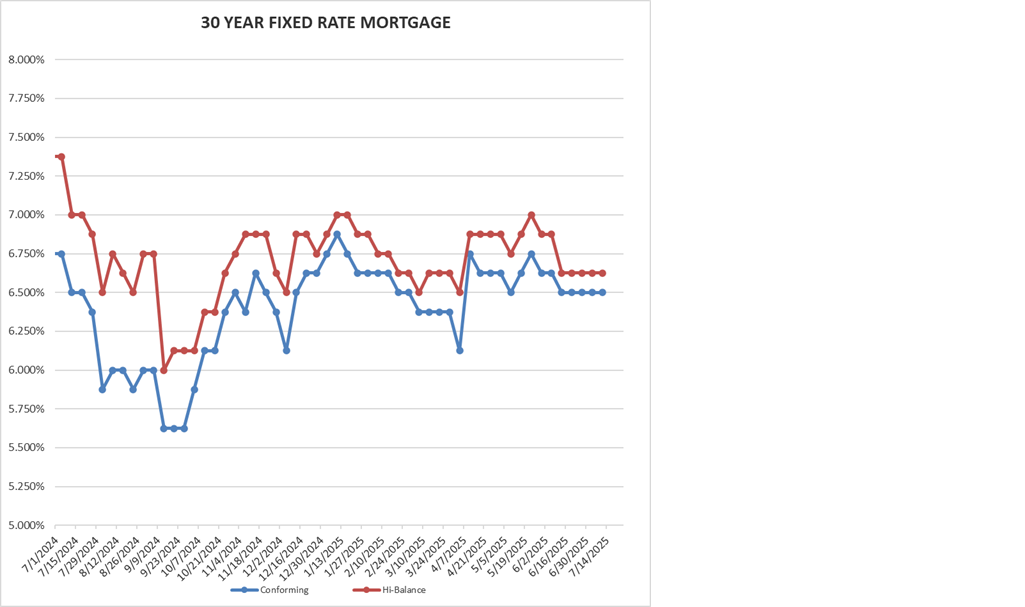
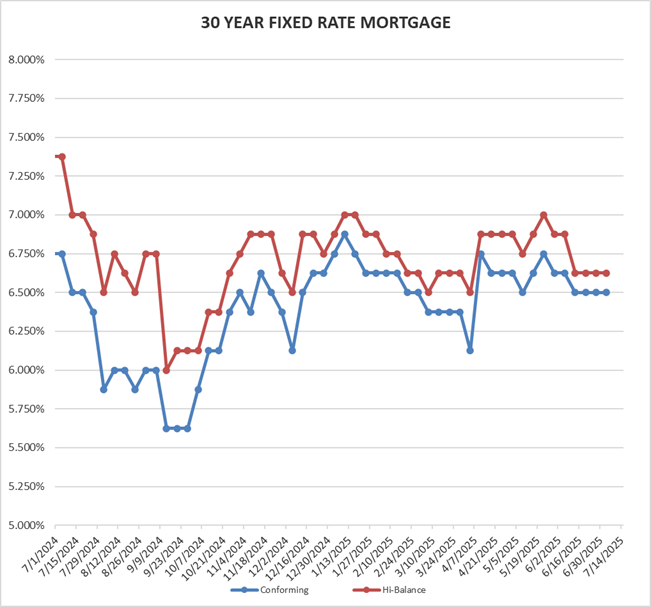
Rates for Friday July 25, 2025: The data has investors holding firm, causing rates to do the same. While the chances of a rate drop next week from the Fed is almost zero, the chances of a drop in September are getting a bit slimmer, dropping to 70% from most, and as low as 50% for some analysts. Rates are the same for the fourth Friday in a row; the longest streak since the 10-week stretch from July 9to September 17, 2021 when the conforming rate was 2.625%–remember those days?

FIXED RATE MORTGAGES AT COST OF 1.25 POINTS LOCKED FOR 45 DAYS:

30 year conforming                                            6.50%    Flat

30 year high-balance conforming                      6.625%   Flat

Please note that these are base rates and adjustments may be added for condominiums, refinances, credit scores, loan to value, no impound account and period rate is locked. Rates are based on 20% down with 740 FICO score for purchase mortgages.
Early in my career I would tell new homeowners that any home project, purchase or modification will cost $1000. Change a latch on a gate, leads to new gate, leads to new flowers and shrubs…$1000. Buy a new throw rug for the den, coffee table looks dated, let’s get a recliner…$1000. Buy a new water heater for $300 (remember this was late ‘80’s early ‘90’s), remodel cabinet and/or location…$1000.

Today, even though the inflation adjustment from 1990 to today is about $2500, I think homeowners should budget up to $5000 for these home expenses. Having a surprise, and when are they not, pin-hole leak in our water main last week, which led to handy man and plumber to  remove plants, dig holes, fix pipes, fill in holes which leads to re-landscaping that section of the front yard, which will lead to re-landscaping the yard on the other side of the walkway…while I hope not it will likely be…$5000.

Where are rates headed?

Question of the week:  Where are rates headed?

Answer:  That is the multi-hundred billion, or several trillion, dollar question being asked around the globe.

The Federal Reserve gets a tremendous amount of attention, and credit and blame, for interest rates, sort of like an NFL quarterback. Yes, they control the proverbial football and can hand-off, run, or throw the ball. The last of which has three results, two bad (a completed pass, an incomplete pass, or an interception).

The Federal Reserve is supposed to be apolitical and independent from all branches of the government. “Supposed” is the key word since the debates to establish the central bank in 1913 when the Federal Reserve Act was signed by Woodrow Wilson.

As with the First Bank of the United States (1791-1811) and the Second Bank of the United States (1816-1836), the Federal Reserve Act, and later the bank itself, was strongly opposed by those who felt a central bank would concentrate too much economic power in the hands of the major bankers and the federal government. Due to its ability to determine what banks paid for borrowing from each other and the Fed, there was, and is, concern that a central bank could manipulate money supply and cause inflation, deflation, thereby impacting how much money people could earn, spend and save due to the economic impact on labor and wages.

The concerns from the late 18th Century remain concerns for many persons today, most notably the person who sits behind the Resolute Desk in the Oval Office at 1600 Pennsylvania Avenue.

Today the Federal Reserve only controls one interest rate, the federal funds rate (also called the Fed’s benchmark rate), which is the rate banks charge each other for overnight loans.

All other interest rates in our economy move according to supply and demand, which are the result of expectations of future economic conditions from those looking to borrow or lend.

The fed funds rate is the basis for many of those expectations, and some rates do move in the same direction and amount as the Fed’s benchmark rate, most notably since the 1980’s the prime rate.

Prime rate was a term that given to the rate that banks charged their best and strongest customers. Banks would set their prime rates independently depending on their local competition and desire to lend more or less. By the mid-1980’s when there was major financial deregulation and the infamous Paul Volcker was chair of the Fed as it changed monetary policy, all banks’ prime rates fell in line with the fed funds rate, moving the same amount and direction, with a pretty standard margin of 3% above the Fed’s rate.

The Fed’s mission is to promote a healthy, stable economy and financial system in the United States, promoting the highest level of employment without causing inflation.

Because this, the Fed determines whether to raise or cut rates depending on inflation and employment. Essentially when the economy is strong and growing quickly the Fed will raise rates, when it is slow and shrinking it will lower rates.

Currently we have seen the Fed cutting rates since last August, having dropped the benchmark rate 1% from August to January of this year. It started cutting rates as inflation was cooling, employment was stable, not shrinking nor growing abnormally.

During this same period, the 30-year conventional mortgage (as priced below) has increased from 6% to 6.5% (after dipping to 5.375% in September). Evidence that the Federal Reserve does not control mortgage rates.

Enough with the background, answer the question.

Depending on the economic background and philosophy/ideology of the economist, banker, analyst, politician, advisor, mortgage hack who writes a weekly e-newsletter, rates should go up, go down or remain the same.

There is no strong consensus as to where rates for consumers and businesses will go in the near and medium future; with the exception of those whose outstanding debt is based on the prime rate. (Betting is very heavy the Fed will lower its rate in September, leading to a drop in the prime rate, therefore lower rates for those with equity lines or other loans tied to the prime rate.)

Back to employment and inflation being the two primary factors in the rate decision making for the Fed.

Typically, these are linked with higher job growth and wages leading to higher inflation as more people are making more money so they can buy more goods and services.

If supply of these goods and services do not keep up with the increasing demand prices go up, inflation.

If employers are laying off workers, decreasing wages, or closing, there are fewer people making fewer dollars and unable to purchase as many goods and services, supply exceeds demand and prices drop, deflation.

In the first case the Fed raises rates to cool labor markets and stem inflation by making it more expense to borrow money, or to pay more for money already borrowed, restricting the flow of money and slowing the economy.

In the second case the Fed lowers rates to make borrowing cheaper, thus encouraging borrowing to expand, buy, hire, creating economic activity that will grow the labor force and push prices up.

Since I have already gone deep into the weeds, I will not get into the Fed’s manipulation of money supply and rates by other means—just know that it does and can usually in line with its desire to raise or lower rates.

Investors and lenders generally “bet,” i.e. invest or loan, based on what they predict the Fed will do with its benchmark rate. If economic data is showing growth and strength, they bet that the Fed will hold or raise rates; if data is showing slowing or contraction of the economy, they bet the Fed will hold or lower rates.

Mortgage rates are determined by the Mortgage-Backed Securities markets (MBS). The bell-weather mortgages the pretty much set the market for all other rates are those purchased by Fannie Mae and Freddie Mac (GSEs for short). In recent years, approximately 505 of all outstanding mortgages are either guaranteed by Fannie Mae or Freddie Mac. Because of their market share, the price at which they sell their mortgages to investors determine interest rates for almost all mortgage products.

You have $1M and want to invest in a fixed rate asset. You can purchase debt from the United States government, that has always been considered the safest investment since the U.S. Treasury has never defaulted on a debt, you can invest in local municipal bonds, which may be somewhat safe, but with some risk, you can invest in corporate bonds, which depending on the company may be somewhat safe, or risky, you can also invest in mortgages sold by Fannie Mae or Freddie Mac, which are extremely safe due to their backing by the U.S. Treasury.

While MBS issued by the GSEs are extremely safe due to their federal backing, they provide returns that are higher than U.S. Treasury debt.

When MBS prices rise, mortgage rates go lower. When MBS prices drop, mortgage rates go higher.

Since last summer, economic data has shown an economy that is resisting inflation dropping, increasing the number of jobs and wages, and creating expectations that rates will not drop in the future as the economic data the Fed considers most important for its rate decisions do not show slowing labor markets and slowing prices.

Predictions, expectations, guessing, as to where rates will go in the future are mixed because different viewpoints have different ideas about the impact of the federal government’s deficits, tariffs impact on trade, prices and employment, what impact new government regulations and policies from taxation to restrictions, or lack-thereof will have on private sector and consumer behaviors, and ultimately whether inflation and labor markets will grow, shrink or slow based on all of the above.

So far, those tariffs that have been implemented have not had the inflationary impact many have anticipated. While some businesses have been harmed with the cost of their goods slowing sales, overall the labor markets have not felt the impact expected from the tariffs.

That said, many are waiting for the other shoe to drop as the deadline for when proposed tariffs will go into effect for many trading partners has been pushed out again, this time to August 1st.

Historically, after our period of very high rates compared to the very long period of very low rates prior, we should expect rates to decrease in the near and medium terms. That said, until the unprecedented, in modern times, tariffs that may be imposed on trading partners, and their reciprocation, are in full effect we still do not know the full impact on our economy.

While there are divisions as to the impact if/when all tariffs are in effect, many of us feel that they will lead to higher prices and lower employment which can lead to stagnation. If this is the case, rates will likely rise in the short term as inflation is usually more of a long-term threat to the economy than higher unemployment—the Fed has acknowledged this with its comments during the early period of its rate increases from March 2022 to August 2023 when members said they can accept much higher unemployment if necessary to lower inflation.

If a period of time passes, one- possibly two-quarters, post-tariffs implementation that shows mild inflation and stable job markets, rates will come down.

You didn’t answer the question.

I find the question unanswerable in a definitive manner due to the number and complexity of factors involved that have no similar basis in the last several decades.

Pressed to make a prediction my stance is rates remain in the same range, plus-minus 0.25% (one-quarter of one percent) at least until September. At that point if the Fed does as currently anticipated, and lowers rates by 0.25%, mortgage rates will fall incrementally. After that we will have 3rd quarter GDP and data prices and labor following a few months of the tariffs. Those will determine rates to the end of the year and early 2026.

Have a question? Ask me!

Last Thursday the jobs report for June was a surprise on the headline number as is showed the economy added 144,000 job for the month, more than the 144,000 added in May and well ahead of the 110,000 forecasted. The big number was met with investors predicting the Fed will not raise its benchmark rate later this month due to the continuing strong labor market, but they feel the chances are very high for a rate cut in September.

Not great, is the data breakdown. Of the 144,000 jobs, only 74,000 were in the private sector, and 59,000 of those in social services or healthcare, the rest were government hires, predominantly state and local. This is not good news as the private sector drives our economy, providing the source for dollars spent beyond what is printed by the government. A decline in government jobs has no where near the same impact as a similar reduction in private sector jobs.

Another anomaly in the data was the reduction in the unemployment rate from 4.2% in May to 4.1% in June and much lower than predictions of a 4.3% rate. The anomaly is not that the drop is because people dropping off the unemployment roles due to new jobs, but rather the rate dropped because more people dropped out of the labor market and quit looking for jobs. The unemployment rate does not measure how many people are not working, but how many people are looking to work.

Rates for Friday July 11, 2025: With the short week last week, little economic data this week, indecision about tariffs, natural disasters, and more, rates are stable for the third week in a row, the longest such streak since March.

FIXED RATE MORTGAGES AT COST OF 1.25 POINTS LOCKED FOR 45 DAYS FOR PURCHASE TRANSACTIONS:

30-year conforming                             6.50%          Flat

30-year high-balance conforming        6.625%        Flat

Please note that these are base rates and adjustments may be added for condominiums, refinances, credit scores, loan to value, no impound account and period rate is locked for 45 days. Rates are based on 20% down with 740 FICO score for purchase mortgages.

I celebrated another tour around the sun this past weekend, yes I celebrate and do not bemoan this annual event as I’d rather be here with everyone than not. My body definitely feels the wear and tear of 63 years, but it still surprises me to look in the mirror and not see someone much younger. The surprise is even greater for my body being unable to do the same things it was capable of doing many years ago as well—with the exception of being a klutz capable of self-harm and breaking innocent objects and body parts.

What about mobile homes?

Question of the week:  What about mobile homes?

Answer:  After reading last week’s WR&MU How can we help our children purchase a home?, weekly reader Leslie (besides wife Leslie, I know a lot of Leslie’s) asked me, (at least think this was the question as we were at Long Beach Rotary President’s Party with a steel band playing in the background) “what do you think about getting a mobile home for our son?”

I replied that it wasn’t a very good time to talk about it because I couldn’t hear very much.

So, Leslie, here is what I think.

I think it is a very good option for those looking for homeownership and priced way out of the market in their current areas.

Television and movies have created a very negative perception of mobile homes in our culture. A joke I tell about my fellow Okies is, “what do a tornado in Oklahoma and a divorce in West Virginia have in common?”

“Some one is losing a mobile home.”

Jokes, and depictions of “tailer trash” neighborhoods filled with dealers, pimps and addicts, aside, Southern California has many mobile home parks in very desirable locations that are clean, safe, and very affordable.

While in common parlance they are called “mobile homes,” in lending and real estate they are manufactured housing.

Manufactured housing comes in different variations. In some areas manufactured homes are the prevalent building style for whole neighborhoods, not in parks but in what could be considered “normal” with driveways, mailboxes at the street, etc.

These are pre-fabricated homes that are either delivered almost fully constructed and then placed and secured onto foundations. In some instances, the pieces of the home are delivered and then put together on site.

For those looking to rebuild after a major fire or other event, manufactured homes can be a much lower cost alternative than traditional home construction. I have been in a few manufactured homes that I did not know they were pre-built until the owners told me. Like mobile homes, there is a negative connotation as to what they are that are not aligned with reality in the overwhelming majority of cases.

For financing manufactured homes, the primary factors in the type of loans available are if the dwelling is permanently attached to a foundation; i.e. not “mobile,” and if the space where the unit is located is leased or owned by the owner of the dwelling.

For those attached with land ownership, many of the loan programs available for traditional homes are available for manufactured housing; Fannie and Freddie, VA, FHA, many jumbo products.

For dwellings in parks with leased land and non-permanent attachment, the unit is considered “chattel.,” for our purposes, mobile homes.

There are lenders that specialize in these loans, which can have higher down payments, shorter loan terms, and higher interest rates. While the total cash to close and monthly payment may be higher for a mobile home versus a traditional home with the same price, because the price is significantly lower, even with the monthly park fee, the cost of ownership can also be significantly lower.

A quick glance at the market shows some mobile homes up to 1400 square feet priced at the mid-$200,000s with the nearest traditional homes for sale in the $900,000 to over $1 million ranges, and condos at $600,000 or over.

Many of the mobile home parks in the region are 55+ (I won’t say “senior”) restricted, making for very affordable housing for those downsizing, retiring to much lower income, or wanting the convenience of less to maintain and a close-knit neighborhood with, in most cases, gated entry.

What about mobile homes? Worth a strong look and putting possibly ingrained prejudices aside to obtain very affordable home ownership.

Have a question? Ask me!

 It was quiet in May for retailers as spending dropped 0.9% in May from April, the second month in a row, retail sales declined. With inflation for the month only 0.1%, the drop in units was even more than the 0.9% decline (retail sales calculated in dollars transacted). The decline was led by restaurant sales, down 1% for the month despite Mother’s Day and graduation celebrations, and new auto sales down 3.5%–the biggest drop in car sales in about two years. Much of the drop in auto sales was the spike in March ahead of potential tariffs causing a four year high in sales. The drop in sales is good news for inflation and rates, but perhaps not so great new for the economy as consumer spending accounts for 65-70% of our economy.

No change. That was the news from the Federal Reserve Open Market Committee, the group that determines the Fed’s benchmark interest rate. As expected, the FOMC did not change the rate at its meeting this week, taking a wait and see position for more data on inflation and employment. Which is the tight rope the Fed is walking. If it zeros in on inflation and lowers rates as prices cool further it risks heating up the economy and restarting a new cycle of inflation. If it zeros in on employment and raises rates as unemployment drops to cool a heating up economy it risks pouring water an economy that is not that hot and cause a move towards recession.  At this point the consensus among the “experts” has moved from one rate cut in 2025 to two rate cuts totaling 0.5%.

Rates for Friday June 20, 2025: Rates are flat from last week as investors try to not react to the economic and global events to see what is next.

FIXED RATE MORTGAGES AT COST OF 1.25 POINTS LOCKED FOR 45 DAYS FOR PURCHASE TRANSACTIONS:

30-year conforming                             6.50%          Flat

30-year high-balance conforming        6.625%        Flat

Please note that these are base rates and adjustments may be added for condominiums, refinances, credit scores, loan to value, no impound account and period rate is locked for 45 day. Rates are based on 20% down with 740 FICO score for purchase mortgages.

I don’t completely recall the exact circumstances, but I believe that 50 years ago this week, as I was exiting 7th grade and about to become 13, my brother Michael, our neighbor Dick Mackey, myself and maybe another kid or two, road our bikes the four to five miles to the theater at King of Prussia Mall to see the original summer blockbuster, “Jaws.”

I had read the book and was excited to see the movie—which was considerably better for a kid given the presence of the shark throughout not visually, but through John Williams’ simple two-note duuun-dunn….duunn-dunn…dunn-dunn dunn-dunn….

Roy Scheider’s line when utters, “You’re going to need a bigger boat,” after seeing the shark for the first time was an ad lib, and one of the most iconic lines in movie history, still used by many people in many circumstances.

Not sure about you, but I think it is time to re-watch this great movie—last last time being many years ago when girls were in 5th and 7th grade having a sleep over.

How can we help our children purchase a home?

Question of the week:  How can we help our children purchase a home?

Answer:  This is a question we repeat every two or so years as parents and their children age and more of my clients now have children of home-buying age. As well, with the ever increasing, property values in the region, many young families need the help parents may be able to provide.

Many parents will do anything they can to help their children get a leg up, to get a strong start, to ensure a more comfortable life. Some parents do it by trying to help their kids get into certain colleges, some parents do it by helping their children with the purchase of their first home. We all want the best for our children, the question is how far are we willing to go, or for many parents how far can we go?

There are several ways parents can help their children purchase a home. Each has different consequences, short and/or long term. A primary factor I have parents consider when we are having these conversations is what will be the impact on their lives today, and in retirement, or if they are retired, their future.

Let’s explore the different ways parents can help their children obtain their own home.

SCENARIO ONE: One way some parents help is by purchasing the house themselves. They provide the down payment, they qualify for the mortgage, and they are the only ones on the title and mortgage. Their child moves in and the agreement is that at some point the parents will give the house to their son or daughter.

Typically, under this type of arrangement the child will make all, or some, of the payments for mortgage, taxes and insurance, either directly to lender, tax collector and insurance company. However, we have seen this situation where they do make the payments but pay their parents directly. If the latter, the parents can then claim the payments as rent and then, if eligible, write off certain expenses. In this set-up, the parents essentially purchased an income property and rented to their child.

If the agreement is that the child will make the payments for the mortgage, taxes and insurance it is advisable for the parents to add the children to the title of the property. If it can be shown they have made those payments then they should be able to deduct the mortgage interest and property taxes (checking with tax professional first). In this scenario, the parents purchase the home, but essentially turn the home over to their child. In the future, by showing they have been making the payments and living in the property it will be easier for the kids to refinance in the future, should it be beneficial, and remove the parents from a mortgage obligation and obtain full title.

A major reason against this option is since there are no owner-occupants on the mortgage, the loan will be non-owner occupied with a higher interest rate.

In my opinion, this is the least desirable way to help your children obtain home ownership.

SCENARIO TWO: A more desirable way to assist your children in the purchase of their own home is to co-sign for them on their mortgage application. Most loan programs will allow family members to co-sign for mortgages and not occupy the property, what we call “non-occupant co-borrowers.” In this scenario, the child cannot qualify for the mortgage, usually because their debt-to-income ratio is too high. Depending on the parent’s total income and debt obligations, including their own housing payment, they may be able to co-sign for their child and enable loan qualifying. The parents would be on the mortgage and on title to the property.

The parents are still liable for the loan payment, as they are in Scenario One above, however the child is also responsible and have a lot more control over the situation than they do in Scenario One. Some parents are concerned, rightfully, how their being on the loan may impact their ability to get a loan in the future; most loan programs have a guideline for such a situation, known as “contingent liability.” If the parents can show the child has made the last twelve payments in a timely fashion, then most mortgage programs will not count the payment for parents qualifying for another loan in the future.

In the future if it makes sense for the child to refinance then it is easier in this scenario than Scenario One as they are on title and on the loan so oan process is easier. As well, depending on their income situation, the child may be able to refinance without having the parents on the new loan, thereby releasing liability for the parents.

SCENARIO THREE: Show me the money! Or in this scenario, show your kids the money. Lack of funds for down payment is major reason many families wait to purchase a home.

Many parents help their children purchase their homes by giving them the funds needed for down payment and/or closing costs. Many families have the income to qualify for a mortgage, but are short in the amount of cash they need. Enter Mom and Dad who can provide a gift for the funds required.

The process is simple, we only need three items for this scenario: proof of funds to gift, proof funds have transferred to the child, a gift letter signed by donor and recipient.

There are loan programs that allow for gift funds for all of the down payment and closing costs, some programs as low as 3.5% down, other five or ten percent.

If the resources are available this is the easiest scenario to enable parental assistance, and the one that has no long-term consequences other than not having those funds available for the parents own use in the future.

If you are considering helping your children with the purchase of their home in the future, or you are wanting to purchase a home but may need parental assistance, please call me so we can develop a strategy that works the best for everyone in the family and results in that homeownership.

Have a question? Ask me!

 What spike? May’s Consumer Price Index followed April’s CPI in showing there has been no spike, so far, as a result of President Trump’s tariffs; likely due to there being considerably less increases in tariffs than initially announced due to delays, suspensions and other changes as the administration negotiates with other nations. Consumer prices rose 0.1% in May, lower than expectations and April’s 0.2% increase. Year over year prices edged up from April’s four year low of a 2.3% increase to 2.4% from May 2024. Taking out energy and food prices, the core index was also up 0.1% for the month. Year over year, the core prices matched March and April’s 2.8% increase. The rather benign data did not put a near term rate drop on anyone’s likely-to-happen list, but increases chances of rate drop later in 2025 if economic data for the past few months continue in the same direction.

What moved? What was more interesting was what prices did not move—cost of goods paid by wholesalers, where tariffs should show higher prices, were flat in May. Household item price rose, especially appliances, which showed large increases two months in a row. Also pushing the index up were services, notably rent and housing costs, as well as auto insurance. Pulling the index down were new and used autos, airline tickets, and interestingly clothing—most of which is imported.

Moving equities but not rates, was the news overnight that Israel conducted bombing raids on Iran. No surprise that stock prices dropped, but no increase in prices for fixed rate investments, like mortgages, (higher prices lower rates) is a surprise. Typically, when an international incident involving armed conflict occurs a “flight to safety” mentality takes over the markets and investors sell their stock holdings and purchase the safer fixed rate investments. So far today, investors are selling stocks, but are not buying bonds and mortgages, instead holding funds in cash.

Rates for Friday June 13, 2025: Rates

FIXED RATE MORTGAGES AT COST OF 1.25 POINTS LOCKED FOR 45 DAYS FOR PURCHASE TRANSACTIONS:

30-year conforming                             6.50%          Down 0.125%

30-year high-balance conforming        6.625%        Down 0.25%

Please note that these are base rates and adjustments may be added for condominiums, refinances, credit scores, loan to value, no impound account and period rate is locked for 45 day. Rates are based on 20% down with 740 FICO score for purchase mortgages.

Happy Father’s Day to all the dads. My Dad taught us many things, two of which I try to adhere to in all circumstances.

Treat everyone the same. No matter their job, their education, their race, sex, beliefs, politics, treat with respect and not better or worse than others just because of who they are.

It is better to lose a friend (or client) by telling the truth, than to gain or keep one by not.

Not always easy tenets to follow, but ones that served my Dad, and myself, well over our lifetimes.

How can I keep my/our house?

Question of the week:  How can I keep my/our house?

Answer: Through the thirty-eight plus years of funding mortgages, I have worked with over one hundred clients where our loan helped them keep a property. Many reading this are probably thinking the loans were to prevent foreclosure, and yes in a very few instances we were able to accomplish that. For the rest, we funded loans that enabled a party to retain a home that would otherwise have been sold due to divorce, death, or other reasons.

In these instances there was typically a legal requirement to distribute net equity to another party, be it a (ex-)spouse, sibling or other beneficiary of a will, or settle a partnership or other legal entanglement or requirement—such as a reverse mortgage when the homeowners no longer occupy the property.

If there is a requirement that equity be shared with another person(s), you need to separate equity to payout the other party with a claim on the equity. This can be done by selling the property, or refinancing.

For our hypothetical, let’s take a home that is valued at $1,000,000 and has an existing loan of $600,000. Whether the equity needs to be split to due divorce or to settle an estate, the math is pretty much the same.

Once Greg and Marsha finished high school, Carol told Mike she was through with being the stay-at-home mom for six kids, three of them his boys, and wanted a divorce. They separated and Mike moved out with his boys.

Given her family situation, Carol was an early YouTuber and then Tik-Tok and Instagram celebrity with over one-million followers on her platforms. This had led to many appearances on podcasts, talk shows and commercials pushing products. Her publisher of her first book It’s a Story… has been pushing her for a second book, and her agent and the publisher are in talks for an advance of End of Story to come out a year after the divorce is final. Her income at this point exceeds Mike’s income as an architect.

They have agreement on separation of assets and no alimony to be paid by either party, with the exception of the home. Looking at selling the property for $1 million, after costs of sale and paying off the $600,000 mortgage they are looking at netting about $330,000 each, assuming 7% as the cost to sell. That is $165,000 each.

Carol would like to keep the home and Mike agrees he will sign over his share of ownership for $165,000.

We determine Carol’s income is sufficient for a $765,000 refinance mortgage that would enable her to pay out Mike his equity in exchange for full ownership.

Cash-out refinances have higher interest rates than purchases and rate and term refinances (refinancing to lower rate or payment with no cash proceeds to borrower).

Even though we are taking cash out of the property, because the funds are part of a divorce and not going to the borrower, transaction is considered the same as a rate and term refinance, saving 0.25% (one-quarter of one-percent) or more in interest rate for Carol.

At the close of escrow, the funds are paid directly to Mike, remember no proceeds can go to Carol, and a deed is recorded where by Mike quit claims his ownership to Carol.

The process is the same if we are working with an estate, the math may be different depending on the number of heirs.

Several years after Homer died in an accident at the Springfield Nuclear Power Plant, Marge passed away after a series of illnesses. Bart, Lisa and Maggie are equal heirs to the Simpson Family Estate and all assets were to be evenly split.

Lisa and husband Milhouse had moved into the family home to raise their son Kirk and twin daughters Patty and Selma and help out with Marge. They would like to keep the house.

As above, the proceeds from a sale would net $330,000 total, or $110,000 for each of the Simpson children. Bart and Maggie agree that each getting $110,000 would be fair settlement.

Lisa and Milhouse get a loan for $800,000, after paying off the $600,000 mortgage checks for $100,000 are sent to Bart and Lisa. For the remaining $10,000 for each of them, Lisa agrees to take $20,000 for her share of the $120,000 left in Marge’s IRA she inherited from Homer.

Provided the party that wishes to retain a property can qualify for the refinance, the process is fairly simple for a spouse in a divorce, or children in an estate settlement, to retain a property.

Note, if they do not intend to occupy the property, if it is a rental, or a second home, the refinance would have a higher rate as the transaction would not be owner-occupied financing.

Finally, we mentioned reverse mortgage above. We have done many transactions over the years where the parents had a reverse mortgage on the property and they have either passed away, or moved out to assisted living or other living arrangements. Once the property is no longer occupied by any of the signers on the loan, the reverse mortgage needs to be paid off. This can happen either through sale, or a refinance similar to above.

If you, or anyone you know, if in a position where they wish to retain a property that would otherwise need to be sold to distribute equity to others, please contact me to help with various options.

Have a question? Ask me!

GDP data for the 2nd quarter got a huge boost in April as the trade deficit declined over 55% as it saw the biggest one month drop ever. Exports rose 3% for the month, the fourth month in a row with an increase; imports dropped over 15%, with imports from China being the largest contributor to less income trade. Trade deficits lower GDP, so the lower trade deficit in April will be a smaller negative to GDP than in the first quarter.

There were 139,000 new jobs added in May, more than the estimates of 125,000, so stronger than expected. The data from the Labor Department also included lower the total jobs created in March and April by 95,000 new jobs. Eighty percent of the new jobs were in healthcare, restaurants and hotels, a pretty narrow focus for stronger growth. Employment shrank in manufacturing, likely due to tariff concerns, retail, government and white-collar jobs. While the unemployment rate remained steady at 4.2%, 7.2 million respondents said they were unemployed, the most since 2021 as we came out of the pandemic.

While hiring and new jobs may be slowing, compensation is not; quite the opposite. Wages climbed 0.4% in May and are up 3.9% year over year; significantly outpacing inflation. Higher income leads to higher spending leads to higher demand leads to higher prices. Or so our historical economic models show us.

In the friend zone? The employment data for May has put the Federal Reserve into a sort of friend zone position. Unemployment, slower hiring, while not enough to put a rate cut by the Fedin the very near future on the table, it is enough to increase the chances of a rate cut. Conversely, the continued increase in wages that can lead to inflation reverse the trend of shrinking into higher prices, especially with expected price increase due to higher tariffs, has the Fed concerned about inflation and the possibility to have to increase rates to once again battle inflation it thought was close to being under control. Just friends who like to hang out, break up because its just not working, or take it to the next level to build a stronger relationship. What does the Fed consider to do with interest rates in the coming months based on the economic data?  

Rates for Friday June 6, 2025: Conforming rate flat from last Friday, though up from a dip yesterday. See below for more on rate chart.

FIXED RATE MORTGAGES AT COST OF 1.25 POINTS LOCKED FOR 45 DAYS FOR PURCHASE TRANSACTIONS:

30-year conforming                             6.625%        Flat

30-year high-balance conforming        6.75%          Down 0.125%

Please note that these are base rates and adjustments may be added for condominiums, refinances, credit scores, loan to value, no impound account and period rate is locked for 45 day. Rates are based on 20% down with 740 FICO score for purchase mortgages.

I started writing the Rate & Market update in 2001. Initially it was a monthly update sent only to real estate professionals. In 2002 I started writing the Weekly Rate and Market Update. I knew that I needed to be consistent in the parameters used for rates every week. At the time FICO scores were still relatively new to the industry, Fannie and Freddie started using the scores as part of underwriting and pricing in 1995.

When I started the WR&MU there was not as much of an advantage for very high scores as there is today, a 740 score received the same rate as someone with a 780 score.

Because of this I chose for my weekly rate update using a hypothetical client purchasing a single-family residence with 20% down, a 740 credit score, with the rate locked for 45 days at a cost of 1.25 points (1.25% of the loan amount, or $1250 for every $100,000 in loan amount).

There are many parameters that results in a lower rate if all other factors are the same, for instance a 90% loan has a lower rate than 80% loan to value due to mortgage insurance, a 780 score has a lower rate, locking for 30-days has a lower rate. All of these factors go up and down the same amount hour-to-hour, day-to-day, week-to-week as the base parameters I have been using for 23 plus years.

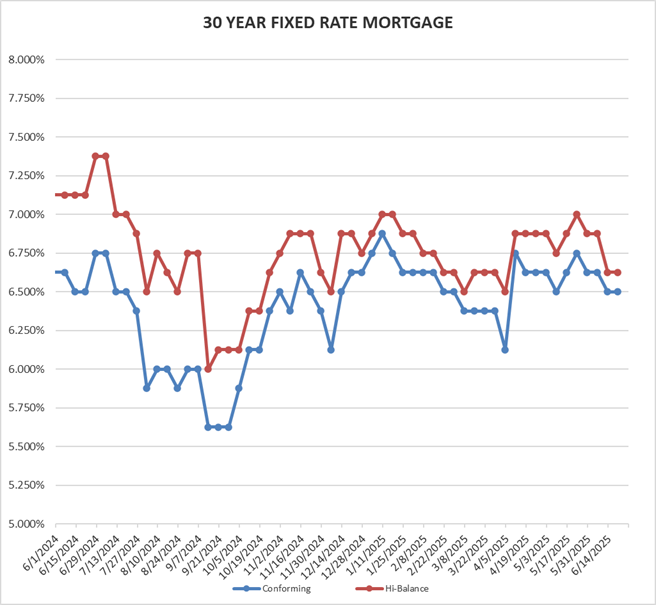
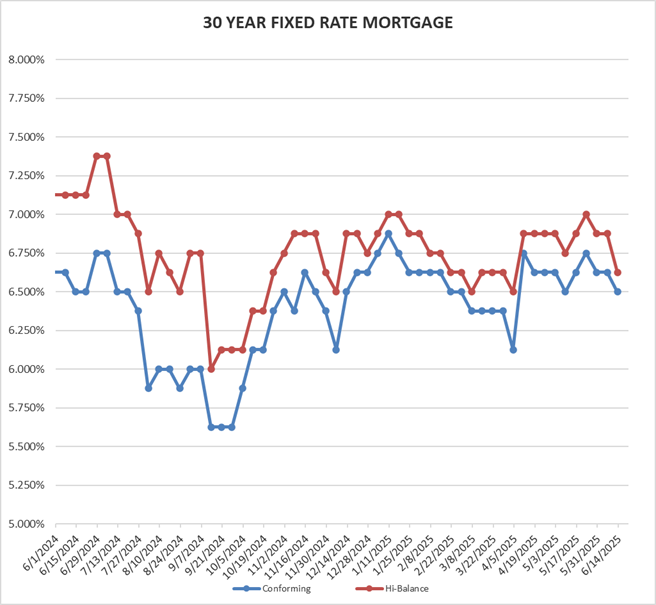
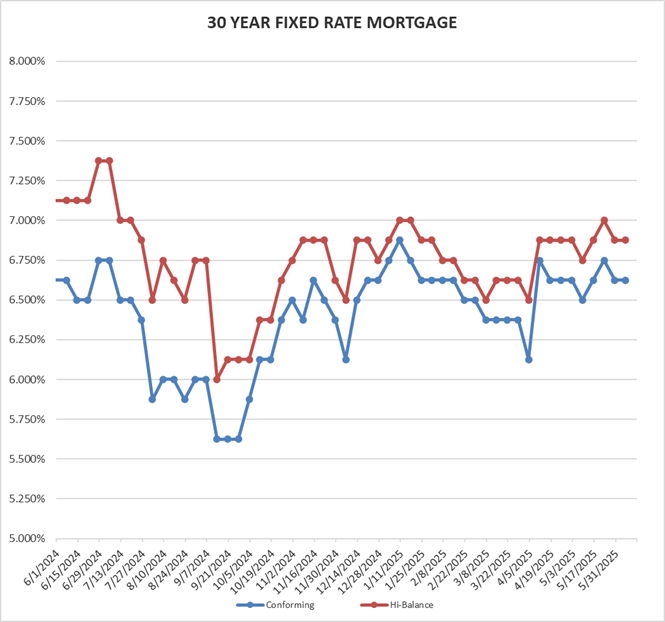
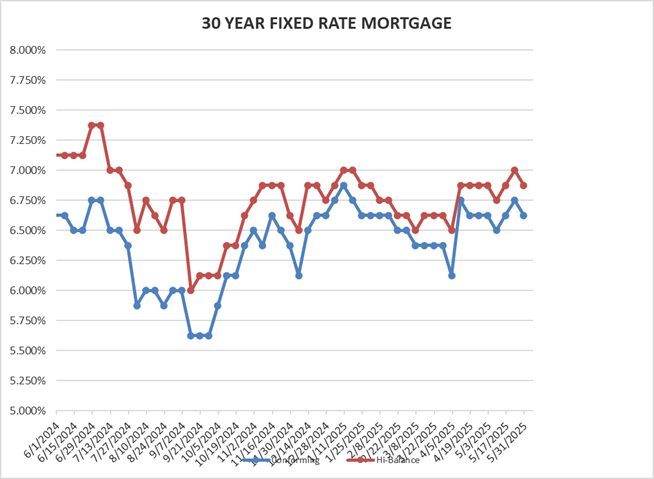
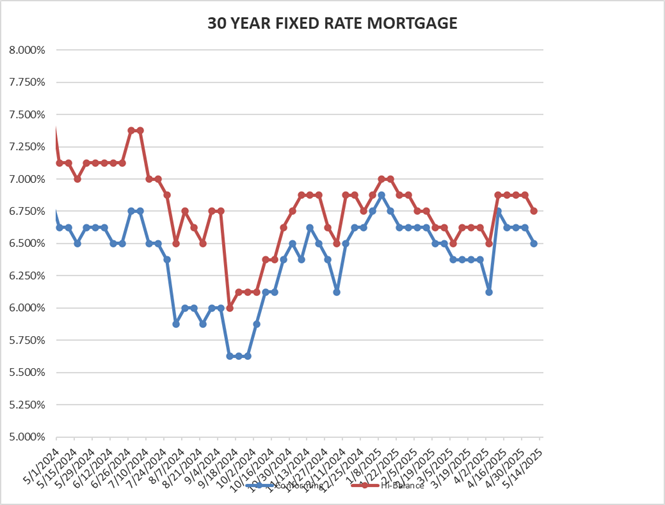
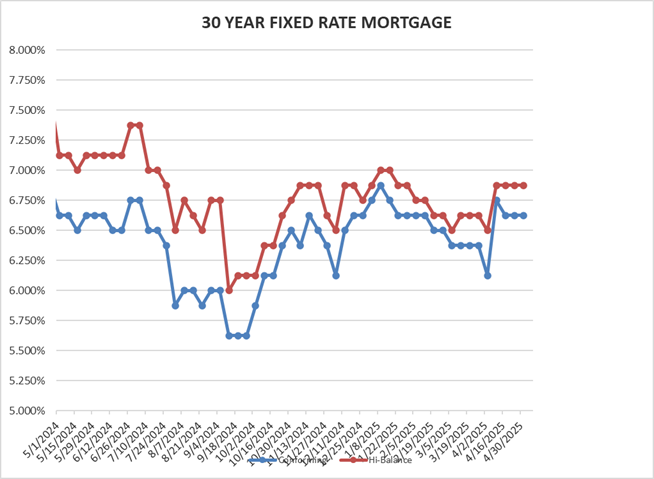
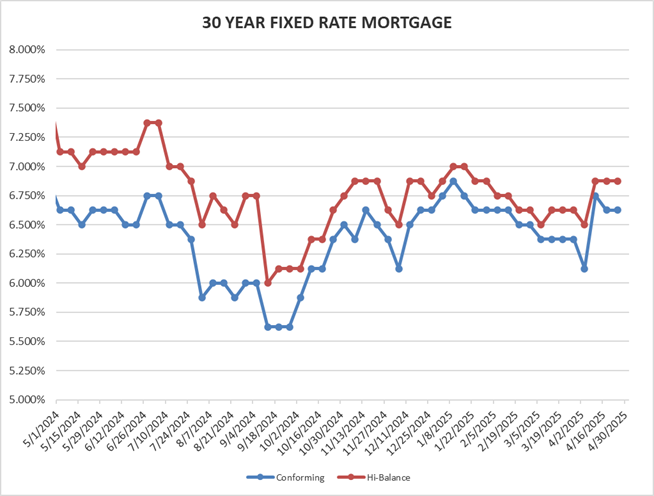
While the weekly rate chart is an indicator one on specific, narrow mortgage, the trend is what is most important, whether purchasing a single-family residence, refinancing a second home, or buying a duplex as a rental.

What is your rate? Give me a call and we can discuss your situation and rate options.

What should we look out for when buying a condo?

Question of the week:  What should we look out for when buying a condo?

Answer: When you purchase a new home, you enter into business relationships.

Unless you are paying cash, you enter a business relationship with a lender.

You enter into a business relationship with your neighbors, depending on distance, the further the distance between the structures the looser the relationship. Consider, if you wish to sell your home and your next-door neighbor has over-grown lawn, trees that are pushing up fence between the properties, old furniture on their porch and dogs running around the fenced in front lawn barking at everyone. Does that help or hurt your value? Their business of (non) home care is impacting your business of selling a home at market value.

When you purchase a property that has a homeowners’ association (HOA), you enter a business relationship with all the other owners in the association. You are part of corporation that has by-laws, rules, costs, obligations. If one, or more, members do not pay their dues it has a financial impact. If the association does not fulfill its obligations for maintenance, security, capital improvements and replacements, financial management, you can suffer loss of property value, and/or financial harm.

When buying a condominium unit, at, or very near, the top of the list of what to investigate is the HOA. First and foremost make sure the complex is not on a “do not lend” list for the type of loan you will be using, conventional, government, etc.

Request copies of the minutes for the last twelve months of board of director’s meetings. This is where you will find discussions regarding building maintenance, capital improvements, assessments, changes to dues, and other governance items that impact your membership in the associations and the quality of building you will be inhabiting.

Request a copy of the financial documents, the budget, the balance sheet, the most recent income and expense statement, the final income and expense statement for the prior fiscal year. What you are looking for:

  • What are the monthly dues?
  • Are their limits as to how often, or how much, they can increase, what is the process to increase the dues?
  • Review the financial documents for the HOA
    • What is the budget? Does it contain provisions for reserves to repair/replace roofs, sidewalks, and other improvements that are the HOAs responsibility?
    • What are the delinquency rates in payment of dues?
    • Are there any special assessments to cover large expenses for roofs, plumbing, electrical etc? Have there been special assessments in the past, if so for what and how often?
  • Read through the Covenants, Conditions and Restrictions (CC&Rs) that cover much of daily life in the complex
    • Pets
    • Parking
    • Ability to rent
    • Ability to remodel or renovate your unit
    • Use of common areas
    • Guests

Those are financial and legal items that will impact not only your financial commitment, and obligations, as part of your purchase, but also your ability to use and enjoy your residence.

As with any home purchase, you will want to ensure it is physically sound. No matter if you are purchasing a condo unit, townhome, single family home, or multi-family dwelling, it is always recommended that you engage an independent inspector to conduct a thorough physical inspection of your dwelling.

If purchasing in a multi-unit condo complex you will also want to see if the buildings and grounds look poorly maintained, have visible defects, structural damage from leaks and cracks. If so, does the budget address these issues, will they lead to increased dues and special assessments in future years to correct them?

Construction defects are not uncommon in newer units; older units tend to have cured many such defects. Are there any lawsuits that are pending, or have been completed against the HOA or contractors? What is the potential financial impact on the HOA? Note that some loan programs will not finance properties with pending litigation, depending on the type of litigation.

A major issue in the housing market the last several years has been insurance; this issue is not just for single family residences but also for condo complexes.

Homeowners’ associations carry a master policy that covers all the common grounds and structures owned equally by all owners in the complex. Some of the master policies also cover the interiors of each unit, but most do not. Because of this you will need a separate policy to cover and damage that may occur to the interior of your unit through fire or other calamity.

A major issue that has come up with lenders on many complexes is lack of adequate insurance to cover replacement value of the complex should it be partially or fully destroyed by fire. Consider the cost to rebuild condominium in Pacific Palisades or Altadena after the fires in January, was there sufficient coverage to rebuild the complexes, or payoff the mortgages for owners, is there any extended liability to the associations or the property owners?

Lack of sufficient coverage results in lack of available financing to purchase units in the complex, which can, and likely will, impact re-sale value in the future.

What is the ratio of owner occupied to non-owner occupied residents in the complex? If there are too many non-occupied residents it may be a challenge to get conventional financing, you may need a larger down payment. As well, if more and more of your neighbors rent out their units, that could impact the lending options for your future buyer.

How quiet, or noisy, is the complex. Ask to see the property in the morning, at night, on weekends. You do not necessarily have to go inside the unit you are looking at, but observe the complex as a whole as to activity, etc. Talk to current residents, are they owners, how long have they been there, will they be staying long, if not why, these are your potential future neighbors, and business partners, see what some are like.

Over the years I have had several clients that upon investigation we determined it would be best for them to pass on a unit they were interested in due to mismanagement of the association or very evident future costs that would be needed.

Over the years I have had many, many, many clients start their homeownership purchasing a condominium that was their first step to our next, and next…homeownerships purchases all leveraged of their initial purchase.

If you, or someone you know, is considering purchasing a condo—or any property—please contact me to discuss mortgage options.

Have a question? Ask me!

Jeopardy! answer: Slowing. Correct question for Ken Jennings, “What is economic data.”  While not 100% correct, the contestant would get the money for their answer and control of the board.

The data: The first revision of 1st quarter GDP showed the economy slowed at a rate of negative 0.2%, slightly better than the initial reading of negative 0.3% growth. Surging imports, causing a 4.9% drag on the economy (trade deficits are negative for GDP), were a primary factor. As was a slowing in consumer spending in the quarter, up only 1.2% annually—less than inflation—and the slowest quarterly increase in three years. Looking ahead, the economic consensus is up to 2% growth in the 2nd quarter.

Personal spending grew as a lower rate, up only 0.2% in April after surging in March as consumers purchased big ticket items ahead of potential tariffs. Persona incomes were not slowing in April, jumping 0.8%, considerably outpacing inflation. It was the third month in a row that personal incomes have increased. With income outpacing spending, consumers are saving more, likely “keeping their powder dry” in anticipation of needing more funds in the future.

While the minutes from the Federal Reserve’s Open Market Committee (group that determines their benchmark interest rate) showed the members are concerned about persistent inflation, April’s Personal Consumption Expenditures (PCE) index (preferred inflation gauge for the Fed) showed inflation rose only 0.1% in April and only 2.1% year-over-year, down from 2.3% in March, almost hitting the Fed’s 2.0% target. The increases were the slowest since the pandemic. The core rate, which strips out energy and food prices, grew 0.1% for the month and 2.5% for the year, the lowest since early 2021.

Rates for Friday May 30, 2025: Markets continue to be skittish and jumping up and down day to day on news about new tariffs, tariff pauses, tariff renegotiations, spending bills. Despite the choppy seas, rates are down slightly from last Friday.

FIXED RATE MORTGAGES AT COST OF 1.25 POINTS LOCKED FOR 45 DAYS FOR PURCHASE TRANSACTIONS:

30-year conforming                            6.625%        Down 0.125%

30-year high-balance conforming       6.875%        Down 0.125%

Please note that these are base rates and adjustments may be added for condominiums, refinances, credit scores, loan to value, no impound account and period rate is locked. Rates are based on 20% down with 740 FICO score for purchase mortgages.

On May 30, 1994 I was visiting Leslie in Sacramento, where she had been living since November 1993. We went to see The Flintstones movie, then stopped by a diner for chili-cheese fries. On the way to her apartment after the nourishing post-movie snack we discussed our future, her moving to Long Beach, getting married, that sort of post-movie and chili-cheese fries conversation. When we returned to her place, I opened my Franklin Day Planner to look at dates and saw that September 4th was Labor Day weekend, perfect.

Leslie was wrapping some gifts for me (still does) I was bringing back to Long Beach and I asked her if she had anything planned for 9/4/94, she didn’t so I asked if she wanted to get married that day.

Thankfully, she said yes!

Should I use my VA eligibility to buy my home?

Question of the week:  Should I use my VA eligibility to buy or refinance my home?

Answer: Probably.

As we honor our fallen heroes this weekend, it is timely to review the tremendous benefit awarded our active duty and Veteran members of the military.

Quick overview of VA loans.

  • The Department of Veterans Affairs, aka VA, guarantees of portion of home loans for eligible veterans. This guarantee results in lenders being able to fund mortgages with more favorable terms and qualifying than those for conventional or other mortgages.
  • To be eligible a veteran must meet certain requirements that include length of service, duty status and “character of service.” Essentially, most veterans who have received an honorable discharge, or active military or military reserve, likely have VA eligibility.
  • VA loans may only be used to purchase a primary residence the veteran must move into within 60-days.
  • Depending on the price and location of the home, a veteran can purchase a home with no down payment; or refinance and pull cashout up to 100% of the appraised value.
  • VA does not have a set maximum loan amount, depending on Veteran’s ability to qualify, Veterans can purchase very high valued homes with no money down; note that some lenders do set down payment requirements for very high priced properties depending on region.
  • VA loans have a funding fee that is added to the loan amount, or can be paid in cash at closing. The amount of the funding fee is 2.15% for Veterans using their benefit for the first time, and 3.3% for subsequent use. Veterans with a disability rating higher than 10%, recipients of the Purple Heart, and surviving spouses of veterans who died in the line of duty are exempt from the funding fee.
  • The only co-signers allowed with the veteran on a VA mortgage are the veteran’s spouse, or another veteran or active service member. All signers on the loan must occupy the home as their primary residence. Note, non-spousal partners are eligible per the VA to co-sign, however most lenders will not accept this type of co-signer as the amount of the loan the VA will guarantee is greatly reduced.
  • Income qualifying is easier for a VA loan vis-à-vis conforming mortgages as debt-to-income ratios are not used. VA loans qualify with “residual income,” how much money you have left each month after making your new house payment plus other obligations.

Back to our question of the week, should you use your VA eligibility to purchase or refinance your home?

Going through the basic guidelines above, one stands out: 100% loan to value, or reduced down payment for high priced properties.

In the current market, another benefit is the current VA 30-year fixed rate is significantly lower than a conforming mortgage, and extremely lower than high-balance and jumbo mortgages (loans over $647,200). Today’s rate for a VA loan is 6.00% for loans within conforming loan amount, and 6.125% for higher balances.

Consider, you wish to purchase a home for $800,000. For a conforming loan you put 5% down ($40,000), for a $760,000 mortgage; because of this down payment amount you will have mortgage insurance. With rate of 6.75% and mortgage insurance your monthly mortgage payment will be $5215 per month.

A $800,000 purchase with no down payment for a first-time user of VA eligibility will have a loan amount including funding fee of $817,200. With a rate of 6.00% your monthly payment will be $4900 per month.

Using your VA eligibility, you save $40,000 in cash to close and have a loan payment that is $315 less per month; over a 5-year period that is a total savings of almost $60,000.

For very high-cost areas, a veteran using VA benefits can purchase a $1.5 million home with about no down payment, and have a 30-year fixed rate mortgage at 6.125%. For most conforming loan programs, down payment of 20% ($300,000) would be needed for this transaction and the rate would be about 7.00%. The VA loan with down payment would have a payment of $9310 per month versus $7985 for the conforming loan. For $1325 more per month, the Veteran saves $300,000 in down payment; the math shows it would take over nineteen years to save back the $300,000 down payment by putting the $1325 a month into the bank for the conforming home buyer with the lower payment.

Should you use your VA to purchase a home? In this market the answer is yes, you can save money on the purchase and on your monthly payment.

For real estate agents reading this, please strongly consider VA offers on your listings. The conventional wisdom in the industry is that more cash down is a better offer. As well, too many agents are ignorant of how VA mortgages work and the think “they take too long to close.” VA loans are easier for qualifying and take the same amount of time to process and underwriter as other mortgages.

Like all transactions, if a buyer, lender, and buyer’s agent have done their diligence to ensure the buyer is pre-approved with all the documents required for loan approval in the file, a VA loan with no down payment is no less risky to a conventional mortgage with 25%, or 30% or even 40% down.

If you, or someone you know, is a veteran considering purchasing a home, please contact me to run through options and qualifying. If you, or someone you know, with VA benefits own a home and want to explore refinancing, possibly pulling cash-out for home improvements, debt consolidation, college costs, or whatever, I can assist with those options as well.

Have a question? Ask me!

Rates for Friday May 23, 2025: Rates have been climbing as investors digest the “big, beautiful tax bill” passed by the House of Representatives and more tariff talk.

FIXED RATE MORTGAGES AT COST OF 1.25 POINTS LOCKED FOR 45 DAYS FOR PURCHASE TRANSACTIONS:

30-year conforming                             6.75%          Up 0.125%

30-year high-balance conforming        7.00%          Up 0.125%

Please note that these are base rates and adjustments may be added for condominiums, refinances, credit scores, loan to value, no impound account and period rate is locked. Rates are based on 20% down with 740 FICO score for purchase mortgages.

Thanks to those who checked in last week to see if I was okay since they did not get the WR&MU, having missed the message the week before that we were in New York City attending our youngest daughter’s college graduation. We had a great trip, it was nice for all to get together for the first time since Christmas, and perhaps the last time until Christmas this year.

Enjoy the long weekend, but please take time to give thanks for those who lives were lost fighting for our nation, and the freedom of those of other nations as well.

How much more is it to buy a home this year from last?

Question of the week: How much more is it to buy a home this year from last?

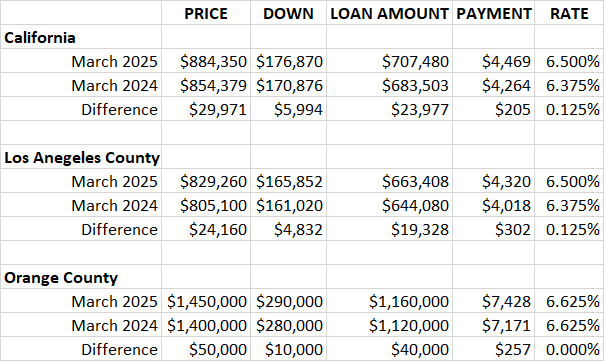
Answer: Using the most current sales data from the California Association of Realtors, sales from March of this year, and comparing to March of last year, prices and number of sales are up statewide, up and down in Los Angeles County, and up in both categories in Orange County.

The median price statewide is up 3.5% for the year, up 3.7% in LA County, and 3.6% in Orange County. While statewide prices are up from February to March this year (6.7%); they are down month-to-month in Los Angeles (-2.7%) and Orange Counties (-1.1%).

Year-to-year total sales volume rose statewide (4.9%) and in Orange County (5.4%), but dropped in Los Angeles (-3.7%).

How does this translate your cost to buy a home?

As you can see below, prices from last year led to higher down payments, higher loan amounts, and higher monthly payments*.

Higher mortgage payments were less than in the prior years due to the conforming rate going up only 0.125% from the last Friday in March 2024.

Overall, the increase in down payment and monthly payments is considerably less than the increases in these areas we have seen for the past several years.

*Payments are calculated on the rates on the last Friday of the month using the same criteria we have used for our Friday rates for more than a decade, 20% down payment, 740 credit score (higher score results in lower rate), cost of 1.25 points for an owner-occupied single-family residence.

With the uncertainty still prevalent in all markets forecasting the housing and mortgage markets is near impossible. Is economy heading into a recession? Will rates go up to try to stifle inflation rising again? Will labor markets turn down resulting in layoffs and less buyer demand? One can read analysts from several different outlets or think tanks  and get several different predictions.

I continue to provide the same advice to clients asking, “is now a good time to buy our new home?”

“Can you afford the home, is the payment within your comfort range, is the house you want on the market? If so buy it.”

To schedule an initial meeting by phone or Zoom, click here for my calendar, please feel free to forward to a friend or family member!

Have a question? Ask me!

Markets reacted positively to the Federal Reserves announcement it was not moving its benchmark interest rate. In comments after the announcement Fed Chair Jerome Powell warned of economic challenges are on the horizon with higher risks of unemployment and inflation. One would traditionally push rates down (higher unemployment), the other push rates up. If both were to occur, we are likely in a period of stagflation. Historically, rates go up when the economy is in stagflation.

Rates for Friday May 9, 2025: Rates dip week to week for the first time since mid-April.

FIXED RATE MORTGAGES AT COST OF 1.25 POINTS LOCKED FOR 45 DAYS FOR PURCHASE TRANSACTIONS:

30-year conforming                            6.50%          Down 0.125%

30-year high-balance conforming       6.75%          Down 0.125%

Please note that these are base rates and adjustments may be added for condominiums, refinances, credit scores, loan to value, no impound account and period rate is locked. Rates are based on 20% down with 740 FICO score for purchase mortgages.

May, the month of celebrations with Mother’s Day and graduations for those completing high schools and colleges. We celebrate both this month as our youngest, who completed her course work for her degree from Pace University in New York City in December has her ceremonies coming up.

We will be travelling to the Big Apple for the Big Walk across the stage, as such no WR&MU next week.

Should we borrower from 401(k) to buy our home?

Question of the week: Should we borrower from 401(k) to buy our home?

Answer: Maybe.

Most 401(k) plans allow for funds to be borrowed for certain life events or emergencies, including purchasing a home. Typically, the guidelines for company plans enable employees to borrow up to half their balance—though some do cap the maximum amount available.

When you borrow from your employer sponsored retirement plan you pay yourself back, with interest. Plans can have different interest rates that are charged, you cannot determine the rate yourself, the prime rate is generally used as the basis for the rate at the time it is executed.

The interest you pay on your loan is paid into your retirement account not to a third party or the plan administrator. Essentially you are paying yourself for the money you borrow.

The term for the loan to be paid off can vary, and often you can pick the term you like from those being offered, say 3- 5-7- or 10-years. Each pay period funds will be withheld in your check to make the loan payment. Note, you can also continue to make contributions to your retirement account with the outstanding loan.

Funds for the loan are created by selling holdings in your account.

If your employment from the employer is terminated, either willfully or unwilfully, the balance on the loan must be paid off, unless the employer allows you to continue to have your account remain in the employer’s plan and to make loan payments. If the loan is not paid off the balance of the loan is considered the same as if you took a distribution; the balance is taxed as ordinary income and if under 59 ½ the 10% penalty is added.

The benefits of using a loan from your retirement account for the purchase of your home are, as stated above, you pay interest to yourself, the payments are automatically deducted from your paycheck, and very importantly, most loan programs do not count the payment on the loan against your for mortgage qualifying.

The detriments of using your 401(k) are the loan payments are after-tax dollars, unlike your contributions to your account that are pre-tax. As well, when you take the funds out of your account later in life, i.e. during retirement, the payments are taxed again as ordinary income—so you are double taxes on the payments, on the income earned to make the payments, and as income when the funds are withdrawn in the future. Besides the potential tax liabilities on the payments, unpaid loan balance and future distributions, some consider taking funds out of the market which are compounding with interest and dividend re-investment a detriment.

This latter issue has had some homebuyers balking at borrowing from the 401(k) because of our natural inclination to want to pay as little as possible in taxes. The decision that needs to be made when considering a 401(k) loan is whether you consider the cost of the taxes on the funds needed to purchase your home are greater than the benefits you will receive with homeownership. Among those benefits are tax deductions for interest paid on your mortgage and property taxes (subject to the $10,000 limit for State And Local Taxes for federal returns), as well as the accumulation of equity during the time of your homeownership.

When you consider that as a renter your housing costs will continue to increase, usually on an annual basis, purchasing a home with a somewhat fixed cost year over year, property taxes and homeowner’s insurance being the variables, that benefit alone should tilt the balance to borrowing the funds to purchase your home.

Finally, keep in mind as well, that purchasing a home when interest rates are high can lead to lowering your housing cost in the future when/if rates drop.

Okay, that wasn’t “finally.” NOTE for first-time buyers, you can withdrawal up to $10,000 without penalty for the purchase of your home. Note “without penalty,” this applies to those who are younger than 59 ½ years old who must pay a 10% penalty on the amount withdrawn, on top of the income tax that is applicable. For the younger folks who take advantage of the $10,000 withdrawal they save $1000 in the penalty tax.

First-time buyers are those you have not owned a principal residence in the previous two years, this includes your spouse.

Finally, finally, the IRS has a 60-day rollover rule during which you can withdrawal funds from a retirement account and the amount is not taxed if you replace the funds into the account within sixty days—to the day. We have used this method for obtaining funds for purchasing a new home for clients who are expecting a large bonus, or funds from the sale of their current home or other asset, or funds from a gift or inheritance, within the 60-day period. This is a rather risky method however as if something happens and house does not close, the company delays the bonus, or other funds do not come through or are less than anticipated, there can be a significant tax hit depending on how much you have withdrawn.

To go through the options of using your retirement account for the purchase of your new home please give me a call.

To schedule an initial meeting by phone or Zoom, click here for my calendar, please feel free to forward to a friend or family member!

Have a question? Ask me!

Consumer confidence is consistent, consistent in going down as it has for the fifth month in a row in April to the lowest level since May 2020. There was only a slight drop in consumers views on the economy, but there was a very large drop in the “expectations index.” This index measures how people think the economy will look six months from now. The 54.4 level is the lowest since October 2011; note that it is significantly below the 80-point level that usually signals a recession ahead. For the first time in five years income expectations turn negative. Negative expectations for income generally tights consumer spending, which slows the economy, which can lead to recession.

Tariffs imposed by President Trump result in GDP shrinking for the first time in three years. The trade deficit between the United States and other nations is a primary factor in Trump’s tariff policy, or theory as not sure what policy actually is with almost daily changes. The tremendous jump in the trade deficit is the primary reason the economy shrank by 0.3% in the 1st quarter of 2025. Businesses went on a spending spree to bring in the foreign goods they need before the tariffs went into effect; the result was the trade deficit cutting 4.8% off GDP.

Consumer spending climbed in March, mainly due to the purchase of new cars and other big-ticket items that are imported to avoid higher prices due to tariffs. The 0.7% monthly increase was driven by a 57% increase in spending for automobiles—the most cars purchased in the past four years. Consumer spending drives the economy, but even the large increase in March, the spending could not off-set the impact of tariffs and the trade deficit. Or rather, the trade deficit was in large part driven by increases in consumer spending.

The job market is still strong. Unemployment is still low, and incomes are rising as employers offer more to attract and retain workers. March saw personal incomes increase 0.5% from the month before, resulting in a $116.8 billion increase in personal income.

The Personal Consumption Expenditures index, the preferred inflation gauge for the Federal Reserve, showed inflation slowed in March. The PCE index was flat in March, after showing prices increasing 0.4% in February. Year over year prices are up 2.3%–inching toward the 2.0% inflation target for the Federal Reserve.

April’s jobs report was higher than expected. Today the Labor Department released employment data for April showing 177,000 new jobs created in the month, well above the 133,000 expected. The report also showed that the unemployment rate remained at 4.2% for the month. It needs to be noted that the report data was collected one week after Trump initial tariff announcement, so many employers who adjusted hiring, and lay-offs, due to the tariffs may not have done so at the time of the report. Likely showing a trend, we may see in coming months, the manufacturing industry was flat in the month. The continuing strength in the jobs market gives the Federal Reserve a good reason to not move interest rates in the near future.

Rates for Friday May 2, 2025: Uncertainty remains the description for markets and expectations for what’s next. Despite the tumult pushing markets up and down daily, rates remain flat from last Friday.

FIXED RATE MORTGAGES AT COST OF 1.25 POINTS LOCKED FOR 45 DAYS FOR PURCHASE TRANSACTIONS:

30-year conforming                            6.625%        Flat

30-year high-balance conforming       6.875%        Flat

Please note that these are base rates and adjustments may be added for condominiums, refinances, credit scores, loan to value, no impound account and period rate is locked. Rates are based on 20% down with 740 FICO score for purchase mortgages.

Anyone mixing some mint juleps tomorrow for a Kentucky Derby party? How about just for yourself?   Can we only have this delicious cocktail only on the first Saturday in May? Is it like egg nog at Christmas time and not appropriate out of season?

No is the appropriate answer to the last two questions.

Can we get a reverse mortgage 2nd?

Question of the week: Can we get a Reverse Mortgage 2nd?

Answer: Yes, if eligible**.

We have had conversations with some homeowners who are age qualified (one signer/occupant 62 years old or older) interest in the financial benefit a reverse mortgage can have, but do not want to payoff their current mortgage with an interest rate well below current rates.

An option for them is to get a reverse 2nd mortgage.

Two weeks ago in the WR&MU, we explained how reverse mortgages work and their benefits.

A reverse 2nd works in the same manner, with an additional factor in determining the loan amount—your current mortgage. Depending on your age, the value of the property, the current interest rate, and the balance on your current mortgage.

These factors are put into an equation to determine how much equity you currently have in your property, and how much of a reverse 2nd you can obtain.

Example: A couple has a home valued at $1.2 million, with an existing mortgage of $378,000, based on the age of the youngest spouse and the current interest rate for a reverse 2nd (9.5%), they are eligible for a $250,000 second mortgage.

The difference between the reverse 2nd and the reverse mortgage discussed two weeks ago, is that it is not an equity line so all the funds must be obtained at closing—no taking some of the available funds at a time.

Comparing the reverse 2nd to a traditional fixed 2nd mortgage with a 30-year term with a 8.25% rate, the borrowers conserve a lot of cash with a reverse 2nd as opposed to a payment of $1878 per month.

With a traditional 2nd mortgage, the couple will be paying $1900 on their primary mortgage and an additional $1878 on the traditional second. On a fixed income that covers most of their expenses, with the remainder coming from retirement accounts, the couple will need to withdraw an additional $22,500, which is taxable, to cover the payments on their second mortgage.

Using the reverse mortgage, they can retain their current cash flow and withdrawals from their accounts to maintain, reducing their tax liability.

Reverse mortgage products are not suitable for everyone who is eligible, however it is very suitable for many seniors living on fixed income and retirement funds, if they have them. They can retain their homes and possibly, probably in many cases, improve their long-term financial security.

**Glaring omission in prior WR&MU I failed to include the paragraph that the income required to qualify for a reverse mortgage is incredibly low. Depending on region of the country, number of people being supported, size of the home, taxes and insurance, most seniors qualify on their social security income. Whereas with traditional mortgages the total housing payment of mortgage, taxes, insurance, HOA fees if applicable, plus payments on other debt, cannot exceed 40% (some exceptions).

For the above example, to obtain the second, with no credit card payments or other loans, they would need about $10,000 per month to qualify for the loan.

For the example of purchasing a home with a traditional mortgage used in the April 11th WR&MU would need around $8000 per month or more depending other debt they may have.

If you, or someone you know, is interested in learning their options for a reverse mortgage, or reverse 2nd, please contact me to run the scenarios available.

To schedule an initial meeting by phone or Zoom, click here for my calendar, please feel free to forward to a friend or family member!

Have a question? Ask me!

Consumer sentiment dropped to its second lowest level since the survey started in 1952. This may be good news for mortgage rates, but is not good news for economic growth. Spooked and uncertain about their economic future due to the uncertainty as to what is, and will, happen with tariffs on imported, and on U.S. exports by other nations, due President Trump’s zig-zag, yes-no, a lot-a little, pronouncements on where tariffs will land for certain nations and certain products, consumers are starting to turtle. Low consumer sentiment should present in lower consumer consumption, impacting retailers, and wholesalers. The biggest concern for economists, investors, and savvy consumers, is stagflation hitting our economy.

Rates for Friday April 25 2025: After spiking earlier in the week, rates have floated down the last few days, ending the week even with last week.

FIXED RATE MORTGAGES AT COST OF 1.25 POINTS LOCKED FOR 45 DAYS FOR PURCHASE TRANSACTIONS:

30-year conforming                             6.625%        Flat

30-year high-balance conforming        6.875%        Flat

Please note that these are base rates and adjustments may be added for condominiums, refinances, credit scores, loan to value, no impound account and period rate is locked. Rates are based on 20% down with 740 FICO score for purchase mortgages.

It’s not as quiet. On our daily walk around the neighborhood with Sammy*. Our route depends on what time we started. This is due to the start of the elementary and middle schools that is a few blocks south of our neighborhood and the kids, some with parents some without, funneling into California Avenue.

During the schools’ spring break last week, our walks were quiet, too quiet. We enjoy seeing the kids and families on their morning commute to school. Over the years we have seen kids take the walk to elementary, then middle and finally towards Atlantic to catch the bus to Poly High.

This week the foot traffic to the California Avenue funnel was busy as usual—welcome back to school kids.

*While it is a walk for Leslie and I, it is scrolling canine social media for Sammy as he sniffs out posts and comments from other dogs on trees, fire hydrants, bushes…the trolls in this social media environment are the coyotes who evidently leave some nasty and hurtful messages and comments.