

Should we get solar energy for our home?
Question of the week: Should we get solar energy for our home?
Answer: I covered this subject last June (Any concerns we should have with solar for our home) and personal experience has led to this week’s question. Last summer I addressed the question framed from the lens of how solar panel acquisition methods impacted the ability to obtain a mortgage for someone buying your home, or if you are refinancing. Today I am addressing the question as a shopper in the solar market.
As I mentioned last June, there are three options for converting your home’s electricity supply from the local utility to solar panels, either purchasing the panels, leasing them or entering into a Power Purchasing Agreement (PPA).
If you purchase solar panels it makes transferring the panels easier if you sell your home, as well as no issues with a new loan. If you lease the panels there is a decision to be made when the lease is up—retain the panels and pay a buy-out fee (similar to a car lease) or turn the panels back in, in which case a company contracted by the leasing company will remove them from your roof. If you enter into a PPA with a provider you will pay a monthly fee for the electricity you use and the company that owns the panels will receive any tax breaks or other incentives. All three are covered in more detail in last June’s WR&MU.
A primary question most homeowner’s have before deciding to go solar is how to pay for them, lease, get an equity line, finance through solar company, or pay cash. One option is the HERO program (covered in the June 17, 2016 WR&MU). This program uses your tax bill to finance the energy efficient renovations to your home. Instead of paying monthly you pay twice a year when your tax payments are due (if you have your taxes paid by your lender then you would be paying monthly as part of your mortgage payment). There are a lot of pitfalls with the HERO program that I outlined in June 2016 that, in my opinion, make it a very unattractive option for homeowners.
To the question, should we solar energy for our home? It is a question Leslie and I have pondered for many years and have sat through different meetings with potential providers. There are a few reasons that have had us considering solar panels, and honestly, they have all been financially related and being more dependent on clean energy is way down the list.
California law requires electrical providers to 100% of their energy from renewable sources by 2045. To reach the goal the utilities must have 60% of their energy from renewable sources by 2030.
As we have seen this summer, California’s electrical infrastructure is insufficient to meet the demands of residential, industrial and commercial users. As a result, the state imports approximately one-third of its electricity from other states, some of it generated from renewable sources and some from fossil fuel sources. During the rolling blackouts in August the cost of electricity to utility companies spiked tremendously, mainly due to the cost of the imported supply.
Looking ahead, the cost of electricity in the state will climb well above the rate of inflation as the utility companies convert more of their generation from coal, oil and natural gas to wind, hydro and solar sources. Because of the inconsistent nature of renewable energy sources, the state will continue to be very dependent on importing energy from other states, leading to higher costs as they bid for the electricity from the Northwest, Southwest and beyond.
The result will be higher prices for consumers, and likely less reliability as “home-grown” power declines as a percentage of supply.
Another financial consideration for us is the cost of comfort. Our home was built in 1936 and none of the owners decided to install air conditioning. For several years Leslie and I have considered it, but decided not until/if we take ourselves off, or mostly off, the electrical grid and install solar panels.
Finally, if we can begin installation in 2020 we will receive a credit against our federal income taxes of 26% of the total cost and installation, if we do not start until 2021 the credit is 21%. This is a direct credit against your tax liability, not a deduction from your income, which means it reduces the taxes owed for the year dollar-for-dollar. For instance if your income taxes for the year are $25,000 and your solar installation costs $15,000 your taxes for the year are lowered by $3900 (15,000 x 26%) to $21,000 (25,000-3900).
To recap, our decision is based on eliminating constantly rising electrical costs, reducing/eliminating the cost to air condition our home and having 22-26% of the cost paid for through the tax credit.
I bring this up this week because later today we are getting a presentation from a company that Southern California Edison has contracted with to work with customers who are interested in converting to solar power. The company analyzes our home and energy usage, designs a solar plan and then puts it out to bid to registered contractors. They then go through the bids with the consumer to look at the options for they system, costs, financing and installation.
Essentially the company is a broker for solar customers, what I do for mortgage clients, doing all the heavy lifting and making it easier to review options. Should there be an issue they are our advocates with the contractor/installer of the system.
As mentioned, we are in the process and have another meeting this afternoon to go through our options. As, if, whether we progress I will keep the WR&MU informed as to how it is going, and why we finally decided to, or not to, install solar at this time.
I am a big believer in California homeowners purchasing solar systems for their homes based on what the future of energy acquisition looks like in the state. In the past we have put off converting due to the costs and the time frame to recoup our expenses, it appears the gap has narrowed.
Finally, while in the current market adding solar panels does not have a large impact on the value of a home, it is my opinion that in the future they could have a higher added value as energy costs climb.
Have a question? Ask me!
Wednesday provided a lot of information for investors to digest. Early in the day retail sales data for August was released. Total sales increased 0.6% from July, and it was the third month in a row that retail sales increased. Looking ahead there is some concern about sales continuing to rebound following the sharp drop when the economy closed down in March due to the discontinuation of the additional monthly funds the government was providing those collecting unemployment payments.
Headlining Thursday morning business sections was not the retail sales numbers but the reporting of comments from Federal Reserve Chairman Jerome Powell that the Fed would very likely keep its benchmark interest rate near zero through 2023. In making the statement the Fed was also acknowledging that it feels the economy will not have extend periods of time of inflation over 2% for the next three plus years. As well, the Fed will continue to purchase at least $120 billion per month of U.S. Treasury debt and mortgage backed securities from Fannie Mae and Freddie Mac. On the face of it, the news would appear to be mortgage market friendly. In reality, investors’ reactions have put upward pressure on rates as the uncertainty of the value of their holdings in the future should the economy experience a surge in growth when a vaccine is widely available, the economy opens back up in a large way and inflation erodes the value of the very low interest rate bonds and mortgages they hold.
The refinance fee imposed by Fannie and Freddie has been priced into rates by lenders this week. You may recall the half-point fee (0.5% of the loan amount) was announced in August with an effective date of September 1st, and was subsequently delayed to December 1st. With the current state of the industry and lengthy pipelines to get through the process, most refinances being locked at application have the fee priced in.
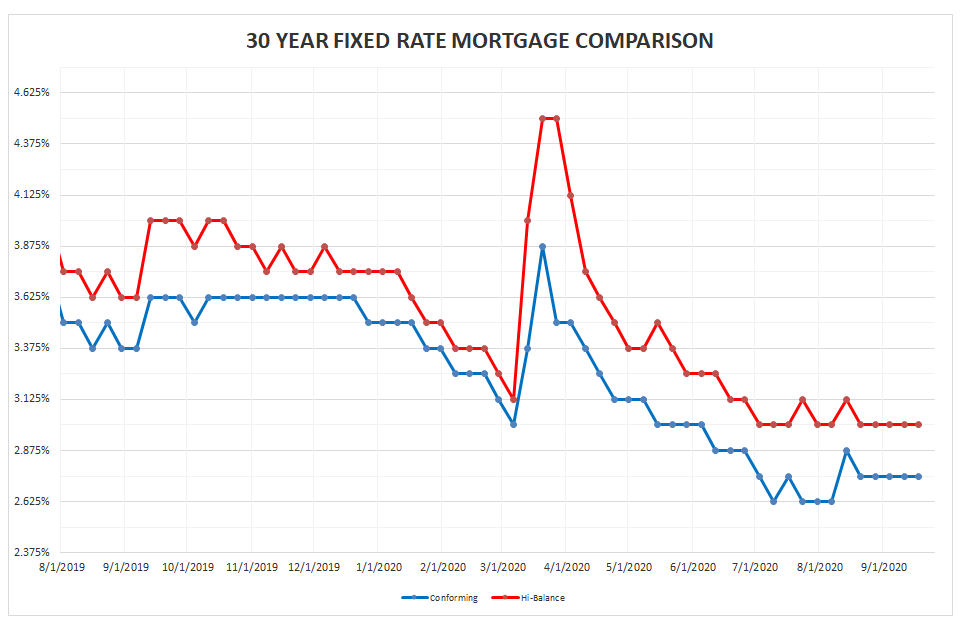
Rates for Friday September 18, 2020: Rates are holding on to remain flat from last Friday, despite a lot of pressure to go higher. There appears to be little flexibility in the market for rates to drop any further and we could be ready to bounce out of the range we have been for the past four weeks.
FIXED RATE MORTGAGES AT COST OF 1.25 POINTS LOCKED FOR 45 DAYS FOR PURCHASE TRANSACTIONS:
30 year conforming 2.75% Flat
30 year high-balance conforming 3.00% Flat
Please note that these are base rates and adjustments may be added for condominiums, refinances, credit scores, loan to value, no impound account and period rate is locked. Rates are based on 20% down with 740 FICO score for purchase mortgages.
This weekend is a lot different than we thought it would be in February. Way back then our plans were for Leslie to travel to Boston to visit our oldest at Boston University and celebrate her 21st birthday tomorrow. From there she would fly to Seattle, joining our younger daughter and me, to help her move into her dorm and settle in at the University of Washington. More likely would be me getting in the way and underfoot, and asking “what do you need that for? Why don’t you get one of these? Anyone else hungry?”
Massachusetts has a quarantine order for travelers from California, so Leslie is staying home. We have given Blaire the green light to use the credit card to take as many of her friends as allowed under the restaurant restrictions in Boston to a nice dinner (Italian in the North End) and will raise a toast to her very socially distant.
Like most schools UW announced in the summer that 90% of their classes would be on-line, and strict social distancing. Our younger daughter made the decision to forego enrolling for several reasons, among them the cost to sit in a dorm room with a stranger watching lectures on a screen and an inability to enjoy the college experience and meet other students and engage in the multitude of activities they should be enjoying.
So instead of planes, hotels, hugs, and saying congratulations and good-byes, Jenna, Leslie and I will have a somewhat quiet weekend at home grateful for everyone’s health and adaptability.
Have a great week,
Dennis
Past Weekly Rate & Market Updates can be found on my blog page at my website www.DennisCSmith.com/my-blog


