


How does a virus in China impact mortgage rates in America?
Question of the week: How is it that a virus in China impacts mortgage rates in the United States?
Answer: This week’s answer may get a little bit wonky in regards to economics but I will try to stay un-wonky.
Long time readers of the WR&MU know that in economics there is a principal that the better an economy does the higher interest rates should be, conversely a slowing or shrinking economy should result in lower interest rates. Because of this, whenever there is strong economic news that shows strong growth happening, or about to happen, rates tend to rise; poor economic data results in rates dropping.
In the United States we have a fairly free economy. There is government regulation that impacts most industries, but compared to other forms of government and economic systems ours is pretty free. Just as the government does not set stock prices for corporations, neither does it set the interest rates for any non-government bond or fixed rate security. These prices and rates are set by the open market and investors.
Investors make their decisions on whether to buy or sell based on the available data and their belief as to what will happen to a certain company, a certain industry or sector of the economy, and the economy as a whole.
One of my favorite movies is “Trading Places” with Eddie Murphy and Dan Aykroyd. The core of the movie is the principle that information available to investors determines whether they buy or sell a stock. I won’t spoil the movie for those who have not seen it, but insist you must, but knowing whether the cold weather in Florida will have an impact on the price of orange juice in the future will determine if you want to buy orange juice futures or sell them short.
If there are major strikes in the coal industry investors will presume that steel companies will have a hard time making profits in the near future and will sell holdings. If a company has patents approved for a new technology that will give its products an advantage in cloud service investors will buy that stock. Good news is an indicator to buy, bad news is an indicator to sell. Of course, it gets a bit more complicated, but these are basic principles.
Fixed rate assets are those which pay a fixed rate of return for a certain period of time. These types of assets are bonds, either government or corporate, and also mortgages. When making a decision to purchase fixed rate assets investors way the return on their money for each investment compared to the risk that they will not get their money back. The United States government is the safest investment in the world, it has never defaulted on any of its debt. As a result, U.S. Treasury bonds and bills have lower interest rates provided to investors than similar type of offerings from corporations, or mortgages.
When investors are deciding whether to buy or sell bonds, or similar options, they are making the decision based on many factors but the two most important are either their perception of what the economy as a whole will be doing in the future, and what is the risk of not investing in fixed rate assets.
One more factor regarding bonds and mortgages, there is an inverse relationship between the price and the rate of return. If bond prices rise that means rates are dropping and vice-versa.
If there is very positive economic news that indicate the economy should be very robust and growing investors will anticipate higher interest rates in the future. This is for a few reasons. First and foremost, every other investor will anticipate higher rates and with the herd mentality their actions will push rates higher. Second, if the economy is growing then private companies will be making higher profits and investors will want to have their money invested in stocks instead of bonds. Third, in the United States the Federal Reserve will increase the rates it charges banks to borrow money in an effort to put some brakes on growth to control inflation.
As investors sell their bond and other fixed rate holdings the price of those assets will drop, which results in higher interest rates. They will use the cash they get from these sales to purchase equities (stocks), causing those prices to rise.
If there is bad economic news the reverse happens, investors sell equities causing those prices to drop and buy bonds and mortgage, causing those prices to increase and rates to drop.
Sometimes we see the phenomenon called, “flight to safety.” This is when there is a significant event that causes investors to want to leave the uncertainty of equities and put their money into investments that have a certain fixed return; in other words sell stocks and buy bonds.
What would create flight to safety activity? A war, or strong threat of a war involving the United States or an area of economic importance. A sudden disruption in an industry that may impact the whole economy or several industries. A major natural disaster or any event that negatively impacts the country or economy.
China is the largest economy in the world. Wuhan is a major city in China with over eleven million people. It is a major economic engine for central China with manufacturing, scientific and technological research and development, and transportation industries generating substantial economic output for domestic and international consumption and use.
Wuhan, as you may know if you have been even slightly engaged in consuming traditional or social media, is ground-zero for the coronavirus which is spreading world wild.
If there is an event that impacts one of the biggest economic regions of the biggest economy in the world, is that a positive or negative for other economies?
A slow down in economic activity in Wuhan impacts other economic activity in China and its trading partners. Companies in Vietnam, Japan, Australia, India, the United States and other nations that are economically tied to companies in Wuhan, or tied to companies tied to companies in Wuhan are impacted when the workers in Wuhan are not going to work that impacts output.
Throw a pebble, the coronavirus, in the pond, the global economy, and where it lands, Wuhan, starts the ripples outward.
The coronavirus is a double impact event for investors. First, it is an indicator for economic slowing in China and around the globe. Second, because of the unknown duration, spread and impact of the virus it creates a sentiment of flight-to-safety. Both of these are reasons for investor to invest in fixed rate assets. Which should put downward pressure on interest rates.
And that in several nutshells is how a cough in Wuhan, China can impact the mortgage rate for a couple in Long Beach, California purchasing their first home.
Have a question? Ask me!
Meyh, is the term to the start of 2020 with early economic data. This week price and purchase data were released, and both saw some growth but not enough to get excited about or impact rates. Consumer prices increased 0.1% in January and year over year the CPI is up 2.5% the highest annual rate since the Fall of 2018. The biggest factor in the increase was housing, especially higher rents. Consumers in January were hot to spend in home centers like Lowes and Home Depot, and then visiting bars and restaurants as those sectors saw strong growth in the retail sales report. What consumers did not do was buy clothing as apparel sales were down considerably. Overall the economic news this week was mortgage rate neutral.
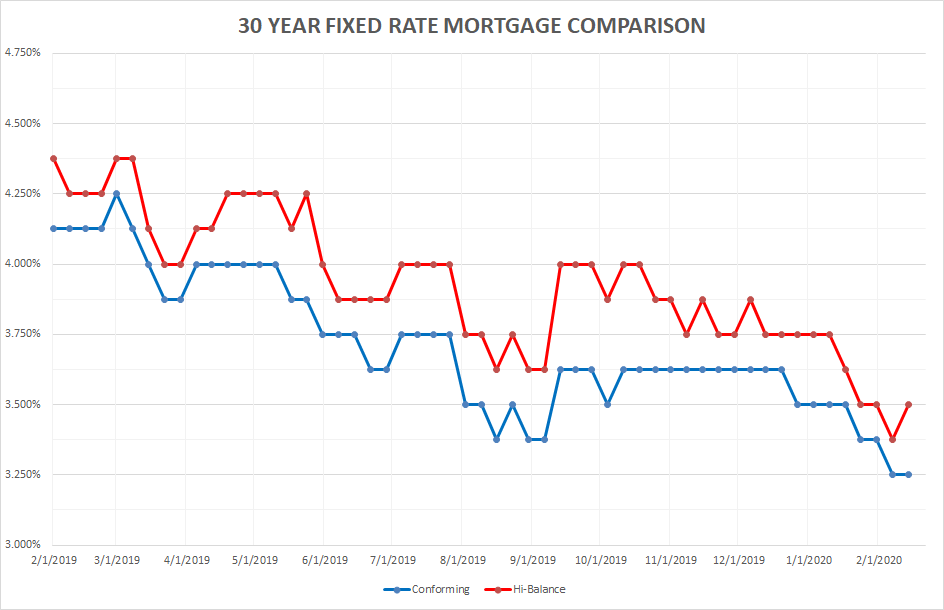
Rates for Friday February 14, 2020: Conforming rates are flat from last Friday and high-balance rates have bumped back up after hitting a multi-year low last week.
FIXED RATE MORTGAGES AT COST OF 1.25 POINTS LOCKED FOR 45 DAYS:
30 year conforming 3.25% Flat
30 year high-balance conforming 3.5% Up 0.125%
Please note that these are base rates and adjustments may be added for condominiums, refinances, credit scores, loan to value, no impound account and period rate is locked. Rates are based on 20% down with 740 FICO score for purchase mortgages.
I hope everyone is having, and will continue to have a happy Valentine with their sweetheart*. Leslie and I will be spending the evening alone, our 17 years and 360 days daughter has decided spending Valentine’s Day evening with her parents is not that cool. I’ll make her favorite dinner, grilled steaks, and evidently, she has some painting project, involving canvas not walls, for us to do after dinner. A nice quiet evening in, which is perfect for me. I hope your evening is a quiet or unquiet as you wish it to be.
*Many of you have likely noticed, I am not the best grammarian, nor speller. I initially wrote sweethearts, and then thought, “is this implying some of the WR&MU readers have multiple sweethearts, or is it correct to use the plural since I am addressing multiple people?” I’m playing it safe and will check with my resident professional grammarian later as to which way I should have gone.
Many businesses are closed on Monday for President’s Day, ours will be as well, however I will be in and working if you or anyone you know needs mortgage assistance or advice.
Have a great week,
Dennis
Past Weekly Rate & Market Updates can be found on my blog page at my website www.DennisCSmith.com/my-blog


