


We are buying a property with an ADU, how can we finance our purchase?
Question of the week: We are buying a property with an ADU, how can we finance our purchase?
Answer: ADU, Accessory Dwelling Unit, is the new “thing” in California, and other states, that governments have enabled to be built in areas previously zoned for only one unit believing it will provide relief to higher housing costs and homelessness.
Leaving the political aspect out of today’s Q&A, what is an ADU?
Depending on your city or county, you may be able to build a small living unit on your property that can be occupied full-time, and if you so desire become a rental unit. When the ADU option first became a popular option, many municipalities and government entities changed their zoning requirements to enable, or to restrict, residential property owners to build ADU’s on their properties. Many localities passed zoning laws with minimum lot size and maximum square footage requirements for ADUs, thereby restricting where they could be built.
Some localities outright banned ADUs to protect their density and character, think of some gated communities.
In October the California legislature passed a myriad of laws designed to “cure” homelessness, housing costs and number of housing units that took away control of ADU zoning from local governments. One of the new laws eliminated the ability of local zoning regulators to place restrictions on lot and square footage sizes, enable up to two ADUs to be built on current single-family zoned lots and for multi-unit buildings to convert storage and other non-dwelling areas (i.e. utility rooms, electrical/mechanical rooms) into ADUs. Finally, the owner need not be an occupant of the primary, or any, of the units on the property.
The new law went into effect on January 1st. One of the many attorneys who are regular readers of the WR&MU may chime in to correct me, but I cannot find where any city or homeowners’ association has filed suit against the state to protect their current zoning and prevent more units and density in their neighborhoods.
This being California I cannot imagine that there will be no such law suits filed. And soon.
In the meantime, over the past few years many property owners have built ADUs on their properties, under then in place local ordinances, and they are starting to come to market.
At first, the available mortgage financing for properties with ADUs was murky as lenders, Fannie Mae and Freddie Mac were uncertain how to classify these properties that were non-conforming to the neighborhood and uncertain as to whether the properties were single- or multi-family.
It took a little while; however, we now have Fannie Mae and Freddie Mac underwriting guidelines for financing properties with ADUs. Not surprisingly, most of the criteria that needs to be met to have the property approved falls upon the appraiser and what needs to be covered in the report.
The distinction between a single-family property and a two-unit property is important because of the qualifying guidelines, and very importantly the rate and price difference between one and two-unit properties. The mortgages for the latter or more costly and have tighter underwriting guidelines.
Another distinction is if the additional unit is interior to a current structure (converted garage, basement or attic), attached to the property or completely detached. Again, there can be pricing differences depending on how the property and the different units are, or are not, connected and designated.
In performing the appraisal on a property with an ADU the appraiser must note:
- If the additional unit is a conversion of previously unused space to living space
- If detached it is designed and built to look like a primary home, i.e. not a garden shed
- If detached, the unit is smaller than the primary residence
- The ADU does not have separate utilities
- Zoning only allows the primary home to be occupied by the property owner (we will need to see how/if guidelines adopt to the new California law)
- Very importantly, the property and ADU conform to the market and neighborhood area.
This last point is important because it requires the appraiser to prove that the subject property and ADU are conforming to the area, which means s/he will need to provide comparable properties that have sold, or at minimum are in escrow or on the market. If there have not been any sales of properties with ADUs in the area the appraisal requirement will be challenging to meet.
There are additional requirements beyond the appraisal that also must be met:
- First and foremost, butting up against the California law, there can be only one ADU on the property
- The borrower must qualify for the mortgage without considering any rental income from the ADU
- Lender must confirm that the existence of the ADU will not jeopardize any future insurance claims against the property
There are conventional loans available for properties with ADUs, not only purchase mortgages but also refinances if you wish to consolidate a loan you may have used to build an ADU. Please note that given the relative newness of the ADU movement many lenders are still trying to determine how they will underwrite loans for these properties. Some will strictly follow the Fannie/Freddie guidelines, others will be more cautious and have “overlays” on the guidelines that have tighter standards.
As more and more ADU properties are funded, as building ordinances and zoning requirements across the country are changed to accommodate, or eliminate ADUs, and as the performance of mortgages on ADU properties are monitored, the guidelines will change.
There is financing available for properties with ADUs. If you are looking at purchasing, or refinancing, a property with an ADU make sure you go through a thorough investigation of the property and how it matches the lending guidelines before committing to your transaction.
Have a question? Ask me!
A lot, and awful lot, going on this week. Senate impeachment trial, coronavirus, Fed talk and economic data bombarded investors this week as they tried to decide where to place their bets (investments), in safety with bonds and mortgages or into equities with expectations of stock markets continuing their climb.
For the most part the virus from China seems to have more impact than the virus of politics. Markets are spooked by the unknown nature of the coronavirus and the impact it could have on the global economy, and most importantly on the Chinese economy. With any news from Washington on the Trump impeachment trial being pushed further and further and further down the news casts and papers, investors have ignored the proceedings and focused instead on other information.
The Fed this week held the line on interest rates and indicated they will not change rates for quite some time. Of some concern is the Fed has been on another buying spree, shades of the post-recession Quantitative Easing, and its balance sheet is now $4.5 trillion dollars. Prior to the recession it was below $1 trillion. Essentially the Fed hold assets, mostly US Treasuries, equal to three to four times the federal annual deficit. The news is mortgage rate neutral.
The economy continued to grow at a measured pace. The economy ended the year with 2.1% growth in the 4th quarter of 2019 and 2.3% for the year. In 2018 the GDP grew at a 2.9% pace and the consensus is for growth to be positive in 2020 but less than 2%. The news is mortgage rate neutral as it shows neither a significant slowing of growth (lower rates) or robust growth (higher rates).
Looking into households across the country, incomes and spending rose in December, the latter more than the former. Personal incomes increased 0.2% from November and consumers increased their spending 0.3% from the prior month. It therefore should be no surprise that personal savings declined for the month, however for the year savings was the highest in 2019 since 2012. Consumer prices for 2019 increase 1.6%, well below the 2% inflation rate targeted by the Federal Reserve. Overall the news was mortgage rate neutral and points to more slow growth in 2020.
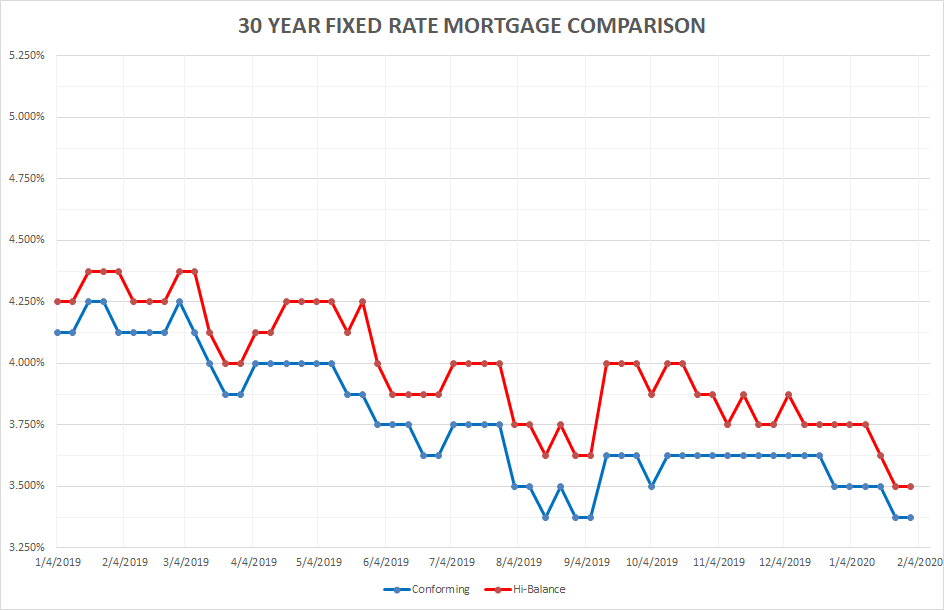
Rates for Friday January 31, 2020: We close out the first month of the new decade with rates flat from last Friday. With the economic news it appears rates should remain near current levels for some time.
FIXED RATE MORTGAGES AT COST OF 1.25 POINTS LOCKED FOR 45 DAYS:
30 year conforming 3.375% Flat
30 year high-balance conforming 3.50% Flat
Please note that these are base rates and adjustments may be added for condominiums, refinances, credit scores, loan to value, no impound account and period rate is locked. Rates are based on 20% down with 740 FICO score for purchase mortgages.
Make sure you wear red on Sunday so as not to upset anyone at the Super Bowl party you will be at watching the commercials. The game between the San Francisco 49ers and Kansas City Chiefs sets up to focus on the Niners defense versus the Chiefs offense, I think the Niners offense and Chiefs defense will have more to say than they both get credit for from the “experts.” My slight rooting interest is for the Niners as I have a financial benefit should they win from a season long pool. That said I would not be disappointed to see the Chiefs and their coach Andy Reid lift the trophy.
Enjoy the game!
Have a great week,
Dennis
Past Weekly Rate & Market Updates can be found on my blog page at my website www.DennisCSmith.com/my-blog


