


Will the ROAD Act help home buying affordability?
Question of the week: Will the ROAD Act help home buying affordability?
Answer: Hopefully, but…
This week the 21st Century ROAD to Housing Act (“Renewing Opportunity in the American Dream”) passed both houses of Congress and is awaiting President Trump’s signature to become law.
Note that as of this writing, Trump is withholding signature on the act until the SAVE Act is passed by the Senate.
The intention of the act is to use the power of legislation to make housing more affordable by increasing housing supply, reducing regulatory barriers and update federal housing programs to make them easier to navigate and increase funding.
Two somewhat unique aspects of the ROAD Act* are that was passed with tremendous bipartisan support in both the House of Representatives and Senate, very rare in the past several decades for any major legislation; as well, unlike most housing bills at all levels of government, the Act focuses heavily on the supply-side of the affordability problem.
Too many legislative acts, especially at the local and state level, have looked to putting more money into the buyers’ side of home buying, expecting to increase affordability.
For instance, Senate Bill 417 in the California legislature is an $11.25 billion housing bond that will, among other items, provide $1 billion in homeowner assistance in the form of down payment and mortgage assistance programs and another $1.25 billion dedicated to veterans’ home loans. Other funds will go to construction of new affordable rental housing, farmworker housing, tribal housing, student housing, and housing for homeless population.
No money is being earmarked to building more homes for purchase. There is no corresponding bill that would support the bond by enabling building new homes for purchase, easing regulations, guidelines, fees, etc to greatly reduce the red tape and costs to build those new homes. Depending on the location of new home construction, fees to developers add $40,000 to $120,000 for permits, plan checks, development impact fees, utility connections, agency fees, among costs.
What SB417 will do is increase the pool of eligible home buyers, i.e. demand, but not increase supply. More demand, same supply, prices increase, homeownership is less affordable to those not fortunate enough to obtain the funds from the state for their home purchase.
The supply side focus of the ROAD Act looks to address home affordability in a few ways.
The headline part of the Act is as restriction on the number of single-family homes that large institutional investors can own and purchase to 350 units. Institutional homeownership is seen by some to be a major factor in affordability as they compete with homebuyers with the ability to purchase quickly with all cash, waive contingencies a family purchasing may request and can become major homeowners in neighborhoods and cities.
On the other side, investors often purchase properties distressed properties, those in foreclosure, vacant, or in need of major rehabilitation. They increase the rental stock in neighborhoods, enabling families unwilling, or unable, to purchase, to live in a single-family home in a neighborhood instead of apartments. Finally, the percentage of homes owned by institutional investors (those owning 1,000 or more homes) was about 500,000 homes nationwide, less than one-half of one-percent of the housing stock in the United States; in some areas, particularly in the Southeast, investors can own up to 20% of the housing stock in some cities—these are the primary areas of concern for those supporting the limitation on investor home ownership.
Private equity firms, real estate investment trusts (REITs), and other entities that currently own more than 350 single-family homes will not be required to sell any of their inventory, which could crash prices in some areas, but would not be able to purchase more.
This is a great headline part of the law, however, when an entity reaches the 350-home limit it is not that difficult to create another entity and purchase more homes.
Since the Constitution was ratified by the original thirteen states, and before as it was being debated, the separation of powers between local, state and federal governments has been a source of many lawsuits and court decisions. A provision in the act will skirt another battle between regulatory authorities at all levels by the use of incentives instead of mandates to encourage local governments to streamline permitting, allow greater housing density, encourage the construction of ADUs, among other areas to increase housing.
As such, the Act includes an incentive program for localities that have been consistent in increasing their housing supply. There is a pool of $200 million per year to award those who qualify with funding every year for five years. This enables long term planning and building for municipalities who have proven their ability to allocate resources successfully to increase their housing stock.
Covid caused significant harm to commercial property owners as work-at-home became mandatory, and in the seven years since it has become predominate for many industries. In the act is a pilot program for local governments to assist in converting vacant commercial buildings into affordable housing. Office buildings, malls and other largely vacant buildings can be converted to housing, helping the property owners and those in need of affordable housing.
In February, our question of the week discussed manufactured housing as an option for building housing on vacant lots, or for ADUs. Included the ROAD Act is more federal funding for the construction of factory-built, i.e. manufactured, homes, reducing the cost of new housing stock.
One more very unique aspect of the ROAD Act is that is it “only” 381 pages, not several thousand as many major pieces of legislation seem to be.
Will the ROAD Act increase home affordability? Yes it can, may, will, in areas where local governments take advantage of the funds and incentives in the Act to leverage their resources. However, in other areas where construction and rehabilitation is retarded by onerous regulations, lawsuits, reviews, fees, permits, etc, the opportunities for success will be limited until changes are made to encourage developers to build, convert and rehabilitate to increase housing.
*When did it become compulsory for legislatures to attach acronyms to all pieces of legislation? How many hours are spent by aides and interns? Let’s make the acronym HOUSE! Homes Our United States Expect? HOME? No, that is the crossword acronym for the Great Lakes. DRIVEWAY? Too long. DOORS? Dwelling something something Road to Success? I like Road…)
To schedule an initial meeting by phone or Zoom, click here for my calendar, please feel free to forward to a friend or family member!
Have a question? Ask me!
Mixed signals from the Commerce Department as its revision of 1st quarter GDP showed the economy grew at a seasonally and inflation adjusted 2.1% rate, previously the estimate was 1.6% growth. The major factor in the revision was a decrease in imports. Why mixed? While GDP increased, the major driver for our economy, consumer spending was revised down to 0.5% growth in the quarter, the weakest growth in quarterly spending in four years.
Unlike April, incomes outpaced inflation in May, increase at a 0.7% clip, which matched the increase in consumer spending.
Inflation continues to climb. The personal-consumption expenditures price index, the Fed’s preferred gauge for inflation, rose 0.4% in May and 4.1% from a year ago, its highest level since 2023. Core prices (food and energy excluded from index) rose 0.3% for the month and 3.4% annually.
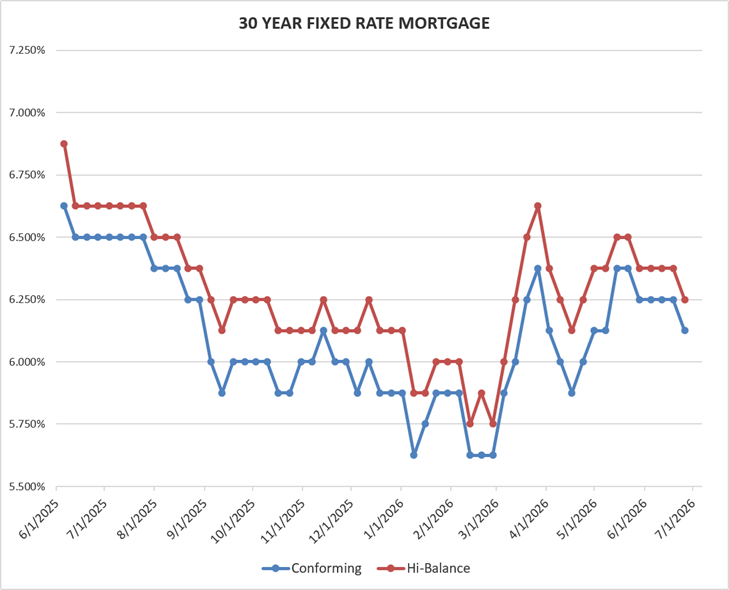
Rates for Friday June 26, 2026: Rates continue their downward trend this week.
FIXED RATE MORTGAGES AT COST OF 1.25 POINTS LOCKED FOR 45 DAYS FOR PURCHASE TRANSACTIONS:
30-year conforming 6.125% Down 0.125%
30-year high-balance conforming 6.25% Down 0.125%
Please note that these are base rates and adjustments may be added for condominiums, refinances, credit scores, loan to value, no impound account and period rate is locked. Rates are based on 20% down with 740 FICO score for purchase mortgages.
I have enjoyed the clips of visitors from other countries in the United States to cheer on their teams in the World Cup. The take over in Boston by the Scottish, Norwegians doing their rowing in Times Square, a German touring the South. One very common aspect of many of the videos is their outright joy in trying American food, and food outlets for the first time.
The smile when a Brit tastes biscuits and gravy for the first time. The wonder as Swedes go to a Buckee’s. The disbelief in the first bite of a Chipotle burrito. Biting into a baby back rib at a roadside barbecue.
As well, their appreciation of the small towns far from the major cities across the country.
As long time readers of the WR&MU know, I love road trips, in large part for the small towns, their diners and restaurants, the warmth of the locals, and the beautiful vistas we are blessed to have access to across America.
Go USA!


