

Will our homeowners insurance go up again?
Question of the week: Will our homeowners insurance go up again?
Answer: Probably.
In 1988, California voters passed Proposition 103 that moved California’s Insurance Commissioner from an appointee of the governor to an elected position beginning with the 1990 election.
Ostensibly, an elected official that was independent of the executive branch would result in a decrease in some insurance rates, put barriers in place for rate hikes by insurance companies as they had to be approved by the Insurance Commissioner’s office, and would expand the regulatory authority of the Department of Insurance (DOI).
As we have seen over the past decade, the Insurance Commissioner has become a very political, and the fourth highest paid statewide elected official. Politics is long on pandering to donors and emotions and short on unintended consequences of policy platforms.
Case in point, California Insurance Commissioner Ricardo Lara, who was elected in 2018 and whose is term limited out of office this year. For most of his term, Lara’s department slow-walked requests for rate increases from insurers, or flat out denied the applications. One result was many carriers pulling out of the state, particularly for property coverage.
It is difficult to determine with accuracy the amount of increase in property insurance premiums since Lara took office in 2019 as the DOI does not publish rate statistics for the overall market, that said estimates run from increases from 40-60% for most homeowners, for those on the FAIR plan (more below on FAIR) premiums have tripled since 2021.
A major factor in the insurance market has been the wildfires that have estimated costs of up to $40 billion in losses by insurance companies since 2024—most of that from the Palisades and Eaton fires in 2025.
Major insurers have denied coverage and/or rejected renewals for property owners in areas prone, or highly susceptible, to wildfires do to the extremely high liability and cost burden it must then pass on to other policy holders—as approved by the DOI. As result, over half a million consumers are covered by California’s Fair Access to Insurance Requirements, the FAIR plan, which was established in 1968 to provide basic coverage to property insurance for those who cannot obtain coverage in the open market. The FAIR plan is backed insurers who are licensed in the state to issue policies, with the “big six” covering most of the costs.
As major insurers pulled back, or out, of their coverage in the state, the number of policies issued by the FAIR plan exploded from about 270,000 policies in 2021 to almost 685,000 as of March of this year, approximately 8% of the insurance market. If there are a series of major events, the exposure could completely collapse the property insurance market, requiring a bailout from the state.
Initially meant as a last-ditch policy for a very small percentage of property owners, between the flood of new policies the FAIR Plans total exposure has surged from about $220 billion in the fall of 2024 to $724 billion at the end of 2025—which must be covered by the private insurance market.
Earlier this week, it was announced that the FAIR plan would be increasing for many homeowners by 29.1% starting October 15th, the modicum of good news is that the DOI rejected the 36% increase sought by the FAIR Plan.
Not all policy holders will experience the 29.1% hike. About 25% may see premium decreases by up to 80% , about 50% will see increase from 30-50%, the remaining 25% will see small changes in premium depending on wildfire risk and how “hardened” their properties are to prevent or mitigate damage from wildfires. Looking at property-specific risk, the FAIR Plan is starting to decrease premium costs for properties that are considered lower risk to wildfire damage.
As for policy holders with “traditional” coverage, the estimated premium increase over the next year is 7-10% across the market, however, like the FAIR Plan some may see decreases while others see higher premiums.
With the FAIR Plan on the edge of a crumbling cliff, the election for the state’s next Insurance Commissioner takes on as much, or more, importance as every other office on the ballot. Like every open office, there are a lot of people on the ballot, in this case eleven. Polling shows about six are serious contenders.
California uses a top-two primary system instead of the traditional political party primary selection process, as such it is possible that the final two candidates in November are very much alike in what their positions will be. Depending on whether the new commissioner understands the nuts and bolts of insurance, i.e. risk mitigation and requirement for ability to remain solvent after claims, the future of the homeowner’s insurance policies and premiums could become healthier, or become a burden on the state and its taxpayers to pay for poor policies and decisions.
Elections are important, do the math and consider if the policies put forth by candidates are feasible to ensure fiscal strength and stability or will require more funding from all taxpayers to pay for their plans.
To schedule an initial meeting by phone or Zoom, click here for my calendar, please feel free to forward to a friend or family member!
Have a question? Ask me!
No surprises in economic data for April. The second revision for 1st quarter GDP was revised down from 2.0% growth to 1.6%. The Personal Consumer Expenditure (PCE) index, the preferred index for the Fed when consider inflation and rates, increased 0.4% in April after March’s 0.7% increase, and was up 3.8% from last year. Stripping out energy and food, the core index was up 0.2% in April and was up 3.3% from last year. Personal incomes were flat from March, or down 0.4% to inflation, while consumer spending was up 0.5%, or almost stagnant after inflation. Not great news for rates…in ordinary times.
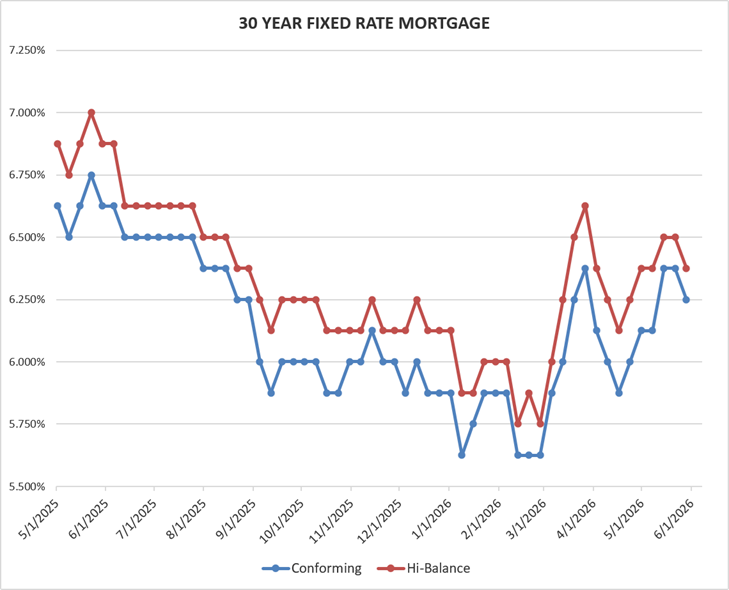
Rates for Friday May 29, 2026: To paraphrase a famous campaign slogan from the early ‘90’s, it’s the war dingbat. Markets were less concerned with the raw economic data than the news on “possible,” “close,” “near” agreement between the United States and Iran that could open the Straits of Hormuz and cease hostilities, as result rates are down from last Friday.
FIXED RATE MORTGAGES AT COST OF 1.25 POINTS LOCKED FOR 45 DAYS FOR PURCHASE TRANSACTIONS:
30-year conforming 6.25% Down 0.125%
30-year high-balance conforming 6.375% Down 0.125%
Please note that these are base rates and adjustments may be added for condominiums, refinances, credit scores, loan to value, no impound account and period rate is locked. Rates are based on 20% down with 740 FICO score for purchase mortgages.
May seems to have flown by for me—likely not for students who have had their eye on the end of their school year which seems further away the closer it gets, if memory serves me right.
Congratulations to all the graduates and their families as you enter the next stage of education and life!
(P.S. if anyone is looking for a very affordable car for their new driver or recent graduate, we are selling our 2001 Infinity…inquire here)
Dennis


