


Are home prices going to “pop?”
Question of the week: Are home prices going to “pop?”
Answer: This is a question that has been batted around a few times in the past several years, and a bit more so lately.
The impetus for the question is the extremely high home values we have seen, a slow sales market, continued high rates, and economic uncertainty. Reminiscent, for some, of two decades ago when home prices spiked and eventually crashed, leading to the Great Recession. The housing bubble popped.
For reference, and those who may be too young to know, or to old to recall (slight dig at our aging audience….), a very quick recap of the bubble expansion and burst in the mid- to late-2000’s is in order.
In the early part of the century (how is that for making us seem old?), very easy mortgage lending led to a glut of homebuyers who forced housing prices up. Mortgages were very easy to obtain with very little down, resulting in an inordinate percentage of homeowners who were very highly leveraged into properties they would very likely not have been qualified to purchase under prior, traditional, mortgage underwriting.
“Very easy” defined as a tremendous amount of mortgage products, including those backed by Fannie Mae and Freddie Mac, that required no verification of one, some, or in some cases none of the following: income, assets to close, appraisal. As well, some products that were available with no down payment, limited income review. The primary basis for many of these products was the borrowers’ credit scores.
The mortgages were not just used to purchase homes, they were also available to those who wanted to cash-out a lot of the equity that had built up in their homes during the bubble expansion.
Highly leveraged, under-qualified borrowers are, as you can imagine, extremely at risk for foreclosure in the future.
Which is what happened when a domino in Irvine, California tumbled.
That domino was First Century Mortgage whose business model was to fund easy-to-get “subprime” mortgages and then sell them to investors on Wall Street. In February, 2007, First Century could not sell a bundle of their mortgages as potential investors dug into the collateral value of the investment and found it grossly insufficient. This led to investigations of other subprime mortgage company’s offerings, which resulted in those companies being unable to sell their portfolios.
We had a crisis in the “subprime” market. If contained to the subprime market the damage would have been heavy, but not extremely damaging to the mortgage and housing markets. But, given the extent of traditional, non-subprime mortgages that were funded using subprime underwriting, it just took a little breeze to blow down the housing market.
Values began to drop in some markets, which put a significant number of homes upside down, many with loans that homeowners were barely able to afford.
Your home you purchased, or refinanced, with a value of $500,000 and has loans totaling $450,000, or $500,000, was now worth $450,000 after a 10% drop. You are struggling to make the payment as the adjustable rate has increased, or perhaps you have been laid off. Solution: give the keys to the bank and walk away.
Banks are now selling properties well below what homeowners are listing their properties for on the market, undercutting them, leading to more foreclosures…and a vicious cycle is building momentum.
The result was home prices in many markets collapsing 20%, or more, banks and investors losing hundreds of billions of dollars, and economic recession.
Back to our question, are home prices going to “pop?”
Maybe someday, but not in the near future unless there is a major event causing economic collapse, and even then it is very likely there will be no pop or repeat of the 2000’s collapse.
Why?
Equity. Historically low interest rates as a result of actions by the Federal Reserve led to the Covid home value boom. Families could qualify for much higher home prices than they thought possible, which exploded the first time buyers’ market. Move-up buyers accelerated their move-up by several years due to lower rates and the growth in the equity in the homes they were selling.
As well, I’m not sure of the exact data, but going back to my start in the industry in 1987, the amount of all cash buyers, at all price points, was historic—meaning a lot of homes with 100% equity and no mortgages.
Because of the very competitive market sellers were accepting the highest and least risky offers, those with all cash or higher down payments—good luck getting an offer accepted with low down payments.
Many families, instead of selling and moving up, took advantage of the historic rates to refinance and reduce their mortgage payments significantly, it was not unusual to have clients reduce their mortgage payments by up to 50%.
During the pandemic, refinances were a major part of the market, the highest percentage of the industry in my career.
The result was a high percentage of homeowners with no mortgage, new homeowners with very low interest rates and higher amounts of initial equity, and existing homebuyers with significant equity and mortgage payments lower than market rents in their neighborhoods.
Housing market “pops” are almost always caused by high foreclosure rates. Because of the amount of equity in the housing, the incidences of foreclosures are low as most homeowners who are in trouble can sell their home before they are foreclosed on.
We have seen a decline in real estate values from their highs, but values are still far higher than they were at the start of the pandemic.

The chart shows the date each of the areas (statewide, LA and Orange Counties) reached their highest median home values, what the median values were in February, and what the values were in March 2020, the start of the pandemic. Many people purchased as values climbed, however, as stated, many of those purchases were cash, or high down payments.
Values have declined from their highs, over 12% in Los Angeles County, but they are still showing unprecedented growth in the past six years, creating enormous equity, and wealth, for homeowners in the state.
Because of the affordability issue in the state, California leads, or is near the top, of the amount of time homeowners staying put for 15-years or more, the latest data shows LA County “stay-put” is around 20 years.
High equity, low-rates, long time residency, reduces the risk of a glut of properties on the market through homeowner sales or foreclosures, thereby precluding a “pop” in the property values.
To schedule an initial meeting by phone or Zoom, click here for my calendar, please feel free to forward to a friend or family member!
Have a question? Ask me!
The situation with Iran has many consequences and impacts. One is how markets are reacting to economic news—which is not in the traditional way. This week data showed that inflation was flat in February using one index (PCE—the Fed’s preferred inflation gauge), before the conflict; and significantly higher in March with the other major price index (CPI) as oil prices spiked pushing other costs higher. This data, historically, would have rates moving up, and anticipation of the Fed not only not looking to lower its benchmark rate, but increase it. Instead, markets are ignoring economic data and fluctuating on an hourly basis based on news of cease-fires, cease-fires but…, oil flow and production, and comments from Pennsylvania Avenue and wherever whoever is speaking for Iran.
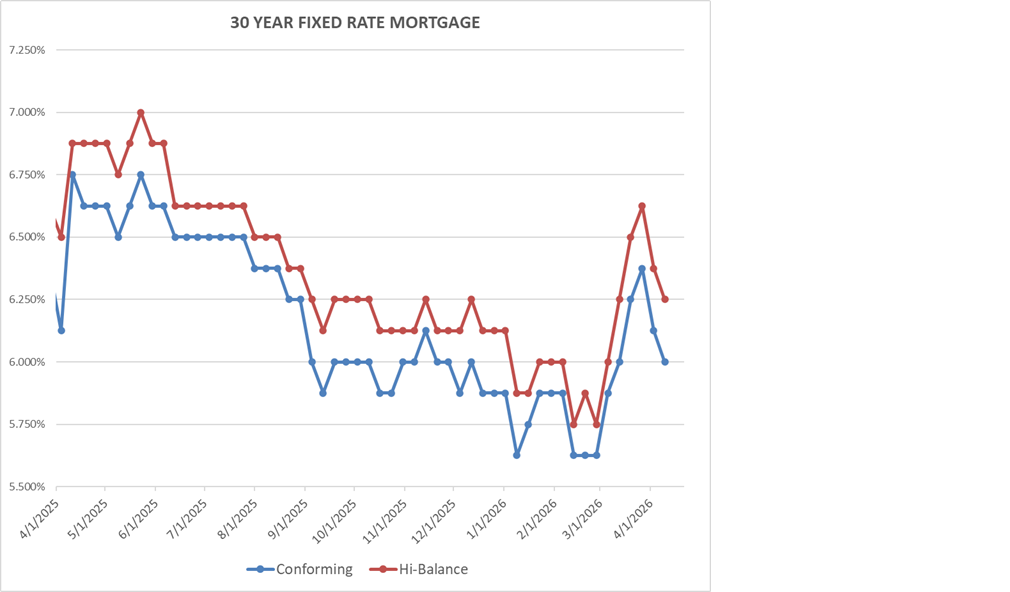
Rates for Friday April 10, 2026: Rates drop for the second week in a row, despite war, inflation and Twitter, or X.
FIXED RATE MORTGAGES AT COST OF 1.25 POINTS LOCKED FOR 45 DAYS FOR PURCHASE TRANSACTIONS:
30-year conforming 6.00% Down 0.125%
30-year high-balance conforming 6.25% Down 0.125%
Please note that these are base rates and adjustments may be added for condominiums, refinances, credit scores, loan to value, no impound account and period rate is locked. Rates are based on 20% down with 740 FICO score for purchase mortgages.
From a work perspective that is non-workish, one of my favorite benefits of the internet is streaming. Streaming sports while working—my office music if you will.
Long time readers of the WR&MU know I love baseball, and thus if a game is being played it is on, either radio or tv broadcast, while I work. Last month it was the NCAA March Madness. This week The Masters.
You can have your jazz, classical, yacht rock, for your background, I’ll take Jim Nantz commentating with the “whack” of a well struck iron into the green at #14 at Augusta in my background!
Dennis


