


Are condos getting harder to sell?
Question of the week: Are condos getting harder to sell?
Answer: Maybe.
Likely.
The primary source of residential mortgages are Fannie Mae and Freddie Mac (henceforth, GSE, for Government Sponsored Entity), they fund approximately 70% of all mortgages in the United States.
The GSE are under the umbrella of the Federal Housing Finance Agency (FHFA), which provides many of the rules and regulations for underwriting and purchasing mortgages.*
*The GSE do not fund mortgages, they purchase them from mortgage companies, banks, credit unions that underwrite and fund mortgages using the GSE criteria. After purchasing mortgages, they bundle them into batches called Mortgage Backed Securities, and sell them in the financial markets. You can purchase MBS through your investment advisor or institution.
Recently FHFA rolled out new rules for condominium associations to follow if they wish to be eligible for funding from the GSE; if they do not follow the rules they will be on the “do not lend list.”
Keep in mind, these rules apply to all GSE mortgages in condominium complexes, whether purchase or refinance mortgages.
Since 70% of mortgages are from GSE, being ineligible for their financing greatly restricts the market for those selling properties.
Some of the new rules that will impact the ability of condo HOAs to remain, or become, eligible:
Higher reserves After decades of requiring HOAs to maintain 10% of their budgets in reserve, as of July 1st they will need to carry a 15% reserve.
Budgeting reserves is meant to build a savings account that can be used for capital improvements and repairs, as well as emergency needs.
If a roof last 15-years and the estimated cost to repair the roof in 15-years is $1 million, the HOA will need to set aside a little over $65,000 per year to have the funds. Or, assess all the units at the time the roof is replaced for their share of the cost of the roof, to be paid at once or over a defined period of time.
If there are 20-units in a complex and their monthly HOA dues are $500 per month, the total collected by the association is $120,000 per year. This is used to pay insurance, maintenance, servicing of pools, elevators, landscaping, and management.
Of the $120,000 the HOA must now set aside $18,000 per year for reserves instead of $12,000, a 50% increase. The result will be an increase in HOA dues to cover the additional reserve requirement, along with increases for other costs.
Since the rule takes effect on July 1st, if HOAs want to stay eligible this year they will need to increase their reserves from budgets already enacted, which may result in special assessments.
This rule can, will, push many associations from eligible to ineligible.
Questionnaire One of the aspects of becoming eligible is the completion, by the HOA, of a questionnaire. The questionnaire covers a wide range of topics, from total number of units, to how many unsold units if a newer projects, to percentage of units that are not owner-occupied, current reserve balance, to how many owners are delinquent in dues, to any repairs or replacements needed that exceed $10,000 per unit, to any litigation.
For many years, a “limited review” was available for some mortgage applications if the loan was considered a low enough risk in an established project. No longer.
A waiver from the questionnaire has been part of the loan approval process, however to qualify for the waiver, the complex would typically have a small number of units, or recently had a full review that passed with flying colors. Unfortunately for borrowers, it is not until a loan application is inputted into the GSE’s automated-underwriting system that we know if the HOA is eligible for a waiver.
Completion of HOA questionnaires add costs and time to transactions. Most HOAs have outside management companies that act as property managers and complete the questionnaires. Depending on the management company and the size of the complex, we have seen fees for completing the paperwork range from $300 to over $500, and take up to two to three weeks for completion. To “rush” the completion there can be an additional fee of several hundred dollars. Note, the fees are almost always paid by the borrower.
Insurance Lack of adequate replacement coverage in insurance policies has been a major factor in many HOAs across the country losing their eligibility for GSE funding. Raising coverage costs, especially in the California insurance market, means raising premiums, which means raising HOA dues, and reserve requirements.
One change in insurance requirements that may make it easier for staying, or becoming eligible, if a bit complicated, but it comes down to the replacement cost of the roof and how it is insured. The new FHFA rules allow for coverage what the actual cash value of the roof is today; i.e. the original cost minus the depreciated value.
The premiums for covering the current cash value is significantly less than premiums for covering replacement costs of a new roof. Think of insurance for the 2010 Honda Odyssey van being for the current cost of the vehicle versus insuring it for the value of a 2026 Honda Odyssey so if the car was totaled the insurer would payout the cost to buy the new edition.
Therefore, some HOAs may opt for the lower premium option, this not only makes it easier to retain/obtain eligibility for GSE mortgages, but also reduces increases to HOA dues.
Taking this route essentially kicks the financial can down the road, as if there is a roof incident through storm or other factor, the lower insurance may barely cover the cost of a new roof—resulting in special assessments or higher HOA dues to cover the difference.
Unit insurance Over the decades I have been in the industry, I have seen a dramatic decline in the number of associations whose master insurance policies cover the interior of the units. For those who own units in complexes where their individual units are covered for fire and other eligible claims, they likely pay higher HOA dues, but the higher payment is likely less than the premium for a HO6 policy.
The HO6 covers the interior of the individual unit and each owner must obtain their own policy. The new regulations, effective July 1st, require all new condo mortgages be listed as loss payees on HO6 policy for the unit in the transaction.
If you own a condo in a complex whose master policy currently covers the interior of your unit, and you want to refinance, you will need a HO6 policy to complete your transaction.
I have always encouraged clients purchasing condos to insist on complete financial statements, board minutes (to see what discussions have occurred regarding financing, capital improvement costs and funding options, etc), and a full physical inspection of the unit and complex—including roofs, basements and all common areas.
The latter to determine likeliness of major costs approaching for repairs or replacements, that will likely lead to higher dues or assessments. Unless, the balance sheet and income statements show the association has done an excellent job creating reserves to cover major improvements.
Last June, our question of the week was, “What should we look out for when buying a condo?” If this question were to be re-visited today, first on the list would be to see if a complex is on the GSE eligible list. Even if it is currently on the list, dig into the financials for the association, is the association strong enough to remain on the eligible list?
Is the association prepared to replace roofs, pool equipment, sprinkler systems, any major physical component of the common areas that inevitably will need to be replaced.
What are financing options for condo units that are not eligible for Fannie Mae or Freddie Mac financing?
If you have 20% or more for down payment, there are several lenders in the “non-warrantable” (lender speak for not eligible for conventional financing). The rates are typically a bit higher than for a conventional loan through a GSE, however, not drastically so.
If the down payment is lower than 20%, options are mainly a VA loan is you are a veteran, or FHA. For the former, an association must be approved by the U.S. Department of Veteran Affairs. For a FHA loan, if the association is not on the FHA approved list, it is possible to get a “spot approval” for a single unit. The spot approval process adds some time and cost to the loan approval process, but if the association can meet the guidelines, it can be worth the cost and effort for a down payment as low as 3% of the purchase price.
What if you own a unit in a complex that is not on the eligible list? Be flexible with your price and terms to make your unit as attractive as possible to potential buyers who will not be able to utilize conventional financing, i.e. typically 70% of the buyers on the market.
If you do own a condo unit(s), I encourage being engaged with the board of directors, ideally having a seat. Read the minutes, read the financials, go to meetings and ask questions. How engaged is the management company? Are they fulfilling their contract? Are they managing finances, repairs and maintenance?
As mentioned last June, owning a condo means you are in a business relationship will all the other owners, as well as the management company. The value of your unit, the desirability to buyers, is strongly subject to the governance and financial stability and oversight of the complex.
To schedule an initial meeting by phone or Zoom, click here for my calendar, please feel free to forward to a friend or family member!
Have a question? Ask me!
Rate cuts are moving further away, not closer. That is the likely outlook based on economic data this week. February saw very strong retail sales, showing economic strength heading into the Iran conflict and subsequent spike in fuel and energy costs. Up 0.6% from January, taking out auto and gas sales, spending was still up 0.5%. A strong indicator of consumer sentiment is luxury spending, strongly gauged by going out to eat rather than saving money and eating at home, restaurant sales were up 0.4% from January and up 4.5% year over year.
Surprise! was the reaction today when the Labor Department announced that 178,000 jobs were added to the economy in March, the most new jobs in more than twelve months. The unemployment rate dropped from 4.4% to 4.3%, however a significant factor in the drop was the labor force shrinking by 400,000 for the month. A concern looking forward is that only 61.9% of those 16 years old and up are either employed or seeking work, known as the labor participation rate; this is the lowest since the fall of 2021.
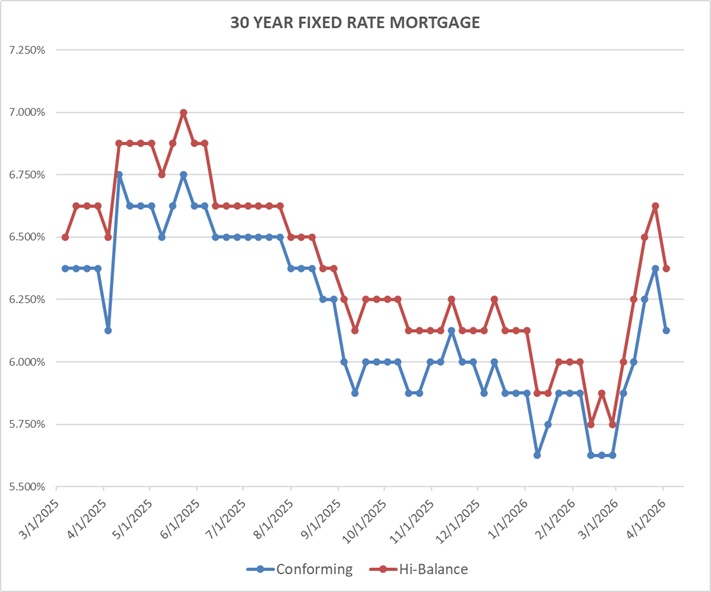
Rates for Friday April 3, 2026: The Federal Reserve’s mandate is the lowest possible rate of inflation for the maximum amount of employment. Prices are going up in response to higher fuel costs, which counters the first part of the mandate, the labor markets appear to be getting stronger, or weaker, depending on what data is being analyzed. With the uncertainty about future costs for consumers, and businesses, the Fed is unlikely to put an increase for their benchmark rate in the near future. As we enter Easter weekend, mortgage rates drop after four straight weeks of climbing.
FIXED RATE MORTGAGES AT COST OF 1.25 POINTS LOCKED FOR 45 DAYS FOR PURCHASE TRANSACTIONS:
30-year conforming 6.125% Down 0.25%
30-year high-balance conforming 6.375% Down 0.25%
Please note that these are base rates and adjustments may be added for condominiums, refinances, credit scores, loan to value, no impound account and period rate is locked. Rates are based on 20% down with 740 FICO score for purchase mortgages.
Happy Easter or Passover to those who observe those holidays. For those with young ones in school, enjoy your spring breaks!
Dennis


