

Can we refinance if our home value drops?
Question of the week: Can we refinance if our home value drops?
Answer: Yes, probably…but does the math make sense?
This question was asked by a client who is holding off refinancing their home because they think rates will drop further, but also concerned that their home value may drop and they won’t be able to do so.
Our case study will be the Jetson’s. They purchased their home in 2024 for $1.3 million with 20% down, funding a $1,040,000 mortgage with a 7,125% rate and a $7000 payment.
The home value has increased by about 4%, to $1,350,000. Having made all the payments in a timely fashion, the current loan balance is $1,020,000; or about 75% loan-to-value.
Refinancing today the rate would be 6.375% with about $6000 in costs for appraisal, escrow, title, underwriting, etc, and the payment would be $6365 per month. The Jetson’s would save $605 per month, recouping the costs of the transaction in just over ten months ($6000 cost divided by $605 per month savings), they are “positive” on the transaction in January 2026.
Consider the question, what if the Jetson’s wait to refinance as they think rates will go lower, but are concerned their home value will drop as well, will they still be able to refinance?
Probably, but…it will depend on the value of their home.
“Bewitch” twitch ourselves to the end of the year (for younger readers, here is the infamous Samantha Stevens magical twitch).
Rates have dropped for the Jetson’s on their rate and term refinance to 6.00%, their mortgage balance has dropped to $1,010,000, but their home value has dropped 5% to $1.28 million. The loan-to-value is 79%.
At this price, since the LTV is below 80% their rate would be 6.00% and refinancing their mortgage of $1.010 million results in a $6055 per month payment, a saving of $945 per month from their original purchase mortgage. Their break-even point on the transaction is their seventh payment, July 2027.
By waiting they cost themselves $605 per month in cash savings, but they did not have the $6000 costs.
Did they come out ahead, behind, or no difference by waiting?
Had they refinanced at 6.375% at the beginning of the year, then refinanced again at the end of the year, their total refinance costs would be $12,000 to go from 7.125% to 6.00% with the two transactions. The total time it would take for them to recoup their costs for the refinances would be 16-months (6000 divided by 605 + 6000 divided by 945), June 2027.
By refinancing at the current rate and home value, then refinancing again with a lower home value, and lower interest rate versus waiting and then refinancing with a lower home value and a lower rate, the Jetson’s essentially end up with the same transaction cost to payment savings time frame.
There are two risk factors the Jetsons take on by waiting.
They have value risk; their property value drops further and results in their LTV being higher than 80% when they look to refinance, resulting in cash into transaction to lower their loan amount to get to 80%, or they take on private mortgage insurance, which adds to their monthly payment.
They have interest rate risk, rates do not go down further, or possible increase, resulting in their missing out on the $605 per month savings.
The answer to our question of the week being a “yes” depends on those two risk factors, if property values decline, by how much do they decline, and what will interest rates be in the future to afford you how much in savings on your monthly payment.
Most current homeowners purchased their homes before the rising rates period that started in 2022 and have seen significant appreciation in the home values. As a result, a drop in value will not endanger them with looking at higher refinance rates based on their LTV. For those who purchase during the rising rate period, property values have not increased to the extent they did before and during the Covid Era.
For those who took out Home Equity Lines of Credit (HELOC) after their Covid-rate-refinance, it is worth looking at the math to consolidate the HELOC with your current mortgage into a new fixed rate mortgage. While it seems counter intuitive to refinance a 3% mortgage to a 6.5% mortgage rate, there is no harm in exploring paying off the adjustable-rate HELOC that may have a balloon payment, or fully amortize to a very high payment, to fix the HELOC repayment to a fixed, lower, monthly payment.
If you would like to go through the math on your current mortgage and debt situation to determine your potential monthly savings please contact me.
Have a question? Ask me!
Want to schedule and appointment? Click Here
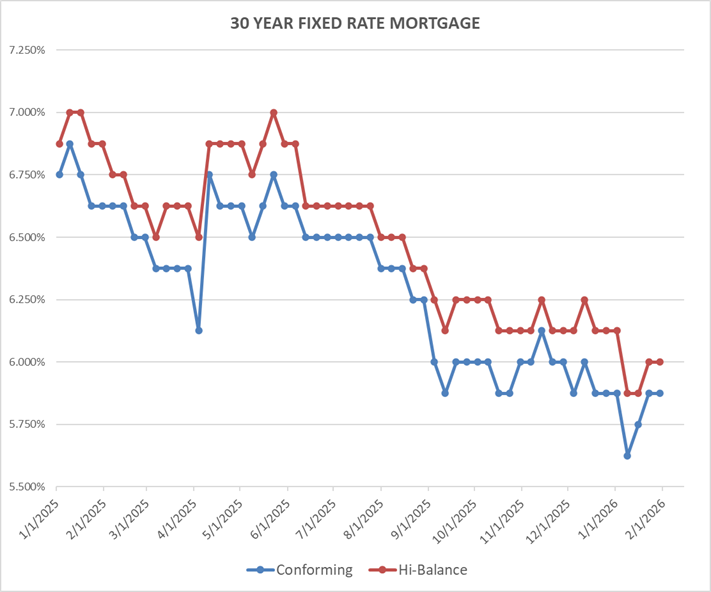
Rates for Friday January 30, 2026: As expected, the Federal Reserve did not change its benchmark interest rate at its meeting this week—the first meeting without moving the rate since July. Fed appears to be on hold as it sees the economy moving at a “solid pace” and tentative signs of stabilizing labor market. Until jobs market weakens, and/or inflation has more consistent move to Fed’s 2% goal, expectations are for no movement by the Fed on rates. After climbing for two weeks, rates are flat from last Friday.
FIXED RATE MORTGAGES AT COST OF 1.25 POINTS LOCKED FOR 45 DAYS FOR PURCHASE TRANSACTIONS:
30-year conforming 5.875% Flat
30-year high-balance conforming 6.00% Flat
Please note that these are base rates and adjustments may be added for condominiums, refinances, credit scores, loan to value, no impound account and period rate is locked. Rates are based on 20% down with 740 FICO score for purchase mortgages.
Any other Southern California residents being brats and sending playing golf in short sleeves, or engaged in other outdoor activities, with snowcapped Mount Baldy in the background, to their friends in other parts of the country?


