


What would you do to soften housing market?
Question of the week: What would you do to soften housing market?
Answer: Last week we answered “What is impact of President Trump having $200B of mortgages being purchased?” The gist being that it puts downward pressure on rates.
This, of course, is good for homebuyers as lower rates mean lower payments mean higher loan amounts for which they qualify.
There are other measures Trump has proposed, or has indicated he may propose, to make home-buying more affordable are ban large intuitional investors (defined as owning more than 100 properties) from buying single-family residences, having Fannie Mae and Freddie Mac offer 50-year mortgages, capping credit card interest rates at 10%, allow portable mortgages (homeowner can take current mortgage at 3% to new home purchase), and first-time homebuyers (generally defined as not owning a primary residence in the past 3-years) being able to penalty- and tax-free withdrawal funds from the 401(k) or other retirement funds.
All of these proposals have positive and negative aspects, as almost everything does, which means depending on who you are reading, watching or listening to a particular idea is even better than sliced bread, or the worst, most horrible idea ever that will lead to starvation and more homelessness.
A challenge that Trump did bring up in his, let’s say interesting, speech in Davos this week at the World Economic Forum, is very true.
“I am very protective of people that already own a house,” Trump said. “Every time you make it more and more and more affordable for somebody to buy a house cheaply, you’re actually hurting the value of those houses, obviously, because the one thing works in tandem with the other.”
“…because the one thing works in tandem with the other.” In other words, supply and demand. The over-riding issue in home affordability has been supply; with the primary reason for lack of supply being the historically low interest rates during the Covid-19 pandemic. The low rates spurned a surge in homebuying pushing prices higher and higher and higher. Those who already owned were refinancing their homes, dramatically lowering their payments, or if keeping their payments the same, dramatically accelerating the pay-off of their mortgages.
Higher rates are supposed to cool demand and flatten, or shrink, home prices as demand dries up with fewer families able to qualify to purchase a new home. As we have seen, the opposite has happened—prices have gone up.
Because supply has shrunk more than demand.
For many years I have defined certain areas, mostly waterfront, such as on the water in Seal Beach, Balboa Island in Newport, the “walk streets” in Manhattan Beach, as D&D areas. By D&D I mean Death and Divorce, as those events were the most likely reason a home would be put on the market.
The broad real estate market, especially in Southern California, is mostly a D&D market.
Many readers of the WR&MU refinance their homes during the pandemic, down to rates at, near, or below 3%. Those who want to move as their family has outgrown their home, or their home is too big for empty-nesters, or to move closer to jobs, are not doing so because they will not, or cannot, trade their 3% mortgage for a mortgage over 6%. Unless they have to, most are not selling their homes.
The significant lack of move-up sellers is the huge hole in the supply market.
So, while many of Trump’s proposals and suggestions have some, or a lot, of negative aspects, the approaches are almost all on the buyer’s side to increase the ability to purchase a home, and not so much about making homes cheaper to purchase.
Supply can be expanded in many parts of the country because they have the land, and friendly government regulations, to build more housing. These conditions are not as prevalent in Southern California, so what actions can be taken to increase supply, without significant harm to homeowners? I.e. increase supply at a moderate rate to level prices, but not tank them?
My solution: use the tax code. My proposal has a lot of opposition, which you can guess and I will reveal below if you happen to be stumped.
Raise the capital gains exemptions for the sale of your primary residence, which have been the same amount, i.e. not indexed for inflation, since the 1997 Taxpayer Relief Act was passed.
Individuals selling their primary residence can claim $250,000 exemption from capital gains and married couples can claim $500,000.
Here is how it works.
Capital gains on the sale of primary residence is calculated by subtracting the acquisition cost of the property plus any home improvements from the sales price less costs of sale.
For many elderly individuals, and couples, who have been in their home for a long time, the exemption still creates a very large tax bill. In my conversations with many of my older clients, they are very hesitant to sell because they do not want to pay hundreds of thousands of dollars to the federal and state governments. Eliminate, or greatly reduce, the taxes they will have to pay to down-size and more homes come on the market.
It is not just older homeowners who face this pay-the-tax-or-sell dilemma. Many California working couples face the same quandary as the state taxes capital gains as ordinary income, which could put their taxes in the higher 9-103% brackets.
If a spouse dies, the surviving spouse has two years to retain the $500,000 exemption, after which it drops to $250,000. That is a significant increase in tax liability for staying in your home after your spouse has passed away.
If the primary residence capital gains exemption was indexed for inflation from its inception in 1997, the individual exemption would be $500,000 and the married couple exemption would be $1,000,000.
Index the primary residence exemption to inflation, with a retroactive one time increase to 1997. As well, extend the married couple deduction to five years from two.
The primary argument against this proposal is it benefits a small, mostly geographic, percent of the population, who have a significant amount of wealth—even though tied up in equity—who benefit from a higher exemption. They will pay less in taxes, reducing the amount of revenue received by states and the federal government.
As of July 2025, the median single family home sales price ten states and the District of Columbia is greater than $500,000; at that time the national median price was $370,523.
Asking putting through a tax exemption that is higher than the median sales price in 40 of 50 states is a big ask.
But…what are the benefits? More homes, especially in high price areas, will come on the market as a result of the higher exemptions. Increasing supply at the top end of the market trickles down stream, opening up lower priced markets as current homeowners move up.
As well, especially in California, states will collect transfer taxes on sales, as well as increasing the amount of property assessments. A couple that purchased their home pre-1978 in California when it was assessed at $40,000 and is now valued at $1 million. Because of Prop 13 they have been able to retain their original tax base and have to sell because their incomes have not kept up with property value increases. Their current tax rate is about $1100 per year.
If they sell the property the tax base will be about $12,500 per year, plus whatever assessments for various school bonds, parks, etc.
If a couple purchased a home in 1978 for $40,000 and sold it for $1,000,000 in 2026, assuming improvements, etc of $300,000, their capital gains tax after exemption could reasonably be $45,000. The state regains that about in less than three years of property taxes, then gains $11,400 per year—on that one property.
We have seen that tax breaks for certain industries increases business for those industries, otherwise why would they happen? The same is true if a home is treated like a business, lower the capital gains being taxed and more homes will be sold. Increasing inventory and softening the market, not drastically, but some. And that is a start.
Have a question? Ask me!
Data = No Rate Change. Government agencies released some catch-up-from-the-shutdown data this week for GDP and inflation. The numbers do not support the Federal Reserve cutting its benchmark rate at its next meeting. The first revision to the 3rd quarter of 2025 showed the economy having strong growth, up 4.4%, pushed by an increase of 3.5% in consumer spending (65-70% of our economy). Rates, as a rule, drop in slowing, or negative, growth economies.
Further supporting no change, is the numbers for inflation in November (delayed reporting due to October shutdown) from the Fed’s preferred metric, the Personal Consumption Expenditures. Prices rose 0.2% in November, consistent with prior month’s 0.2% rise. Year-over-year prices rose 2.8%, above the Fed’s 2% target they have been chasing since it was at 2% in March 2021. The core index (energy and food stripped from data) was also consistent with prior reading, growing 0.2% in November, and up a tick from a year ago at 2.8%. Rates, as a rule, increase with inflation.
Workers continue to see higher wages, with personal incomes increasing 0.3% in November, out pacing inflation. However, spending increased 0.5%, mostly due to holiday traffic on-line and in stores; consumers either borrowed more or dipped into savings to make up the difference between their spending growing more than their income. Spending cannot outpace earnings for long. Since it is easier to cut spending than increase earnings, if the data trend continues spending will slow, which will slow the economy.
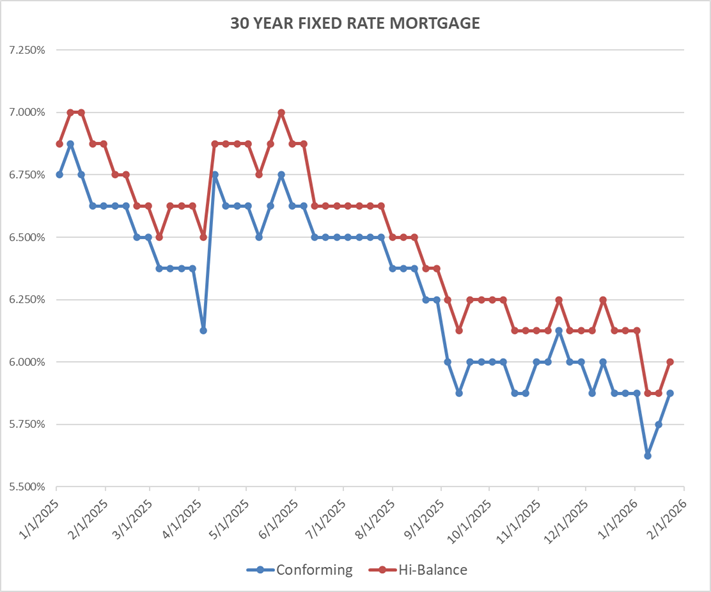
Rates for Friday January 23, 2026: Rates are not just determined by economic data, politics, international relations, natural disasters, and other events that impact buying and selling of goods and services also determine rates. Pricing in no rate change by the Fed, plus geopolitical news this week, has resulted in rates inching up for the second week in a row.
FIXED RATE MORTGAGES AT COST OF 1.25 POINTS LOCKED FOR 45 DAYS FOR PURCHASE TRANSACTIONS:
30-year conforming 5.875% Up 0.125%
30-year high-balance conforming 6.00% Up 0.125%
Please note that these are base rates and adjustments may be added for condominiums, refinances, credit scores, loan to value, no impound account and period rate is locked. Rates are based on 20% down with 740 FICO score for purchase mortgages.
Great news for Rams fans, of which there are many in the WR&MU readership, and those who get 3 & 4 in the squares pools from Oz the Mentalist.


