


What is impact of President Trump having $200B of mortgages being purchased?
Question of the week: What is impact of President Trump having $200B of mortgages being purchased?
Answer: As I mentioned in rate recap part of last week’s WR&MU (sorry no link to the update as issue with website—if you deleted and would like to read let me know and I can send to you), President Trump ordered representatives to purchase $200 billion of mortgage-backed-securities (MBS). This action has a tremendous impact on the mortgage market.
Going through this subject can get a bit wonky, but if I made New Year’s resolutions, one would be to try to make my WR&MU less wonky. Let’s see if I can.
Quick update for long-time WR&MU readers, background for newer readers, on the American mortgage market…
The overwhelming majority of funded mortgages in the United States are “conforming,” or “conventional,” and are approved using guidelines from either the Fannie Mae or Freddie Mac. Fannie and Freddie, for our purposes with be labelled GSE.
GSE stands for Government Sponsored Entity(s). A GSE meets certain criteria, mainly they are created by federal law and have a federal charter, are privately owned*, operate in certain credit markets (mortgages, student loans, etc), can borrow money or guarantee debt without being backed by the full faith and credit of the U.S. government*.
*As a result of the mortgage and real estate market meltdowns in 2008 that precipitated the Great Recession. Congress created the Federal Housing Finance Agency as an independent regulator to oversee the GSE and the Federal Home Loan Banks with powers of regulation, supervisions and conservatorship authority.
*(con’t) While technically private, share-holder owned entities, the GSE have been under full control of the U.S. government since 2008, and the U.S. Treasury owns about 80% of common shares and control the company. So, while there are private shareholders in the GSE, they have no operational control.
*(con’t) As part of the transfer of control and ownership, the United States Treasury does not back GSE mortgages with the full faith and credit of the U.S. government, the GSE do have the implicit support of the Treasury as a backstop through the conservatorship via FHFA.
What do the GSE do for the mortgage market? They stabilize it, they make it uniform, they reduce general risk.
A simplified version of the process of a mortgage to purchase or refinance a single-family residence using conventional finance.
Application for a $500,000 mortgage is submitted to a lender which underwrites the borrower and property using GSE guidelines for credit risk. If it meets guidelines the loan is approved and the lender is issued an approval that enables the loan to be sold to one of the GSE.
The lender funds the $500,000 mortgage. The mortgage is placed in pool with other mortgages using the same underwriting guidelines (either Fannie or Freddie—their guidelines vary slightly). The lender then sells the pool, saw $25 million, based on the aggregate rate of return on the pool, say 6.00%.
The lender uses the funds from the sale of the pool of mortgages to fund future mortgages.
The GSE package the various mortgages into pools and sell them on the open market as mortgage-backed-securities (MBS). The typical minimum price an investor must purchase is $1000—similar to most bond purchases.
The investor receives an interest payment based on his/her share (slice) of the mortgage pool in which s/he is invested, receiving monthly payments on the MBS coupon rate (not the borrower’s note rate which is higher).
Depending on the MBS coupon rate compared to other available fixed rate investments (i.e. bonds, particularly U.S. Treasury issues), and other markets, prices of MBS move up and down daily; like prices for company stocks on the stock exchanges.
For MBS and other fixed rate investments, there is an inverse relationship between prices and rates; higher price means lower rate, lower price means lower rate. I.e. if you have a $1000 bond with a 5% rate, your return will be $50 per year. If you purchase the bond for $980 and receive a $50 in interest for the year, your rate of return is 5.102%; lower price higher return. If you purchase the bond for $1020, your $50 interest is 4.9%; higher price lower return. This may not seem like a lot of difference, one-tenth of one-percent (0.1%), on $1000, but if you invest $10 million in MBS that 0.1% is $10,000.
President Trump directed his “representatives” to purchase $200 billion in MBS. Since the GSE, Fannie Mae and Freddie Mac, are under conservatorship of the FHFA, they fall under the Executive branch of the federal government, and are therefore representatives of the Office of the President.
Rather than hold onto $200 billion in MBS and not put them on the market, thereby decreasing supply, Trump’s directive is to purchase the MBS on the open market, thereby increasing demand.
Rough estimates show that the $200 billion purchase of mortgage-backed-securities by Fannie and Freddie is equal to a little over half a week of trading volume. While seemingly insignificant over 52-weeks of trading and the total volume of the MBS market, having one buyer (split into two entities) purchasing that amount of the market has a significant impact on prices and returns.
With changes in prices and returns depending on what investors require in order to make the investment, MBS are like every other commodity with prices based on other factors (i.e. risk) but mostly on supply and demand.
As supply lowers against steady demand, prices go up and rates go down. As supply grows against steady demand, prices drop and rates go up.
Trump’s directive has the impact of lowering interest rates on conforming mortgages, which ripples into other interest-rate based investments, and further into rates charged by lenders and creditors.
Hope the above was not too wonky!
Have a question? Ask me!
Not great, but not bad…That is the consensus on the final data for the Consumer Price Index for 2025. Prices rose 0.3% in December from November, 0.2% if energy and food are stripped out (the “core” rate). Year over year, prices rose 2.7% from the start of the year, with the core rate of inflation at 2.6%. The monthly and annual price increases in December matched those for November. The data eases pressure on the Fed heading into its January meeting. The expectation from the Fed was to hold its benchmark rate steady, CPI data for December supports the non-action on rates.
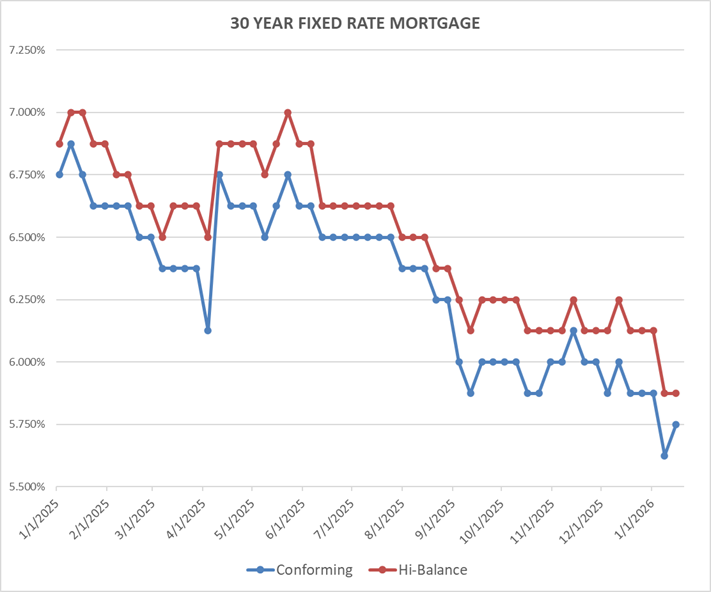
Rates for Friday January 16, 2026: After last week’s sharp week-to-week drop in rates, we see a little rebound in the conforming rate this week.
FIXED RATE MORTGAGES AT COST OF 1.25 POINTS LOCKED FOR 45 DAYS FOR PURCHASE TRANSACTIONS:
30-year conforming 5.75% Up 0.25%
30-year high-balance conforming 5.875% Flat
Please note that these are base rates and adjustments may be added for condominiums, refinances, credit scores, loan to value, no impound account and period rate is locked. Rates are based on 20% down with 740 FICO score for purchase mortgages.
In 1972 journalist Harold Pullman Coffin created an annual “un-holiday” every January 16th. The purpose of the day is an anti-holiday after the hustle, bustle, and tussle of the holiday season running from Thanksgiving through the New Year.
Today, Friday January 16, 2026 is National Nothing Day! Because it is Nothing Day, there is no celebrating, because we are supposed to do nothing.
By my writing and sending this I have not fully participated in Nothing Day. Nor have you by virtue of reading this!


