


What tax benefits for homeowners are in new tax bill?
Question of the week: What tax benefits for homeowners are in new tax bill?
Answer: After inter-party wrangling and horse trading the ridiculously named One Big Beautiful Bill has been signed into law, and there were some benefits for homeowners.
For California residents the biggest benefit as a homeowner appears to be the increase of the allowable SALT (State And Local Taxes—primarily income and property) from $10,000 to $40,000*. You may recall that the SALT deduction limit of $10,000 was part of the Tax Cuts and Jobs Act signed in 2017 during President Trump’s first term in office; prior to the Act there was no limit on SALT deductions.
After the 2017 Act, if purchased a home for in the state for $850,00 or above, your property taxes likely were $10,000 more, meaning you could not deduct any income taxes you paid to the State of California. Or, if you owned a home with a lower property tax bill, but your taxable income was $170,000 you could not deduct your property tax.
*The $40,000 cap will increase by 1% per year. It expires in 2029, reverting back to the $10,000 cap unless extended by Congress. For a married couple filing jointly the cap phases out until it reaches $10,000.
If a married couple filing jointly has $120,000 in income the potential savings with the increase deduction can be almost $6000.
For those earning less income, and have mortgage insurance, the 2025 Act (notice I am avoiding the official name) has made permanent the deduction of mortgage insurance for loans with private mortgage insurance (PMI) the upfront and monthly mortgage insurance premiums for FHA mortgages, and the upfront funding fee for VA mortgages. This mortgage insurance deduction is subject to income limits, phasing out after $100,000 in taxable income is reached to no deduction if income is higher than $109,000.
The home mortgage interest deduction on loans up to $750,000 put in place in the 2017 Act remains. There was some talk of extending the cap but it was last in the horse-trading for the SALT deduction increase.
Also remaining in place, and made permanent with a 1% annual increase, is the $15 million exemption of the Estate and Gift Tax. If not extended the limit would have reverted to the prior limit of $5 million. This is big benefit for families whose primary homes, and businesses they own, have increased significantly in value since acquired.
What was not included is a change I feel needs to be made to benefit seniors and also increase housing supply across the country. In 1997 President Clinton signed into law the Taxpayer Relief Act (how come tax law names always sound like a benefit to tax payers?) which increased the capital gains exclusion on the sale of a primary residence to $500,000. Since 1997 the national median home price has gone from around $115,000 to around $415,000, in California it increased from just under $200,000 to over $800,000.
We have a housing shortage in California and have seen a precipitous drop in inventory for sale since the pandemic. Many older homeowners have received a favorable tax benefit from new laws that enable them to carry their current property taxes to their new homes if they down size.
However, the $500,000 exemption limit on the capital gains deduction produces a significant barrier for many who do not want to sell and pay a significant amount of taxes to the state and federal governments.
Take a couple who purchased their home in 1995 for $250,000. Their kids are grown and they are ready to downsize their home and be able to enjoy retirement. Their home is currently worth $1.1 million dollars. Their acquisition and sales costs and monies spent on significant improvements, totals $200,000. $1,100,000 less $250,000 purchase price and less $150,000 in costs and improvements, their capital gains is $700,000. Take the $500,000 exemption out and their taxable capital gains is $200,000.
Assuming moderate income, their federal taxes owed could be around $30,000. For the state of California, the $200,000 is taxed as ordinary income, the taxes can be an additional $18,000 or more.
Paying $38,000 in taxes on the sale of their property is significant enough to prevent many older homeowners.
This is for a married couple. It should be noted that if the seller is widowed for more than two years the exemption drops to the $250,000 limit for single filers. This adds a significant amount of taxes to the seller.
One final note, if a spouse retains a home following divorce the exemption is the $250,000 limit for single filers.
Home buying, and selling, has some complexities beyond what is the price. Let me assist you, or someone you know, who is considering a real estate transaction to go through the various factors, options, and consequences that could be involved.
Have a question? Ask me!
The chances of a rate cut by the Federal Reserve next week is approximately 0.01%. Economic indicators this week did not suggest a slowing economy, nor do they forecast a slowing economy, or much lower inflation in the coming months. Highlights:
- Consumer Price Index for June showed a .3% increase in prices from May and a 2.7% increase from June 2024.
- While the monthly increase was the biggest one-month hike, it was in line with expectations so minimal impact on rartes.
- Gas and shelter, particularly shelter, had the largest impact on CPI in June.
- Tariffs are not showing significant impact on prices at this point.
- The core rate (strip out energy and food) was up only 0.2% for the month and 2.9% for the year—also as expected.
- Retail sales were hot in June after being cold in May, increasing 0.6% for the month after dropping 0.9% from April to May.
- Vehicles led the way as car shoppers hit the lots as tariff related increases have not hit stickers yet.
- Restaurants saw a big boost, 0.6% after a big drop in May. Dining out is a key indicator of consumer confidence in their economic future as they spend discretionary income rather than save.
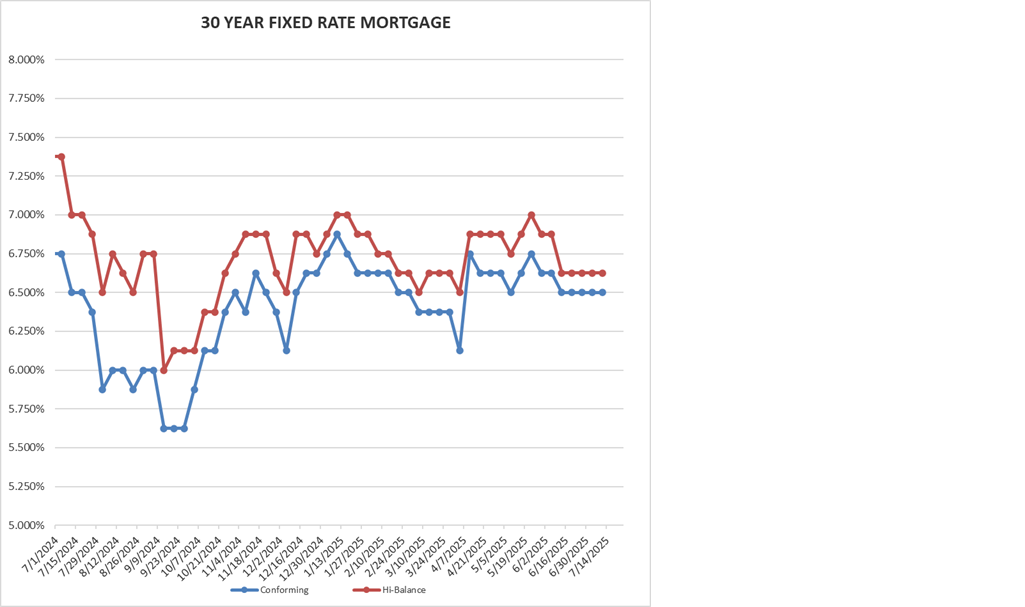
Rates for Friday July 25, 2025: The data has investors holding firm, causing rates to do the same. While the chances of a rate drop next week from the Fed is almost zero, the chances of a drop in September are getting a bit slimmer, dropping to 70% from most, and as low as 50% for some analysts. Rates are the same for the fourth Friday in a row; the longest streak since the 10-week stretch from July 9to September 17, 2021 when the conforming rate was 2.625%–remember those days?
FIXED RATE MORTGAGES AT COST OF 1.25 POINTS LOCKED FOR 45 DAYS:
30 year conforming 6.50% Flat
30 year high-balance conforming 6.625% Flat
Please note that these are base rates and adjustments may be added for condominiums, refinances, credit scores, loan to value, no impound account and period rate is locked. Rates are based on 20% down with 740 FICO score for purchase mortgages.
Early in my career I would tell new homeowners that any home project, purchase or modification will cost $1000. Change a latch on a gate, leads to new gate, leads to new flowers and shrubs…$1000. Buy a new throw rug for the den, coffee table looks dated, let’s get a recliner…$1000. Buy a new water heater for $300 (remember this was late ‘80’s early ‘90’s), remodel cabinet and/or location…$1000.
Today, even though the inflation adjustment from 1990 to today is about $2500, I think homeowners should budget up to $5000 for these home expenses. Having a surprise, and when are they not, pin-hole leak in our water main last week, which led to handy man and plumber to remove plants, dig holes, fix pipes, fill in holes which leads to re-landscaping that section of the front yard, which will lead to re-landscaping the yard on the other side of the walkway…while I hope not it will likely be…$5000.


