


How can I keep my/our house?
Question of the week: How can I keep my/our house?
Answer: Through the thirty-eight plus years of funding mortgages, I have worked with over one hundred clients where our loan helped them keep a property. Many reading this are probably thinking the loans were to prevent foreclosure, and yes in a very few instances we were able to accomplish that. For the rest, we funded loans that enabled a party to retain a home that would otherwise have been sold due to divorce, death, or other reasons.
In these instances there was typically a legal requirement to distribute net equity to another party, be it a (ex-)spouse, sibling or other beneficiary of a will, or settle a partnership or other legal entanglement or requirement—such as a reverse mortgage when the homeowners no longer occupy the property.
If there is a requirement that equity be shared with another person(s), you need to separate equity to payout the other party with a claim on the equity. This can be done by selling the property, or refinancing.
For our hypothetical, let’s take a home that is valued at $1,000,000 and has an existing loan of $600,000. Whether the equity needs to be split to due divorce or to settle an estate, the math is pretty much the same.
Once Greg and Marsha finished high school, Carol told Mike she was through with being the stay-at-home mom for six kids, three of them his boys, and wanted a divorce. They separated and Mike moved out with his boys.
Given her family situation, Carol was an early YouTuber and then Tik-Tok and Instagram celebrity with over one-million followers on her platforms. This had led to many appearances on podcasts, talk shows and commercials pushing products. Her publisher of her first book It’s a Story… has been pushing her for a second book, and her agent and the publisher are in talks for an advance of End of Story to come out a year after the divorce is final. Her income at this point exceeds Mike’s income as an architect.
They have agreement on separation of assets and no alimony to be paid by either party, with the exception of the home. Looking at selling the property for $1 million, after costs of sale and paying off the $600,000 mortgage they are looking at netting about $330,000 each, assuming 7% as the cost to sell. That is $165,000 each.
Carol would like to keep the home and Mike agrees he will sign over his share of ownership for $165,000.
We determine Carol’s income is sufficient for a $765,000 refinance mortgage that would enable her to pay out Mike his equity in exchange for full ownership.
Cash-out refinances have higher interest rates than purchases and rate and term refinances (refinancing to lower rate or payment with no cash proceeds to borrower).
Even though we are taking cash out of the property, because the funds are part of a divorce and not going to the borrower, transaction is considered the same as a rate and term refinance, saving 0.25% (one-quarter of one-percent) or more in interest rate for Carol.
At the close of escrow, the funds are paid directly to Mike, remember no proceeds can go to Carol, and a deed is recorded where by Mike quit claims his ownership to Carol.
The process is the same if we are working with an estate, the math may be different depending on the number of heirs.
Several years after Homer died in an accident at the Springfield Nuclear Power Plant, Marge passed away after a series of illnesses. Bart, Lisa and Maggie are equal heirs to the Simpson Family Estate and all assets were to be evenly split.
Lisa and husband Milhouse had moved into the family home to raise their son Kirk and twin daughters Patty and Selma and help out with Marge. They would like to keep the house.
As above, the proceeds from a sale would net $330,000 total, or $110,000 for each of the Simpson children. Bart and Maggie agree that each getting $110,000 would be fair settlement.
Lisa and Milhouse get a loan for $800,000, after paying off the $600,000 mortgage checks for $100,000 are sent to Bart and Lisa. For the remaining $10,000 for each of them, Lisa agrees to take $20,000 for her share of the $120,000 left in Marge’s IRA she inherited from Homer.
Provided the party that wishes to retain a property can qualify for the refinance, the process is fairly simple for a spouse in a divorce, or children in an estate settlement, to retain a property.
Note, if they do not intend to occupy the property, if it is a rental, or a second home, the refinance would have a higher rate as the transaction would not be owner-occupied financing.
Finally, we mentioned reverse mortgage above. We have done many transactions over the years where the parents had a reverse mortgage on the property and they have either passed away, or moved out to assisted living or other living arrangements. Once the property is no longer occupied by any of the signers on the loan, the reverse mortgage needs to be paid off. This can happen either through sale, or a refinance similar to above.
If you, or anyone you know, if in a position where they wish to retain a property that would otherwise need to be sold to distribute equity to others, please contact me to help with various options.
Have a question? Ask me!
GDP data for the 2nd quarter got a huge boost in April as the trade deficit declined over 55% as it saw the biggest one month drop ever. Exports rose 3% for the month, the fourth month in a row with an increase; imports dropped over 15%, with imports from China being the largest contributor to less income trade. Trade deficits lower GDP, so the lower trade deficit in April will be a smaller negative to GDP than in the first quarter.
There were 139,000 new jobs added in May, more than the estimates of 125,000, so stronger than expected. The data from the Labor Department also included lower the total jobs created in March and April by 95,000 new jobs. Eighty percent of the new jobs were in healthcare, restaurants and hotels, a pretty narrow focus for stronger growth. Employment shrank in manufacturing, likely due to tariff concerns, retail, government and white-collar jobs. While the unemployment rate remained steady at 4.2%, 7.2 million respondents said they were unemployed, the most since 2021 as we came out of the pandemic.
While hiring and new jobs may be slowing, compensation is not; quite the opposite. Wages climbed 0.4% in May and are up 3.9% year over year; significantly outpacing inflation. Higher income leads to higher spending leads to higher demand leads to higher prices. Or so our historical economic models show us.
In the friend zone? The employment data for May has put the Federal Reserve into a sort of friend zone position. Unemployment, slower hiring, while not enough to put a rate cut by the Fedin the very near future on the table, it is enough to increase the chances of a rate cut. Conversely, the continued increase in wages that can lead to inflation reverse the trend of shrinking into higher prices, especially with expected price increase due to higher tariffs, has the Fed concerned about inflation and the possibility to have to increase rates to once again battle inflation it thought was close to being under control. Just friends who like to hang out, break up because its just not working, or take it to the next level to build a stronger relationship. What does the Fed consider to do with interest rates in the coming months based on the economic data?
Rates for Friday June 6, 2025: Conforming rate flat from last Friday, though up from a dip yesterday. See below for more on rate chart.
FIXED RATE MORTGAGES AT COST OF 1.25 POINTS LOCKED FOR 45 DAYS FOR PURCHASE TRANSACTIONS:
30-year conforming 6.625% Flat
30-year high-balance conforming 6.75% Down 0.125%
Please note that these are base rates and adjustments may be added for condominiums, refinances, credit scores, loan to value, no impound account and period rate is locked for 45 day. Rates are based on 20% down with 740 FICO score for purchase mortgages.
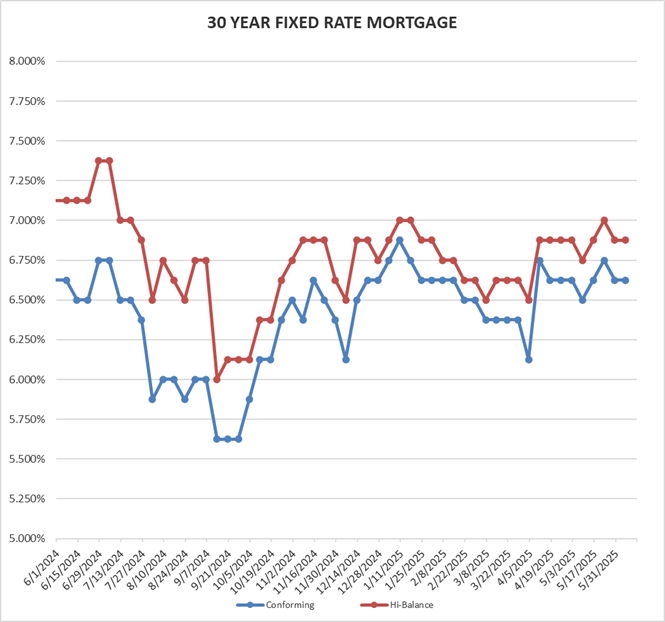
I started writing the Rate & Market update in 2001. Initially it was a monthly update sent only to real estate professionals. In 2002 I started writing the Weekly Rate and Market Update. I knew that I needed to be consistent in the parameters used for rates every week. At the time FICO scores were still relatively new to the industry, Fannie and Freddie started using the scores as part of underwriting and pricing in 1995.
When I started the WR&MU there was not as much of an advantage for very high scores as there is today, a 740 score received the same rate as someone with a 780 score.
Because of this I chose for my weekly rate update using a hypothetical client purchasing a single-family residence with 20% down, a 740 credit score, with the rate locked for 45 days at a cost of 1.25 points (1.25% of the loan amount, or $1250 for every $100,000 in loan amount).
There are many parameters that results in a lower rate if all other factors are the same, for instance a 90% loan has a lower rate than 80% loan to value due to mortgage insurance, a 780 score has a lower rate, locking for 30-days has a lower rate. All of these factors go up and down the same amount hour-to-hour, day-to-day, week-to-week as the base parameters I have been using for 23 plus years.
While the weekly rate chart is an indicator one on specific, narrow mortgage, the trend is what is most important, whether purchasing a single-family residence, refinancing a second home, or buying a duplex as a rental.
What is your rate? Give me a call and we can discuss your situation and rate options.


