


What should we look out for when buying a condo?
Question of the week: What should we look out for when buying a condo?
Answer: When you purchase a new home, you enter into business relationships.
Unless you are paying cash, you enter a business relationship with a lender.
You enter into a business relationship with your neighbors, depending on distance, the further the distance between the structures the looser the relationship. Consider, if you wish to sell your home and your next-door neighbor has over-grown lawn, trees that are pushing up fence between the properties, old furniture on their porch and dogs running around the fenced in front lawn barking at everyone. Does that help or hurt your value? Their business of (non) home care is impacting your business of selling a home at market value.
When you purchase a property that has a homeowners’ association (HOA), you enter a business relationship with all the other owners in the association. You are part of corporation that has by-laws, rules, costs, obligations. If one, or more, members do not pay their dues it has a financial impact. If the association does not fulfill its obligations for maintenance, security, capital improvements and replacements, financial management, you can suffer loss of property value, and/or financial harm.
When buying a condominium unit, at, or very near, the top of the list of what to investigate is the HOA. First and foremost make sure the complex is not on a “do not lend” list for the type of loan you will be using, conventional, government, etc.
Request copies of the minutes for the last twelve months of board of director’s meetings. This is where you will find discussions regarding building maintenance, capital improvements, assessments, changes to dues, and other governance items that impact your membership in the associations and the quality of building you will be inhabiting.
Request a copy of the financial documents, the budget, the balance sheet, the most recent income and expense statement, the final income and expense statement for the prior fiscal year. What you are looking for:
- What are the monthly dues?
- Are their limits as to how often, or how much, they can increase, what is the process to increase the dues?
- Review the financial documents for the HOA
- What is the budget? Does it contain provisions for reserves to repair/replace roofs, sidewalks, and other improvements that are the HOAs responsibility?
- What are the delinquency rates in payment of dues?
- Are there any special assessments to cover large expenses for roofs, plumbing, electrical etc? Have there been special assessments in the past, if so for what and how often?
- Read through the Covenants, Conditions and Restrictions (CC&Rs) that cover much of daily life in the complex
- Pets
- Parking
- Ability to rent
- Ability to remodel or renovate your unit
- Use of common areas
- Guests
Those are financial and legal items that will impact not only your financial commitment, and obligations, as part of your purchase, but also your ability to use and enjoy your residence.
As with any home purchase, you will want to ensure it is physically sound. No matter if you are purchasing a condo unit, townhome, single family home, or multi-family dwelling, it is always recommended that you engage an independent inspector to conduct a thorough physical inspection of your dwelling.
If purchasing in a multi-unit condo complex you will also want to see if the buildings and grounds look poorly maintained, have visible defects, structural damage from leaks and cracks. If so, does the budget address these issues, will they lead to increased dues and special assessments in future years to correct them?
Construction defects are not uncommon in newer units; older units tend to have cured many such defects. Are there any lawsuits that are pending, or have been completed against the HOA or contractors? What is the potential financial impact on the HOA? Note that some loan programs will not finance properties with pending litigation, depending on the type of litigation.
A major issue in the housing market the last several years has been insurance; this issue is not just for single family residences but also for condo complexes.
Homeowners’ associations carry a master policy that covers all the common grounds and structures owned equally by all owners in the complex. Some of the master policies also cover the interiors of each unit, but most do not. Because of this you will need a separate policy to cover and damage that may occur to the interior of your unit through fire or other calamity.
A major issue that has come up with lenders on many complexes is lack of adequate insurance to cover replacement value of the complex should it be partially or fully destroyed by fire. Consider the cost to rebuild condominium in Pacific Palisades or Altadena after the fires in January, was there sufficient coverage to rebuild the complexes, or payoff the mortgages for owners, is there any extended liability to the associations or the property owners?
Lack of sufficient coverage results in lack of available financing to purchase units in the complex, which can, and likely will, impact re-sale value in the future.
What is the ratio of owner occupied to non-owner occupied residents in the complex? If there are too many non-occupied residents it may be a challenge to get conventional financing, you may need a larger down payment. As well, if more and more of your neighbors rent out their units, that could impact the lending options for your future buyer.
How quiet, or noisy, is the complex. Ask to see the property in the morning, at night, on weekends. You do not necessarily have to go inside the unit you are looking at, but observe the complex as a whole as to activity, etc. Talk to current residents, are they owners, how long have they been there, will they be staying long, if not why, these are your potential future neighbors, and business partners, see what some are like.
Over the years I have had several clients that upon investigation we determined it would be best for them to pass on a unit they were interested in due to mismanagement of the association or very evident future costs that would be needed.
Over the years I have had many, many, many clients start their homeownership purchasing a condominium that was their first step to our next, and next…homeownerships purchases all leveraged of their initial purchase.
If you, or someone you know, is considering purchasing a condo—or any property—please contact me to discuss mortgage options.
Have a question? Ask me!
Jeopardy! answer: Slowing. Correct question for Ken Jennings, “What is economic data.” While not 100% correct, the contestant would get the money for their answer and control of the board.
The data: The first revision of 1st quarter GDP showed the economy slowed at a rate of negative 0.2%, slightly better than the initial reading of negative 0.3% growth. Surging imports, causing a 4.9% drag on the economy (trade deficits are negative for GDP), were a primary factor. As was a slowing in consumer spending in the quarter, up only 1.2% annually—less than inflation—and the slowest quarterly increase in three years. Looking ahead, the economic consensus is up to 2% growth in the 2nd quarter.
Personal spending grew as a lower rate, up only 0.2% in April after surging in March as consumers purchased big ticket items ahead of potential tariffs. Persona incomes were not slowing in April, jumping 0.8%, considerably outpacing inflation. It was the third month in a row that personal incomes have increased. With income outpacing spending, consumers are saving more, likely “keeping their powder dry” in anticipation of needing more funds in the future.
While the minutes from the Federal Reserve’s Open Market Committee (group that determines their benchmark interest rate) showed the members are concerned about persistent inflation, April’s Personal Consumption Expenditures (PCE) index (preferred inflation gauge for the Fed) showed inflation rose only 0.1% in April and only 2.1% year-over-year, down from 2.3% in March, almost hitting the Fed’s 2.0% target. The increases were the slowest since the pandemic. The core rate, which strips out energy and food prices, grew 0.1% for the month and 2.5% for the year, the lowest since early 2021.
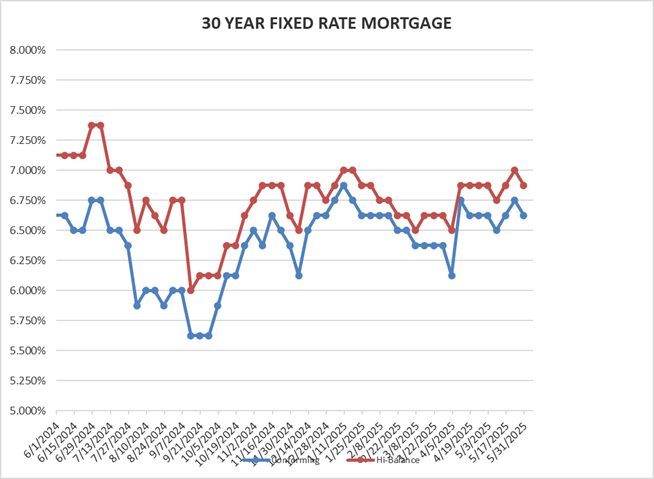
Rates for Friday May 30, 2025: Markets continue to be skittish and jumping up and down day to day on news about new tariffs, tariff pauses, tariff renegotiations, spending bills. Despite the choppy seas, rates are down slightly from last Friday.
FIXED RATE MORTGAGES AT COST OF 1.25 POINTS LOCKED FOR 45 DAYS FOR PURCHASE TRANSACTIONS:
30-year conforming 6.625% Down 0.125%
30-year high-balance conforming 6.875% Down 0.125%
Please note that these are base rates and adjustments may be added for condominiums, refinances, credit scores, loan to value, no impound account and period rate is locked. Rates are based on 20% down with 740 FICO score for purchase mortgages.
On May 30, 1994 I was visiting Leslie in Sacramento, where she had been living since November 1993. We went to see The Flintstones movie, then stopped by a diner for chili-cheese fries. On the way to her apartment after the nourishing post-movie snack we discussed our future, her moving to Long Beach, getting married, that sort of post-movie and chili-cheese fries conversation. When we returned to her place, I opened my Franklin Day Planner to look at dates and saw that September 4th was Labor Day weekend, perfect.
Leslie was wrapping some gifts for me (still does) I was bringing back to Long Beach and I asked her if she had anything planned for 9/4/94, she didn’t so I asked if she wanted to get married that day.
Thankfully, she said yes!


