

Should we refinance?
Question of the week: Should we refinance?
Answer: Maybe not yet.
Turbulence is an understatement to describe our markets this week, and the turbulent conditions will not be more stable for a little while yet.
Investors are not fans of turbulence as it makes the future murky as to what investments will be beneficial and which will result in losses. When this is the case “smart” money moves into more stable investments with expected guarantees, like United State Treasury bonds and bills; and to a certain extent mortgages.
As more investors move into the safety of fixed rate investments, the prices on those investments climb, and the price of investments they are selling, i.e. stocks, drop. For fixed rate investments, where return is based on the interest rate of the investment, as the price increases the rate of return decreases.
For example, if you purchase a $1000 bond with a 4% return for $1000 you will earn $40 for the year. If the $1000 bond becomes a sought after investment, a holder of the $1000 bond may want to sell it to you for $1100. If you purchase at this price your return will be 3.64% ($40 interest divided by $1100 cost). The seller of the bond will have made 10% on their initial investment, plus 4% from the date of purchase to sale (profit $100 divided by initial investment of $1000).
On the other hand, if investors feel better returns are in stocks, they will sell their fixed rate investments to get cash to purchase stocks. If a lot of investors are selling bonds, supply exceeds supply and prices will go down.
The holder of the $1000 bond wants to sell to get cash to invest elsewhere and sells it for $900. The buyer of the bond is receiving a 4.44% return on investment ($40 divided by purchase price of $900). The seller will take a 10% loss on his investment, minus however much they were paid in interest between buying and selling.
This week we are seeing stock market prices drop and fixed-rate asset prices climb. Interest rates are falling.
Whenever refinancing the primary math is how much is it costing and how much is it saving. This is true if you are doing a rate and term refinance to lower your rate and payment, or if you are doing a cash-out refinance to payoff other debt.
Refinancing is not free, there are certain hard costs involved, escrow, title insurance, appraisal, underwriting, credit report, etc. Depending on loan size in Southern California these costs can total $4000-5000.
Another cost are loan points, the cost for the interest rate. As described above the higher the cost the lower the rate, the lower the cost the higher the rate.
You can add the fixed costs and points to your loan amount, getting a smaller rate. Or you can choose a higher rate and have the costs paid by the lender as part of the transaction. Or you can do a little of both, add the fixed costs to your loan and have a slightly higher rate to cover the cost of the loan.
You want a rate and term refinance to lower your payment. You add $4500 to your loan to cover costs and decide upon a not point loan. With the costs your loan amount is $800,000, which is 70% of the value of your property, and you have good credit with a score o 760. You can lock in a rate of 6.375%.
Your payment will be $5122 (rounded).
You purchased your property for $1,015,000 with 20% down in March 2023 with a rate of 6.875% and a payment of $5334 per month.
If you refinance, you added $4500 to your loan and are saving $212 per month; which is a 21 month “pay-back” ($4500 cost divided by $212 savings.
You are likely going to be in your home for more than two years, so the cost will be “repaid” by the savings. However, what if rates drop further and in two months you can refinance for 6.00%, lowering your payment to $4796 per month, a $538 per month savings. If you have not refinanced yet your pay-back period for the costs drops to eight months. If you have refinanced already, the payback becomes and additional fourteen months plus however many months from your prior refinance (your savings on second refinance is $326 per month below payment after first refinance).
There is a lot of uncertainty as to where rates will go, certainly down in the short term, but how far? If you jump in too soon, will you then jump in again later adding more costs to lower your payments, and then again if they drop further, adding even more costs?
Homeowners are about to be inundated with calls, texts, emails, mailbox-mail, soliciting them for refinancing—remember the period of the Covid rate drops? Many with offers* that are enticing (*rates and terms subject to change after reviewing application—so no, you probably can’t get 4.5% with no points).
The challenge for homeowners who have purchased after rates spike in 2022 is to refinance for lower saving now to start saving, with possibility lower rates could be available in a short period of time for more savings?
If you need help with your math and to discuss timing contact me.
To schedule an initial meeting by phone or Zoom, click here for my calendar, please feel free to forward to a friend or family member!
Have a question? Ask me!
Employers disrupted expectations in March. There were 228,000 jobs added to the economy last month, a lot more than the 140,000 Wall Street expected, and more than the adjusted 119,000 added in February (adjusted down for the 151,000 reported last month). While hiring increased, the unemployment rate also increased to 4.25 from 4.1% in February as more job seekers entered the market. Average hourly wages increased 3.8% from last March, down from the 4.0% increase in February.
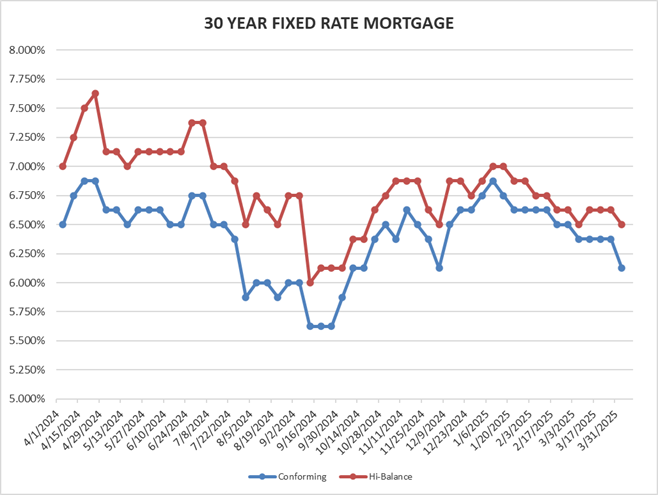
Rates for Friday April 4 2025: Typically higher employment numbers push rates higher as they can foretell a stronger economy; however, Wednesday’s tariff announcements through all other economic data into the somewhat superfluous category for a little while. Investors leaving equities and buying bonds and mortgages, resulting in the lowest Friday rate since early December.
FIXED RATE MORTGAGES AT COST OF 1.25 POINTS LOCKED FOR 45 DAYS FOR PURCHASE TRANSACTIONS:
30-year conforming 6.125% Down 0.25%
30-year high-balance conforming 6.50% Down 0.125%
Please note that these are base rates and adjustments may be added for condominiums, refinances, credit scores, loan to value, no impound account and period rate is locked. Rates are based on 20% down with 740 FICO score for purchase mortgages.
Not sure if addict is the correct word, perhaps strong enthusiast might be more appropriate as millions have the same enthusiasm, perhaps tens of millions.
I referring to our nightly viewing, or future viewing is unable to watch on the nights that Jeopardy! is aired.
While it is fun to answer in the form of a question, an added benefit for me is using the show as a source for my reading list. Biographies of presidents (I’ve been working through pre-Civil War office holders), or classics (currently reading Elmer Gantry by Sinclair Lewis), plus many other books and authors that appear on the 30-square board for the show.
Jeopardy! A source of entertainment in more ways than initially intended!


