

Should we have seller pay costs?
Question of the week: Should we have seller pay costs?
Answer: Yes.
While the answer seems obvious, of course you should have a seller pay costs for you—if they are willing.
But what if the question was, “should we pay more and have the seller pay costs?” The answer will almost always still be “yes.”
In the WR&MU last Friday we answered, “Are prices dropping?” In the discussion were statistics from the California Association of Realtors for home sales in February. Amongst the data were that homes sold at 99.4% of their list price, that 31% of homes on the market reduced their list price, and that the median size of the price reduction was 4.5% of the original list price.
This data shows list prices are softer and that the market overall is shifting from sellers to buyers.
Let’s do some math comparing a lower price or the same price with seller paying costs.
Because I like even numbers, let’s assume a home has been on the market for 60-days is listed for $1,050,000. The timing may be right for the listing agent to approach the seller to lower the price closer to $1,000,000—or perhaps $999,990 because for the psychology of sales indicates it will attract more attention for the extra 1% price reduction because it is not One Million Dollars.
In negotiations the sales price offered by the seller is $1,000,000.
Should you purchase the home for $1,000,000 or more?
You accept the offer and structure your financing with 20% down and a $800,000 loan at 6.5%. Let’s assume loan costs, escrow, title, etc of close to $20,000, is $220,000 for down and closing costs. Your monthly payment on the mortgage would be $5057 per month.
But what if you offered a sales price of $1,035,000? As part of the offer, the seller pays the $20,000 in closing costs, plus agrees to pay for a temporary rate buy down for your loan; a 2/1 buydown.
What is a temporary buydown? It is loan strategy used primarily in higher rate markets to soften the monthly payment for borrowers. In a 2/1 buydown mortgage’s rate is 2% lower for the first year, 1% lower for the second year, then for the rest of the loan at the note rate.
The cost of the buy-down is the total savings in payments for the two years the rate is bought down.
$828,000 mortgage with a 6.5% rate payment is $5235 per month. If you have a 2/1 buydown:
Year Rate Payment Savings/mo Annual Savings
1 4.50% $4,190 $1045 $12,540
2 5.50% $4700 $535 $6,420
3-30 6.50% $5235 $0 $0
Total savings on monthly payments $18,960 thanks to the buydown, this amount is also the cost of to temporarily buydown your interest rate.
Your costs to close are $38,960, the original closing cost plus the buydown.
The seller agrees to pay this amount for you, net proceeds to the seller is about the same as if they sold the property for $996,040.
Your down payment is higher, by $7000, but you save almost $19,000 in monthly payments and the new mortgage for only $178 more per month after two years. The math, cash savings $38,900, divided by $178 per month after two years is almost twenty years before the higher monthly payment equals the savings at closing.
An added bonus, if you sell or refinance the property before the loan rate and payment adjusts to 6.5%, the amount remaining from the buydown is credited to your loan balance for payoff.
Consider in 18-months you can refinance your home for 5.5%, you can do so, get a credit to paydown your balance of approximately $3200, and lock in your lower rate and payment for the future.
If the seller is negotiating on price, negotiate on price and terms for seller to credit costs at closing. The credit can pay closing costs, pre-pay HOA fees, or with the change in real estate agent compensation the seller can pay your agent’s fee.
While a higher sales price will come with a higher down payment and monthly payment, the savings is costs compared to the higher down payment and monthly mortgage difference almost always works out in your favor in the long run.
If you focus on cash to close as opposed to sales price you can generally find common ground with a seller that does them no to little harm while providing a tremendous financial benefit to you.
To schedule an initial meeting by phone or Zoom, click here for my calendar, please feel free to forward to a friend or family member!
Have a question? Ask me!
The second, and final, revision of GDP for the 4th quarter of 2024 showed economic growth of 2.4%, higher than the prior revision of 2.3% growth. Last year ended with a nice amount of growth, though slowing from the prior quarter (3.1%), consistent with inflation slowing as well.
Enough to weather the storm? Personal income increased 0.8% in line with Wall Street estimates, thanks in part to social security benefits being paid out to public sector retirees who had non-Social Security Administration pensions. With personal spending increasing 0.4% in February, incomes far outpaced spending—increasing savings that can be used to buffer possible increases in inflation due to tariff increases.
As expected, the preferred inflation gauge for the Federal Reserve, the Personal Consumption Expenditures (PCE), rose 0.3% in February. The core index (energy and food stripped from data) rose a tick over expectations, up 0.4%. Year over year inflation remains, stubbornly, above the Fed’s 2.0% target, rising 2.5% in February, in line with January’s increase; the year-to-year core rate increased last month to 2.8% from 2.7%. While meeting expectations, inflation is still higher than expectations from five to six months ago and remains a concern for the Fed, and investors.
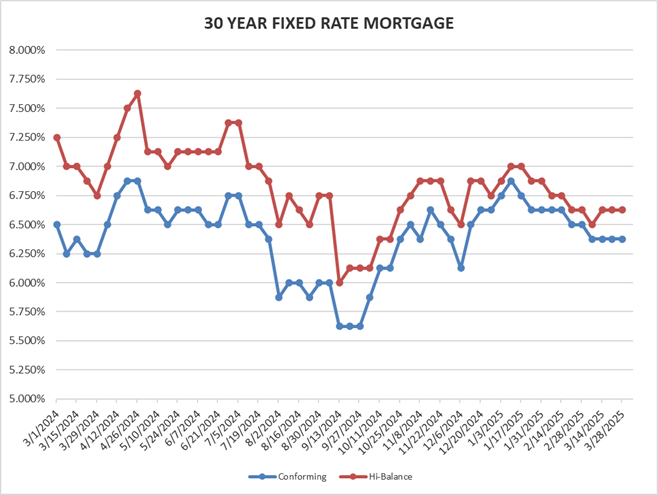
Rates for Friday March 28 2025: We love consistency and stability, and the 30-year fixed rate is giving us that Friday to Friday, despite some early week volatility. The conforming rate has stayed the same for four straight weeks, since it dropped the first week of the month.
FIXED RATE MORTGAGES AT COST OF 1.25 POINTS LOCKED FOR 45 DAYS FOR PURCHASE TRANSACTIONS:
30-year conforming 6.375% Flat
30-year high-balance conforming 6.625% Flat
Please note that these are base rates and adjustments may be added for condominiums, refinances, credit scores, loan to value, no impound account and period rate is locked. Rates are based on 20% down with 740 FICO score for purchase mortgages.
It’s here, it’s here!
Major league baseball is officially underway for all teams (I will refrain from a prolonged rant against the first regular season games being played overseas a week before every other team starts).
Optimism is in the air for most clubs, “this could be our year!” Which is valid as no team has repeated as World Series champions since the Yankees won three in a row from 1998 to 2000.
Eternal hope is all Seattle Mariner fans have had as their team has never made the World Series. Joining the Mariners in having never won the championship trophy, but having played in the World Series, are the Milwaukee Brewers San Diego Padres, Tampa Bay Rays and Colorado Rockies.
This phan is rooting for the Philadelphia Phillies for the 56th straight year!
Ring the Bell!


