


Economy: breezy or stormy?
Question of the week: Economy: breezy or stormy?
Answer: Back from relaxing week in Maui with very soft and pleasant breezes, where a cold front is 81 degrees and a heat wave is 87 degrees, I spent some time relaxing by diving into so economic and mortgage data as we enter the end of the first quarter of 2025.
Some of the news portends soft breezes ahead, some portend potential storms brewing.
Consumer spending drives the economy (65-70% of the economy). The top 10% of income earners (making $250,000 and up) have been responsible for 49.7% of spending, that is approximately one-third of GDP. From September 2023 to September 2024 spending increased 12%, during this same period middle- and lower-class spending dropped.
The bottom 80% of income earners saw a 25% increase in spending from four years ago, the top 10% increased spending by 58%. Inflation during the period was 21%, the increase in spending by the bottom 80% was only 4% above inflation over a four-year period.
Our economic growth has been unhealthily dependent on the very top income earners spending a lot of money.
Housing is another primary driver of our economy. It is not news that housing sales have been very (very) slow the last several years. High interest rates and rising prices has driven many home buyers to FHA mortgages with their low-down payments and some easier to qualify guidelines than conventional mortgages.
Over the past few years, the risk on FHA mortgages has increased somewhat substantially.
In 2007 35% of new FHA mortgages had a debt-to-income (DTI) ratio over 43%. Debt-to-income is your total credit debt, including new housing payment, inclusive principal, interest, home insurance, property taxes, and if applicable mortgage insurance and homeowners association fees, divided by your gross income. If you monthly housing and credit payments are $4300 and your monthly income ins $10,000, your DTI is 43%.
In 2020 the number of new FHA loans with a DTI over 43% was 54%, in 2024 the number grew to 64%. Take out income taxes, social security, health insurance premiums from paychecks, for many FHA borrowers their DTI of net income exceeds 80%, leaving not much for other life essentials like food, clothing, transportation, and almost none for savings.
It is estimated that 79% of first-time buyers using FHA financing have one month or less of financial reserves in the bank. Lack of reserves puts homeowners in a precarious position should a set-back occur.
Of the FHA mortgages funded last year 7.05% were 90 days or more past due on their mortgage payment within the first twelve months of closing. This is higher than the prior peak in 2008, when we saw the mortgage and real estate markets crash and drive the economy and into the Great Recession.
The collapse leading into the Great Recession was greatly caused by homes going into foreclosure driving home values down, leading to more foreclosures as loan balances exceeded home values, or short-sales with lenders agreeing to take large losses through short sales rather than massive losses through the foreclosure process.
Covid relief by the last administration to borrower and mortgage servicers has rescued many delinquent loans. Last year there were 52,531 FHA loans in serious delinquency in their first year, yet only nine went into foreclosure. Many of the homes were saved by owners having enough equity to sell and payoff their mortgage and closing costs, others were propped up with funds from the government.
These funds pay servicers to work with borrowers missing payments to add those payments to the back end of the loan, to be repaid with interest, and/or cut payments by 25% for up to three years. In the past year 556,841 “incentive payments” were made to services to prevent foreclosures, almost the same amount of new loans funded.
Data above from Wall Street Journal
With new administration steam-rolling through federal agencies looking to cut costs and spending, will the federal payments to mortgage servicers to prop up delinquent borrowers continue? If not what is the impact on housing?
The lop-sided spending skewed to upper income earners, and the increasing risk taken by lenders for lower income borrowers and resulting challenges in their making payments, belies some of the strength in economic growth. As well, should employment markets weaken, the first to be cut are usually lower paying jobs, many of whom are already having challenges meeting all their household costs, which could be a tipping point for housing and the economy as a whole.
These are clouds gathering for a potential storm.
On the breezy side, economic data released this week shows continuity from the end of 2024 into 2025. The first revision of GDP for the last quarter of 2024 was no revision; the economy grew at a healthy 2.3% in 2024. Spending increased a healthy 4.2% for the year; the GDP report did show inflation at 2.7%, up from initial estimate of 2.5%.
Looking forward, the Atlanta Federal Reserve revised its estimate of GDP growth in the first quarter down from positive 2.3% growth to negative 1.5% on an annual basis. Part of the downturn can be attributed to severe winter weather in much of the country and the devastating wildfires in Southern California. A large part of the estimate is due to a large trade deficit as wholesalers, retailers, and consumers purchase imported goods ahead of tariffs being put in place by the Trump Administration.
Looking back, in January the Personal Consumption Expenditures (PCE) index, which is the Fed’s preferred gauge of inflation when considering its policy on interest rates, was up and expected 0.3% in January and 2.5% year over year. The core index (food and energy stripped from calculations) showed 0.3% increase in the month and 2.6% year over year, down from December’s 2.9% increase. The drop in the core rate is positive for rates.
Personal incomes grew well above 0.4% expectations, rising 0.9%. The growth was well above inflation, but did not spur increased spending as the report showed spending dropped 0.2% from December—likely attributed to weather and fires.
To schedule an initial meeting by phone or Zoom, click here for my calendar, please feel free to forward to a friend or family member!
Have a question? Ask me!
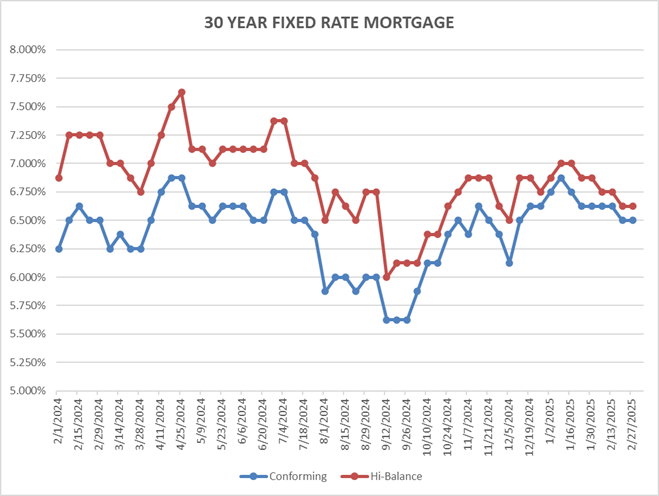
Rates for Friday February 28, 2025: Benign inflation news keeps rates flat from last Friday.
FIXED RATE MORTGAGES AT COST OF 1.25 POINTS LOCKED FOR 45 DAYS FOR PURCHASE TRANSACTIONS:
30-year conforming 6.50% Flat
30-year high-balance conforming 6.625% Flat
Please note that these are base rates and adjustments may be added for condominiums, refinances, credit scores, loan to value, no impound account and period rate is locked. Rates are based on 20% down with 740 FICO score for purchase mortgages.
Happy Birthday to those who don’t have a birthday this year; I’m speaking of course of those born on February 29th. Since the last day of the month is on a Friday this year, assuming a lot of celebrations between 11:59:59 and 12:00:00 tonight!


