


Can we pay off debt to qualify?
Question of the week: Can we pay down debt to help qualify?
Answer: Yes.
But before you start paying off credit obligations know how much and what needs to be paid down, or off, so you do not pay more than you need to in order to qualify—and leave yourself with less cash for closing.
As well, it is better to a have plan before you open escrow on your new home, and even better if you have that plan before you start looking.
With some exceptions, mainly court ordered spousal or child support, the debt payments we will use for your loan qualifying will be those that show on your credit report. Your credit report will show the mandatory minimum payment for each account, this is the amount we will use.
I bring up that last statement as often when doing a quick initial pre-qualification without a credit report I ask clients what their credit card payments are and they will give what I feel is a large number, “about one-thousand a month.” When probing further, I learn this is the amount they are paying, but their minimum payments are actually $250 per month.
Using $250 per month as opposed to $1000 is a big difference in qualifying loan amount.
As a rule, most credit card companies’ minimum payment is 2% of the outstanding balance. When calculating how much to pay down on credit cards to ensure qualifying, that is the calculation we use to determine the balance, and therefore the monthly payment, we will need.
After housing, the largest payment most families have are car payments. Because of this, if we are able to eliminate a car payment we can leverage into a much higher mortgage amount. Before you go pay off your car before you start looking for your new home, know that for conventional mortgages you do not need to pay off the balance to eliminate the payment from your mortgage qualifying.
Installment loans, which includes car and student loans, that have ten or fewer payments remaining will not be included in qualification calculations. If your car loan payment is $750 per month, the payment will not count if the balance is $7500 or less.
Note lease payments cannot be eliminated unless you can show you no longer have the car or the payment. If you trade it in for a lower lease payment we will use the new lease.
When is the best time to lower balances to improve your qualifying? Ideally before you find a home and we start your mortgage application, but not too long before as credit reports are valid for 60-days before they have to be refreshed and updated.
After paying down your balances we will need a credit report showing the new balances. If we have already run a credit report to use for calculating balances and minimum payments, we will need to run an updated report to show the lower balances and payments.
Here is a quick example: Fred and Martha have $25,000 in credit card balances with $500 in minimum payments. They also two car payments, one for $650 with a balance of $12,000 and another for $480 with a $7,000 payment. Their monthly income is $15,000 per month.
They want to purchase a home for $1 million and have $225,000 from the sale of their prior home to purchase their new one.
The payment for mortgage, taxes and insurance is about $6000 per month, or 40% of their gross income, their monthly payments are 11% of their monthly income if 11% for a debt-to-income ratio of 51%. We would like to get to 45%. Which means we need to eliminate $900 in payments.
Paying off the credit cards costs $25,000 and eliminates $500 in payments leaving us $400 short. Leaving them with $200,000 for their purchase.
Paying down the $650 payment auto loan to $6500 and the $480 payment auto loan to $4800 eliminates both those payments, $1130, and costs only $8200 ($12,000 – $6500 = 5500; $7000 – $4800 = $2700). Leaving them with $216,800 for their purchase.
Often when we are paying credit down and off to lower payments, we are also targeting certain accounts and balances to also improve credit scores. If this is the case for Fred and Martha we may target some credit cards as well.
Schedule an appointment to discuss your options if you are considering purchasing a new home or property, or refinancing an existing one and want to know the mortgage options available to you.
Have a question? Ask me!
How much? That is the question all the econ kids are asking after Wednesday’s Consumer Price Index data for August was released. How much with the Fed cut its benchmark interest rate next week, 0.25% or 0.50%. The CPI data was a bit mixed as total CPI dropped 0.2% in August and was 2.5% since last August, the lowest inflation rate since early 2021. The “core” rate, which strips out food and energy due to their price volatility and is the data most important to the Fed in it decisions, rose 0.3% last month, the highest increase since March and year over year the core rate was a 3.2% increase in prices.
Why mixed? A rate cut next week is as certain as the Kansas City Chiefs beating the local high school team. What has not been certain is how much the rate cut will be. There has been some support for the larger rate cut from those who feel the Fed will want to get ahead of the economy if slowing to prevent a “hard” landing into recession. The stickiness of core prices to come down lessens the chance for the larger rate cut.
Holding prices up is most families’ primary expense: housing. Rents and home prices continue to increase over much of the country, preventing the core price index from slowing. Looking forward, this trend is likely to continue as lower interest rates will not ease home prices as demand will increase as rates drop without a corresponding increase in supply to slow prices, or cause prices to drop.
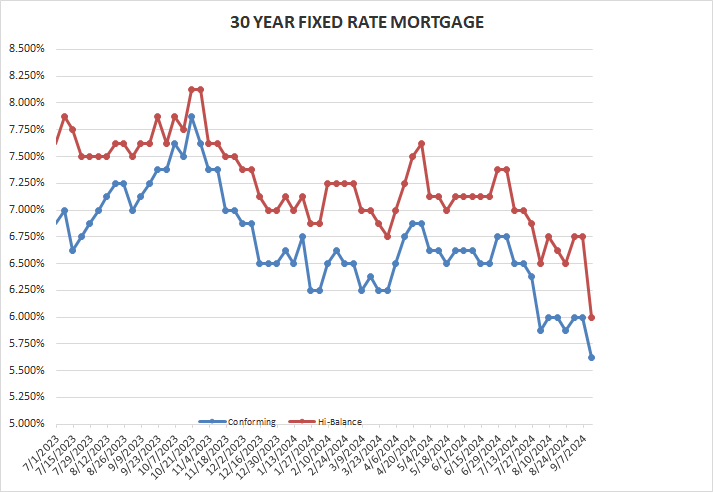
Impact on mortgage rates is significant, as rates this week are their lowest since two years ago this week. Regardless of whether the Fed drops its rate by one-quarter or one-half a percent next week the result should not have a negative impact on mortgage rates.
Rates for Friday September 13, 2024: The conforming rate drops three-eighths of one percent this week (0.375%) to, as mentioned, its lowest level since September 2022.
FIXED RATE MORTGAGES AT COST OF 1.25 POINTS LOCKED FOR 45 DAYS FOR PURCHASE TRANSACTIONS:
30-year conforming 5.625% Down 0.375%
30-year high-balance conforming 6.00% Down 0.75%
Please note that these are base rates and adjustments may be added for condominiums, refinances, credit scores, loan to value, no impound account and period rate is locked. Rates are based on 20% down with 740 FICO score for purchase mortgages.
For some mathematical reason the 13th of the month is more likely to fall on a Friday than any other month. Which is strange that it is the combination of the two that is, to some, bad luck and a reason to stay under the covers all day.
Friday the 13th is so scary there are two names for it, paraskevidekatriaphobia or friggatriskaidekaphobia. Both look like who ever typed them fell asleep with their fingers on the key board.
Happy Friday the 13th to you, knowing something positive will happen to you today!


