


Do we need title insurance?
Question of the week: Do we need title insurance?
Answer: Yes, no, maybe…
Title insurance is in the news this week as the Biden Administration is investigating the title insurance industry and the relationship between the cost of the insurance to consumers and the risk to the insurance companies.
Earlier this week a roundtable at the Treasury Department that included title insurance officials, consumer advocates and others to examine the issue. The meeting is an extension of the Consumer Financial Protection Bureau’s investigation into “junk fees” in mortgage closing costs, which included fees from other industries, including title insurance.
What is title insurance and why do you need it?
Without going deep into the weeds, as is my norm, here is what I hope is a simple explanation.
When there is a property sale with a mortgage there are two title insurance policies that are issued.
One policy, that is typically paid for by the seller, protects the new owner should any claims against their title arise in the future. Claims could include someone claiming they have ownership rights and the property should not have been sold, perhaps a divorce or probate sale in the past. The boundaries of your property are covered, a neighbor builds a wall on what they think is the property line, and it is not, or an easement for rights of way for ingress and egress, such as the power company or other utility, on the property may have limits, exclusions, or may have changed over the years.
The ownership, the physical boundaries, and right to access are insured by the title company, any disputes that arise later that may cost you money for correction or loss will be covered by your policy.
If there is a mortgage as part of the purchase transaction, or if you are refinancing, the lender requires a title company policy that insure that the only liens that will be against the property will be those disclosed prior to closing by the title company. This policy is paid for by the buyer, or homeowner is a refinance.
Prior to closing the title company will provide the lender with a preliminary title report that shows liens for taxes, perhaps a homeowners’ association if applicable, and other entities that will be on the title at closing. If there are current mortgages, loans, judgments, back taxes, etc that are currently on the property, the title insurance is guaranteeing to the lender this will be paid at, or before closing, and will not be on the title after closing.
The lender is very concerned about this because they do not want a lien holder filing a claim and requesting payment or it will foreclose on the property that has priority over the lender if there is a foreclosure resulting in the lender losing a lot of money.
As well, with a purchase, the lender will require the policy insuring the buyer will have complete ownership and control of the property as that is the person(s), or entity, that they are funding for the purchase.
The answer to your question is, if you are buying a home with a mortgage, yes, you will need title insurance—two separate policies, one paid for by the seller and one by the buyer.
If your are buying a home without a mortgage, you do not need the policy that protects the lender, and if you want to risk it, you do not need the policy insuring your ownership and rights after closing—though it is highly suggest your do have the seller provide this policy.
If you are refinancing, you will need the policy insuring that the only liens on the property after closing are those disclosed in the preliminary report.
The issue that is being investigate by the federal government is primarily the policy the buyer pays for that insures against future liens on title that pre-date the closing date.
The typical home sale for existing homes, i.e. not new construction, has gone through several sales and refinances over the years. Each of the transactions has had many title insurance investigations and policies issued guaranteeing rights of ownership and lien holders. The contention that is being investigated is because of all the prior policies have guaranteed the title, why are large premium costs being charged for new policies, especially for a refinance.
Studies that are being used by the government show that the amount of payouts by insurers amount to around 3% of total premiums, showing the cost of the policies is not in step with the risk the companies are taking. As such, the costs to consumes for title insurance should be lower.
Fannie Mae is working on a pilot program that will waive the title insurance requirement on refinance transactions that are considered low risk.
Real estate, mortgage and title insurance companies are awaiting the final determination by the CFPB that could, probably will, result in regulations regarding title insurance fees—as well as fees in mortgage transactions.
Until then, if you are buying or refinancing your home you will need title insurance.
Schedule an appointment to discuss your options if you are considering purchasing a new home or property, or refinancing an existing one.
Have a question? Ask me!
I don’t want to signal anything, but…Federal Reserve Chair Jerome Powell had two days of testimony before Congress this week, leading with not wanting to provide any signals about cutting rates. He then went on to say that continuing softening of inflation, and that looking at the labor market it has cooled; both of which portend the Fed lowering its benchmark interest rate in September. Markets liked his not signaling an rate cuts, their reaction was pricing in a rate cut in September.
Supporting rate cuts in the near, and longer term, was Thursday’s Consumer Price Index report for June that showed prices dropped month to month for the first time since May 2020, prices in the index being 0.1% lower than in May. Year over year CPI was up 3.0%, after being 3.3% in May. Core prices (stripping food and energy from the data) was up 0.1% from May and up 3.3% from June 2023. The primary factors for the negative prices from May are gas prices dropping 3.8% and used vehicles down 1.5%. Good news for those looking for housing, rent increases are slowing nationwide.
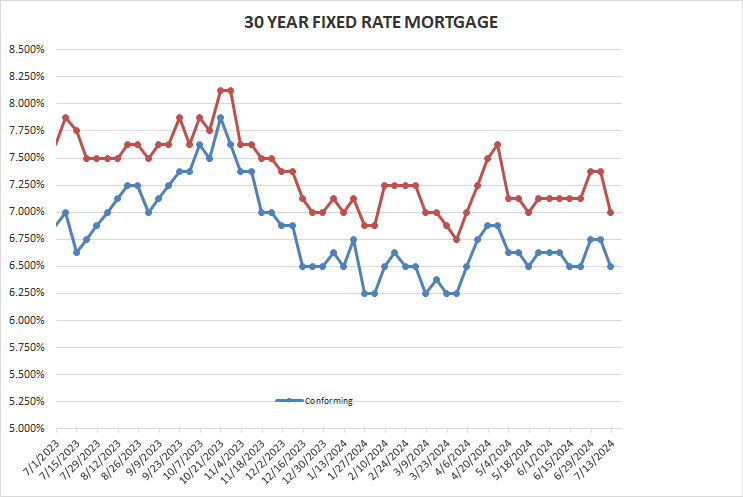
Rates for Friday July 12, 2024: Rates last Friday were consistent from the week before, not so this week as rates had their largest week to week decline since May.
FIXED RATE MORTGAGES AT COST OF 1.25 POINTS LOCKED FOR 45 DAYS FOR PURCHASE TRANSACTIONS:
30-year conforming 6.50% Down 0.25%
30-year high-balance conforming 7.00% Down 0.375%
Please note that these are base rates and adjustments may be added for condominiums, refinances, credit scores, loan to value, no impound account and period rate is locked. Rates are based on 20% down with 740 FICO score for purchase mortgages.
The Smith household is back to “normal,” which is empty-nesting after having our girls home for a few weeks. We are at that stage that we love having them home, but also happy when they go to pursue their own lives.
Back to watching Jeopardy! and other shows we like…
Have a great week,
Dennis
Past Weekly Rate & Market Updates can be found on my blog page at my website www.DennisCSmith.com/my-blog


