


How do we pay off ________?
Question of the week: How do we pay off _______?
Answer: Parent passing away, divorce, vacation home with family member, college, medical bills, credit card and other debt, are some of the scenarios when we are contacted by clients looking for assistance to obtain a large amount of funds.
In the past five years home prices in California have rocketed up. From June 2019 to April 2024 (most recent data available from the California Association of Realtors) the median home price statewide have increased 48%, in Los Angeles County the median price is up 38%, and in Orange County the five year increase is a staggering 71%.
This increase in home values has created almost hundreds of billions of dollars of equity for homeowners.
Equity can be used to payoff debts, settle legal actions, or improve the value of property. In other words, equity can be converted to cash to be used in any manner desired.
Equity is mostly converted to cash with either a long-term mortgage or a Home Equity Line of Credit. Each has their advantages and disadvantages depending on the reason for the funds, long-term plans, and ability to repay.
For mortgages we will use a standard 30-year fixed mortgage for our examples. The rate and payment are fixed for the term of the mortgage and the guidelines used will be those set forth by Fannie Mae. This is the Wonder Bread of mortgage products.
A HELOC, is a loan that is secured by the property, is in second position to an existing mortgage (meaning in foreclosure is gets paid after costs of the foreclosure, the government for taxes owed if any, and the primary mortgage). HELOCs are similar to credit cards, there is an maximum credit limit, with the exception of a possible annual fee, payments are based only on the outstanding balance—so if no balance no payment, and there is a minimum payment based on the balance—typically interest only.
Where HELOCs differ from most credit cards is the rate is adjustable. HELOC rates are based on the prime rate and move up and down as the prime rate moves.
A very big advantage the HELOC has over a traditional mortgage are the significantly lower credit costs. The primary disadvantages are the rate is usually higher than the fixed rate mortgage, and the adjustable rate as borrowers do not know what their rate and payment will be in the future. Note, the prime rate almost always moves up or down when the Federal Reserve raises or lowers its benchmark rate. With the Fed signaling it is pretty certain it will not raise rates in the future, those with HELOCs are fairly safe in assuming their rates will go down in the future (see economic recap below).
For traditional mortgages pulling equity out of a home is known as a cashout refinance. A cashout refinance has a fairly significantly higher interest rate than a rate and term refinance that is used to lower the rate and payment on a mortgage with not funds being distributed to the homeowner.
However, when equity is pulled out of a home to settle a legal matter and funds are paid directly to the other party as a settlement the transaction is priced as a rate and term refinance and not a cash out. This applies to pulling funds out to settle and estate or a divorce.
Sara and Frank are getting divorced after 10 years. They own a home that is worth $1 million and they have a mortgage of $500,000. As part of their division of assets in their divorce decree, Sara will retain the home if she removes Frank from the current mortgage and pays him $200,000.
If it was just paying him the $200,000 Sara may want to get a HELOC as their current mortgage rate is 3%. However, she needs to get him off the current mortgage so she applies for and qualifies a $700,000 mortgage at a 6.5% rate. Her payment will be about $4400 per month, however the $2000 per month in support payments from Frank bring the payment to close their current mortgage payment.
Another common legal settlement is the family home. Mrs. Miller passed away, the family home she has lived in for the past fifty years is valued at $1,000,000, there is a balance of $300,000 on a reverse mortgage taken out several years ago to pay off her mortgage and provide monthly income to pay for home care. Her children Jack, Jill and Jane are the beneficiaries of her estate that includes not only the home but an IRA with about $300,000 and other liquid assets totaling about $100,000. Jack and Jill live a distance from the family home, while Jane lives not far away and would like to keep the home. In the division of assets, the total of the IRA, other liquid assets, and net equity is about $1.1 million. Each child is to receive approximately $367,000.
Jane proposes that her siblings split the IRA and other liquid assets for $200,000 each, and she pays them another $167,000 for their share of ownership in the family home.
Jane refinances for a total of $634,000 at a rate of 6.5% with the proceeds of the mortgage, after the reverse mortgage being paid off, going directly to Jack and Jill or to the estate to distribute. Each of the children has benefited close to equally from mom’s estate.
A further bonus for Jane is due to Proposition 19, because she will occupy the home, she will also inherit her mom’s property tax base.
Pulling equity out to pay off other debt changes what instrument to use for two reasons. One, there will be no change in title or need to remove a party from the mortgage. Two, because the transaction will need to be a cash out refinance the rate will like be higher than a rate and term refinance.
Because of this, depending on the amount needed, and the current rate on the primary mortgage, the homeowner may find a HELOC is a better option.
Consider Barry and Betty who have a home valued at $1 million, they have a 30-year fixed rate mortgage with a balance of about $465,000 with a payment of $2100 and a rate of 3%. Over the past several years they did a lot of small home improvement/remodeling projects in their home, and each had some significant medical situations; the result is they have about $75,000 in credit card debt costing them about $1500 per month in just the minimum payments.
Option one is to refinance their mortgage and debt for a total of $540,000 at a rate of 7.00%. This will give them a payment of about $3600 per month, about what they are paying now.
Their other option would be to get a HELOC with a maximum amount of $250,000* with a rate of the prime rate plus one-half of one percent (0.50%) for a current rate of 9.00%. The interest only payment on the balance would be $563 per month, however, by making this payment the balance never gets paid off.
If the current payments to the credit cards of $1500 per month is paid on the HELOC, at the current rate the balance will be paid off in about five years. However, with rates likely to be going down over the next few years, the rate on the HELOC will drop, accelerating the payoff of the balance.
Using the HELOC and paying the current credit card payment the amount is paid off in 5-years, whereas using a 30-year mortgage the amount is carried proportionally over 30-years, not to mention another four years have been added to the mortgage, which is about $170,000 in payments.
A question some may be thinking, “if rates are going down, can’t the 30-year mortgage be refinanced to lower the payment?” Yes, it can, however in doing so costs will be incurred, and the length of the mortgage extended.
Whether extending the term of the mortgage matters or not is a different question for another WR&MU.
*Since not paying for unused amount available on the HELOC, it makes sense to get more than needed in case something comes up in the future so you don’t need to go through process and expenses of getting another HELOC.
Using home equity to payoff debt can be a problem if, like we saw in the mid-2000’s, homeowners begin to use their homes as credit cards, constantly pulling out equity to payoff debts for credit card debt used for consumer goods, trips, boats, cars, other “toys.” However, for unusual, or one-time situations, using equity for debt consolidation can be a beneficial financial move.
To schedule an initial meeting by phone or Zoom, click here for my calendar, please feel free to forward to a friend or family member!
Have a question? Ask me!
Yes, no? Another pogo-stick week as investors got good news (for rates) then not as good news. Early in the both the Canadian and European Central Banks lowered their benchmark interest rates by 0.25% based on economic conditions in their regions. This combined with labor data showing an increase in unemployment claims, and a decrease in job openings, gave support to the Fed lowering its benchmark rate this year, with some saying two rates cuts by the end of the year.
From “yes” to “no.” A wet blanket was thrown on the lower rate expectations today with the Labor Department’s release of May jobs data. The expectations were that 185,000 jobs were added to the economy for the month, somewhat missing the mark when the data showed 275,000 new jobs in May. Also in the report was the average hourly wage increased 0.4% for the month and 3.9% year over year—both higher than inflation. One concern I have in the data is that the second highest sector adding jobs is local, state and federal government positions—my concern is that these jobs do not add to economic growth but instead to government spending and debt that is paid for by the private sector. The report reversed gains in mortgage securities (lower rates) from earlier in the week.
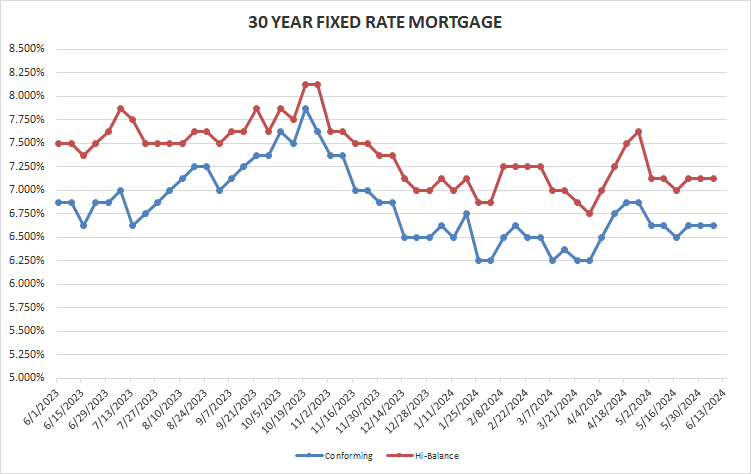
Rates for Friday May 31, 2024: As a result of today’s data, rates are the same for the third week in a row.
FIXED RATE MORTGAGES AT COST OF 1.25 POINTS LOCKED FOR 45 DAYS FOR PURCHASE TRANSACTIONS:
30-year conforming 6.625% Flat
30-year high-balance conforming 7.125% Flat
Please note that these are base rates and adjustments may be added for condominiums, refinances, credit scores, loan to value, no impound account and period rate is locked. Rates are based on 20% down with 740 FICO score for purchase mortgages.
Yesterday was the 80th anniversary of D-Day. Eighty years before D-Day, June 1864, the Civil War was approaching its tipping point, in part because of the Battle of Cold Harbor, part of General Grant’s attempt to take Richmond, the capital of the Confederacy. The two week battle was brutal with over 12,000 Union casualties and almost 5,000 Confederates killed or wounded. General Lee and his troops repelled the Union attack, a victory that would be Lee’s last against the Union Army.
Eighty years later American soldiers would again fight a brutal battle in a prolonged war fought to free millions from oppression. Thankfully, due to those who fought these battles 80 and 160 years ago, we remain a free nation and a beacon to the world shining a light of liberty.
One final note, eighty years before the Battle of Cold Harbor, on June 3, 1784 the Congress of the Confederation established the United States Army on June 3rd(put into power with the Articles of Confederation, replacing the Continental Congress and in place until 1789 with the ratification of the Constitution).
This being the often personal section of the WR&MU, since our move to the Philadelphia area, where we could ride bikes to Valley Forge National Park, I have had a lifelong interest and in American history, particularly the “war eras” of the Revolution-Constitution, Civil War and World War II, they come together in our update this week.
Have a great week,
Dennis
Past Weekly Rate & Market Updates can be found on my blog page at my website www.DennisCSmith.com/my-blog


