


When should I throw away our financial and tax documents?
Question of the week: When should I throw away financial and tax documents?
Answer: NEVER!
Never throw away any document that has any financial or personal identification information such as your social security number, ALWAYS SHRED THEM.
Okay, perhaps that was a bit over the top, but before I get to how long you should retain records, I want to strongly emphasize never tossing any bank statements, tax documents, paystubs, etc into your trash. Always shred these documents to prevent identity or financial theft. One of the primary sources of identity theft is your garbage bin outside your home, many thieves posing as recycle bin divers are more interested in what financial documents they can find in your trash can other than the soda cans and wine bottles.
Buy a home shredder, Amazon and other stores have many low cost, small shredders that you can use to shred any documents and protect your identity and assets. If you do not have one, buy one, a $50 or $60 investment that may save you thousands.
Now onto the intent of the question, how long should you retain financial and tax records?
Over the years I have been asked this question by many clients and the standard answer from most tax professionals is for federal tax documents retain your records for three years and for state taxes retain your documentation for four years. Conventional wisdom to retain the records for seven years. The IRS can audit you for the prior three years, however in auditing one year they can discover something that causes them to look for the prior year, and then the year prior. From the IRS website, “Generally, the IRS can include returns filed within the last three years in an audit. Additional years can be added if a substantial error is identified. Generally, if a substantial error is identified, the IRS will not go back more than the last six years.”
There is a very important qualifier to retaining your records: records relating to the purchase of your home and mortgage documents should be kept permanently. Even if you are in your home for fifty years, when the time comes for the property to be sold or transferred as part of your estate there may be, probably will be, the need[DCS1] to establish the cost basis and other factors that weigh into any potential capital gains calculations.
Other factors that could trigger capital gains calculations and needing documents establishing value are death of spouse or co-owner of home, divorce, major remodel.
So, there you have it, on the short side three years for federal tax documents and four years for state documents, but to be safe save records for seven years for most records like bank statements and income records, but save records on your home purchase until you no longer own the home.
To schedule an initial meeting by phone or Zoom, click here for my calendar, please feel free to forward to a friend or family member!
Have a question? Ask me!
The economy remains hot and does not appear to be cooling for a while. Consumer spending is 65-70% of our economy, retail spending, purchases of goods[DCS2] , is an estimated one-third of consumer spending. In March retail sales increased a robust 0.7% from February, as well sales in February were increased from the original report. Auto sales were slow in March, taking that sector out of retail sales and the monthly increase was 1.1%. Driving the data was a 2.7% increase in internet sales.
A strong indicator of consumer sentiment regarding their future economic situation is discretionary spending, eating out is a very big factor in this sector. In March spending in restaurants increase 0.4% and is up 6.5% from last year.
Looking at the data for the past few months, next week’s GDP report is expected to show growth of 2.0% in the first quarter, my expectation is higher, closer to 2.5% than 2.0%. Also coming out next week is the Fed’s primary inflation indicator, the Personal Consumption Expenditures Price Index (PCE). There is a good chance that PCE will not be moving to the Fed’s liking, i.e. down, putting Fed rate cuts in 2024 as less likely.
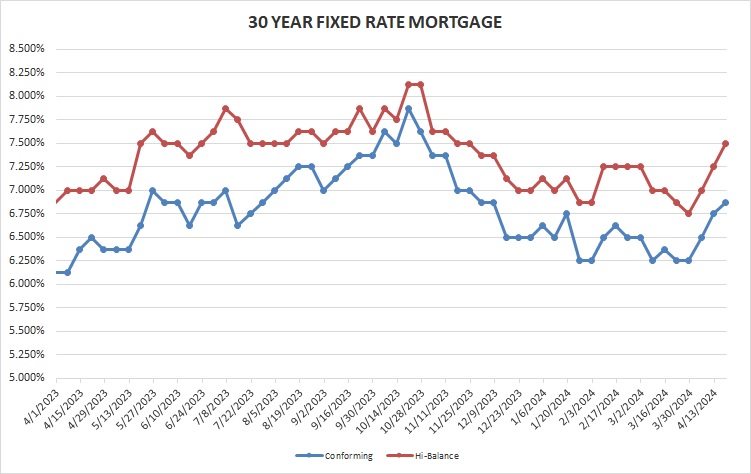
Rates for Friday April 19, 2024: Historically armed conflict creates a “flight to safety” for investors, moving investments from stocks to bonds, thereby pushing rates lower. Our economic data has suppressed this flight to safety as the Iran-Israel conflict escalates. Rates are higher, again, this Friday, to their highest since early December 2023.
FIXED RATE MORTGAGES AT COST OF 1.25 POINTS LOCKED FOR 45 DAYS FOR PURCHASE TRANSACTIONS:
30-year conforming 6.875% Up 0.125%
30-year high-balance conforming 7.50% Up 0.25%
Please note that these are base rates and adjustments may be added for condominiums, refinances, credit scores, loan to value, no impound account and period rate is locked. Rates are based on 20% down with 740 FICO score for purchase mortgages.
The WR&MU is coming to you from a laptop. Yes, my ThinkPad laptop, but also my laptop as I work from the family room recliner with an ice wrap around my right knee which was jealous of my left knee’s replacement in November and followed suit on Monday.
The process begins again to rehab a knee, with the big goal to be playing golf by winter, hopefully sooner!
Have a great week,
Dennis
Past Weekly Rate & Market Updates can be found on my blog page at my website www.DennisCSmith.com/my-blog


