


How will AI impact the mortgage industry?
Question of the week: How will AI impact mortgage industry?
Answer: It already has.
In the mid-1990’s Fannie Mae and Freddie Mac rolled out “Automated Underwriting Systems” (AUS). It enabled lenders to upload loan applications and credit reports through AUS where the program analyzes the data and returns with a credit decision.
The decisions are returned very quickly, less than a minute.
Using Fannie Mae as our example, when the decision is returned it will have one of three decisions:
- Approve/Eligible
- Approve/Ineligible
- Declined
With each of the decisions the results will indicate what will be needed for final loan approval, why the file is ineligible, or why it was declined.
If eligible, the decision will list conditions that have to be met/proven for final approval. Proof of income and assets listed on the application, and an appraisal confirming the value are the three main factors listed. With the Approve/Eligible, we send the file to underwriting with the Fannie list of conditions proving income, assets, property value, and any factors that also need to met per overall underwriting requirements, i.e. sourcing large deposits, gift letters if applicable, explain gap in employment.
If the Approve/Eligible is our AUS result, it may not be unexpected. Most lenders require an AUS result for their jumbo mortgage products. The “ineligible” for these applications is usually because the applied for mortgage amount exceeds the maximum loan limits for the area.
At times the ineligible results in operator error when inputting the file (occasionally guilty) which when corrected returns the Approve/Eligible result.
When “declined” is the result, this is usually an input or calculation error. My experience is that I most frequently receive decline results when applicants have multiple properties and calculating rents, expenses, mortgages, matching them to the correct properties.
It is very rare that we have a “declined” as a final result as we will not submit files into AUS unless we know the file meets underwriting guidelines, we have the evidence to back up our application, and the file is approvable and able to close when underwriting.
It is for another WR&MU, but the Fannie/Freddie AUS were a primary factor in the mortgage and real estate collapse that began in 2007 due to very loose conditions regarding income and asset verification.
Looking forward, there is not much more that AI can do in the mortgage process in our industry. One area being explored is scanning a file into a program and having it analyze the data on paystubs, W2s, tax forms, bank statements, to confirm income and assets.
Where AI will have a very difficult time replacing humans is setting up mortgages application packages for applicants who are not “cookie-cutter” for lack of a better analogy; borrowers who are W2 employees with long term employment, have very good credit, their funds for closing are in their accounts with no big deposits or unusual transfers.
Where files have wrinkles, such as self-employment, using asset depletion for qualifying, inter-family transfers such as estate or divorce, multiple properties owned, whoever writes code for AI underwriting will have a very challenging time to understand nuances, sleuth through documents and histories to put together a file that meets the underwriting guidelines and result in an approved file and funding.
Where I see a lot of AI being increasingly used, and it is somewhat annoying, is marketing. My inbox is exponentially getting filled with messages that are marketing services and companies, not all of them in the mortgage or real estate industries, that obviously are written by AI, and have time frames for re-sending “you must have missed my email” messages with a day or two. My list of emails that automatically go to my Junk folder seems to double weekly—not counting those in our system spam folder than never reach my inbox.
As I see it, the mortgage industry, which has been using AI for around thirty years, does not have a lot of room for expansion in regards to mortgage origination and approval processes. But, I am likely wrong with this assessment and will be proven so in the coming years/decade.
To schedule an initial meeting by phone or Zoom, click here for my calendar, please feel free to forward to a friend or family member!
Have a question? Ask me!
Slowing. That is the description of consumer spending and inflation. January saw consumers spend 0.2% more in January than December, which did not result in more goods and services, as the inflation index used by the Federal Reserve to determine interest rate decisions increased 0.3% for the month, 0.4% if fuel and food taken from the data. Income jumped up 1.0% in January, but the increase was mostly due to dividend payments being received from December and more importantly the cost-of-living increase to social security recipients. Overall, the data this week was somewhat mortgage rate neutral as the data was as expected.
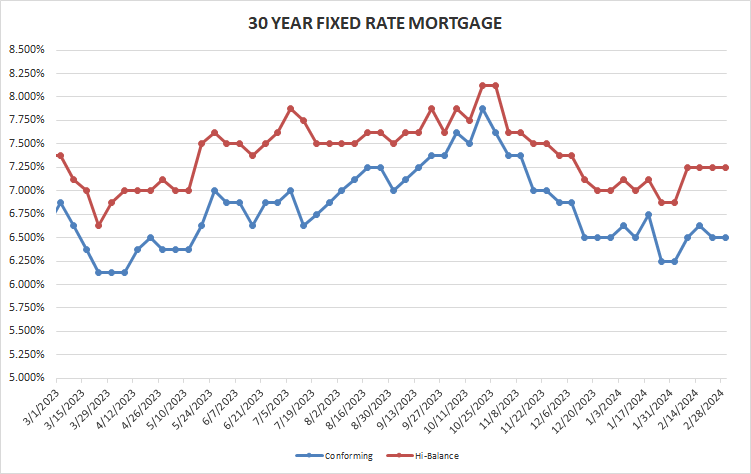
Rates for Friday March 1, 2024: With the PCE inflation index coming in as expected, investors are anticipating a rate decrease by the Fed as more likely than not. While rates are flat from last week there appears to be some downward pressure on rates.
FIXED RATE MORTGAGES AT COST OF 1.25 POINTS LOCKED FOR 45 DAYS FOR PURCHASE TRANSACTIONS:
30-year conforming 6.50% Flat
30-year high-balance conforming 7.25% Flat
Please note that these are base rates and adjustments may be added for condominiums, refinances, credit scores, loan to value, no impound account and period rate is locked. Rates are based on 20% down with 740 FICO score for purchase mortgages.
March 1st…this morning on our walk with the dog I told Leslie that in elementary schools in Oklahoma and Pennsylvania, March 1st meant that our classrooms would be decorated with lambs and lions. Of course, with seasons in those areas that have weather that is different in each season, the onset of Spring had more impact than it does here in Southern California year after year. The “in like a lion out like a lamb” was hopeful for kids and adults alike as we looked forward to mowing lawns and playing ball in the streets, instead of shoveling driveways, or stuck inside due to freezing rain or sleet.
California’s in like a lamb out like a… lamb? Ewe? Ram? March weather doesn’t seem to have the same impact.
Thankfully!
Have a great week,
Dennis
Past Weekly Rate & Market Updates can be found on my blog page at my website www.DennisCSmith.com/my-blog


