


Can commercial market drag economy into recession?
Question of the week: Can commercial market drag economy into recession?
Answer: Maybe.
Those of you who are old enough may recall that the Great Recession that began in late 2007 was precipitated by a collapsing housing market. Dropping housing prices led to many homeowners owing more on mortgages than their homes were worth. Some tried short-sales, others just left their homes. As more and more properties hit the market, either through short-sales, or as bank owned properties following foreclosures or abandonment, prices continued to drop.
The dropping value of bank collateral put banks underwater as well and led to many banks failing—their assets being purchased at discounts by other, much bigger banks, often at the insistence of the Federal Reserve.
The negative repercussions began to ripple, then flood, through other sectors of the economy and unemployment soared, especially for the major foundation for homeownership, middle income earners.
Technically lasting from December 2007 to June 2009, the impact of the Great Recession to the housing market lasted well into 2010, in some regions into 2011.
Our question of the week asks if the commercial market today can do what the residential market did in 2007 and pull the economy into the recession.
There is a fairly good chance that it may.
Some data on commercial real estate (note “commercial” encompasses a very large range of property, essentially anything that is not 1-4 residential units):
- 19.6% of office space vacant in 4th quarter 2023, highest since 1979
- $541 billion in commercial loans were due in 2023, many of these loans, and loans due in 2022, received one- or two- year extensions which run out this year and next
- $2.2 trillion in commercial loans mature between now and the end of 2027
- Rent regulated residential buildings (again not 1-4 units) values dropped 34% since 2019
- 25% of central business district buildings (think high rises in major cities) loans are with foreign banks, 17% with regional and local banks
- Regional and local banks hold 54% of medical office building and 45% of suburban office building debt
What does all this mean in regards to our economy?
Last week in the economic roundup section of the WR&MU the trouble New York Community Bank is in was mentioned. Delving further into that trouble, as a microcosm for the commercial banking issues that may come to bear, provides us with a very similar set of circumstances that led to the residential real estate market collapsing the U.S. and global economies.
NYCB is the biggest lender to owners of rent stabilized apartments, i.e. rent controlled by government fiat, with approximately $18 billion outstanding, or 20% of its loans. Above it is mentioned that rent regulated buildings have lost 34% of their value; not mentioned above is the increasing number of buildings/complexes in New York City, and other urban areas, selling for 50% or below of their prior purchase prices.
If 20% of your portfolio’s collateral has lost 34% of its value, that means the overall collateral for the bank has lost 6.8%, absent decline in values of other assets, i.e. office buildings.
Expand NYCB to other banks, say two other banks that hold a lot of loans to residential buildings that are rent regulated, JPMorgan Chase and Wells Fargo. The regional bank’s issues are also issues that two of the biggest banks in the world are also having, again absent the declining values of commercial office space and other commercial loans. Expanding overseas, whose banks hold 25% of business district loans, U.S. banks are not the only ones at risk in the commercial space.
Higher vacancies, weaker cash flows, declining values, loans coming due, rates on new loans up to 3%, or more, from existing debt that is having troubled being serviced by leases, add up to a very concerning sector of the economy. A sector, that is highly leveraged, though not as much as the residential real estate sector leading to the Great Recession.
Using NYCB as the example of the commercial banking sector is appropriate. Why? Because the first domino to fall that led to the Great Recession fell in February 2007 when Irvine based New Century Mortgage could not sell a portfolio of mortgages on Wall Street as they were determined to be too risky, too leveraged, for the rates of return. This led to the collapse of New Century, which led to scrutiny of other “hard money” lenders, who in turn could not sell their portfolios, leading to their collapse.
At the time I wrote that the hard money mortgage market only made up about 10% of the residential mortgage market. Ten percent was enough to pull down several lenders and banks, and property values.
Loans coming due on properties with declining values and cash-flows, into higher interest rate market is a good formula to weaken any banking system.
To schedule an initial meeting by phone or Zoom, click here for my calendar, please feel free to forward to a friend or family member!
Have a question? Ask me!
Our market this week could have the Ohio Players providing the theme song (with Wolfman Jack as bonus). Okay, so the rate roller coast was not something to love…Rates jumped up on Tuesday, started rebounding on Wednesday and Thursday, then jumped again on Friday. Since prices of mortgages are inverse to rates, your roller coaster had big drop, then slowly climbed before having a big drop to conclude your ride.
Inflation spiking in January more than anticipated caused the drop in prices and spike in mortgage rates on Tuesday. Up 0.3% for the month, the Consumer Price Index was higher than Wall Street’s consensus of a 0.2% increase. Year over year inflation slipped to 3.1% from 3.4% in December. The 3% level of inflation has been tough to crack, inflation has not been below 3% since March 2021. Putting pressure on rates was the 0.4% increase in the “core rate” of inflation (stripping food and energy from the data), with the annual rate remaining at 3.9%.
Several factors contributed rates rebounding mid-week. Among them annual changes to how the government calculated price in CPI, many companies using the beginning of the year to increase prices—which CPI should adjust for the formula for doing so often needs tweaking, and the primary factor for the CPI increase was housing related as rents and home prices increased. Taking these into consideration, the market felt the inflation impact on consumers for their everyday spending was not as significant as the total increase in prices including in CPI.
Pushing bond and mortgage prices higher, and rates lower, on Thursday was a sharp drop in retail sales in January. A slow down was expected following the large increase in sales in December, however the actual drop of 0.8% in sales was considerably higher than the consensus decline of 0.3%. The decline in sales was the largest in ten months. Auto sales had some impact of the sharp decline, however removing autos from the data, sales still dropped a significant. 0.6% for the month. Weather, blowing out spending budgets for the December holidays, “dry January” may all have contributed to the lack of ringing cash registers. If the primary reason for the slow down was consumers reducing their spending outside essential needs, the economy should see a slow down and rates falling. “If” and “should” being key words.
Ordinarily the Producer Price Index has some influence on investors’ decisions. Today’s PPI data had significant influence as it increased 0.3% in January, consensus was a 0.1% increase, the largest one month jump in five months. The core wholesale prices jumped 0.6%, the largest increase in a year. Wholesale prices can be a very good predictor of what is to come for consumers as retailers must gauge how much, of if, to raise their prices to offset the costs they pay for goods and services.
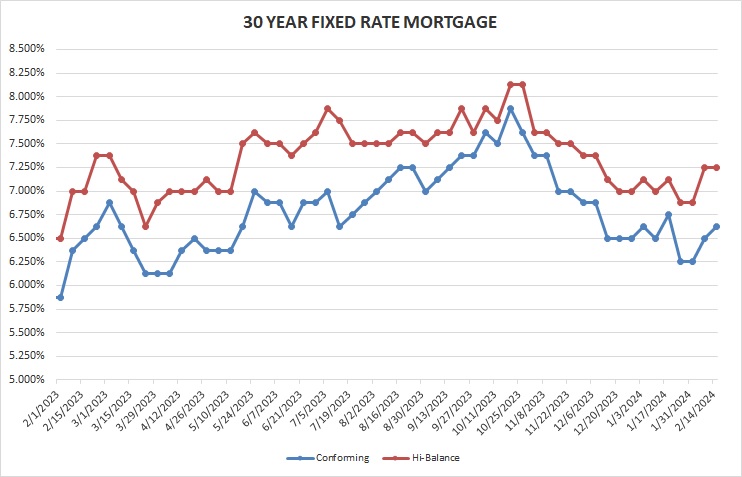
Rates for Friday February 16, 2024: The rate roller coaster ended up going up another incline as the conforming rate is up for the second week in a row after hitting a nine month low at the end of January.
FIXED RATE MORTGAGES AT COST OF 1.25 POINTS LOCKED FOR 45 DAYS FOR PURCHASE TRANSACTIONS:
30-year conforming 6.625% Up 0.125%
30-year high-balance conforming 7.25% Flat
Please note that these are base rates and adjustments may be added for condominiums, refinances, credit scores, loan to value, no impound account and period rate is locked. Rates are based on 20% down with 740 FICO score for purchase mortgages.
Woo-hoo! Great finish to the Super Bowl as I won the final score in the squares pool!
The analogy I have been using for the game was that for the first half it was a pitchers’ duel with defenses dominating the game. In the second half the Niners brought in their bullpen that gave up some runs in the 3rd quarter. In the fourth both bullpens faltered, then in the bottom of the 10th the Niners brought in the wrong relief pitcher and gave up a grand slam to lose the game. (For those not following my analogy, with my Eagles out of the playoffs my heart and mind turn to baseball and my Phillies).
There has been so much chatter about turnover on a punt, blocked extra point, coach decision on the coin flip, that great performances seem to be over looked. My top performers are both teams defenses who held down two of the best offenses in the game to only thirteen points total in the first half, Brock Purdy who played a great game for the Niners, and of course Patrick Mahomes who just wins games.
Mahomes is starting to be compared to Tom Brady, who has seven Super Bowl rings. I’m comparing the two to Tiger Woods (Mahomes) and Jack Nicklaus (Brady). Nicklaus won 18 majors in golf, Woods has 15. Tiger is still chasing Jack as he is active and playing the four majors, but the chances are very slim he will catch them. I feel the same with happen with Mahomes’ chase of Brady.
Have a great week,
Dennis
Past Weekly Rate & Market Updates can be found on my blog page at my website www.DennisCSmith.com/my-blog


