


If buyer has to pay agent commission, will mortgage regulations change?
Question of the week: If buyer has to pay agent commission, will mortgage regulations change?
Answer: Good question, my thought is that there will be no change, my reasoning further down.
This week’s question is a follow up to the WR&MU from before Thanksgiving asking if recent court cases regarding real estate commissions. In re-reading the update I realize I should not have tackled a somewhat complicated issue a few days after knee replacement surgery and the resulting narcotic pain killers I was still taking—it is a bit disjointed, more so than my normal WR&MU’s.
For those who missed the not well written WR&MU, it centered on decision by a jury in federal courts against the National Association of Realtors and a few of the biggest brokerages in the United States. The suit was in regards to the practice that home sellers pay the real estate commissions to the buyers’ agents—standard practice across the country and part of the membership requirements for all agents who are member of NAR.
The decision in the case likely will lead to a change in the practice, and thereby require buyers to pay their agents directly.
If this is the case, if the agreed upon commission is 3% for each agent upon closing, for a $750,000 home, the buyer would need to pay $22,5000 to their agent, for $172,000 for down payment and commission.
Under the current arrangement, where that $22,500 comes out of the sellers proceeds from the sale, the commission to the buyer’s agent is included in sales price, and therefore part of the financing, the buyer pays the $150,000 down payment and seller pays the commission.
Our question above concerns if federal regulations require each party in a real estate sale pay their own agents, will mortgage regulations change to allow buyers to add the commission to their real estate agent to the loan amount and finance the fee.
Example as to how this might look. In the above example, buyer is purchasing the home for $750,000, putting 20% down ($150,000), and funding a mortgage for $600,000, and there is a $22,000 commission. The question is, will guidelines change to allow the commission to be financed?
If underwriting requirements for Fannie Mae, Freddie Mac, FHA, etc were to allowing financing of commissions what would it look like? Add the commission to the loan amount, and still price the loan as if the commission was not part of the loan?
Example, the above loan would be priced as an 80% loan to value mortgage. If a 3% of the sales price broker commission is added to the loan, the amount financed would be $622,000, or 83% of the sales price.
Under today’s regulations, the 83% LTV would have a slightly better rate than the 80% loan, but would require mortgage insurance.
The change that would need to be made to make the guidelines under new regulations requiring buyers to pay their own agents, without adding to the loan-to-value of the transaction, means that the total loan will still be $622,000, but the guidelines would price the loan at 80% loan to value and not require mortgage insurance.
The reason this likely will not happen is the secondary market. Most mortgages are sold by Fannie, Freddie, FHA, to investors purchasing Mortgage Backed Securities (MBS). The price of the MBS are what determine interest rates for borrowers. The price investors are will to pay of MBS is determined in part by the risk that a loan will not pay off and go through foreclosure. Mortgage insurance protects lenders, therefore investors, from losses due to foreclosure.
If lending guidelines were to change to allow commissions being financed as part of closing to not be factored into loan-to-value guidelines, investors will balk, or require different pricing on those mortgages—which would mean if buyers want to finance commissions and not have the amount added to the loan-to-value, instead of paying mortgage insurance they will pay a much higher rate due to the higher risk.
The reason a mortgage at 85% loan to value has a lower rate than a loan at 80% loan to value is because investors are protected against foreclosure losses due to mortgage insurance. The estimated loss in a foreclosure is about 25% of the loan amount, which is what mortgage insurance covers.
If/when the market changes and buyers have to pay their agents’ commissions, I do not see a change in lending guidelines to accommodate the new regulations. I do see a significant change in the real estate compensation models and the industry creating separate structures for listing (represent seller) and selling (represent buyer) agencies.
To schedule an initial meeting by phone or Zoom, click here for my calendar, please feel free to forward to a friend or family member!
Have a question? Ask me!
Momentum continues for lower rates. Economic data is showing inflation is slowing, as are consumer spending and income. While the economy grew at a very fast 5.2% in the third quarter, estimates for the 4th quarter of the year is grow between 1-2%. The data supports a “soft landing” for the economy as inflation slows, possibly avoiding a recession in 2024.
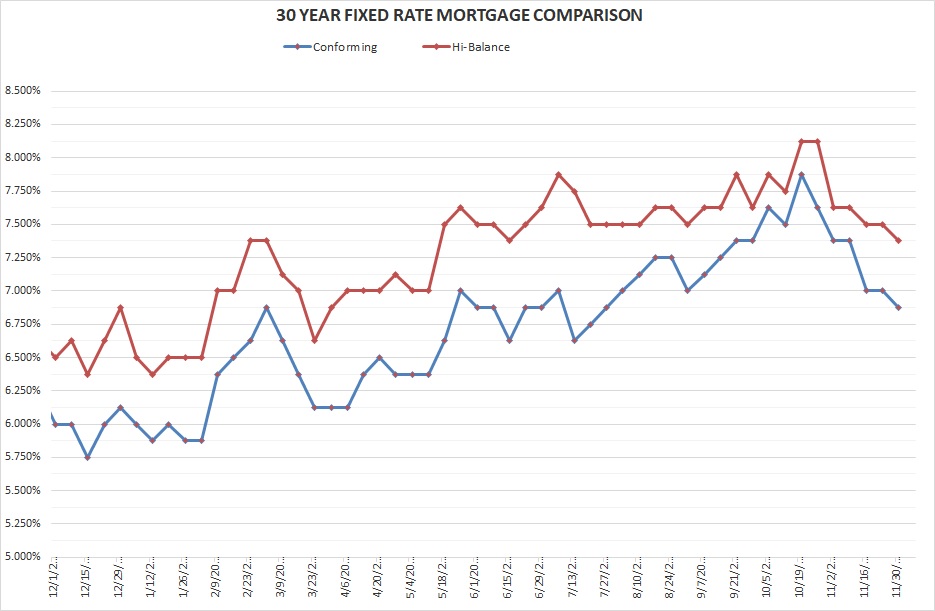
Rates for Friday December 1, 2023: Back to summer, that is where we look to find rates as low as they are this Friday, down 1% from their high in late October.
FIXED RATE MORTGAGES AT COST OF 1.25 POINTS LOCKED FOR 45 DAYS FOR PURCHASE TRANSACTIONS:
30-year conforming 6.75% Down 0.25%
30-year high-balance conforming 7.25% Down 0.25%
Please note that these are base rates and adjustments may be added for condominiums, refinances, credit scores, loan to value, no impound account and period rate is locked. Rates are based on 20% down with 740 FICO score for purchase mortgages.
A different Thanksgiving for Leslie and I this year. Last week was the first time in close to 20 years that we did not host family and friends, and that I did not do most of the cooking. It is my favorite holiday, the sentiment of gratitude, gathering those close to us, and for me cooking the meal.
With me being somewhat immobile, we ordered a meal from a restaurant around the corner (Wood and Salt for those in the area) who provided a twelve-pound turkey, stuffing, potatoes, and green beans. Everything was delicious and since it was just the two of us we had plenty of leftovers to enjoy.
Unusually quiet and restful, but looking forward to next year and back to our traditional holiday.
Have a great week,
Dennis
Past Weekly Rate & Market Updates can be found on my blog page at my website www.DennisCSmith.com/my-blog


