


Should we enroll in auto-pay?
Question of the week: Should we enroll in auto-pay?
Answer: Yes.
Too often we see credit reports for clients who have excellent credit, except….one credit account that has a late payment or two, thus turning excellent credit into fair credit and resulting in a higher interest rate on their mortgage.
The lates could have been easily avoided if they had set up auto-pay on the accounts.
The most common scenarios where we see the “rogue” derogatory reporting are HELOCs (Home Equity Lines of Credit) and credit cards with small balances.
Here are some scenarios that are not uncommon.
First scenario: You get a HELOC with a bank or credit union with which you have never had an account. You open an account with a minimum balance of $2500 to lower the rate on the HELOC by 1%, and you must maintain at least that amount to avoid monthly bank charges.
Your minimum payment is interest only, and because you are using the loan to do various home maintenance and remodeling projects, the amount owed varies from month to month.
Every month you transfer money from your personal checking account to the bank or credit union to make the payment.
One month you forget that you had transferred money from the HELOC to your bank account, therefore raising the balance and the minimum payment. You send the same payment from the month before, which is not enough.
You get your next statement and notice two things, a late charge for the last payment, and that the minimum payment was more than you sent. You now have a 30-day late on an account that lenders see as a mortgage late, a very egregious late reporting for mortgage underwriting.
Second scenario: You have several credit cards, but primarily use two; one for most of your transactions that builds miles for an airline you use frequently for the family, the other builds points for a hotel chain your family uses frequently when you travel and you only use it at those hotels as they triple the points when used at their properties.
Your primary card was compromised and you are waiting for the replacement card to arrive. You are shopping with your son before he heads back to college, he needs a good pair of boots. You use your hotel-points credit card for the $250 purchase.
You have paperless statements, and since you have not travelled in a while you don’t go on-line to check your hotel-points card account. You miss the payment and you end up with a late charge and a reporting on your credit report of a 30-day late.
In both of these scenarios setting up auto-pay would have prevented the late reporting of the two late payments.
For the HELOC, set up an automatic transfer every month to send a deposit from your checking account to the HELOC for the interest on 2-3 times the balance. If your current rate is 8.5% and your balance is $30,000 the minimum payments of interest only is $212.50, send $500 to $600 to your account at bank with the HELOC. Next set up auto-pay for the HELOC that will take the minimum payment each month from the account.
Your balance at the HELOC bank account will grow from the minimum required $2500 as you deposit more than the interest only payment being taken to pay the HELOC’s interest. Every quarter, or month if you prefer, review the account and you can decide to pay down some principle on the HELOC or leave the funds in excess of the $2500 account minimum as you know the balance on the HELOC will go up in the near future.
Even if your balance were to fall below the $2500 minimum after the bank takes out the minimum interest only HELOC, resulting in monthly bank charges for a month or two, those charges will cost you less in the long run than having a 30-day late on your credit report.
For all your credit cards setup and auto-pay for the credit card company to pull out the minimum monthly payment from your bank account. This way when you have a one-time charge on a card you do not use very often the minimum payment will be made until you remember you made that charge. On the card you use most frequently you can always pay as you always have, but if travelling or something else comes up they payment will be made.
Using auto-pay is wise for all your accounts, mortgages, auto loans, student loans, etc. Set them up for the minimum required payments, and if you want to make a higher payment you can do so.
For mortgages, I prefer to set up an auto-send from my account to be taken on the 5th of the month. This is because our household income varies every month since we are both self-employed. By having the payment taken on the 5th I have a few days to see what has come in for the month prior and if we need to make a transfer from savings or not to cover the mortgage payment.
With mail theft seemingly increasing by the month, the stories about mishandled checks at payment processing centers, I strongly recommend that if you are writing checks every month to pay your bills, “because that is the way I have always done it,” set up auto-pay through your bank, and/or creditors.
To schedule an initial meeting by phone or Zoom, click here for my calendar, please feel free to forward to a friend or family member!
Have a question? Ask me!
Bang, Zoom, to the Moon (Alice—a reference for some of our mature in age readers), describes fixed rate investment markets this week (meaning markets for bonds, mortgages) as prices soared and interest rates plummeted. Why? The Fed did not make any move on rates, letting market rates cool the economy and inflation was on reason. The other was today’s jobs report from the Labor Department.
After heating up the economy and contributing to inflation, the heat is way down in labor markets as seen by September’s payroll and unemployment figures. The unemployment rate rose to 3.9% in September, continuing a steady climb since April’s 3.4% low. Employers hired 150,000 more workers in September, down from 297,000 new hires in August. Analysts are showing that most of the added jobs were “back-fill” in services still trying to get back to pre-pandemic numbers, i.e. retail, hospitality, healthcare. Hiring slower, unemployment rising, so no surprise that wage growth is weaker, up .2% from August and 4.1% from last September. Taking an annualized figure for the last three months and wages are growing at 3.2%. All of this news is positive for mortgage rates.
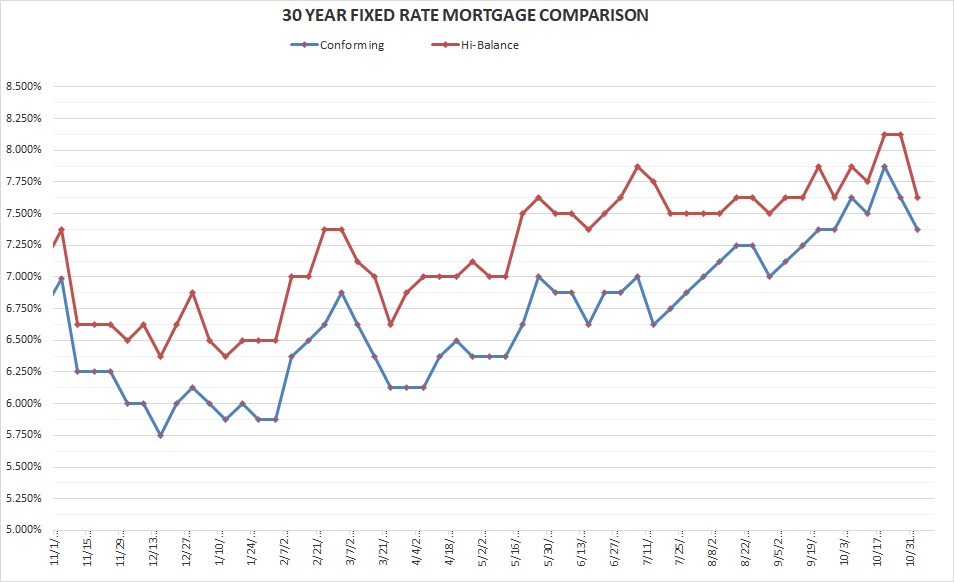
Rates for Friday November 3, 2023: Mortgage rates have their biggest Friday-to-Friday drop since July this week. The trend is downward for rates, will it continue? For how long? How far will they go
FIXED RATE MORTGAGES AT COST OF 1.25 POINTS LOCKED FOR 45 DAYS FOR PURCHASE TRANSACTIONS:
30-year conforming 7.375% Down 0.25%
30-year high-balance conforming 7.625% Down 0.50%
Please note that these are base rates and adjustments may be added for condominiums, refinances, credit scores, loan to value, no impound account and period rate is locked. Rates are based on 20% down with 740 FICO score for purchase mortgages.
Time for the bi-annual debate: should we move the clocks back and forth each year or just pick a time and stick with it?
If we stick with one time there are plenty who argue for each time to be the one, the daylight savings time (34 weeks every year) and those who want standard time (18 weeks). With the government deciding when to move the clocks, it is evident which way they lean.
Don’t forget to “fall back” Saturday night before you go to bed.
Have a great week,
Dennis
Past Weekly Rate & Market Updates can be found on my blog page at my website www.DennisCSmith.com/my-blog


