


Should we get an adjustable rate mortgage?
Question of the week: Should we get an adjustable rate?
Answer: Maybe
For decades we’ve steered clients away from adjustable rate mortgages (ARM) because of the uncertainty in the future compared to a fixed rate mortgage. However, with the primary uncertainty in the market being when rates will go down, now is a very good time to consider an ARM for your home purchase, and possibly refinance.
First the benefit, then the risk.
Today a $800,000 purchase with 20% down and a 760 FICO score, the rate on a 30-year fixed rate mortgage is 7.625%, with a payment of $4530 per month.
The rate for the same transaction with a 5/6 ARM (description below) is 7.25% with a payment of $4365 per month.
Simple math shows us a payment differential of $165 per month, or almost $2000 per year.
For high-balance loans (soon to be loan over $750,000) the 5/6 ARM rate is 7.25%, the fixed rate is 8.00%, on a loan of $800,000 the difference in monthly payment is $413 per month, or almost $5000 per year.
A 5/6 ARM has a fixed rate the first five years of the loan and then adjusts ever six months. The most the rate can change, up or down at the first adjustment is 2%, thereafter the cap and floor each adjustment is 1%. The maximum the rate can increase is 5% above the start rate. For above examples with 7.25%, the most the rate can increase is to 12.25%.
When the loan enters the adjustable period, the new interest rate is calculated by taking the 30 day Average Secured Overnight Financing Rate (SOFR) and adding a margin of 3%.
Today the SOFR is 5.32%. If you have a 5/6 ARM currently and has adjusted to the fully adjustable rate (i.e. without consideration of the 1% or 2% cap limit) the rate would be 5.32% + 3.00% = 8.32%.
That is the primary risk for an ARM, if rates increase so when you enter the adjustable period you may see your rate increase.
On the other hand, if rates drop you will see your rate go down.
Most borrowers funding 30-fixed rate, or 15-year fixed rate, mortgages are rate watching so they can refinance when rates drop. With a 7.25% ARM, you will be watching rates to refinance as well.
A homeowner that has funded a 7.75% rate on an $800,000 loan is paying approximately $5730 per month. If/when rates go to 7.25%, they are highly likely to refinance as they will drop their payment to $5400 or less (depending on how much principal they have paid on the mortgage) saving at least $330 per month.
The homeowner that has a 7.25% mortgage saves the cost of refinancing (about $4-5,000 for fixed costs before considering the points vs. rate cost—no points means a higher rate than paying points).
If/when rates drop to 6.50% both homeowners are likely to refinance. Assuming both borrowers have lowered their loan balances to $775,000 by this time, they lower their payments to about $4900, saving almost $400 per month.
Both homeowners have the same payment, however the one who purchased with the 5/6 ARM saved considerably more money due to the lower monthly payments until the rate lowered to 6.50% when both homeowners refinanced, plus the costs of the additional refinance the fixed rate homeowner funded.
Why wouldn’t someone obtain an adjustable rate mortgage?
Qualifying. For the majority of ARM programs, the qualifying rate is the greater of the note rate (start rate) + 2%, or the fully adjusted rate today.
Looking above at the calculation of the fully indexed rate, today is it 8.32%. The start rate on the 5/6 ARM is 7.25%, add the 2% for qualifying and you need to qualify for a rate of 9.25%.
Real numbers, a $800,000 home with 20% down and a mortgage of $640,000. Assuming approximately $1100 per month for taxes and insurance, let’s look at the different income needed to qualify for this mortgage using a fixed rate and a 5/6 ARM.
At 7.625% for the 30-year fixed the PITI is approximately $5630 per month. Assuming this is 35% of your income, you will need monthly income of $16,000 per month ($192,000 per year) to qualify.
At a qualifying rate of 9.25% the payment for PITI on the 5/6 ARM is approximately $6365 per month. Using the 35% of your income to qualify,, you will need monthly income of $18,100 per month ($217,200 per year).
An ARM may be the right loan for you, call me to run the numbers on your qualifying ability using an ARM to see if it is.
To schedule an initial meeting by phone or Zoom, click here for my calendar, please feel free to forward to a friend or family member!
Have a question? Ask me!
When? Our economy’s GDP grew a very robust 4.9% in the 3rd quarter, driven by consumer and government spending. The growth in Q3 was greater than Q1 and 2 combined and the biggest expansion in the economy, absent the pandemic burst, since 2014. The surge in growth, not only in the 3rd quarter, but this year, has heads being scratched. The Feds systematic increase in rates to slow the economy, to slow, even contract job growth, and to slow inflation, had many, including myself, predicting a slow-down, even recession, in 2023. When will economic growth slow, much less contract? When will the next recession occur? When will inflation drop below 3% much less hit the Fed target of 2%? When will the sustained high interest rate environment have the historical result of all these occurrences?
Another hike on the table? Following the GDP data were numbers on consumer spending, incomes and prices. Consumer spending, as seen in the GDP data, is 65-70% of the economy. In September spending rose a very robust 0.7%, after adjusted for inflation spending rose 0.4%. Incomes, adjusted for inflation, increased 0.3% for the month, dropping for the third month in a row. With growth in spending outpacing growth in wages, it is no surprise the personal savings rate dropped to 3.4%, a trend that has continued since the end of the pandemic. While several Fed officials have said a hike at their next meeting was unlikely, the latest price data may have some fence sitters at the Fed voting to hike rates. The PCE index, the preferred inflation index for the Fed, showed prices increased by 0.4% for the second month in a row, driven by oil prices. Year over year, the index is up 3.4%, well above the Fed’s 2% target.
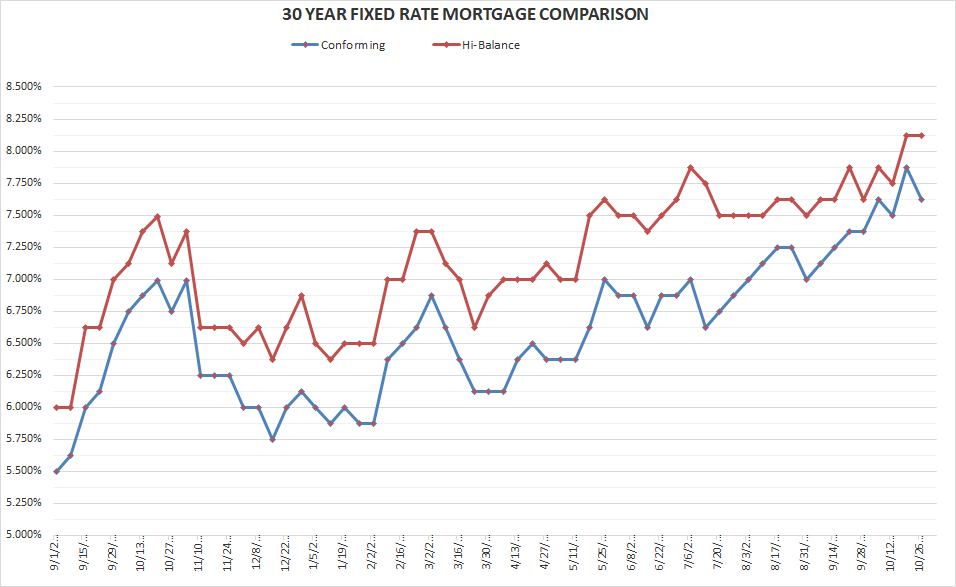
Rates for Friday October 27, 2023: Despite the economic news, rates rode rallies in the bond markets early in the week to today, over coming a strong drop yesterday, to show a strong drop in the 30-year fixed from last week.
FIXED RATE MORTGAGES AT COST OF 1.25 POINTS LOCKED FOR 45 DAYS FOR PURCHASE TRANSACTIONS:
30-year conforming 7.625% Up 0.25%
30-year high-balance conforming 8.125% Flat
Please note that these are base rates and adjustments may be added for condominiums, refinances, credit scores, loan to value, no impound account and period rate is locked. Rates are based on 20% down with 740 FICO score for purchase mortgages.
There’s always next year. That is the most benign statement coming from most of my fellow Phillies phans, who were unable to knock out the Arizona Diamondbacks to make the World Series for the second year in a row. For those on social media, there are endless videos of the team’s phans that are more typical of the city’s love-hate relationship pitch-to-pitch, snap-to-snap, free-throw-to-free-throw, for all the teams. Caution, most are not to be played with sound up in the office or in front of children.
Almost all of the commentaries though end with a common sentiment, “Go Birds,” hopeful our Eagles will repeat a trip to the Super Bowl with a different outcome.
About fifteen weeks until pitchers and catchers report to spring training, the start of the always next year…
Have a great week,
Dennis
Past Weekly Rate & Market Updates can be found on my blog page at my website www.DennisCSmith.com/my-blog


