


How do labor contracts impact mortgage rates?
Question of the week: How do labor contracts impact mortgage rates?
Answer: Home to the two of the busiest ports in the world, if not the busiest, Southern California news outlets are frequently reporting on shipping and cargo movement issues.
Anyone on the beach from Huntington Beach to South Bay beaches during labor stoppages, or during the pandemic when consumer spending resulted in historic delivery of goods manufactured across the Pacific, had the ocean view one of container ships anchored off-shore waiting to be off-loaded.
The goods in the containers on those ships need to be off-loaded at the port, loaded onto a train or a truck, shipped to a distribution hub and off-loaded, have contents separated for delivery to distribution centers for different retail companies, shipped to those distribution centers where packages were off-loaded, have packages separated and packaged for shipping to homes and offices, packages loaded into trucks for delivery, and finally individual packages delivered to homes and offices.
This is a nutshell of the supply chain.
Each step has costs that add to the price of your bar-top popcorn machine (comes in red or black). Infrastructure, transportation fuel, capital equipment, utilities, local, state, and federal taxes, and the primary cost: labor. Wages, benefits, healthcare, workman’s comp insurance, social security contributions, all add to the cost of your popcorn maker.
After over a year of negotiations, the International Longshore and Warehouse Union (ILWU) and port managers on the West Coast appear to have reached an agreement on a new contract than will result in a 32% salary increase for ILWU members over the six-year contract and a $70 million dollar bonus.
Absent any other impacts on consumer prices, i.e., zero inflation, your brother in-law, who has been envious of your bar-top popcorn machine that cost you $165.12, will likely pay $217.96 when he purchases the same Great Northern Top Popcorn Popper Machine (in red) in 2029—32% more than you paid in 2023.
As you are aware, I hope, the Federal Reserve has been raising its benchmark interest rate since March 2022 to fight inflation. The plan has worked, somewhat, as inflation, after increasing to 9.1% in June 2022 has dropped to 4% in May 2023.
With the Fed raising rates, other interest rates have also gone up considerably since 2021, including mortgage rates. With inflation still above the Fed’s 2% target rate, rates will continue to be significantly higher than 2021 as the fight against inflation continues and the Fed increases rates.
If one sector of the supply chain is going to see its primary cost, labor, increase by 32%, resulting in higher costs for the goods that sector moves from one sector to the next. Considering a significant percentage of consumer goods, as well as parts and machines for manufacturers and businesses, are imported from the Pacific Rim through West Coast ports, a 32% increase in costs will push up the cost on those goods correspondingly.
What is the ripple effect of higher prices on this one portion of our economy? It is reasonable that prices for other goods, and labor, will also increase.
Increasing prices, inflation, puts upward pressure on interest rates, impacting auto loans, student loans, and mortgages.
While the new contract for the ILWU will not be solely responsible for pressure on interest rates, it does have an impact.
It should be noted that while I used the ILWU as an example since it is in the news, all labor costs have an impact on prices, and inflation, and therefore rates.
Consider public employee contracts. Like the private sector, the largest cost for public entities is their labor costs. As labor costs increase, so much revenue that is only derived from taxes. In an economic bubble, i.e., not other changes to any costs or prices in the economy, rising public employee costs that require higher taxes, has the opposite effect on the economy than increasing labor costs in private sector. Increasing taxes takes money from the private sector, decreasing the amount of funds consumers have to purchase goods and services, thereby reducing economic activity, which can lead to recession and possibly lower costs for goods and services.
Again, these examples are in “bubbles” where the assumptions are that no other changes occur in any other sector of the economy; however there is no such bubble in any economy and changes in one sector impacts other sectors, which impact other sectors.
How do labor contracts impact mortgage rates? By possibly impacting costs of doing business and therefore prices, which impact mortgage rates.
If the overall impact on prices put inflation at less than 3%, we can expect rates to be stable, and likely lower than they are today.
Finally, it needs to be noted that while I used the ILWU as an example, a larger impact on prices and costs is a mandated wage that must be paid that is higher than the open market would dictate; in other words, if the government sets a minimum wage requirement for employers at higher rates than would be paid due to supply and demand for labor, prices must increase to meet the higher wage costs. This impact is far greater than a labor contract in one sector of the economy. That said, minimum wage requirements are usually a factor in labor contracts.
To schedule an initial meeting by phone or Zoom, click here for my calendar, please feel free to forward to a friend or family member!
Have a question? Ask me!
While wages impact mortgage rates, impacting them far faster are words. More specifically words from the Chair of the Federal Reserve. Currently that is Jerome Powell, who in testimony before Congress yesterday and today indicated that the Fed will increase rates two times for certain before the end of the year. When asked what the economy would need to look like before the Fed stopped increasing rates, and possibly begins cutting them. Paraphrasing Powell’s rather hawkish answer, he indicated that inflation would have to decline considerably more, and that labor markets need to be a lot softer with lower wages and higher unemployment to reach the point where future rate hikes would cease. This was not positive for mortgage rates.
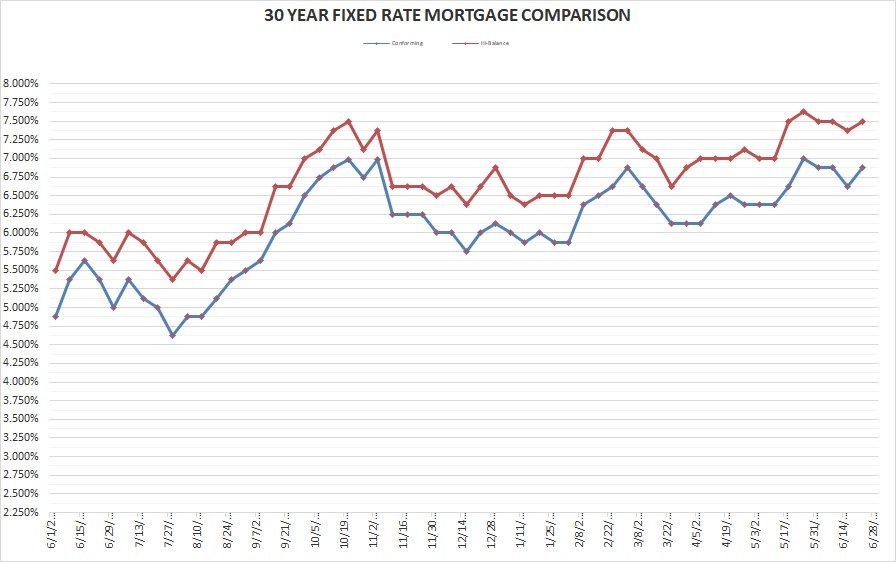
Rates for Friday June 23, 2023 There is still a lot of volatility in the interest rate markets, as exhibited by the reaction to Powell’s statements. Rates reverse last week’s declines and climb back to the upper end of the range for the past four weeks.
FIXED RATE MORTGAGES AT COST OF 1.25 POINTS LOCKED FOR 45 DAYS FOR PURCHASE TRANSACTIONS:
30-year conforming 6.875% Up 0.25%
30-year high-balance conforming 7.50% Up 0.125%
Please note that these are base rates and adjustments may be added for condominiums, refinances, credit scores, loan to value, no impound account and period rate is locked. Rates are based on 20% down with 740 FICO score for purchase mortgages.
On Saturday we had an outing to the Academy Museum of Motion Pictures. If you have not been, I highly recommend a visit. We spent several hours enjoying the exhibits, and could have spent more.
Of all the exhibits, the one I enjoyed the most was on Casablanca, one of my favorites that I watch every year or so. I learned a lot about the cast and crew and their personal experiences that paralleled the movie as they fled the Nazis in Europe, taking different paths to end up in Hollywood making a film that was very experiential for them.
Another great venture is to the Grammy Museum. Visit both and you are halfway to your own EGOT.
Have a great week,
Dennis
Past Weekly Rate & Market Updates can be found on my blog page at my website www.DennisCSmith.com/my-blog


