


Can Fannie Mae impac the value of our condo?
Question of the week: Can Fannie Mae and/or Freddie Mac affect the value of my condo?
Answer: Yes.
Note: while I am using “condo” for this week’s question of the week and answer, the following applies to properties that have Homeowners Associations, townhomes, PUDS, Co-ops.
The overwhelming majority of mortgages in the United States are sold by mortgage lenders to either Fannie Mae or Freddie Mac (GSEs for Government Sponsored Entities), known as “conventional,” or “conforming” loans or mortgages. In order for those loans to be purchased the loans must adhere to their underwriting guidelines.
For condominiums the underwriting does not only approve the credit worthiness of the borrower, the value and general condition of the property and unit as detailed in the appraisal, but also the Homeowners Association (HOA) is also underwritten.
For condo loans to be approvable, or “warranted,” by lenders for sale to the GSEs, the complexes and their HOAs must be on the GSEs approved condo list, or documentation must be submitted to have the complex where the subject unit is located approved by one of the GSEs before a lender can approve the loan.
Because the vast majority of all mortgages funded are conventional, it is no surprise that the same is true for mortgages used to purchase condominium units, or refinance existing mortgages for condo units.
If a condo unit is located in a complex that is not approved, or warranted, by one of the GSEs, that means the primary mortgage used to finance the purchase and refinances for units is not available.
If the primary funding source for affordable mortgages is unavailable the value of the units in these unwarranted complexes is greatly impacted as it reduces the size of the pool of potential buyers.
In a nutshell, Condo A is eligible for conventional financing, a buyer can purchase with a conventional loan of 6.125%; Condo B is not eligible for conventional financing as it has been labelled unwarranted by the GSEs, so a buyer must use cash, or get a non-conforming loan from a lender who will lend on unwarrantable condos with a larger down payment and a much higher rate, today in the 8% range.
If Condo A is in a complex right next to Condo B, which unit will have a larger number of interested buyers, the one with lower down, lower rate financing, or the one that would require higher down, higher rate, or all cash? By not being warrantable by the GSEs, the value of Condo B is significantly less than Condo A.
Ergo, Fannie and Freddie dramatically impact the value of units in complexes not on their approved lists.
This question arises as there have been complexes across the country, and in our region, that have been removed from GSE lists of approved complexes. The primary reason is lack of adequate insurance on the complexes.
Deeper dives into properties on GSE approved condo lists is a result of the collapse of the Champlain Towers in Surfside, Florida a few years ago. In the aftermath of the collapse it was discovered that the HOA’s insurance coverage was about $1 billion less than what was needed to cover losses for the owners of the destroyed units.
Because of rising property values, therefore rising mortgage amounts, as well as increasing costs of material and labor for repairs and replacements of damaged units, many (most?) HOAs have not been increasing their insurance coverage to meet what would be needed to properly payout policies to rebuild units, or payoff lien holders.
There could be many reasons for this, but a primary one often comes down to monthly HOA dues and what owners are willing to pay. Or new buyers who compare not only prices of comparable units on the market but also monthly costs.
Here are some, but not all, of the issues that create issues for condominiums obtaining, or retaining, approval from the GSEs for conventional mortgages
- Extent of deferred maintenance in common areas
- Structural issues, such as balconies, roofs, carports, or other areas where collapse may cause severe injury or death*
- Sufficient reserves in the HOA accounts to make repairs and maintenance on a consistent basis
- Any significant special assessments on owners
- Litigation against the HOA, builder or other entity, especially if litigation is centered on structural deficiencies or defects
- Insufficient insurance coverage
- Significant number of accounts delinquent in their HOA dues
*Several years ago, after the collapse of a balcony in Berkeley that resulted in the death of six UC Berkeley students, California enacted SB 721, the Balcony Inspection Bill. It requires all multifamily buildings with three or more units undergo periodic inspections. The initial inspections must be completed by January 1, 2025 and must then have inspections every six years. Many HOAs have yet to complete these inspections, the results of which may require significant repairs to ensure balconies, and other external, elevated structural elements such as decks. If this is the case there will likely be significant costs that may not be accounted for in the HOA budget and reserves, the result of which will likely be an increase in HOA dues and/or special assessments.
When purchasing a condo you have the right to inspect HOA documents, including but not limited, minutes from recent meetings of the board of directors, budgets, CC&Rs, list of schedule maintenance, and other documents you feel are important to your decision. Note that when you receive these documents we are very happy to review them with you—not everyone is familiar with reading financial statements or other pertinent documents.
This can be important to know what the financial stability is for the business in which you are about to become a partner—that is what an HOA is, a business where all the owners, and occupants, are in a business relationship dependent upon each other to ensure your home, your investment, has the ability to maintain the buildings and improvements in good working order.
An example of this importance. Several years ago, I had a client in escrow to purchase a unit in a very desirable complex. The price and HOA dues were attractive to the buyer compared to other nearby properties on the market. The unit itself was in good condition, but walking through the complex it was evident there was a lot of deferred maintenance, and repairs in progress.
After several requests the seller, through their agent, supplied requested documentation. After reviewing the budget and the minutes of the past several board meetings, I met with our client and their agent, and suggested they cancel the escrow and we continue looking for the right unit. This was hard because the client really liked the unit.
Why did I make this recommendation? The budget showed that the HOA had almost no reserves, for a budget near a million dollars, the reserves were close to $10,000, and that there was very little in the budget for maintenance and repair of major cost items, such as roofs, pool, garages.
Because the financials were the way they were, the minutes of the HOA showed the board of directors discussing and proposing increases in the monthly dues of 10% per six months for the next three years; an increase in the dues of over 60%. Doing the math of what expenses were, what maintenance and major repair estimates were, and the amount of the HOA increases would amount to, after three years it appeared they would still be short of funds needed.
For condo buyers, and current owners, it is important to research the financial status of the HOA, including the insurance coverage, and its stability. If there are issues it can, likely will, impact the future value of your home.
To schedule an initial meeting by phone or Zoom, click here for my calendar, please feel free to forward to a friend or family member!
Have a question? Ask me!
Cooler, but cool enough? I’m not talking about myself after getting a haircut, as I will never achieve the latter. I’m talking about inflation as the February Consumer Price Index data showed an increase of 6% from last year, it’s lowest level since September 2021. For the month, prices rose 0.4%, slow enough to perhaps have the Fed increase its benchmark rate next by only 0.25% instead of 0.50%. Digging deeper into the data to the “core” rate (energy and food stripped from the calculation), prices increased 0.5% for the month, and 5.5% for the year. That is encouraging, but perhaps not encouraging enough to slow the Fed’s inflation fight.
For condo loans to be approvable by lenders for sale to the GSEs, the complexes must be on their approved condo list, or documentation must be submitted to have the complex where the subject unit is located approved by one of the GSEs before a lender can approve the loan.
Sooner than later? Consumer spending is 65-70% of our economy. In February retail sales dropped 0.4% from January, the third time in four months that retail spending has declined. Taking into account that retail sales are calculated on dollars and not units, with prices increasing the dollar volume of sales, and the number of higher dollar volume sales decreasing, it means consumers are buying even fewer units. This data leads one to believe the economy is slowing and if the trend continues, we could be entering a recession sooner than later. This will slow, or cease, the Fed’s inflation fight as slower economy means less demand means lower prices.
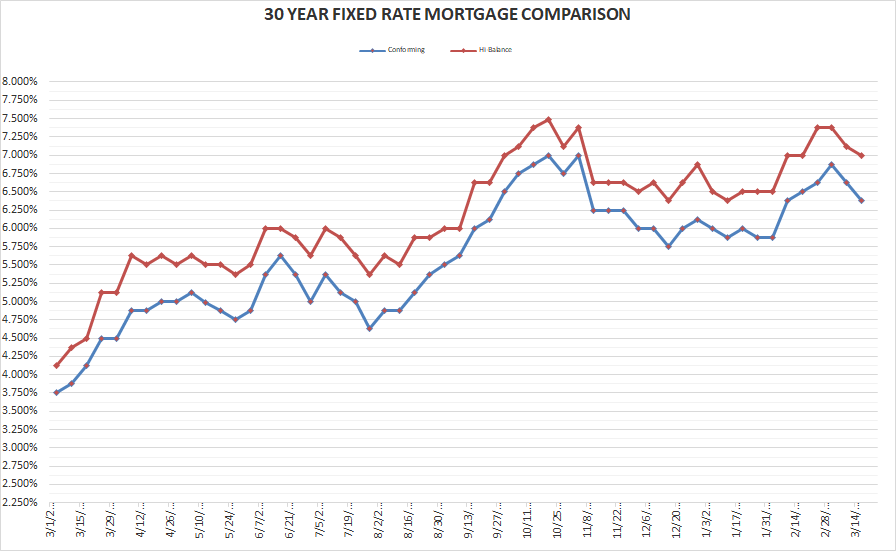
Rates for Friday March 17, 2023: While the economic data is a bit mixed, and the CPI data warranting upward pressure on rates, the banking crisis has investors engaging in a “flight to safety,” which means purchasing fixed rate investments such as bonds and mortgages. The result is a drop in rates again this Friday from last. The conforming rate is at its lowest in five weeks.
FIXED RATE MORTGAGES AT COST OF 1.25 POINTS LOCKED FOR 45 DAYS FOR PURCHASE TRANSACTIONS:
30-year conforming 6.375% Down 0.250%
30-year high-balance conforming 7.00% Down 0.125%
Please note that these are base rates and adjustments may be added for condominiums, refinances, credit scores, loan to value, no impound account and period rate is locked. Rates are based on 20% down with 740 FICO score for purchase mortgages.
A harmonic conversion occurs today that used to mean more to me in my younger, single, days. March Madness and St. Patrick’s Day provides a double-down must make the call to bosses that one has “a bug” and can’t come in today, don’t want to infect my co-workers. A few decades ago, or more, I witnessed this call being made more than once from a hotel room in Vegas (pre-caller ID), by friends who had flown in the day before after work, on the first Friday of the NCAA Men’s Basketball Tournament, aka March Madness.
Now that I am older and much more mature, or perhaps the other way around, I ask Leslie what we should have for dinner as we avoid the masses in nearby pubs with Irish names and other establishments, and have games streaming on the upper right corner of my second monitor. Ain’t technology and older age terrific!
Happy St. Patrick’s Day from Dennis Cleary (pronounced Clare-ee) Smith, and Slainte to Ernest “Pop” Cleary, my great-grandfather whose name I carry.
Have a great week,
Dennis
Past Weekly Rate & Market Updates can be found on my blog page at my website www.DennisCSmith.com/my-blog


