

Should we sell our home to avoid losing money?
Question of the week: Should we sell our home to avoid losing money?
Answer: With home prices regionally, statewide, and nationally, dropping from all time highs, many property owners are asking this question.
Before we answer, some statistics on home sales in January from the California Association of Realtors.
- Statewide, the median price in January was $751,330, down 3.00% from December and down 1.79% from January 2022. In 2022 the median price increased 1.12%, before dropping in January.
- Los Angeles County’s median price of $778,540 was 2.6% lower than December and 2.8% lower than last January. For 2022 the median price was pretty much unchanged, down $1,290 for the year.
- Orange County’s $1,194,500 was $500 less than it was last January, and $62,740 higher than December, a price increase of 5.5%.
- Sales are down significantly month-to-month and year-to-year locally, LA and Orange down 22.0% and 20.5% from December and 38.2% and 35.6% from January 2022.
- In Southern California there is 3.6 months of inventory on the market, with the median time on the market being 32 days and the properties on average are selling at 96.7% of list price.
- If you list a home for the median sales price of $778,540 in Los Angeles County today, it will sell on March 28th for $752,848 statistically.
Listening to podcasts and news reports, reading papers and blogs, viewing real estate reports on streaming sites or news channels, the data above should be somewhat surprising. Because negative sells better than positive, the public has largely been led to believe that their home values have plummeted because of the spike in interest rates in 2022, and their remaining high today.
However, looking at the data, while sales are down significantly, sales prices are down less than should be expected, significantly less, for the drop in sales.
This supports our question in one way, prices are still near all time highs, should you take advantage of this and sell your home, or other property, near the top of the market, and risk losing value and profit should, when ?, prices drop further in 2023?
To answer the question, we need to ask more questions.
- When you purchased the property, what was the reason?
- When did you buy your home and at what price?
- What will you do for housing after you sell your home?
- If your intent it to buy another home in the future, when will be the right time?
- If the property you are thinking of selling is a rental property, will you purchase another one as an exchange to pay taxes, or will you pay whatever taxes you will owe and retain the proceeds?
- Have you done the math?
Did you purchase the property as an investment or as your home? If you purchased as an investment, it makes sense for you to look at the current market and explore the profit you may realize from a sale. If this is the case, skipping to the final question above, if you do sell, then what? Unless you enter into an IRS 1031-exchange to defer the taxes, you likely will owe capital gains taxes. Are you willing to pay those taxes, which will leave you with cash that is then tax free pending future investments. If you are going to exchange the property to defer capital gains, what are you going to purchase, will it cash-flow with current mortgage rates?
If you purchase the property as your home, why are you concerned with profit when you are still using it as your home? When you purchased the property was the intent to sell it when there was X-amount of equity in the property? Or was it to retain the property as your home until your kids reached a certain age, until you could afford a bigger home, or buy a home in a different area?
What is your plan for housing after you sell? Will you purchase a new home, perhaps thinking the value of the new home will hold at your purchase price better than the home you are selling? Or purchase a bigger home, or home in area more desirable to you and your family, with thought that if prices are soft now is the time to purchase the new home?
If you intend to rent, what is the amount of the rent you will pay for your new home, and how does it compare with your current housing payment? What happens if you sign annual leases and you feel the time is right to buy another home, but you still have several months left on your lease?
Let’s do some math.
Dennis & Leslie purchased a home in January 2018 for the median price in LA County, $564,100, with 10% down, and additional closing costs of about $15,000 for a total out of pocket of close to $70,000. Their mortgage rate was 4.25% and the payment was about $2500 per month for the mortgage, $125 for mortgage insurance and about $600 for property taxes. In August 2021 they refinanced with a balance of about $475,000 to 2.625%, eliminating mortgage insurance and lowering the payment to almost $1900 per month, saving $725 monthly.
Using the data above, they determine they can sell the property for about $755,000 after having it on the market for just over 30 days. Your current loan balance is close to $455,000.
A quick rule of thumb for costs to sell a home in Southern California is between 7-8% of the sales price, the primary determinant being the commission for the real estate agents. Splitting the difference and putting the cost at 7.5%, that is $56,625 for a sales price of $755,000.
This leaves $698,375 after costs, after paying off the mortgage Dennis & Leslie will have net proceeds of approximately $243,375. A very good return on their initial $70,000 spent to purchase the home.
Of those proceeds, almost $53,000 of the money was money they essentially paid themselves through principal reduction of their mortgage, subtracting those funds and their initial cash to close, their gain from the increase in value of their home is around $120,000—still an excellent return on their initial investment in their home.
When looking at selling their home for $755,000 after purchasing for $564,000 and thinking they would make almost $200,000 in profit, when faced with the actual numbers their initial excitement is somewhat tempered.
Looking ahead, they feel confident the median price home will drop an additional 5% over the next year, and they will be able to purchase a similar home to the one they will be selling for around $715,000.
In February 2024, rates have dropped some, but no where near where they were in 2021, the 30-year fixed rate is 5.5%. Putting $220,000 down from their sale proceeds, and estimating about $20,000 for costs to close, if they purchase a home for $715,000 with a mortgage of $495,000 with a rate of 5.5%, their new mortgage payment will be $2810 per month, $900 more per month than they are currently paying.
As well, their new property tax base will increase from close to $600 per month to $745. Their new housing costs for mortgage and property taxes will be $1045 more per month, $12,540 per year, than the home they currently own.
Essentially, selling their home, then buying almost the same home one year later at a lower price, using all the proceeds from their current home to purchase their new home, results in spending $12,540 more per year. This is without factoring in the rent they will pay for the year, which is likely higher than their current housing payment—without the added benefit of deducting their mortgage interest to save on their income taxes.
The answer to the question of the week is, probably not if it is your primary residence.
Going through all the same math for an investment property, it may make sense depending on several factors. If you are exchanging into another property, you may be receiving more rent proceeds, you may have higher deductions with larger depreciation schedule. A pure mathematical calculation.
If you are considering selling the property, paying the taxes and keeping the capital gains, this may make sense as, depending on your other income, your capital gains tax may be as low as $40,000, leaving you net proceeds of close to $200,000 after taxes.
A major factor in the ballooning prices that eventually popped leading into the Great Recession was the mentality of buyers purchasing homes with the intent to make a profit. Some people bought and sold two, three, four times between 2004 to 2008. Paying the transaction costs on each move, keeping most of the proceeds and highly leveraging into their next purchase. When the market collapsed, many were in homes with mortgages much higher than the value of their property. Since they purchased with an investment mentality, and not a homeowner mentality, it was easier for them to walk away from the property.
If you purchase a home the value of your home is less relevant than if you purchase a property for investment to capture income and appreciation. A traditional lifetime home cycle is purchasing first home that is small and affordable, when home is too small for the family purchasing a bigger home, if possible one that can last until the kids are out of high school, perhaps there is another purchase during the school years. Then when empty nesters either retaining the home until it becomes too much to care for or not near your children and grandchildren, when you sell and downsize; or you have to leave either through need for assisted living or…
While the value of the homes over the years are interesting, they only really matter when it is time for you to sell to purchase your next home that will enhance your life.
If you are purchasing a home to make money, do not call it a home, call it an investment. In which case math and not memories are more important to you.
To schedule an initial meeting by phone or Zoom, click here for my calendar, please feel free to forward to a friend or family member!
Have a question? Ask me!
Rates won’t be dropping for a while based on economic data released this week; rather they will likely increase before dropping. The headline news for the week was the key inflation index for the Federal Reserve increasing in January, with the largest increase since inflation peaked in July. The Personal Consumption Index (PCE) is preferred to the Consumer Price Index by the Fed because it takes into account consumers switching their purchasing habits to cheaper, or off-brand, items. In January the PCE rose 0.6%, and increased year over year from 5.3% in December to 5.4% in January. The news heavily impacted markets and put more upward pressure on rates, given that this is the index the Fed would like to see move to 2.00% before easing its current policy of slowing the economy with higher interest rates.
Other rate impacting news showed that despite climbing inflation, consumers returned to markets in January as consumer spending for the month increased the most in almost two years, up 1.8% from December, the first increase in three months. The primary cause of the increase was a jump in auto sales, a volatile market the past few years with big swings up and down depending on dealers have cars available on their lots.
Workers are still left behind, as the data showed personal income increased 0.6% for the month, primarily because of the big boost in Social Security payments due to adjustments for inflation.
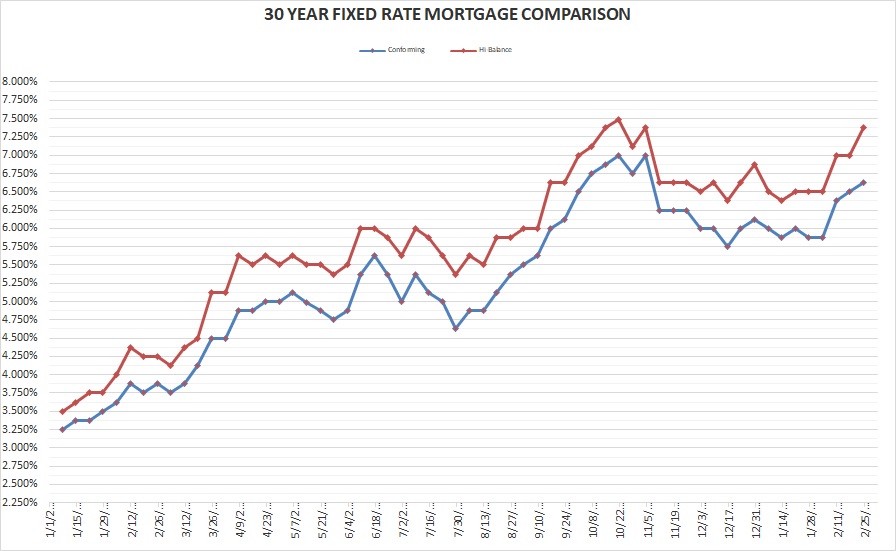
Rates for Friday February 24, 2023: The conforming rate is up three-quarters of one percent (0.75%) since the beginning of the month, part of the increase is due to the additional fees being added by the FHFA to conforming loans that meet the criteria used below, most of it due to investors seeing higher rates ahead as the Fed’s efforts to drop inflation and slow the economy is not working very expeditiously.
FIXED RATE MORTGAGES AT COST OF 1.25 POINTS LOCKED FOR 45 DAYS FOR PURCHASE TRANSACTIONS:
30-year conforming 6.625% Up 0.125%
30-year high-balance conforming 7.375% Up 0.375%
Please note that these are base rates and adjustments may be added for condominiums, refinances, credit scores, loan to value, no impound account and period rate is locked. Rates are based on 20% down with 740 FICO score for purchase mortgages.
I am likely in the minority. I enjoy stormy weather. It helps that for us stormy means high winds, rain and cool temperatures, and not snow, ice, high winds and well below freezing temperatures. When I learned that our current storm system would bring snow to low elevations, I became excited with hope that I will be able to take a picture of our home dusted with snow in a historic event.
It also helps that I have no where to go during this stormy weather, with the exception of the theater tonight at the Carpenter Center on the CSULB campus.
If you are driving, be careful and watch for the ding-a-lings who seem to think it is okay to drive in this weather the same as they do when it is sunny and 80 in July.
Have a great week,
Dennis
Past Weekly Rate & Market Updates can be found on my blog page at my website www.DennisCSmith.com/my-blog


