


What are bank statement loans?
Question of the week: What is a bank statement loan?
Answer: A few years ago, the Question of the Week was “what are different types of mortgages?” One of the types of mortgages describe was “Non-QM,” QM standing for “qualified mortgage,” Also known as alternative mortgages, this group of loans does not follow traditional qualifying guidelines, particularly for the underwriting of income.
A very popular Non-QM mortgage product is the “bank statement” loan. The income used for these mortgages is lifted from the applicants bank statements, no paystubs, tax returns, W2s or other standard income verification documents.
The most common bank statement mortgage programs use the deposits on the last 24- or 12-months of bank statements to calculate total income. Then, depending on the lender and program, a factor is used to account for expenses—such as 50% of the total deposits.
For instance, for the last 12-months the deposits into your qualifying account total $800,000, subtracting 50% for expenses, your qualifying income is $400,000, or $33,333 per month.
Another scenario, in the prior 12-month period the deposits totaled $550,000, using 24-months of qualifying deposits we take 50% of $1,350,000 ($800,000 + $550,000) divide for 24-months, your monthly qualifying income is $28,125.
What is a “qualifying account?” Some bank statement programs will only use personal bank statements, in which case the calculation for expenses may differ. Other programs use business bank statements for the income calculations.
For self-employed borrowers, business owners, those dependent on income from leases and rents, borrowers whose income can vary greatly year to year due to the nature of their business, such as working several months or a year to put together and close a transaction, bank statement programs may offer the best opportunity to purchase your new home, or refinance your existing home.
Because of the less stringent qualifying process for bank statement loans, the risk is greater for the lender. Because the risk is greater the interest rate is greater than mortgages underwritten to conventional income qualifying guidelines.
There are a variety of programs and rates can vary depending on whether using 12- or 24-months of bank statements, if the loan is 30- or 40-year fixed, fully amortized or interest-only, or has an adjustable rate.
A strategy that is commonly used by borrowers is to purchase their new home with a bank statement loan, then refinancing after they have filed taxes that have two-years of qualifying income using a more conventional loan with a potentially lower interest rate. It should be noted, that those who purchased homes with bank statement loans prior to 2022 have generally not refinanced as their rates are still lower than current rates on conventional qualifying mortgages.
There are a lot more nuances and guidelines for the different programs than I have written above, however this should give you information on bank statement loan programs and very broadly how they work.
If you, or someone you know, has been wanting to purchase a home but have not because they are concerned about qualifying, please contact me to set up and appointment to discuss circumstances and options.
To schedule an initial meeting by phone or Zoom, click here for my calendar, please feel free to forward to a friend or family member!
Have a question? Ask me!
Ruh-Roh! to quote Scooby Doo. Those looking for last week’s spike in rates to be a quick rebound before the downward momentum that continued in November continued won’t find that to be the case. Rates climb again this week on economic news.
January saw the largest increase in the Consumer Price Index in the past three months, up 0.4% from December (plus 0.1% for the month). Year over year CPI did decline slightly in January, down from 6.5% in December to 6.4% in January. Pushing costs up was a 2.4% jump in gasoline prices. Some good news for families, grocery prices increased only 0.4% for the month, the smallest increase in seventeen months. While still up 11.3% year over year, slowing price growth is very welcome news to parents trying to feed their families and pay other bills.
Piling on the rate negative news, January saw retail sales jump after slow months to end 2022, increasing 3% from December. Pushing the sales figures higher were very strong auto and gasoline sales in the month. Making a big showing, after a disappointing 2022, were sales at department stores which saw an 18% climb from December. Restaurants and bars also experienced a jump in sales, up 7.2% for the month. These are important categories, especially dining out, for economic predictions as they represent discretionary spending more than spending for needed items, which consumers are lax to do if they feel in economic peril or uncertainty.
However….while the CPI and retail sales numbers are not positive news, in fact are negative, for lower rates, it needs to be noted that historically January data in these two reports can be somewhat inflated as the government agencies that report this data make seasonal adjustments to their models. Even with those adjustments, the data shows that the American consumer is buying goods and services, even as prices continue to rise. As consumer spending is approximately 70% of our economy, the data likely pushes off any potential recession.
Talk moves markets. As long time readers of the WR&MU are aware, equity and fixed rate markets are sensitive to what important people state publicly. Important people like members of the Board of Governors of the Federal Reserve. Early in the week, two governors made comments that definitely impacted markets when they both stated that they felt one more future rate increases by the Fed should be one-half of one percent (0.50%) rather than the one-quarter of one percent (0.25%) increase the Fed made earlier this month.
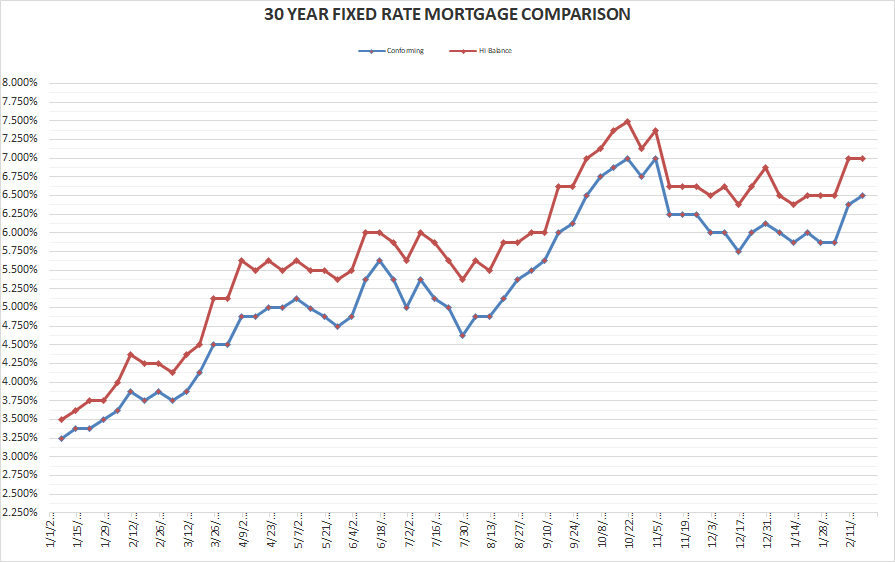
Rates for Friday February 17, 2023: Mortgage rates took a hit earlier in the week on the CPI data, and have struggled to maintain ground and not go up even further. With a three day weekend we may see a bump in rates later in the day as investors sell off holdings to sit on cash over the weekend to see how other markets globally do on Monday. For the week the conforming rate is up from last Friday, and up five-eighths on one percent (0.625%) from the start of the month and at their highest level since November.
FIXED RATE MORTGAGES AT COST OF 1.25 POINTS LOCKED FOR 45 DAYS FOR PURCHASE TRANSACTIONS:
30-year conforming 6.50% Up 0.125%
30-year high-balance conforming 7.00% Flat
Please note that these are base rates and adjustments may be added for condominiums, refinances, credit scores, loan to value, no impound account and period rate is locked. Rates are based on 20% down with 740 FICO score for purchase mortgages.
What a game on Sunday, perhaps one of the best ever. As an Eagles fan I did not like the outcome, but am very glad my team made the Super Bowl with a chance to win it’s second trophy. It has been a great year for Philadelphia phans with the Phillies in the Series and the Eagles in the Super Bowl, likely the only time in my lifetime this will happen.
Good news for many of us, pitchers and catchers reported to spring training camps this week. It is baseball season!
Have a great week,
Dennis
Past Weekly Rate & Market Updates can be found on my blog page at my website www.DennisCSmith.com/my-blog


