


Why did you encourage our kids to look at houses last weekend?
Question of the week: Why did you encourage our kids to look at houses last weekend?
Answer: Because it was raining.
Why would you want them to look at houses in the rain?
Because in Southern California you can own a home for many, many, many months before it rains for the first time, and then you discover issues you might have found if you had viewed the home, and had it inspected, during a rain storm, or shortly thereafter.
Water is the most detrimental problem for buildings in Southern California.
Yes, prolonged exposure to sun causes paint to blister on wood trim, doors, and siding; however this can be rectified fairly easily and somewhat inexpensively.
Yes, wind can knock down a tree that can cause damage to your home, however the chances of this happening is not extremely high.
Yes, earthquakes can, and do, cause more damage, however they are not as frequent as rain.
Perhaps instead of “most” detrimental you should write, “one of the most” detrimental…
Rain is a big problem to homes in Southern California for several reasons, it can damage your home from above, below, and next to structures.
From above, the obvious damage is a leaky roof. Sun dries out and creates cracks flat roofs, makes composite roofs brittle over time, and due to heat causes materials to expand and contract when cooler in small amounts. After several years of Southern California sunshine beating down for an average of 275 days a year, the chances of your roof developing a leak, or two, or three, becomes higher and higher.
From below and side, many (most?) homes in our area are not properly landscaped with a barrier, preferably concrete, between soil and the perimeter of the structure. This can lead to water puddling and seeping into cracks in the stucco or siding, and for those with slabs instead of raised foundations, moisture seeping under the foundation.
In many areas of the region the soil is expansive clay soil. In these areas rainwater does not seep down into the water table, but is absorbed by the soil, which expands against the foundation, and walls, creating pressure that can, and does, crack them. Over time the expansion during rainy periods, and contraction during dry periods, causes the foundation to move back and forth, requiring repairs to the foundation, walls, ceilings, where cracks appear.
Our region averages about 35 days of measurable rain per year, the overwhelming percentage of rainfall occurs between October and April, and within that period from December into February. This means homebuyers have, on average, a small period of time to see the effect of rain on their potential new home.
Rachel and Adrian are looking at homes in August and find one to buy. There had not been substantial rain in the area since early February, six months ago. In late December, as they were getting ready to host Christmas for their families in their new home, there were several days of steady rain.
Leaks appear in their dining room and kitchen. Their laundry room/pantry has water coming in through the door to their side yard. The drain for their gutter is backed up and a pond has appeared from the side of their home to across their walkway. And, because their street floods several feet into everyone’s yard, and the water takes a few days to fully recede, they moved Christmas to a relatives.
None of these potential issues were disclosed by the seller, who can say, “the last time it rained we experienced none of those problems.”
Donna and Greg, Rachel’s sister and brother in-law. Looked at homes in January, it was a raining off and on through the weekend, and had rained several times in the prior weeks. One home they really liked had water stains on the ceilings in a few rooms on one side of the house. The noticed a water line of dirt and leaves several inches up the side of the house where there was a flower bed running out from the walls of the house. In the garage, which opens on an alley, the concrete looked moist and there were water marks several feet into the garage.
Donna and Greg wanted to pursue purchasing the home, and their home inspector noted several areas that needed repair and/or correction. Besides the roof, concrete sloping away from the walls of the home new concrete leading into the garage, a new garage door, and graded floor in the garage were recommended. They negotiated with the seller on price and credits to closing costs that would cover the costs of these corrections so their new home would be less susceptible to damage from rainfall in the future.
Not everyone is untruthful. That said, there are many tricks that can be used to hide water damage in a home. Paint over water stains in ceilings. Place planters against walls to hide bubbling stucco. Window treatments that conceal water marks on walls. New sod, dirt, mulch to fill in erosion from water streaming down the side of the home. Paint on the walls of the bathroom on the other side of the wall from the bubbling stucco where mold tends to appear. Some of these are egregious enough that a home buyer discovering the cover-ups may be eligible for restitution for non-disclosure by the seller and listing agent, some however are effective until many months, possible a year or more, when California is in the rainy/deluge period of the drought-rain-drought-rain weather cycles we experience.
If you are able to view homes while it is raining, my strong advice is to do so in order to see the impact on your potential new home that you may not see, or experience, until you are the owner and will be paying the costs to repair and correct.
The lag time between rainy seasons in Southern California is yet another reason to have a qualified, and impartial, inspector go through, under, over, your potential new home. Perhaps s/he will uncover water stains on beams in the attic, the bubbling stucco, and other issues you may discover on your own after you become the homeowner.
Bring an umbrella, and wipe your feet on the mat!
If you, or someone you know, is thinking about purchasing a new home in the future, please contact me to run numbers and discuss options for purchase price, down payment, mortgage types, and monthly housing costs.
To schedule an initial meeting by phone or Zoom, click here for my calendar, please feel free to forward to a friend or family member!
Have a question? Ask me!
It’s working. The Federal Reserve’s policy to slow the economy to push inflation lower appears to be working. We have seen the Consumer Price Index drop from above 9% in June to 6.5% in December. Higher prices are starting to impact consumer behavior. Retail sales in December dropped 1.1% from November, the drop led by falling gasoline prices (down 4.6% for the month) and new auto sales (down 1.2%). Extracting gas and autos from the data and sales still had a large decline, 0.7%, during the busiest shopping month of the year. Following November’s revised 1% drop in sales, higher prices are keeping consumers’ wallets shut. While all sectors were down, the area that is closely watched as a gauge of consumer sentiment is bars and restaurants, the only service sector in the retail sales data. Spending at bars and restaurants is purely discretionary, as opposed to clothing, groceries, gas, when consumers cut back on nights out it indicates they are concerned about their household expenses to income and funds needed for necessities. Spending in this sector dropped 1%, the second month in a row with a 1% drop. While month-to-month-to-month sales have decreased to end the year, sales were still up 6% from last December, however much of the year over year increase can be attributed to higher prices.
Considering the time period of the report, December, when families are purchasing presents and going out to see family and friends for Christmas and Hannukah, the slow down in sales portends larger drops in sales for retailers in coming months.
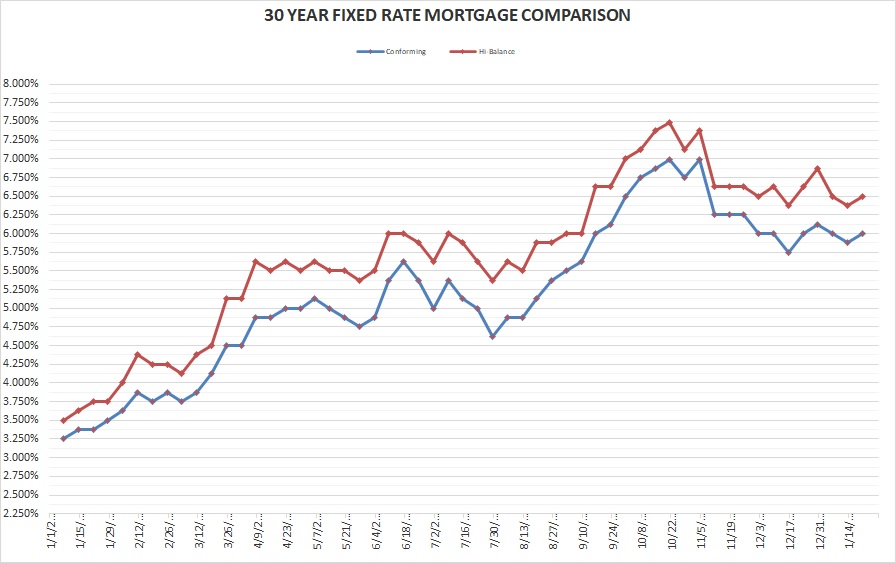
Rates for Friday January 20, 2023: The retail sales report gave a boost to mortgage markets, causing a dip in rates midweek. However, rates popped up today due to several factors, among them international issues and oil prices rising. Week to week rates lose last week’s gains.
FIXED RATE MORTGAGES AT COST OF 1.25 POINTS LOCKED FOR 45 DAYS FOR PURCHASE TRANSACTIONS:
30-year conforming 6.00% Up 0.125%
30-year high-balance conforming 6.50% Up 0.125%
Please note that these are base rates and adjustments may be added for condominiums, refinances, credit scores, loan to value, no impound account and period rate is locked. Rates are based on 20% down with 740 FICO score for purchase mortgages.
It’s back to dinner on the couch watching Jeopardy! and then trying to remember where we are with what shows were are watching and which streaming platform they shows are on and whose profile are we using to watch the shows.
Our youngest left on Monday to go back to New York to start her spring semester. The dog is slightly sad she is gone, but thrilled she left and not Leslie.
We are glad/sad she is gone given the reason she is not home is that she working on her degrees. Not so sad to no longer have her telling us at 5:00 she is going out with friends for dinner and will be home at I-don’t-know-o’clock.
Joking aside, it was great to have our daughters home for one and three weeks respectively, and while we miss them it is great they are moving forward with their lives.
Have a great week,
Dennis
Past Weekly Rate & Market Updates can be found on my blog page at my website www.DennisCSmith.com/my-blog


