


What are some areas we should review to start the year?
Question of the week: What are some areas we should review to start the year?
Answer: If the question of the week looks familiar, it is as it is one we ask near the beginning of every year; because it is that important. Over the next few weeks, or months depending on your particular situation, you will be gathering statements, forms, and information to prepare your tax returns. While you have all this information in the same place it is a good time to also review various areas of your economic life to see what may need updating, or changing.
Here are some of the areas I suggest you review:
- Retirement Did you alter your retirement withholdings in 2022? Do you need to increase or decrease your deductions for your 401(k)? The maximum contribution for 2023 is $22,500, up $2000 from 2021. If you are over 50 the “catch up” contributions also increase from last year to $7500 for a total contribution (pre-tax) of $30,000.
Are you self-employed or work for an employer who does not have a retirement plan so you contribute to some type of IRA? Review your 2022 income and contributions and determine based on estimated income in 2023 whether you need to adjust your monthly or quarterly contributions to your IRA. If you do not make regular contributions to your IRA I strongly recommend it so you can take advantage of “dollar cost averaging.”
- Insurance Is your hazard insurance policy current and accurately reflecting the replacement value of your home? Is your life insurance coverage adequate? Are you home, auto, life insurances with the same company allowing you to take advantage of bundled discounts? Even though real estate values in some areas are flat, or slightly down, from January 2022, many readers of the WR&MU benefited from the tremendous run up in property values during the pandemic. If you have significant equity in your property, consult with your property and casualty agent to see if you should consider earthquake insurance. Because the deductibles are extremely high for earthquake insurance, it is not recommended if you do not have enough equity to protect when calculating premiums and deductible.
- Estate Planning Do you have an estate plan? Is it current and reflective of your current assets and wishes? Do you own property but do not think you need any family planning because you are single? Everyone with assets should have an estate plan, especially if they own real estate in California (or any other state with inheritance taxes). If you have an estate plan and family trust when was the last time you had it reviewed? Have your children become adults since the trust was last reviewed and amended? What about your wishes for you when you pass on to the next dimension, are they the same as they were when you initiated your trust?
- Debt Have you increased your debt in the past twelve months? Do you have a plan to pay it down and off? Can you restructure your debt to lower the overall interest rates being charged or the monthly cash flow required to manage the debt and keep payments current? Was your 2022 resolution to pay down/off debt but were unable to do so? Call me and we can discuss potential plans to help you achieve this goal in 2023.
- Mortgage Do you need a review of your current mortgage and options? Call me!
These are not fun or sexy issues for most people to be tackling, but like changing the batteries in your smoke detectors you need to regularly review and update these critical areas of your home economics. If you have any questions or looking for qualified professionals to assist you, please do not hesitate to contact me.
Have a question? Ask me!
Fed unlikely to lower rates in 2023. In the released minutes from the Federal Reserve’s Open Market Committee (FOMC), which sets the Fed’s benchmark federal funds interest rate, showed that none of the officials on the committee expect to cut rates in 2023. Almost all the members foresee the rate, currently at 4.25% to 4.50%, will be over 5.00% by the end of 2023. Many analysts feel the rate will peak around 5.25% by the summer.
December jobs data supports the Fed’s policy of continuing to increase interest rates to cool the economy and push inflation down to near 2% from the current rate of 7.1%. Employers added 223,000 jobs in December, while the smallest monthly increase in two years, the number of new higher was considerably higher than the “neutral” number of hires needed to absorb new workers entering the labor market. After reaching 3.5% several times in the last three years, the unemployment rate dropped to that figure again in December, matching the lowest rate since 1969.
While the continuing growth in employment is bad for rates, inside the monthly report from the Labor Department was data that is positive for rates. The average hourly rate rose only 0.3% from November, down from 0.4% the prior month; year over year wage gains have slowed from 4.8% to 4.65%, the lowest gain since the middle of 2021. The decline in hourly pay in a labor market that has about two job openings for every worker searching for a job seems counter-intuitive, employers should be paying more to fill their openings. I see two primary factors that have average wages shrinking in a tight labor market. First, average hours worked are declining; employers are paying less overtime and hourly hours. Second, a significant amount of the new hiring is in the leisure and hospitality sector, with strong hiring in other sectors where a significant percentage of workers earn minimum wage or slightly higher.
Following a record year for job creation in 2021, when $6.7 million jobs were added to the nation’s workforce, the most since records started in 1940, 2022 saw the second biggest increase in employment with 4.5 million jobs added to the economy. The overall robust year in number of workers, the increase in wages, the ratio of job openings to job seekers, are not positive for inflation to decline quickly to the target level near 2%. Thus, the unlikeliness of the Fed reversing its current rate hike policy to a rate decrease policy this year.
What may relieve some upward pressure on mortgage rates is the likeliness that the Fed will slow down, or stop, its “quantitative tightening” policy it began in June. Under this policy the Federal Reserve has been selling $60 billion in U.S. Treasury and $35 billion in conventional mortgages every month from its holdings that are near $8 trillion. This added supply to the fixed rate markets has done more to increase mortgage rates than the Fed’s rate hikes. Consider that after $1.3 trillion in Fannie Mae mortgages were funded in 2021, that through November 2022 only $578.5 billion funded. From June to November 2021, only $200.5 billion, or around $33.4 billion per month, Fannie Mae mortgages funded. During this period, the Fed was putting more mortgages into the Mortgage Backed Securities markets than new mortgages from Fannie Mae, doubling the natural amount of supply for investors to bid on. When you double supply prices will plummet, in bond and mortgage markets, lower prices mean higher rates.
Should, as many predict, the Fed slow down, or stop, selling off its Treasury and mortgage assets in the summer, the lack of increase supply should cause rates to steady, and possibly decline. Without going into the weeds, the reason for this prediction is that the Fed’s quantitative easing policy has the effect of decreasing liquidity in the banking system. Before liquidity gets too low, the Fed will need to act by retaining the assets it has been dumping.
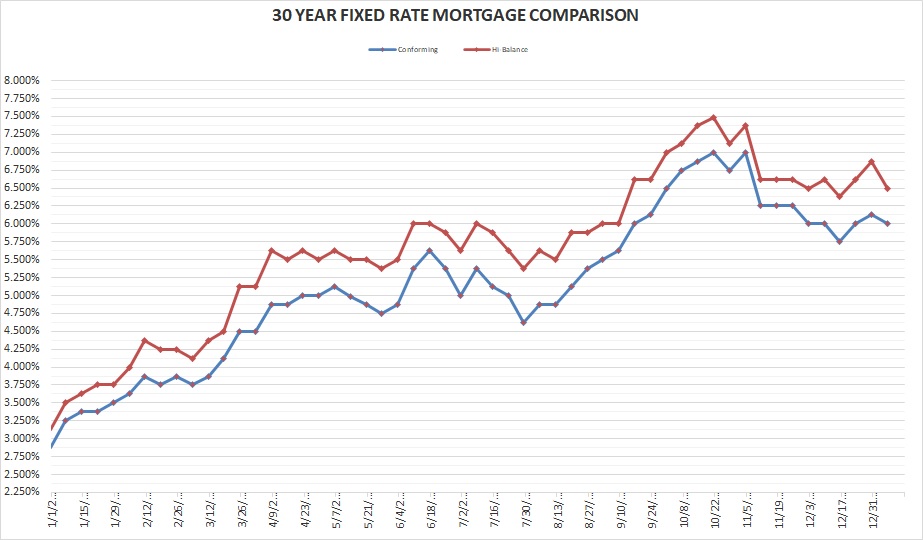
Rates for Friday January 6, 2023: We start the year off with mortgage rates declining following the holidays, despite the labor news released today. Will be drop below 6% on conventional rates and stay below that level into 2023? My feeling is that we will. Bouncing around the 6% level through the next several weeks, then going below 6% and likely staying there through the year.
FIXED RATE MORTGAGES AT COST OF 1.25 POINTS LOCKED FOR 45 DAYS FOR PURCHASE TRANSACTIONS:
30-year conforming 6.00% Down 0.125%
30-year high-balance conforming 6.50% Down 0.375%
Please note that these are base rates and adjustments may be added for condominiums, refinances, credit scores, loan to value, no impound account and period rate is locked. Rates are based on 20% down with 740 FICO score for purchase mortgages.
Raise your hand if you made it to midnight on Saturday night {keeps own hand down}. My excuse is that I was up before dawn to play a final round of golf Saturday morning, rain be damned. In reality, even if I had slept in until 7:00, Leslie would likely have been watching Duran Duran and the ball drop on her own last weekend.
I hope you had a wonderful holiday season with as much family, friends, and fun as you desired. Cheers to a happy, healthy and prosperous 2023 to us all.
Have a great week,
Dennis
Past Weekly Rate & Market Updates can be found on my blog page at my website www.DennisCSmith.com/my-blog


