


Year in review
Question of the week: Would you like a look back at 2022?
Answer: Sure! (I hope that is your answer.)
2021 ended with the benchmark 30-year conforming fixed rate used for the weekly rate quote in the WR&MU at 2.875%. Portending the year to come, 2022 started with a three-eighths of one percent (0.375%) increase from December 31, 2021 to January 7, 2022, the largest week to week increase since March of 2020 when the economy went into pandemic lock-down.
The large week-to-week increase was the first of five increases of 0.375% or larger during the year; in June we saw the benchmark increase one-half of one percent (0.500%) from 4.875% on June 3rd to 5.375% on June 10th.
In November the conforming rate peaked for the year at 6.99%, hitting that mark on November 4th and eleventh. Immediately following the peak on the eleventh, the rate fell 0.74%, the largest drop in one week since March 2020 when rates began to plummet in reaction to the Fed’s move to lower rates and investors reacting to an economy almost at a standstill.
As we close the year, the benchmark conforming rate is at 6.125%. The market saw the conforming rate at 6.00% or above for 15-weeks. The last time the rate was at 6.00% or over was in 2008, when we saw 22-weeks at or above 6.00%.
Rates spiked to start the year following announcement for the Federal Reserve that it would begin to raise rates in 2022 to fight inflation, which was 7.1% in December 2021. Inflation peaked in 2022 at 9.1% in July, in November it had cooled to 7.1% (December’s price data will be available in the middle of January).
The big news in the interest markets came from the Federal Reserve each month as it announced rate increases to its federal funds rate. In January the rate was 0.00 – 0.25%, today the rate is 4.25 – 4.50%. Expectations are that the fed funds rate will hit 5.00%, or slightly higher, in 2023.
Not making as much noise in the press, but as impactful, if not more so, than the rate increases by the Federal Reserve, has been its “unwinding” of it assets. As part of its policy to stimulate the economy through the pandemic the Fed began purchasing mortgages from Fannie Mae and Freddie Mac, and bonds issued by the U.S. Treasury. Known as “quantitative easing,” this policy pushed rates to all-time lows.
At the start of the pandemic the Fed’s balance sheet was approximately $4.2 trillion dollars. In April 2022, the balance sheet, loaded with debt from U.S. homeowners and the U.S. government, peaked at just under $9 trillion dollars. Selling almost $500 billion of this debt in the market by the end of the year, the unwinding (or “quantitative tightening”) contributed significantly to higher rates for two primary reasons.
First, the Federal Reserve was no longer soaking up mortgages and bonds in the market place, leaving more supply for investors to purchase. Higher supply leads to lower prices, lower prices in fixed rate markets (i.e. markets based on interest rates) lead to higher rates.
Second, not only was there more supply for investors to purchase due to the absence of the biggest buyer from the market, but that buyer was now a seller pushing more supply into the market, dumping prices further and therefore pushing up interest rates.
Looking ahead to 2023, we can expect rates to stay at fairly high levels compared to the last decade as the Fed continues to increase its benchmark rate, and sell off more assets, to fight inflation. Having stated that it is not concerned about pushing the economy into recession, nor pushing the unemployment rate to 5% or higher, the Fed is singularly focused on dropping inflation to the 2% level.
While rates will stay at elevated levels, that are not expected to climb much higher than they are today. “Expected” being the key word in that sentence.
Have a question? Ask me!
Rates for Friday December 30, 2022: As stated above, rates are higher this week from last. Investors are selling off stocks, bonds, mortgages to close out 2022, taking capital losses if possible to offset any gains, and in many cases have on their books to carry forward in future years to offset future gains (one tax rule that enables high wealth individuals to reduce future tax obligations). We see rates up for the second week in a row to end 2022.
FIXED RATE MORTGAGES AT COST OF 1.25 POINTS LOCKED FOR 45 DAYS FOR PURCHASE TRANSACTIONS:
30-year conforming 6.125% Up 0.125%
30-year high-balance conforming 6.875% Up 0.25%
Please note that these are base rates and adjustments may be added for condominiums, refinances, credit scores, loan to value, no impound account and period rate is locked. Rates are based on 20% down with 740 FICO score for purchase mortgages.
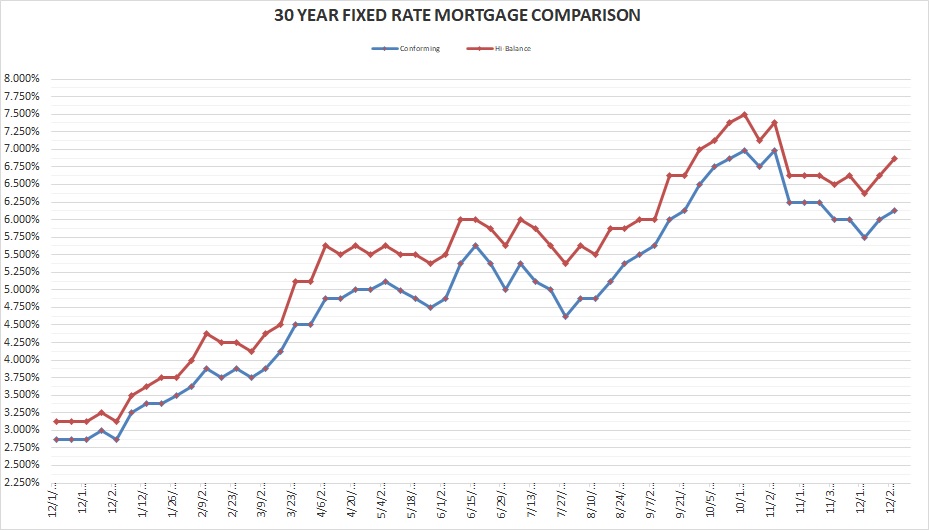
It has been a challenging year in the mortgage and real estate industries due to rates climbing 213% (245% when rates peaked in November). We are very grateful for our clients, friends, professionals and others who continue to refer us their family, friends, and clients, more so this year than many others.
Thank you for supporting myself and Stratis Financial over the past 23-plus years.
Wishing you a happy, prosperous, and safe New Year’s.
Dennis
Past Weekly Rate & Market Updates can be found on my blog page at my website www.DennisCSmith.com/my-blog


