


Why should we purchase a new home now?
Question of the week: Why should we purchase a new home now?
Answer: This is a follow up to our October 28th question of the week, “Is now a good time to buy a home?” In our current market environment, I suspect some version of this question will be reprised every few months, because it is a question I am asked frequently.
To recap for those who read the October 28th WR&MU, and to reveal for those who have not, we looked at the financial differences in purchasing if prices and rates went up or down from the October and September median prices and rates.
Comparing prices and rates between October and November, here is our data:
| AREA | OCT MEDIAN PRICE | NOV MEDIAN PRICE |
| California Statewide | $801,190 | $777,500 |
| Los Angeles County | $854,560 | $836,630 |
| Orange County | $1,165,000 | $1,100,000 |
As you can see, statewide prices drop month-to-month 3.0% statewide, 2.4% in LA County, and in Orange County by 5.0%; year over year the decreases were lower, 0.6% statewide, 1.3% in LA, and 4.3% in the OC.
Significantly larger drops occurred both month-to-month and year-to-year when looking at the number of sales, the number of homes that closed escrow. Across the state, total sales were down 13% from October and 48% from November 2022. Los Angeles County saw a 16% decrease from the prior month and 44.5% from last year. Drops of 19% from October and 46% in the past year were seen in Orange County.
There is no doubt that the increase in interest rates is responsible for the dramatic shift in home sales. Speaking with real estate agents in our region, the continued lack of inventory is propping up home prices with little for those in the market to bid on, as well cash buyers taking advantage of the significant decline in competition.
How can you say “prop up home prices when they declined from month to month?”
Were there more inventory on the market, and fewer cash buyers to reduce the number of eligible buyers, home prices would be down significantly more than they are today.
Which brings us to the question of the week, “why buy a home now?”
Supply and demand, motivation, getting ahead of the rush, are the three primary reasons.
Regarding supply and demand. The equilibrium between supply and demand is skewed a bit to buyers, as evidence in month-to-month price declines. This means the demand is less than supply. Homes that are moving off the market are pricing just below prior sales and others comparable homes on the market.
Why would someone sell in a market that is soft for sellers? Not because they want to, but rather because they need to. Many, most, of the homes on the market are there because there is a need to sell, death of the owner(s), divorce requiring a division of equity, relocation to another area to take advantage of lower cost of living and housing prices. Few are selling to buy-up in the area, for the same reason few are looking to purchase now—unless they have cash they are reticent to obtain a mortgage at a rates that are at recent history highs.
These two factors lead us to the third, getting ahead of the rush.
Rates are down over one percent (1.00%) from highs in October. What happens when they drop another one-half of one percent (0.50%), or another one percent? Will there be more families looking to purchase homes or fewer? What happens when rates get below 5%, below 4.5%? How many more families will be in the market when that happens?
With rates dropping will more or fewer homes come on the market? Will there be more homes or buyers coming to market?
Looking at the purchasing activity from 2019 through 2022, many families purchased new homes and locked in their monthly mortgage at very low rates, how many of those families will become “move-up” buyers as rates drop? Consider that those purchasing at the end of last year have seen their home values remain somewhat level, except in higher price neighborhoods, what is their motivation to sell after a few years, pay high transactions cost to sell and buy a new home at a higher rate than they have today?
With the low volume in sales, the steepest year to year drop in homes sold on record, there is a tremendous amount of pent\-up demand for homeownership, and it grows monthly. When rates go lower and lower, this demand grows exponentially with ability to qualify, and leaks into the market bringing more and more demand.
What happens when demand grows and inventory stays static or grows at a slower pace? Prices increase.
Currently there are sellers on the market how are motivated to sell, accepting prices lower than list price, accepting concessions such as paying closing costs, pre-paying association dues or property taxes, to entice the limited number of buyers on the market to purchase their homes.
Hypothetical scenario to consider. Dennis and Leslie decide to purchase a home today, purchasing a home for $775,000, the state median. They buy with 10% down and have a rate of 5.75%, their monthly payment is $4522 per month.
Through the spring and summer rates have been dropping and more buyers are looking to purchase homes. Dennis and Leslie see a few homes go on the market in their neighborhood that sell quickly. Each home is selling for a bit more and their neighbors are telling them they had multiple offers to select from. In June the rates have dropped to 4.5%, and they have seen their value increase due to all the sales activity, increasing from a little over $800,000. They refinance their mortgage, lowering their payment to $3900.
Lower rates will bring more buyers to the market, putting upward pressure on prices, and also presenting opportunities for those who purchased home with higher rates the opportunity to refinance and lower their payments. Over time there may be more opportunities to lower mortgage payments even further depending on what happens with rates.
Yes, there is the declining price factor that may result in people purchasing homes in the near future may see their home values decline after they have closed escrow, which is what is happening to many of those who purchased earlier this year. However, the purchase of a home is not a short term investment, but a long-term buy and hold. The value of your home does not matter until you go to sell, in the mean time if you can purchase and asset ahead of a market which will push prices up, and lower the cost of holding that asset over time, it will result in a positive financial outcome.
Whenever you purchase a home always consider the long-term not the short-term, as the chances are you will be in the home for at least six to seven years.
If you, or someone you know, would like to start looking at what buying options you have in the current market, or be prepared to act very quickly in the near to medium future to purchase a home, give me a call.
Have a question? Ask me!
As expected, the Federal Reserve increased its benchmark interest rate by 0.50% this week. The increase was already priced into the markets and had not impact on mortgage rates. After starting the year at a range of 0.00 – 0.25%, the Fed has increased its rate to 4.25 – 4.50% this year. The current projection is for the rate increases to push the Fed funds rate to 5.25%, though several officials expect it to climb as high as 5.75%.
Not getting expectations up, Chair Jerome Powell painted a picture of strict adherence to pushing inflation down by the Fed. In comments after the release of the rate hike announcement, Powell said they had no intention of cutting rates in 2023, its benchmark rate will climb over 5%, and that while inflation is slowing, the slowdown will slowdown as prices are mostly dependent on labor markets, and “the labor markets remain broken.” As mentioned in previous WR&MU’s, the Fed is predicting its actions to push inflation down to 2% will likely result in unemployment increasing to 5% or above due to the relationship between labor and prices.
Rate hikes are apparently working, as seen by the Consumer Price Index increased 0.1% in November, at an annual rate of 7.1, down from 7.7% in October and a high of 9.1% in June. The last time CPI was this low was in December of last year. The “core” rate of inflation, which removes food and energy from the data, was up 0.2% for the month and 6.0% year over year. With a gallon of gasoline close to what it cost before Russia invaded Ukraine, other prices are seeing the benefit of lower costs to bring goods to market, and transport them home. While grocery prices are up 12% from a year ago, shoppers paid a bit less in November, 0.5%, than October to fill the cupboards and fridge. The news was very positive for mortgage rates as investors foretell lower rates in the future with falling inflation.
The big number is worrisome, or is it? Retail sales dropped 0.6% in November, the largest decline since early in the year. The smaller number, a drop of 0.2% is not as worrisome. The smaller number is the drop in sales if auto sales and gasoline are removed from the sales data. With inflation running at 7.1% retails sales have only increased 6.5% since last November. Since retails sales are calculated on dollars spent and not units sold, the adjusted retails sales numbers show a decline year over year of 0.6%. Consumer spending makes up 65-70% of our economy. Dropping retails sales results in a slowing, or shrinking economy. If sales continue to decline the result will most likely be a recession. Which many have been predicting, and the Fed is looking for in order to slow inflation. So, are declining sales and moving to a recession worrisome if the result is a decline in prices and inflation? Depends on how bad you are hurt in a recession versus a high inflation economy. Mortgage rates drop in recessions and increase during inflation, for those looking to get a mortgage in the near or medium future this is good news.
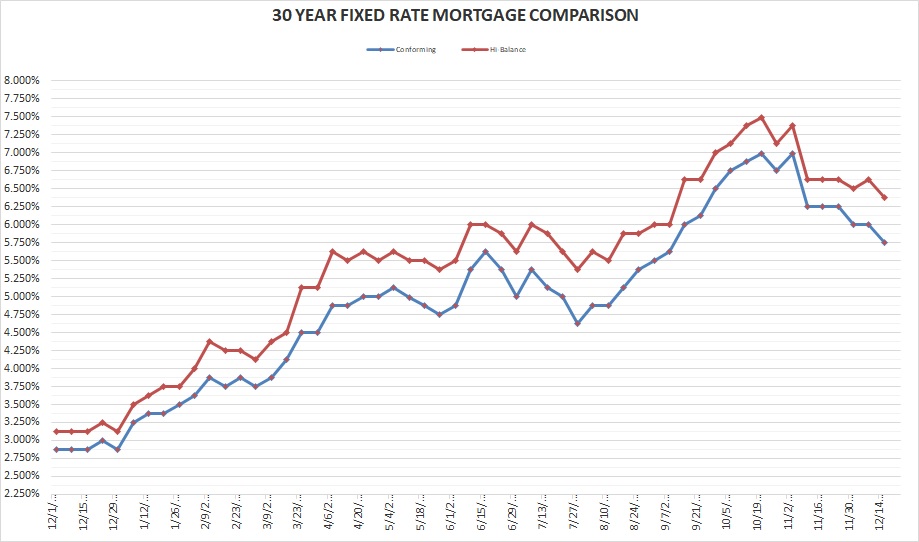
Rates for Friday December 16, 2022: The CPI and retail sales data gave a big boost to Mortgage Backed Security prices, which means a drop in rates. While flatter than the curve leading into late October has rates climbed, the curve is trending lower for mortgage rates. Our hope is the trend continues and does not reverse as it did following the drop in rates between mid-June and the end of July.
FIXED RATE MORTGAGES AT COST OF 1.25 POINTS LOCKED FOR 45 DAYS FOR PURCHASE TRANSACTIONS:
30-year conforming 5.75% Down 0.25%
30-year high-balance conforming 6.375% Down 0.25%
Please note that these are base rates and adjustments may be added for condominiums, refinances, credit scores, loan to value, no impound account and period rate is locked. Rates are based on 20% down with 740 FICO score for purchase mortgages.
Leslie and I are excited as new week both our girls come home for short visits. Our empty nest will be full for one week with both, and then another week with our youngest. My main task is to semi-convert my older daughter’s room from my home office to her bedroom. “Semi-“ as she still has a lot (a LOT) of stuff in here dating back to elementary school that we are encouraging her to go through and purge so that we can use the space for my office, and when needed a guest room. Raise your hands if you have been successful in getting your young adults to let go of fingerpaintings, stuffed animals, clothes, and countless knick-knacks…
Have a great week,
Dennis
Past Weekly Rate & Market Updates can be found on my blog page at my website www.DennisCSmith.com/my-blog


