

Should we get solar panels?
Question of the week: Should we get solar panels?
Answer: This is a question we covered a little over two years ago when Leslie and I were in the process of starting the process to install solar panels on our home. A subsequent WR&MU covered ways to finance a home solar project.
Due to legislation in Sacramento, regulations from the California Air Resources Board (CARB) and other departments, and energy markets, this question is one that should be explored once again. Particularly in light of the housing markets the past three years that resulted in many families purchasing new homes that will very likely be their “forever home,” or at least until they are retired and ready to downsize.
Let’s start with energy use and supply in many homes in Southern California. With the exception of homes built this century, and perhaps many built in the 1990’s, many homes have a combination of electric and gas appliances. Many homes still have gas ovens and ranges, water heaters, clothes dryers, and home heating. Lighting, refrigerators, air conditioning, laundry units, and, if part of the property, pool equipment use electricity.
In September CARB banned the sale of natural gas heaters and water heaters by 2030, which will require and replacement units to use electricity.
The state has moved to ban the sale of gasoline powered cars by 2035.
Sacramento has developed a housing plan that requires local governments to submit housing plans that will result in 2.5 million new homes across the state by 2030.
California has a goal of 100% of energy supply to meet electrical needs by from renewable sources (i.e. wind and solar) by 2045.
California currently imports 30% of its electricity from other states.
With the above regulations to convert homes, cars, and new buildings away from gas and to electricity, adding over two million new homes to electrical grids, within eight years, and requiring 100% of electricity to be from renewable sources by 2045, there will be a great demand for electricity year over year.
Underlying all of this is that for the past several years we have experienced rolling blackouts across the state when heat waves hit each summer.
The question that arises is with consumers being pushed to rely on electricity, and the required electricity having to be generated from renewable sources, what are the plans to increase renewable energy production within the state to handle the increased demand?
The California Energy Commission website has a page about developing renewable energy. There is no information on new power sources coming on line in the state, but it does indicated that financial incentives have been provided to homebuilders to encourage installing solar panels on new homes, and tens of millions being disbursed to local governments support geothermal development and to agriculture entities to install renewable energy on their farms and land holdings.
The website also indicates the regulations that utility companies must follow to increase their renewable energy sources for the state’s power grid to 100% by 2045.
From an economics viewpoint, all signs point to ever increasing costs for electricity and gas to light, heat, cool, and run our homes.
While California does not have a tax credit for the installation of solar energy panels for your home, with the exception of qualifying low-income single-family homeowners, the federal government does—but hurry as the credit is 22% of the installation costs in 2023 and goes away in 2024.
Another tax incentive, if you finance the purchase of the panels with a HELOC or home refinance, the interest is deductible as it is for home improvement (not a CPA or tax professional, please consult yours to determine the extent of any tax credits, write-offs, or rebates).
Another financial incentive is the “buy-back,” or net-metering, from your local electricity supplier for electricity your solar panels are producing but you are not using.
All the above factors, plus our finally adding air conditioning to our 85+ year old home, went into our decision two years ago to install solar panels. As part of our A/C install is also new heating supply, so good-bye to our old gas furnace; next will likely be an electric water heater when the current one is due to be replaced after 2030.
If you are intending to stay in your home for several years the timing is definitely right to convert to solar energy for your home. With the incentives and costs the “pay-back” period (cost less incentives/annual electric bill cost) is probably around 7-8 years.
If you sell before that time frame, it is estimated that solar panels add 5-8% to your home’s value, likely to increase if/when costs to purchase electricity from the utilities increase over the years.
Have a question? Ask me!
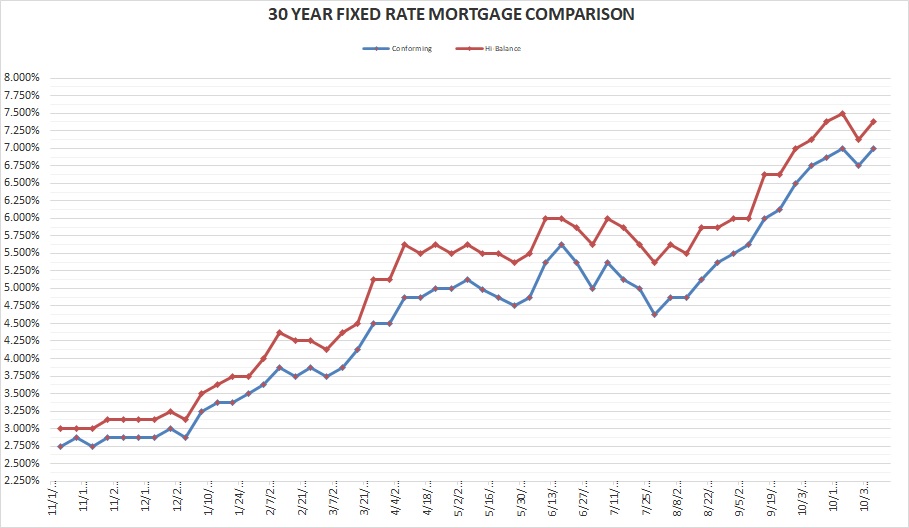
As expected, the Federal Reserve’s Open Market Committee (FOMC) increased its benchmark rate by 0.75% earlier this week; the increase met expectations and was already priced into the mortgage markets. Not priced in were comments from Fed Chair Jerome Powell. Powell indicated that the final landing spot for its rate hikes will be 5% or higher, prior estimates were for a ceiling of 4.75% (current rate is between 3.75-4.00%) from a starting point of 0-0.25% when the current policy of raising rates started. Rates will continue to be pushed higher until they are “sufficiently restrictive” to push inflation to 2% or below “over time.”
A small hint of possibly positive information in Powell’s comments is that future rate increases may come at a slower pace. With climbing 4% in eight months, it appears that the Fed wants to slow the pace to let the economy catch up to the rate hikes and other monetary moves being made by the Fed. The expectation has been for a 0.5% in December by the Fed, but the market appears to be pricing in another 0.75% increase.
Finally, regarding Powell, he said the window for a “soft landing” is narrowing; meaning the window for the Fed to push inflation down without pushing the economy into a recession. If (when?) there is a recession, it will not stop the Fed’s policy of higher rates as it has been made clear that there is greater concern for getting inflation down than economic recession and job losses.
Speaking of jobs. The Labor Department released its monthly jobs report that showed 261,000 new jobs last month. While this is the lowest number of new jobs since April 2021, it is still a historically high number based on the monthly average being 200,000 new jobs in the five years before the pandemic. As a result of layoffs and a shrinking labor force, unemployment climbed from 3.5% to 3.7% in October. With a net of 260,000 jobs added, there are still almost 11 million job openings and fewer people to fill them. Wages continue to increase, those at 4.7% year over year the amount has slowed down and is still far behind inflation.
Rates for Friday November 4, 2022: Everything in the economy is slowing but labor markets. This is a big concern for the Fed as they wait for wages lagging inflation to impact consumer spending and slow down inflation and the economy. For now, the news this week pushed rates back up from last Friday after dropping last week.
FIXED RATE MORTGAGES AT COST OF 1.25 POINTS LOCKED FOR 45 DAYS FOR PURCHASE TRANSACTIONS:
30-year conforming 6.99% Up 0.24%
30-year high-balance conforming 7.375% Up 0.255%
Please note that these are base rates and adjustments may be added for condominiums, refinances, credit scores, loan to value, no impound account and period rate is locked. Rates are based on 20% down with 740 FICO score for purchase mortgages.
It appears not to be. Philadelphia sports fans are very pessimistically hopeful, I am no different. While excited with the two wins the Phillies have had, it appears that may be all we will have to celebrate against a great pitching staff for Houston. Before the Series started I told Leslie that while I was thrilled they, improbably, made the Series there was a big chance they would get swept. Hopeful for two wins in Houston, but…
Thanks to all the people who replied last week regarding the baseball books I recommended, happy reading and gifting!
Have a great week,
Dennis
Past Weekly Rate & Market Updates can be found on my blog page at my website www.DennisCSmith.com/my-blog


