


Can we buy a new car while buying our new home?
Question of the week: Can we buy a car while buying our new home?
Answer: Maybe, but you better disclose the purchase or you could be in for a big surprise, and not a good surprise.
It is not uncommon for us to have a client call us while they are in escrow for their new home inquiring if they can purchase a new car, or change jobs, or loan their brother in-law Fred some money.
That is good, very good. Call us before doing any of the above, because if you do not issues may occur for you in the future.
Let’s go back to the beginning of the purchase mortgage process.
Ideally our initial contact is your calling to get pre-approved to purchase a home. We discuss your financial situation, determining the income that will be used for qualifying, obtaining a credit report to determine the debt obligations that will be used for qualifying, verify the funds you will have available for your new home purchase, and with this information determine the price range for which you qualify.
If any of these variables change the purchase price and loan amount for which you qualify may change. Perhaps for a higher sales price, perhaps for a lower sales price. Because of this, once we start the process of your purchasing a new home, or refinance, it is imperative that we know any changes to the three categories of income, debt, and/or cash available.
There have been instances where after pre-approval and before having an offer accepted clients have purchased a new car, with a higher loan payment than their prior auto loan. Not having been informed, we obtain an updated credit report, and the new payment has created an issue with qualifying.
As well, we have had clients change jobs just before, or during, escrow. Depending on the new position, how they are paid, and the amount they are paid, this may or may not be a problem. Like with new loans or other credit obligations, the sooner we know and due the qualifying calculations, the sooner we can determine if this causes an issue or not.
Typically, job changes are easier for us to discover than new credit obligations because part of the closing process is to verify you are still employed with the employer listed on the loan application, as well recent paystubs confirming your income has remained the same.
New credit obligations are not as easily discovered due to the timing of credit reports. The first credit report we pull will be to support any pre-approval letters we send out to accompany your purchase offer. Credit reports have a shelf life of 60-days. When we obtain your credit report we will ask you the purpose of any inquiries listed on your report, if they resulted in a new credit card account, auto loan, or other credit obligation that are not showing on the report as an active account with a balance and monthly payment.
If you are closing within the 60-day time frame a new report will be required to confirm that there are no new accounts, confirm the credit score has not changed significantly that can impact the rate lock on your loan, and see if there have been any other inquiries that may have resulted in new credit accounts not showing on the report.
As you can tell, if you do purchase, or lease, a new car, from the time of our initial report to the closing on your new home, there is a decent chance we will find out, and we all hope if this is the case it does not negatively impact your ability to qualify for the loan for which you have applied.
However, depending on timing of this process, it is possible for homebuyers to purchase a new car, or open other new credit accounts, without our discovering unless you tell us you have done so. If this happens there could be problems with you after your close on your new home.
One of the documents you sign with the other loan documents is the Uniform Residential Loan Application (URLA). This is a form we complete to start your mortgage application at the start of your purchase, or refinance, transaction. During processing changes may be made to the information on the original form; the initial income may be different when verified with the employer, account balances may have changed due to adding an additional account or recalculated due to updated bank statements, a copy of a divorce decree may add income or debt for spousal/child support.
The URLA signed during loan documents has all the data for income, assets to show funds for closing, and credit obligations that the underwriter used to approve the loan. By signing the form you are acknowledging that all the information on the form is accurate and correct.
Scenario, the Smith’s get pre-approved to purchase a new home for $875,000, putting 10% down in July. On their initial credit report there are some inquiries from auto dealers earlier in the month. When asked if they purchased a new car, they say they have not as they decided to wait until after they purchase their new home. They are told that if they do buy a new car that we have to know so we can calculate the payment in their mortgage qualifying. They are told that we are qualifying them at the top of their ability to purchase based on their debt-to-income ratio, so any changes could impact the sales price. Not an issue, they are waiting to purchase.
At the beginning of September, they have an offer accepted for $865,000, the timing is very good as we are able to lock them in at the same rate we used to pre-approve them in July. Because our credit report is about to expire, we pull a new report and it shows no changes or new inquiries. We are on our way.
In mid-September we have loan approval and are ready to close on time at the end of the month. The Smiths sign their loan documents, including the URLA listing the income, assets, debts, etc used for the lender’s approval. On September 30th escrow closes and they own their new home.
In December we receive a call from the lender. In the post-closing audit process, a new credit report was obtained and it showed the Smiths funded an auto loan with a $900 per month payment on September 23rd, three days before they signed their loan documents.
The payment has pushed their debt-to-income ratios beyond the qualifying limits. Since the loan and payment was not disclosed on their URLA signed with loan documents, the Smiths have submitted a false loan application, the lender is putting the loan in default and requiring it be paid off.
They are calling the loan due after only two payments have been made. This is a big problem for the Smiths.
When called regarding the issue and why they purchased the car the week before closing they replied, “the dealership called us, the car we were looking at was available at a much lower price as they wanted it off the lot. If we didn’t buy it they were calling the next family on their list.”
Because the loan was approved and they were signing loan documents in a few days they didn’t think it was an issue.
They have their nice new car at a great price, but there is a chance they could lose the garage where they park it at night because they did not wait to purchase the car until after they purchased the garage.
If there are any changes between your initial pre-qualification/approval and the funding of your mortgage you must disclose it immediately. Ideally, we discuss the potential change before it happens.
A new job, even if the position and salary are the same or higher.
A new credit account, even if a credit card obtained to consolidate other balances “with no interest” that results in a lower payment.
Changes to your bank, or investment, accounts, whether higher or lower. If you deposited funds from a source that is not your employer, we need to track the source and explain the reason—if you receive a large bonus check from your employer, we will need to trace that as well.
Even if any of these do not show up on during our processing and prior to funding, a post-closing audit by the lender may very well discover the change. If it any changes have an adverse effect on qualifying guidelines the result could be a significant headache, and possible financial detriment, to you.
With information before any major changes occur, we can assist with planning and actions that may be taken to keep your home purchase process on track and result in your owning your home for many, many years.
Buy the garage, then the car, regardless of the “deal” being offered.
Have a question? Ask me!
A busy week for economics writers. Fed meeting minutes, consumer prices, retail sales, were all in the news, these are some of the major areas of economics that move markets. No new data was released with the minutes from the meeting of the Federal Reserve Open Market Committee in September (the FOMC sets the Fed’s benchmark rate). The minutes of the discussion at the meeting that resulted in a 0.75% increase in the Fed’s rate showed that the voting members of the FOMC are more concerned about taking too little action in their rate increases than taking too much action with their rate hikes. In other words, they are more concerned with high inflation than the results if they over-jump inflation with rate hikes than the results in a “hard” landing if they push rates too high.
Their concerns were not in any way allayed by the data in the Consumer Price Index release on Thursday. Prices increased 0.4% in September, up 8.2% from last year (down from 9.1% in June). Weighing down the CPI were gasoline prices, which were down for the third month in a row. The “core” CPI (food and energy prices removed from index) was up 0.6% in the month, and 6.6% year-over-year. This is important as the Fed considers the core index a better indicator of inflation when formulating policy.
Increases that create concerns that inflation is hard to fight were seen in groceries, up 13% annually (highest since 1979); and rents which were up 0.8% for the month and 7.2% for the year. Rents are concerning as rents are a major contributor to inflation and are sticky going down; groceries are concerning as they are not a discretionary purchase and impact many segments of the economy. Of note, butter and margarine, eggs, and flour are all up 24% or higher from last year.
Higher prices for food, housing, consumer goods, and many other sectors have eroded the purchasing power of higher paychecks over the past year. Real wages, defined as current wages adjusted for current inflation, were down 0.1% in September and down 3% from last year. Take away the downward weight for prices at the pump in September and those losses are greater. Higher salaries and wages are adding to the costs of goods and services we buy, however they are not keeping pace with goods and services.
Speaking of goods and services, the retail sales report showed a relatively flat month for retailers in September—a historically slow month for retail sales as it is sandwiched between back to school and holiday shopping seasons. Overall sales were up 0.3%, just below CPI, with declines in auto sales (-0.4%), and gasoline (-1.4%) pulling the overall data lower. One area that continues to surprise is bar and restaurant spending, despite higher labor and food costs for the sector, which impacts prices on menus, spending increased in September 0.5%, which is greater than overall inflation. Because dining out is a discretionary expense, it is an indicator of consumers mood and possible concerns about impact of the economy on their personal finances. Maybe they are consuming too much in bars because it takes their minds off rising rent, butter and clothing costs, or they are not as concerned about those rising costs as economists and pundits feel they should be.
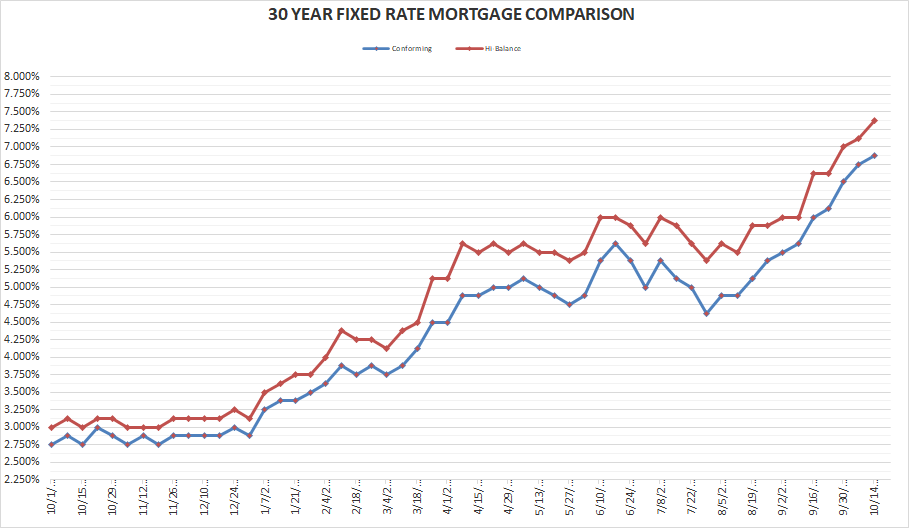
Rates for Friday October 14, 2022: Markets were closed on Monday, and when the Mortgage Backed Securities markets opened on Tuesday they did so significantly lower than closing last Friday (lower MBS prices mean higher rates). Despite the news and data mentioned above that puts upward pressure on rates, despite bouncing around the past three days, rates have remained somewhat flat after opening on Tuesday. Flat for the week, but not from last Friday. The upward climb continues.
FIXED RATE MORTGAGES AT COST OF 1.25 POINTS LOCKED FOR 45 DAYS FOR PURCHASE TRANSACTIONS:
30-year conforming 6.875% Up 0.125%
30-year high-balance conforming 7.375% Up 0.25%
Please note that these are base rates and adjustments may be added for condominiums, refinances, credit scores, loan to value, no impound account and period rate is locked. Rates are based on 20% down with 740 FICO score for purchase mortgages.
It finally feels like Fall in Southern California, Dodger playoff games, Angels having MVP caliber players know sees after the regular season, football well under way, hockey and basketball starting…and rain! And cooler weather! And pumpkin spiced coffee, cereal, oatmeal bars, and dog biscuits clogging shelves.
Well most of the above are good to see in the middle of October!
Have a great week,
Dennis
Past Weekly Rate & Market Updates can be found on my blog page at my website www.DennisCSmith.com/my-blog


